|
|||||||||||||
 |
|||||||||||||
Electromaze Puzzle
|
|||||||||||||
Here are the February 1966, April 1966, and June 1966 Electromaze Puzzles. Electromaze Puzzle
Here's a new kind of crossword puzzle designed to test your knowledge of electronic terminology. Refer to the clues given and fill in the word called for by the first clue. Start at the arrow. Thereafter, fill in each new word called for by the following clues perpendicular to each preceding word. The last letter in each preceding word will be common to the first or lost letter of each new word, and all words will read vertically downward or from left to right. The tenth word will have a letter in common with the word at the first exit. Nine more correct entries will take you to the word at the second exit, which will also share a letter with the last of these nine words. In each case, the first or last letter of the exit word will be the first or last letter of the next word. An additional nine correct entries will put you at the final exit for a perfect score. The Editors invite your comments on this type of puzzle.
1 A component that introduces inductance in on a.c. circuit. 2 Single unit of a device that converts chemical energy into electrical energy. 3 A luminous glow formed by the difference of potential between two electrodes. 4 Conductors used for transmitting and receiving r. f. energy. 5 Antennas specifically arranged or grouped together so as to produce a desired directivity pattern. 6 High-gain VHF antenna array whose directors are made progressively shorter toward the front of the array. 7 The video information reproduced by a television receiver. 8 Conductor used to establish electrical contact with a non-metallic part of a circuit. 9 Lines produced by a TV receiver flyback pulse. 10 Slang term for ham radio equipment. Exit 1. The adjustable iron core of a coil. 11 A circuit operating as a switch. The presence or absence of a control voltage can apply or eliminate a signal. 12 Abbreviation for the force that causes current to flow in a circuit. 13 Narrow metallic strips used to produce clutter on enemy radar screen to obscure targets. 14 A The paper diaphragm of a loudspeaker. 15 Waveform of a modulated carrier. 16 Two-element electron tube. 17 The unit used to express power ratio. 18 Path of a completed circuit, especially in servo systems. 19 Maximum amplitude of a sine wave. Exit 2. A hand-operated switch used in radio telegraphy. 20 System of interconnected electrical circuits. 21 Flow of electrons in a vacuum tube. 22 A three-element electron tube. 23 Group of three phosphor dots on a color television picture tube. 24 Slang word for a parabolic reflector. 25 In solid-state technology, empty space in the valence bond of on impurity atom. 26 Preparation of a computer routine in machine language. 27 To remove gases from on electron tube envelope. 28 A secondary emission electrode in a multiplier-type photo-tube.
See answer below. Here are other electronics-themed crossword puzzles from vintage electronics magazines (RF Cafe Crosswords here):
1 Coil 2 Cell 3 Arc 4 Antenna 5 Array 6 Yagi 7 Image 8 Electrode 9 Retrace 10 Rig Exit 1. Slug 11 Gate 12 EMF 13 Chaff 14 Cone 15 Envelope 16 Diode 17 Decibel 18 Loop 19 Peak Exit 2. Key 20 Network 21 Emission 22 Triode 23 Triad 24 Dish 25 Hole 26 Encode 27 Evacuate 28 Dynode |
|||||||||||||
 |
|||||||||||||
|
|||||||||||||

 By Robert C. Radford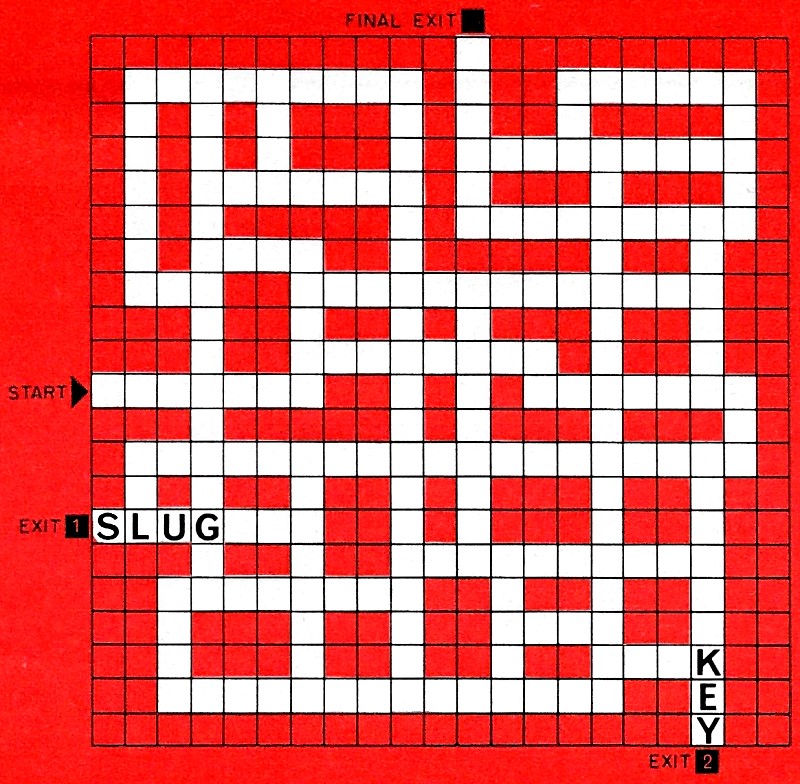


|
||||||||||||||||||||||||||||||||||||