See Page 1 |
2 | of the February 2026
homepage archives.
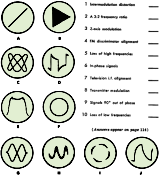 A lot of RF Cafe visitors might not be familiar
with some of the electronic waveforms presented in this
Oscilloscope Quiz by Popular Electronics magazine's ultimate quizmaster, Robert
Balin. The shapes are recognizable to anyone who has done a lot of design, troubleshooting,
testing, or alignments on analog circuits. Electronics repairmen were intimately
familiar with these - and much more complex - waveforms. Modulation of the z-axis
is especially cool as it varies the intensity of the waveform. I always roll my
eyes when, back in the day, a laboratory or medical facility in movies or on TV
had an oscilloscope display with a Lissajous pattern writhing on the display... A lot of RF Cafe visitors might not be familiar
with some of the electronic waveforms presented in this
Oscilloscope Quiz by Popular Electronics magazine's ultimate quizmaster, Robert
Balin. The shapes are recognizable to anyone who has done a lot of design, troubleshooting,
testing, or alignments on analog circuits. Electronics repairmen were intimately
familiar with these - and much more complex - waveforms. Modulation of the z-axis
is especially cool as it varies the intensity of the waveform. I always roll my
eyes when, back in the day, a laboratory or medical facility in movies or on TV
had an oscilloscope display with a Lissajous pattern writhing on the display...
 "SpaceX
is putting its longstanding focus of sending humans to Mars on the backburner to
prioritize
establishing a settlement on the Moon, founder Elon Musk said Sunday. The South
Africa-born billionaire's space company has found massive success as a NASA contractor,
but critics have for years panned Musk's Mars colonization plans as overambitious.
The move also puts Musk in alignment with U.S. President Trump's shift away from
Mars. "For those unaware, SpaceX has already shifted focus to building a self-growing
city on the Moon, as we can potentially achieve that in less than 10 years, whereas
Mars would take 20+ years. Difficulties in reaching Mars include the fact that "it
is only possible to travel to Mars when the planets align every 26 months..." "SpaceX
is putting its longstanding focus of sending humans to Mars on the backburner to
prioritize
establishing a settlement on the Moon, founder Elon Musk said Sunday. The South
Africa-born billionaire's space company has found massive success as a NASA contractor,
but critics have for years panned Musk's Mars colonization plans as overambitious.
The move also puts Musk in alignment with U.S. President Trump's shift away from
Mars. "For those unaware, SpaceX has already shifted focus to building a self-growing
city on the Moon, as we can potentially achieve that in less than 10 years, whereas
Mars would take 20+ years. Difficulties in reaching Mars include the fact that "it
is only possible to travel to Mars when the planets align every 26 months..."
 Life for the blind has always been fraught
with obstacles that we who can see will never be able to fully appreciate. Society
has come a long way in accommodating the special needs of those with no or severely
reduced eyesight. Recent news stories report of experiments with electronic implants
that use implants set into the eye and couple somehow with the retina to send image
information to the person's brain. While in no way close to being able to be called
sight, it has at least allowed the guy or girl with training to detect and avoid
obstacles based on changes in scenery shading. We are probably a century away from
true
bionic vision, incremental improvements will thankfully improve
the lives of our thusly challenged brethren. This article from a 1947 edition of
Radio News reports on efforts made by the New York Institute for the Educations
of the Blind to make amateur radio... Life for the blind has always been fraught
with obstacles that we who can see will never be able to fully appreciate. Society
has come a long way in accommodating the special needs of those with no or severely
reduced eyesight. Recent news stories report of experiments with electronic implants
that use implants set into the eye and couple somehow with the retina to send image
information to the person's brain. While in no way close to being able to be called
sight, it has at least allowed the guy or girl with training to detect and avoid
obstacles based on changes in scenery shading. We are probably a century away from
true
bionic vision, incremental improvements will thankfully improve
the lives of our thusly challenged brethren. This article from a 1947 edition of
Radio News reports on efforts made by the New York Institute for the Educations
of the Blind to make amateur radio...
 everythingRF, a long-time supporter of this
website, is now, in addition to publishing e-books, putting out an
e-zine which provides
some insightful content, interesting products and expert interviews within the RF &
Microwave industry. Vol. 4, now available, includes articles on Next Gen Adjustable
Q-Band Gain Equalizers, Earth to Orbit:The Important Role of Antennas in NTN, Benefits
for Phased Array Systems Through SM Components, as well as product features, upcoming
industry events, and more.
Download it now. everythingRF, a long-time supporter of this
website, is now, in addition to publishing e-books, putting out an
e-zine which provides
some insightful content, interesting products and expert interviews within the RF &
Microwave industry. Vol. 4, now available, includes articles on Next Gen Adjustable
Q-Band Gain Equalizers, Earth to Orbit:The Important Role of Antennas in NTN, Benefits
for Phased Array Systems Through SM Components, as well as product features, upcoming
industry events, and more.
Download it now.
 Have you ever heard of a
"globar" resistor? They have been around since the early days
of radio and were used, among other things, to protect vacuum tube heater elements
from burning up due to high inrush current when first turned on. Globars have a
negative temperature coefficient (NTC) of resistance
so that, opposite of standard carbon and metal film type resistors, they exhibit
a higher resistance when cold than when hot. Mac and Barney discuss their use in
this episode of "Mac's Radio Service Shop." You might be more familiar with the
name "thermistor" for such devices, but globars are unique elements in that their
construction from non-inductive ceramic material makes them useful at high power
levels and high frequencies. Globar appears to now be owned by Kanthal (aka Kanthal
Globar). Interestingly, Keysight Technologies... Have you ever heard of a
"globar" resistor? They have been around since the early days
of radio and were used, among other things, to protect vacuum tube heater elements
from burning up due to high inrush current when first turned on. Globars have a
negative temperature coefficient (NTC) of resistance
so that, opposite of standard carbon and metal film type resistors, they exhibit
a higher resistance when cold than when hot. Mac and Barney discuss their use in
this episode of "Mac's Radio Service Shop." You might be more familiar with the
name "thermistor" for such devices, but globars are unique elements in that their
construction from non-inductive ceramic material makes them useful at high power
levels and high frequencies. Globar appears to now be owned by Kanthal (aka Kanthal
Globar). Interestingly, Keysight Technologies...
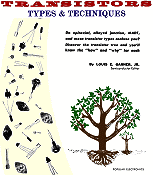 Louis Garner was the semiconductor guru
for Popular Electronics magazine in the 1960s when he wrote this article
attempting to
demystify the proliferation of over 2,000 transistor types. He devised a "transistor
tree," tracing evolution from the obsolete point-contact transistor - unstable with
high gain but noisy - to advanced designs balancing cost, frequency, power, and
reliability. It covers pnp and npn basics, then details processes: grown-junction
(inexpensive, good high-frequency); meltback diffused (similar, better response);
alloyed-junction (popular for power); surface-barrier family (SB, SBDT, MA, MADT;
excellent high-frequency, low voltage); post-alloy-diffused... Louis Garner was the semiconductor guru
for Popular Electronics magazine in the 1960s when he wrote this article
attempting to
demystify the proliferation of over 2,000 transistor types. He devised a "transistor
tree," tracing evolution from the obsolete point-contact transistor - unstable with
high gain but noisy - to advanced designs balancing cost, frequency, power, and
reliability. It covers pnp and npn basics, then details processes: grown-junction
(inexpensive, good high-frequency); meltback diffused (similar, better response);
alloyed-junction (popular for power); surface-barrier family (SB, SBDT, MA, MADT;
excellent high-frequency, low voltage); post-alloy-diffused...
 "Gentlemen,
ei*π
+ 1 = 0 is surely true, it is absolutely paradoxical; we cannot understand
it, and we don't know what it means. But we have proved it, and therefore we know
it must be truth." - Benjamin Peirce
(not to be confused with Captain Benjamin Franklin "Hawkeye" Pierce), 19th century Harvard mathematician.
ei*π
+ 1 = 0 i, BTW, is known as
Euler's identity
- engineers live by it. "Gentlemen,
ei*π
+ 1 = 0 is surely true, it is absolutely paradoxical; we cannot understand
it, and we don't know what it means. But we have proved it, and therefore we know
it must be truth." - Benjamin Peirce
(not to be confused with Captain Benjamin Franklin "Hawkeye" Pierce), 19th century Harvard mathematician.
ei*π
+ 1 = 0 i, BTW, is known as
Euler's identity
- engineers live by it.
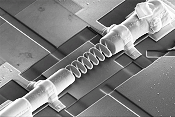 "Scientists have shown that
twisting a crystal at the nanoscale can turn it into a tiny, reversible diode,
hinting at a new era of shape-engineered electronics. Researchers at the RIKEN Center
for Emergent Matter Science, working with collaborators, have created a new technique
for building three-dimensional nanoscale devices directly from single crystals.
The approach uses a focused ion beam instrument to precisely carve materials at
extremely small scales. Using this method, the team shaped tiny helical structures
from a topological magnetic material made of cobalt, tin, and sulfur, known by its
chemical formula Co3Sn2S2..." "Scientists have shown that
twisting a crystal at the nanoscale can turn it into a tiny, reversible diode,
hinting at a new era of shape-engineered electronics. Researchers at the RIKEN Center
for Emergent Matter Science, working with collaborators, have created a new technique
for building three-dimensional nanoscale devices directly from single crystals.
The approach uses a focused ion beam instrument to precisely carve materials at
extremely small scales. Using this method, the team shaped tiny helical structures
from a topological magnetic material made of cobalt, tin, and sulfur, known by its
chemical formula Co3Sn2S2..."
 I am constantly amazed when reading stories
about how easily Adolph Hitler rose to power in Germany by encouraging and exploiting
resentment of his countrymen over being forced, among other concessions outlined
in the Treaty of Versailles, to disarm militarily and make reparations for atrocities
committed in World War I. Part of the Nazi (National Socialist) party success
was extensive use of propaganda via print, radio, and the relatively new technology
of television. Government exercised complete control over the mainstream media (i.e.,
not "underground") by dictating content that promoted the proclaimed virtues of
Nazism and the Aryan race and the vices of just about every other form of government
and race. At the height of Hitler's reign of terror during the Third Reich era,
radio and television sets were only permitted to use crystals
tuned to state-sponsored... I am constantly amazed when reading stories
about how easily Adolph Hitler rose to power in Germany by encouraging and exploiting
resentment of his countrymen over being forced, among other concessions outlined
in the Treaty of Versailles, to disarm militarily and make reparations for atrocities
committed in World War I. Part of the Nazi (National Socialist) party success
was extensive use of propaganda via print, radio, and the relatively new technology
of television. Government exercised complete control over the mainstream media (i.e.,
not "underground") by dictating content that promoted the proclaimed virtues of
Nazism and the Aryan race and the vices of just about every other form of government
and race. At the height of Hitler's reign of terror during the Third Reich era,
radio and television sets were only permitted to use crystals
tuned to state-sponsored...
 Manmade electrical noise (QRM) and natural
electrical noise (QRN) has been the nemesis of communications
- both wired and wireless - since the first signals were sent. While it is true
that over the last century the amount of "background" noise has increased significantly,
the ability of modern circuits to deal with (reject) it and/or accommodate (error
correction) it has pretty much kept up with the advancement. You might be tempted
to think that "back in the good old days" such problems did not exist, but operators
were plagued by poorly designed and inadequately filtered transmitters as well as
really deficient electrical service installation that spewed noise from transformers,
inadequately grounded transmission lines, lousy connections... Manmade electrical noise (QRM) and natural
electrical noise (QRN) has been the nemesis of communications
- both wired and wireless - since the first signals were sent. While it is true
that over the last century the amount of "background" noise has increased significantly,
the ability of modern circuits to deal with (reject) it and/or accommodate (error
correction) it has pretty much kept up with the advancement. You might be tempted
to think that "back in the good old days" such problems did not exist, but operators
were plagued by poorly designed and inadequately filtered transmitters as well as
really deficient electrical service installation that spewed noise from transformers,
inadequately grounded transmission lines, lousy connections...
 Please take a few moments to visit the
everythingRF website to see how they can assist you with your
project. everythingRF is a product discovery platform for RF and microwave products
and services. They currently have 354,801 products from more than 2478 companies
across 485 categories in their database and enable engineers to search for them
using their customized parametric search tool. Amplifiers, test equipment, power
couplers and dividers, coaxial connectors, waveguide, antennas, filters, mixers,
power supplies, and everything else. Please visit everythingRF today to see how
they can help you. Please take a few moments to visit the
everythingRF website to see how they can assist you with your
project. everythingRF is a product discovery platform for RF and microwave products
and services. They currently have 354,801 products from more than 2478 companies
across 485 categories in their database and enable engineers to search for them
using their customized parametric search tool. Amplifiers, test equipment, power
couplers and dividers, coaxial connectors, waveguide, antennas, filters, mixers,
power supplies, and everything else. Please visit everythingRF today to see how
they can help you.
 The debate about upgrading electronics service
shop equipment
from vacuum tube to solid-state instruments was raging in the late 1960s, when
this Mac's Service Shop story appeared in Electronics World magazine. Barney
is querying Mac regarding FET-based VOM performance specifications he is considering
to replace a VTVM. He covets the Hewlett-Packard 217A square-wave generator, delivering
clean 1 Hz-10 MHz waves with 5-ns rise time and scope triggering, justifying its
$300-$400 cost for precise scope testing. An electronic counter for 5 Hz-10 MHz
frequencies, with four- or six-digit readouts and line- or crystal-gated accuracy.. The debate about upgrading electronics service
shop equipment
from vacuum tube to solid-state instruments was raging in the late 1960s, when
this Mac's Service Shop story appeared in Electronics World magazine. Barney
is querying Mac regarding FET-based VOM performance specifications he is considering
to replace a VTVM. He covets the Hewlett-Packard 217A square-wave generator, delivering
clean 1 Hz-10 MHz waves with 5-ns rise time and scope triggering, justifying its
$300-$400 cost for precise scope testing. An electronic counter for 5 Hz-10 MHz
frequencies, with four- or six-digit readouts and line- or crystal-gated accuracy..
 A lot of people like to demean engineers
and scientists for their propensity to want to
conduct experiments and obtain measured, empirical data rather
than "winging it" and being satisfied with "intuitive" knowledge or the contemporarily
popular term "gut." If mankind had not adopted scientific methods and ventured beyond
the "cradle of civilization" on the African continent, we would all still be living
in grass huts, hurling rocks at prey, making clicking sounds for communication,
and foraging for berries. Quantifying and categorizing all things in nature helps
inventors create new and improved implements that help make life better. Early on
it was mostly individuals like Archimedes, Euler, Newton, and Edison who built the
pool of knowledge that fed and evolved into corporations, governments, and universities
doing the vast majority of the work. Bell Laboratories... A lot of people like to demean engineers
and scientists for their propensity to want to
conduct experiments and obtain measured, empirical data rather
than "winging it" and being satisfied with "intuitive" knowledge or the contemporarily
popular term "gut." If mankind had not adopted scientific methods and ventured beyond
the "cradle of civilization" on the African continent, we would all still be living
in grass huts, hurling rocks at prey, making clicking sounds for communication,
and foraging for berries. Quantifying and categorizing all things in nature helps
inventors create new and improved implements that help make life better. Early on
it was mostly individuals like Archimedes, Euler, Newton, and Edison who built the
pool of knowledge that fed and evolved into corporations, governments, and universities
doing the vast majority of the work. Bell Laboratories...
 "A new metasurface lets scientists flip
between ultra-stable light vortices, paving the way for tougher, smarter wireless
communication. Scientists have developed a new optical device capable of producing
two different types of vortex-shaped light patterns: electric and magnetic. These
unusual light structures, called
skyrmions, are known for their exceptional stability and resistance to interference.
Because they hold their shape so reliably, they are strong candidates for carrying
information in future wireless communication systems. 'Our device not only generates
more than one vortex pattern in free-space-propagating..." "A new metasurface lets scientists flip
between ultra-stable light vortices, paving the way for tougher, smarter wireless
communication. Scientists have developed a new optical device capable of producing
two different types of vortex-shaped light patterns: electric and magnetic. These
unusual light structures, called
skyrmions, are known for their exceptional stability and resistance to interference.
Because they hold their shape so reliably, they are strong candidates for carrying
information in future wireless communication systems. 'Our device not only generates
more than one vortex pattern in free-space-propagating..."
 You can buy a pretty good metal detector
today for a hundred dollars that will find coins buried many inches deep and larger
metallic items even deeper, and you even get discriminator functions to filter out
unwanted objects like tin cans. They weigh just a couple pounds and can be used
with one arm. Compare that to early
metal detectors that had huge induction coils on a frame so heavy
that shoulder straps were needed just to lug them around. Some models came on wheels
for pushing or pulling like a cart. You could plan to spend a few hundred dollars
(a thousand or more in today's dollars) for one. Even then, they were not as sophisticated
as the $50 models sold in Walmart now. In classic fashion, teen electronics hobbyists
Carl and Jerry use their technical prowess to design and build their own metal detector
and then unintentionally using it to convince... You can buy a pretty good metal detector
today for a hundred dollars that will find coins buried many inches deep and larger
metallic items even deeper, and you even get discriminator functions to filter out
unwanted objects like tin cans. They weigh just a couple pounds and can be used
with one arm. Compare that to early
metal detectors that had huge induction coils on a frame so heavy
that shoulder straps were needed just to lug them around. Some models came on wheels
for pushing or pulling like a cart. You could plan to spend a few hundred dollars
(a thousand or more in today's dollars) for one. Even then, they were not as sophisticated
as the $50 models sold in Walmart now. In classic fashion, teen electronics hobbyists
Carl and Jerry use their technical prowess to design and build their own metal detector
and then unintentionally using it to convince...
 This might be one of the earliest printed
instances of Harold A. Wheeler's simplified formulas for the
three basic inductor forms. Wheeler is credited with having devised the first
automatic volume control (AVC) using diode envelope detection. We all use them on
a regular basis, but for most the origin was never known or has long since been
forgotten (I fall into the latter category). I did some research on Wheeler's
inductance formulas a few months ago while working on what is now titled "RF Cafe
Espresso Engineering Workbook™," so it was sort of déjà vu when this blurb appeared
in a 1932 edition of Radio-Craft magazine... This might be one of the earliest printed
instances of Harold A. Wheeler's simplified formulas for the
three basic inductor forms. Wheeler is credited with having devised the first
automatic volume control (AVC) using diode envelope detection. We all use them on
a regular basis, but for most the origin was never known or has long since been
forgotten (I fall into the latter category). I did some research on Wheeler's
inductance formulas a few months ago while working on what is now titled "RF Cafe
Espresso Engineering Workbook™," so it was sort of déjà vu when this blurb appeared
in a 1932 edition of Radio-Craft magazine...
 The leading website for the PCB industry.
PCB Directory is the largest directory of
Printed Circuit Board (PCB)
Manufacturers, Assembly houses, and Design Services on the Internet. We have listed
the leading printed circuit board manufacturers around the world and made them searchable
by their capabilities - Number of laminates used, Board thicknesses supported, Number
of layers supported, Types of substrates (FR-4, Rogers, flexible, rigid), Geographical
location (U.S., China), kinds of services (manufacturing, fabrication, assembly,
prototype), and more. Fast turn-around on quotations for PCB fabrication and assembly. The leading website for the PCB industry.
PCB Directory is the largest directory of
Printed Circuit Board (PCB)
Manufacturers, Assembly houses, and Design Services on the Internet. We have listed
the leading printed circuit board manufacturers around the world and made them searchable
by their capabilities - Number of laminates used, Board thicknesses supported, Number
of layers supported, Types of substrates (FR-4, Rogers, flexible, rigid), Geographical
location (U.S., China), kinds of services (manufacturing, fabrication, assembly,
prototype), and more. Fast turn-around on quotations for PCB fabrication and assembly.
 Don't let the title fool you. This "Ultrafax" system developed by RCA in the late 1940s was essentially
the first attempt at video on demand, or streaming video. Rather than piping the
signal over cable or local broadcast frequency towers, a microwave link was used.
While initial system equipment space and financial requirements meant only corporations,
universities, and governments could procure an Ultrafax, engineers who developed
the system envisioned an eventual culmination of equivalent systems in every home.
Even at the end of the last century it was still not possible for program providers
to personalize broadcasts to individuals. It wasn't until broadband Internet came
on the scene in the 2000s that such services were possible. Now, a decade later,
people watch any video they want on cellphones while riding in a car... Don't let the title fool you. This "Ultrafax" system developed by RCA in the late 1940s was essentially
the first attempt at video on demand, or streaming video. Rather than piping the
signal over cable or local broadcast frequency towers, a microwave link was used.
While initial system equipment space and financial requirements meant only corporations,
universities, and governments could procure an Ultrafax, engineers who developed
the system envisioned an eventual culmination of equivalent systems in every home.
Even at the end of the last century it was still not possible for program providers
to personalize broadcasts to individuals. It wasn't until broadband Internet came
on the scene in the 2000s that such services were possible. Now, a decade later,
people watch any video they want on cellphones while riding in a car...
 Maxwell's inception of the theory of electromagnetic
radiation is compared here to if Christopher Columbus had conceptualized the existence
of America and mapped its features based solely on observations of how the known
oceans and land masses interacted. I have always been amazed at the ability of people
who formulate entirely new theories of science, finance, medicine, etc., and manage
to detail and support their ideas with hard data and mathematics. Einstein did so
with relativity, Dalton did so with atomic structure, Darwin did so with evolution,
Pasteur did so with germ theory; the list is long. There are lots of geniuses out
there, but a relative few change the world... Maxwell's inception of the theory of electromagnetic
radiation is compared here to if Christopher Columbus had conceptualized the existence
of America and mapped its features based solely on observations of how the known
oceans and land masses interacted. I have always been amazed at the ability of people
who formulate entirely new theories of science, finance, medicine, etc., and manage
to detail and support their ideas with hard data and mathematics. Einstein did so
with relativity, Dalton did so with atomic structure, Darwin did so with evolution,
Pasteur did so with germ theory; the list is long. There are lots of geniuses out
there, but a relative few change the world...
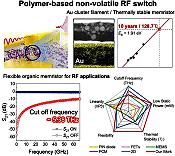 "A research team affiliated with UNIST has
introduced a novel, high-performance, and thermally stable polymer-based non-volatile
analog switch. This next-generation device is as
thin and flexible as vinyl, yet capable of withstanding high temperatures. Professor
Myungsoo Kim and his team from the Department of Electrical Engineering at UNIST,
in collaboration with Professor Minju Kim from Dankook University, have developed
this robust, flexible radio-frequency (RF) switch. Such technology could enable
reliable 5G and 6G wireless communication in demanding environments -- such as wearable
devices and the Internet of Things (IoT)..." "A research team affiliated with UNIST has
introduced a novel, high-performance, and thermally stable polymer-based non-volatile
analog switch. This next-generation device is as
thin and flexible as vinyl, yet capable of withstanding high temperatures. Professor
Myungsoo Kim and his team from the Department of Electrical Engineering at UNIST,
in collaboration with Professor Minju Kim from Dankook University, have developed
this robust, flexible radio-frequency (RF) switch. Such technology could enable
reliable 5G and 6G wireless communication in demanding environments -- such as wearable
devices and the Internet of Things (IoT)..."
 Werbel Microwave began as a consulting firm,
specializing in RF components design, with the ability to rapidly spin low volume
prototypes. Our
WM4PD-0.5-18-S is a wideband 4-way in-line power splitter covering 500 MHz
to 18 GHz with excellent return loss, low insertion loss, and high isolation
performance. The device covers several military radios letter octave bands in one
product, delivering much value to the program. Aluminum enclosure measures 6.25
x 2.98 x 0.50", includes four through-mounting holes, and has durable, stainless
steel SMA female connectors. One device covers the upper UHF band, as well as L,
S, C, X and Ku bands... Werbel Microwave began as a consulting firm,
specializing in RF components design, with the ability to rapidly spin low volume
prototypes. Our
WM4PD-0.5-18-S is a wideband 4-way in-line power splitter covering 500 MHz
to 18 GHz with excellent return loss, low insertion loss, and high isolation
performance. The device covers several military radios letter octave bands in one
product, delivering much value to the program. Aluminum enclosure measures 6.25
x 2.98 x 0.50", includes four through-mounting holes, and has durable, stainless
steel SMA female connectors. One device covers the upper UHF band, as well as L,
S, C, X and Ku bands...
 This week's
Wireless Engineering crossword puzzle contains the usual collection
of only words and clues related to RF, microwave, and mm-wave engineering, optics,
mathematics, chemistry, physics, and other technical subjects. As always, this crossword
contains no names of politicians, mountain ranges, exotic foods or plants, movie
stars, or anything of the sort unless it/he/she is related to this puzzle's technology
theme (e.g., Reginald Denny or the Tunguska event in Siberia). The technically inclined
cruciverbalists amongst us will appreciate the effort. Enjoy! This week's
Wireless Engineering crossword puzzle contains the usual collection
of only words and clues related to RF, microwave, and mm-wave engineering, optics,
mathematics, chemistry, physics, and other technical subjects. As always, this crossword
contains no names of politicians, mountain ranges, exotic foods or plants, movie
stars, or anything of the sort unless it/he/she is related to this puzzle's technology
theme (e.g., Reginald Denny or the Tunguska event in Siberia). The technically inclined
cruciverbalists amongst us will appreciate the effort. Enjoy!
 Providing full solution service is our motto,
not just selling goods. RF &
Connector Technology has persistently pursued a management policy stressing
quality assurance system and technological advancement. From your very first contact,
you will be supported by competent RF specialists; all of them have several years
of field experience in this industry allowing them to suggest a fundamental solution
and troubleshooting approach. Coaxial RF connectors, cable assemblies, antennas,
terminations, attenuators, couplers, dividers, and more. Practically, we put priority
on process inspection at each step of workflow as well as during final inspection
in order to actualize "Zero Defects." Providing full solution service is our motto,
not just selling goods. RF &
Connector Technology has persistently pursued a management policy stressing
quality assurance system and technological advancement. From your very first contact,
you will be supported by competent RF specialists; all of them have several years
of field experience in this industry allowing them to suggest a fundamental solution
and troubleshooting approach. Coaxial RF connectors, cable assemblies, antennas,
terminations, attenuators, couplers, dividers, and more. Practically, we put priority
on process inspection at each step of workflow as well as during final inspection
in order to actualize "Zero Defects."
 "Essayons," that's the motto of the U.S.
Army Corps of Engineers. It means "Let us try," in French. In 1968, when this
G.I. Engineers editorial appeared in Electronics World magazine, it noted that
about 38,000 engineers, or roughly roughly 6% of the nation's total, served in the
U.S. Armed Forces, far more technically skilled than in World War II or Korea. Despite
surpluses in bachelor's-degree holders, advanced-degree shortages persisted, with
over 15 thousand master's and PhD positions unfilled - by fewer than 8,500 qualified
personnel, forcing underqualified assignments. Utilization varied: Air Force effectively
deployed 14,000 engineers in R&D and civil roles; Navy specialist programs covered
ship, ordnance, aeronautical, and Civil Engineer Corps (Seabees)... "Essayons," that's the motto of the U.S.
Army Corps of Engineers. It means "Let us try," in French. In 1968, when this
G.I. Engineers editorial appeared in Electronics World magazine, it noted that
about 38,000 engineers, or roughly roughly 6% of the nation's total, served in the
U.S. Armed Forces, far more technically skilled than in World War II or Korea. Despite
surpluses in bachelor's-degree holders, advanced-degree shortages persisted, with
over 15 thousand master's and PhD positions unfilled - by fewer than 8,500 qualified
personnel, forcing underqualified assignments. Utilization varied: Air Force effectively
deployed 14,000 engineers in R&D and civil roles; Navy specialist programs covered
ship, ordnance, aeronautical, and Civil Engineer Corps (Seabees)...
 Here is a handy-dandy baker's dozen worth
of "kinks," otherwise known as
tricks, shortcuts, or clever ideas, that could prove useful while
working in the lab at work or in your shop at home. One suggestion is to place a
sheet of tracing paper over your schematic while wiring a circuit and draw each
connection as it is completed, rather than mark up the original drawing. That was
definitely good for a time when making a spare copy of a magazine page or assembly
instruction from a kit was not as simple a matter as it is today... Here is a handy-dandy baker's dozen worth
of "kinks," otherwise known as
tricks, shortcuts, or clever ideas, that could prove useful while
working in the lab at work or in your shop at home. One suggestion is to place a
sheet of tracing paper over your schematic while wiring a circuit and draw each
connection as it is completed, rather than mark up the original drawing. That was
definitely good for a time when making a spare copy of a magazine page or assembly
instruction from a kit was not as simple a matter as it is today...
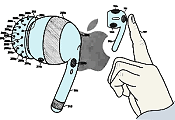 "Apple has published a patent application
describing a method to detect user gestures on wireless earbuds by measuring changes
in RF antenna impedance, potentially reducing the need for dedicated touch-sensing
hardware. The filing, titled 'Gesture
Detection Based on Antenna Impedance Measurements,' published on January 8,
2026 as US 20260010234, describes using antennas already present for wireless communication
as dual-purpose components that can also detect user input..." "Apple has published a patent application
describing a method to detect user gestures on wireless earbuds by measuring changes
in RF antenna impedance, potentially reducing the need for dedicated touch-sensing
hardware. The filing, titled 'Gesture
Detection Based on Antenna Impedance Measurements,' published on January 8,
2026 as US 20260010234, describes using antennas already present for wireless communication
as dual-purpose components that can also detect user input..."
 This week's
crossword puzzle has the theme of electronics and engineering
magazines and their editors. I have to plead guilty at not knowing who the editor-in-chief
(EiC) of many of the publications were. After so often reading the names of the
many authors and technical editors and contributing editors, etc., getting printed
every month, keeping track is difficult. You should recognize all the magazine names
since they are our industry's primary publications. Apologies to Microwaves &
RF magazine (Nancy K. Friedrich, EiC), and to High Frequency Electronics
(Scott Spencer, EiC), for not including them in the puzzle. The fact is, though,
that the more words I insert at the outset, the more difficult it is... This week's
crossword puzzle has the theme of electronics and engineering
magazines and their editors. I have to plead guilty at not knowing who the editor-in-chief
(EiC) of many of the publications were. After so often reading the names of the
many authors and technical editors and contributing editors, etc., getting printed
every month, keeping track is difficult. You should recognize all the magazine names
since they are our industry's primary publications. Apologies to Microwaves &
RF magazine (Nancy K. Friedrich, EiC), and to High Frequency Electronics
(Scott Spencer, EiC), for not including them in the puzzle. The fact is, though,
that the more words I insert at the outset, the more difficult it is...
 Exodus Advanced Communications, is a multinational
RF communication equipment and engineering service company serving both commercial
and government entities and their affiliates worldwide. Exodus'
AMP20097 Pulse Amplifier is designed for Pulse/HIRF, EMC/EMI Mil-Std 461/464,
and radar applications. Providing superb pulse fidelity and up to 100 μsec
pulse widths to 10 kW peak power. Duty cycles to 10% with a minimum gain of
63 dB. Available monitoring parameters for forward and reflected power in watts
and dBm, VSWR, voltage, current, and temperature sensing for outstanding reliability
and ruggedness in a compact 7U chassis... Exodus Advanced Communications, is a multinational
RF communication equipment and engineering service company serving both commercial
and government entities and their affiliates worldwide. Exodus'
AMP20097 Pulse Amplifier is designed for Pulse/HIRF, EMC/EMI Mil-Std 461/464,
and radar applications. Providing superb pulse fidelity and up to 100 μsec
pulse widths to 10 kW peak power. Duty cycles to 10% with a minimum gain of
63 dB. Available monitoring parameters for forward and reflected power in watts
and dBm, VSWR, voltage, current, and temperature sensing for outstanding reliability
and ruggedness in a compact 7U chassis...
 If you have been searching for a do-it-yourself
VLF loop antenna that can be resonated from approximately 14 to
25 kHz, then look no more. This article from a 1963 edition of Electronics
World presents a relatively simple to build job that reportedly provides excellent
reception. At these frequencies a wavelength is measured in miles, which makes even
a simple dipole antenna impractical, so the multi-turn loop is the only alternative.
It is the same principle that allows the little ferrite-core antenna inside your
AM radio to work so well when the shortest wavelength in the commercial AM broadcast
band is nearly 600 feet... If you have been searching for a do-it-yourself
VLF loop antenna that can be resonated from approximately 14 to
25 kHz, then look no more. This article from a 1963 edition of Electronics
World presents a relatively simple to build job that reportedly provides excellent
reception. At these frequencies a wavelength is measured in miles, which makes even
a simple dipole antenna impractical, so the multi-turn loop is the only alternative.
It is the same principle that allows the little ferrite-core antenna inside your
AM radio to work so well when the shortest wavelength in the commercial AM broadcast
band is nearly 600 feet...
 This 1968 Electronics World magazine
article nails the basics of
trade secrets law that still hold today: if you learn your boss's secret info
- like formulas, processes, or customer lists that give them a business edge - you
can't share it with a new job, even by accident, and your new employer can get sued
if they know about it and use it. No signed paper needed; courts protect "real"
secrets (not public stuff or your general skills) with court orders to stop use
or money damages. Good faith matters - act fair, don’t copy files or exact products,
and you have defenses like competing honestly. Big changes now: almost all states
follow uniform rules (UTSA) plus a 2016 federal... This 1968 Electronics World magazine
article nails the basics of
trade secrets law that still hold today: if you learn your boss's secret info
- like formulas, processes, or customer lists that give them a business edge - you
can't share it with a new job, even by accident, and your new employer can get sued
if they know about it and use it. No signed paper needed; courts protect "real"
secrets (not public stuff or your general skills) with court orders to stop use
or money damages. Good faith matters - act fair, don’t copy files or exact products,
and you have defenses like competing honestly. Big changes now: almost all states
follow uniform rules (UTSA) plus a 2016 federal...
 Here is a batch of
electronics-themed comics that appeared in the July 1948 edition of Radio
News magazine. The comic on page 122 would probably elicit cries of racism
or hate speech these days, even though there is nothing racist about it. Note how
prescient the comic on page 140 was. It shows how long futurists have ben contemplating
the technologies that have become or are becoming common place today - of course
many of them were promised to us by the end of the last century by the like of
Popular Mechanics, Mechanix Illustrated, et al... Here is a batch of
electronics-themed comics that appeared in the July 1948 edition of Radio
News magazine. The comic on page 122 would probably elicit cries of racism
or hate speech these days, even though there is nothing racist about it. Note how
prescient the comic on page 140 was. It shows how long futurists have ben contemplating
the technologies that have become or are becoming common place today - of course
many of them were promised to us by the end of the last century by the like of
Popular Mechanics, Mechanix Illustrated, et al...
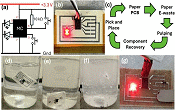 "A
new type of circuit board which is almost entirely biodegradable could help reduce
the environmental harms of electronic waste, its inventors say. Researchers from
the University of Glasgow have developed a new method of printing
zinc-based electronic circuits on environmentally friendly surfaces including
paper and bioplastics. Once the circuits are no longer needed, 99% of their materials
can be disposed of safely through ordinary soil composting or by dissolving in widely
available chemicals like vinegar..." "A
new type of circuit board which is almost entirely biodegradable could help reduce
the environmental harms of electronic waste, its inventors say. Researchers from
the University of Glasgow have developed a new method of printing
zinc-based electronic circuits on environmentally friendly surfaces including
paper and bioplastics. Once the circuits are no longer needed, 99% of their materials
can be disposed of safely through ordinary soil composting or by dissolving in widely
available chemicals like vinegar..."
 If you think government bureaucracies meddling
in the affairs of private business is a relatively new phenomenon, think again.
Elected and unelected persons and agencies have since the inception of control over
the populace made it their business to dictate which pursuits of technology are
sanctioned and which are not. Often, the motivation lies in who within those bureaucracies
stands to benefit monetarily from the decision. In this story lamenting the painfully
and, in the author's opinion, unnecessarily long time experienced in bringing
commercial broadcast television to the marketplace - in 1935.
One of the primary stumbling blocks was the FCC preventing companies from televising
paid commercials during programs because, in the FCC's view, picture quality was
not good enough to serve advertisers' interests. In this story lamenting the painfully... If you think government bureaucracies meddling
in the affairs of private business is a relatively new phenomenon, think again.
Elected and unelected persons and agencies have since the inception of control over
the populace made it their business to dictate which pursuits of technology are
sanctioned and which are not. Often, the motivation lies in who within those bureaucracies
stands to benefit monetarily from the decision. In this story lamenting the painfully
and, in the author's opinion, unnecessarily long time experienced in bringing
commercial broadcast television to the marketplace - in 1935.
One of the primary stumbling blocks was the FCC preventing companies from televising
paid commercials during programs because, in the FCC's view, picture quality was
not good enough to serve advertisers' interests. In this story lamenting the painfully...
 Here in one short editorial article, Hugo
Gernsback outlines the application of
shortwaves in "the next war" to maintain wireless surveillance of the airspace
over towns and cities via what is essentially radar, to detonate explosive devices
by means of a powerful "special combination impulse," and long-distance wireless
communications via radios "so small that one man can easily carry it." This might
seem rather moot in today's world, but in 1935 it required a certain amount of knowledge
of wireless communications and a vision regarding its potential. In my readings
of a great many early- to mid-20th-century technical articles on electronics, aeronautics,
physics, etc., it is interesting to notice how authors of the pre-WWII era referred... Here in one short editorial article, Hugo
Gernsback outlines the application of
shortwaves in "the next war" to maintain wireless surveillance of the airspace
over towns and cities via what is essentially radar, to detonate explosive devices
by means of a powerful "special combination impulse," and long-distance wireless
communications via radios "so small that one man can easily carry it." This might
seem rather moot in today's world, but in 1935 it required a certain amount of knowledge
of wireless communications and a vision regarding its potential. In my readings
of a great many early- to mid-20th-century technical articles on electronics, aeronautics,
physics, etc., it is interesting to notice how authors of the pre-WWII era referred...
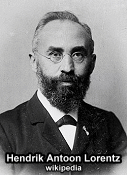 Here is a layman's analysis of the Lorentz
force, a fundamental principle in electromagnetism governing the interaction of
charged particles with electric and magnetic fields. Named after Hendrik Lorentz,
the force law underpins numerous engineering systems from electric motors to particle
accelerators. The document details Lorentz's biography, the discovery context, precise
definition, mathematical derivation, equations, and both historical and contemporary
applications. Hendrik Antoon Lorentz (1853-1928) was a Dutch physicist whose contributions
to theoretical physics... Here is a layman's analysis of the Lorentz
force, a fundamental principle in electromagnetism governing the interaction of
charged particles with electric and magnetic fields. Named after Hendrik Lorentz,
the force law underpins numerous engineering systems from electric motors to particle
accelerators. The document details Lorentz's biography, the discovery context, precise
definition, mathematical derivation, equations, and both historical and contemporary
applications. Hendrik Antoon Lorentz (1853-1928) was a Dutch physicist whose contributions
to theoretical physics...
 In 1938, Bell Telephone Laboratories, Western
Electric Company, United Air Lines, and Boeing worked together to developed the
first practical
microwave radio altimeter for use in commercial aircraft. This
is not a radar unit in that the distance is not determined solely by emitting a
signal and measuring the time taken to the target (the ground in this case) and
back again. Rather, the radio altimeter relies on a heterodyned beat frequency generated
between a reference signal and that of the transmitted and received ground-directed
signal. Author Washburn does a nice job explaining the process, so I needn't add
to it. It is interesting to note the statement about the 500 MHz used being
the "highest frequency ever to be used for practical purposes... In 1938, Bell Telephone Laboratories, Western
Electric Company, United Air Lines, and Boeing worked together to developed the
first practical
microwave radio altimeter for use in commercial aircraft. This
is not a radar unit in that the distance is not determined solely by emitting a
signal and measuring the time taken to the target (the ground in this case) and
back again. Rather, the radio altimeter relies on a heterodyned beat frequency generated
between a reference signal and that of the transmitted and received ground-directed
signal. Author Washburn does a nice job explaining the process, so I needn't add
to it. It is interesting to note the statement about the 500 MHz used being
the "highest frequency ever to be used for practical purposes...
 "A UCLA-led, multi-institution research
team has discovered a metallic material with the
highest thermal conductivity measured among metals, challenging long-standing
assumptions about the limits of heat transport in metallic materials. Published
in Science, the study was led by Yongjie Hu, a professor of mechanical
and aerospace engineering at the UCLA Samueli School of Engineering. The team reported
that metallic theta-phase tantalum nitride conducts heat nearly three times more
efficiently than copper or silver, the best conventional heat-conducting metals..." "A UCLA-led, multi-institution research
team has discovered a metallic material with the
highest thermal conductivity measured among metals, challenging long-standing
assumptions about the limits of heat transport in metallic materials. Published
in Science, the study was led by Yongjie Hu, a professor of mechanical
and aerospace engineering at the UCLA Samueli School of Engineering. The team reported
that metallic theta-phase tantalum nitride conducts heat nearly three times more
efficiently than copper or silver, the best conventional heat-conducting metals..."
 Modulating a light beam for secure communications
was not a new concept is 1939 when Gerald Mosteller invented his device, but doing
so with inexpensive equipment, using "outside-the-box" thinking, was new. Exploiting
the relatively recently discovered physical phenomenon of "skin effect," his system
used a specific range of frequencies to modulate the filament of a standard flashlight
type incandescent light bulb that could effect temperature changes - and therefore
intensity changes - rapidly and of significant amplitude to transmit information
in the audio frequency range. Mr. Mosteller's contraption evolved as the result
of a college thesis project. There does not exist a plethora of modern-day
modulated light communications systems using incandescent bulbs
as the source, so it is safe to assume insurmountable physical and/or financial
obstacles... Modulating a light beam for secure communications
was not a new concept is 1939 when Gerald Mosteller invented his device, but doing
so with inexpensive equipment, using "outside-the-box" thinking, was new. Exploiting
the relatively recently discovered physical phenomenon of "skin effect," his system
used a specific range of frequencies to modulate the filament of a standard flashlight
type incandescent light bulb that could effect temperature changes - and therefore
intensity changes - rapidly and of significant amplitude to transmit information
in the audio frequency range. Mr. Mosteller's contraption evolved as the result
of a college thesis project. There does not exist a plethora of modern-day
modulated light communications systems using incandescent bulbs
as the source, so it is safe to assume insurmountable physical and/or financial
obstacles...
 In no way do I advocate going back to the
'old ways' for manufacturing electronic components, but I do admire and like to
give credit to the people who used to perform the tedious procedure of
building vacuum tubes, hand-wire chassis assemblies, circuit boards,
etc. The process required being able to sit or stand at the same work station and
perform the same range of operations day after day, often for years on end. Of course
at the time, automation processes were not what they are today and machinery needed
to be driven by mechanical means using motors, solenoids, and limit switches. That
made employing people more financially rewarding than using a machine. You can find
details on the algorithms and methodology for designing those contraptions in older
engineering handbooks. It is an amazing sight to to tour a WWII vintage battleship
and look at the hardware that... In no way do I advocate going back to the
'old ways' for manufacturing electronic components, but I do admire and like to
give credit to the people who used to perform the tedious procedure of
building vacuum tubes, hand-wire chassis assemblies, circuit boards,
etc. The process required being able to sit or stand at the same work station and
perform the same range of operations day after day, often for years on end. Of course
at the time, automation processes were not what they are today and machinery needed
to be driven by mechanical means using motors, solenoids, and limit switches. That
made employing people more financially rewarding than using a machine. You can find
details on the algorithms and methodology for designing those contraptions in older
engineering handbooks. It is an amazing sight to to tour a WWII vintage battleship
and look at the hardware that...
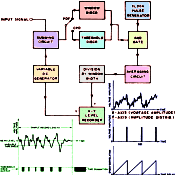 I learned (or, "leared," in MN Somali daycare
lingo) a new word today -
ergodic - from a 1968 issue of Electronics World magazine. Ergodicity is a concept
from mathematics and physics describing systems where the time average of a property
equals its average across all possible states (space average). In simpler terms,
a system is ergodic if, over time, it explores all possible states in a way that
reflects the overall statistical distribution of those states. In physics and dynamical
systems: An ergodic system eventually visits all parts of its phase space... I learned (or, "leared," in MN Somali daycare
lingo) a new word today -
ergodic - from a 1968 issue of Electronics World magazine. Ergodicity is a concept
from mathematics and physics describing systems where the time average of a property
equals its average across all possible states (space average). In simpler terms,
a system is ergodic if, over time, it explores all possible states in a way that
reflects the overall statistical distribution of those states. In physics and dynamical
systems: An ergodic system eventually visits all parts of its phase space...
 Once again, electronics and overall tech
visionary Hugo Gernsback, editor at the time of Radio-Craft magazine, prognosticated
in the 1930s what was then a pipe dream but what is today commonplace -
remote control of multi-functioned apparati (sic) via secure wireless digital
communications. Adolph Hitler had risen to power a year earlier and was a precursor
to what would officially become World War II. By 1937, nations were thinking
about what kinds of technologies would be necessary should the little mustachioed
dictator decide to invade his neighbors' countries in an attempt to rule over the
Earth. That this was so is apparent in many magazine articles in the decade of the
1930s: The Saturday Evening Post, Life, Popular Mechanics, and
even Good Housekeeping... Once again, electronics and overall tech
visionary Hugo Gernsback, editor at the time of Radio-Craft magazine, prognosticated
in the 1930s what was then a pipe dream but what is today commonplace -
remote control of multi-functioned apparati (sic) via secure wireless digital
communications. Adolph Hitler had risen to power a year earlier and was a precursor
to what would officially become World War II. By 1937, nations were thinking
about what kinds of technologies would be necessary should the little mustachioed
dictator decide to invade his neighbors' countries in an attempt to rule over the
Earth. That this was so is apparent in many magazine articles in the decade of the
1930s: The Saturday Evening Post, Life, Popular Mechanics, and
even Good Housekeeping...
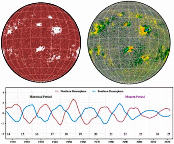 "An international team of astronomers has
developed a new way to extract
solar polar magnetic information from more than a century of historical observations,
improving prospects for predicting future solar cycle activity. The work combines
data from the Kodaikanal Solar Observatory in India with modern measurements to
reconstruct the behavior of the Sun's polar magnetic field over more than 100 years.
Researchers from Southwest Research Institute, the Aryabhatta Research Institute
of Observational Sciences and the Max Planck Institute used archival Calcium K (Ca
II K) images..." "An international team of astronomers has
developed a new way to extract
solar polar magnetic information from more than a century of historical observations,
improving prospects for predicting future solar cycle activity. The work combines
data from the Kodaikanal Solar Observatory in India with modern measurements to
reconstruct the behavior of the Sun's polar magnetic field over more than 100 years.
Researchers from Southwest Research Institute, the Aryabhatta Research Institute
of Observational Sciences and the Max Planck Institute used archival Calcium K (Ca
II K) images..."
 The use of
intermediate frequency (IF) coils
and interstage coupling transformers were a major feature of vacuum tube based receivers.
Both served the dual purpose of impedance matching and frequency selectivity. Resistive
losses in the relatively large passive components required careful attention to
matters that affect signal sensitivity, especially in the front end where losses
add significantly to the overall noise figure. This article appeared in an early
1930s edition of Radio-Craft magazine at a time when superheterodyne receivers
were just coming into popularity and were a new challenge for many designers... The use of
intermediate frequency (IF) coils
and interstage coupling transformers were a major feature of vacuum tube based receivers.
Both served the dual purpose of impedance matching and frequency selectivity. Resistive
losses in the relatively large passive components required careful attention to
matters that affect signal sensitivity, especially in the front end where losses
add significantly to the overall noise figure. This article appeared in an early
1930s edition of Radio-Craft magazine at a time when superheterodyne receivers
were just coming into popularity and were a new challenge for many designers...
 Repair service businesses have always gotten
a bad rap for deliberately inflating part and labor costs - often deservingly so
- but it's a shame the honest brokers are dragged down by the scum (or "gyps" as
this article calls them). Come to think of it, the word "gyp" is likely short for
"gypsy," which is sure to offend someone these days. Along with admonishing customers
to beware of shyster servicemen, there is an example of an orchestrated
"sting" operation whereby a radio set was intentionally "broken"
in a certain way with witnesses as to the fault, and then a couple dozen repair
services were called upon to troubleshoot and fix it, then present a bill for their
work. The result is interesting, and even resulted in one guy being... Repair service businesses have always gotten
a bad rap for deliberately inflating part and labor costs - often deservingly so
- but it's a shame the honest brokers are dragged down by the scum (or "gyps" as
this article calls them). Come to think of it, the word "gyp" is likely short for
"gypsy," which is sure to offend someone these days. Along with admonishing customers
to beware of shyster servicemen, there is an example of an orchestrated
"sting" operation whereby a radio set was intentionally "broken"
in a certain way with witnesses as to the fault, and then a couple dozen repair
services were called upon to troubleshoot and fix it, then present a bill for their
work. The result is interesting, and even resulted in one guy being...
 This is an all-star cast of
radio pioneers if there ever was one. It's not comprehensive by
any means, but most of the first-string players are here in this 1936 Radio-Craft
article. One thing I like about reading these old pieces is that they, for the most
part, are reporting on contemporary events; they are not merely a historian's interpretation
of what the original witnesses recorded. That is not to say early writers did not
editorialize, err, or outright lie about content, but I give these guys the benefit
of the doubt based on the sources. You have certainly heard of people like Hertz,
deForest, and Marconi, but what about coherer (early detector) inventor Edouard
Branly and ground-breaking commercial radio broadcast engineer Frank Conrad? Magazine
editor, publisher, and inventor Hugo Gernsback properly give a short... This is an all-star cast of
radio pioneers if there ever was one. It's not comprehensive by
any means, but most of the first-string players are here in this 1936 Radio-Craft
article. One thing I like about reading these old pieces is that they, for the most
part, are reporting on contemporary events; they are not merely a historian's interpretation
of what the original witnesses recorded. That is not to say early writers did not
editorialize, err, or outright lie about content, but I give these guys the benefit
of the doubt based on the sources. You have certainly heard of people like Hertz,
deForest, and Marconi, but what about coherer (early detector) inventor Edouard
Branly and ground-breaking commercial radio broadcast engineer Frank Conrad? Magazine
editor, publisher, and inventor Hugo Gernsback properly give a short...
 As the advertisement for membership in the
Official Radio Service Men's Association says, structured organizations
for people of like mind and interests have long been the hallmark of an advanced
society where there is a need for directed socialization and the 'strength in numbers'
benefit. I suppose most people reading this piece belong to at least one such association
like the Institute for Electrical and Electronics Engineers (IEEE), American Radio
Relay League (ARRL), Armed Forces Communications and Electronics Association (AFCEA),
Association of Old Crows (AOC), Electronics Technicians Association (ETA), etc.
Having significant representation in government in the form of lobbyists is essential
these days in order to obtain and retain fair treatment... As the advertisement for membership in the
Official Radio Service Men's Association says, structured organizations
for people of like mind and interests have long been the hallmark of an advanced
society where there is a need for directed socialization and the 'strength in numbers'
benefit. I suppose most people reading this piece belong to at least one such association
like the Institute for Electrical and Electronics Engineers (IEEE), American Radio
Relay League (ARRL), Armed Forces Communications and Electronics Association (AFCEA),
Association of Old Crows (AOC), Electronics Technicians Association (ETA), etc.
Having significant representation in government in the form of lobbyists is essential
these days in order to obtain and retain fair treatment...
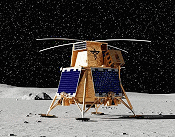 "Isolation dictates where we go to see into
the far reaches of the universe. The Atacama Desert of Chile, the summit of Mauna
Kea in Hawaii, the vast expanse of the Australian Outback -- these are where astronomers
and engineers have built the great observatories and radio telescopes of modern
times. The skies are usually clear, the air is arid, and the electronic din of civilization
is far away. It was to one of these places, in the high desert of New Mexico, that
a young astronomer named Jack Burns went to study radio jets and quasars far beyond
the Milky Way. Could there be a better, even lonelier place to put a
radio telescope? Sure,
a NASA planetary scientist named Wendell Mendell, told Burns: How about the moon..." "Isolation dictates where we go to see into
the far reaches of the universe. The Atacama Desert of Chile, the summit of Mauna
Kea in Hawaii, the vast expanse of the Australian Outback -- these are where astronomers
and engineers have built the great observatories and radio telescopes of modern
times. The skies are usually clear, the air is arid, and the electronic din of civilization
is far away. It was to one of these places, in the high desert of New Mexico, that
a young astronomer named Jack Burns went to study radio jets and quasars far beyond
the Milky Way. Could there be a better, even lonelier place to put a
radio telescope? Sure,
a NASA planetary scientist named Wendell Mendell, told Burns: How about the moon..."
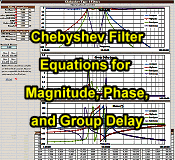 For decades - literally - I searched in
vain for explicit , but could never find more
equations for calculating Chebyshev filter phase and group delay than textbook
definitions, with instruction to extract phase from the real and imaginary parts
of the magnitude equation, and then take the negative first derivative of the phase
to get group delay. A lot of good that did - not! I have perused dozens of filter
design books, to no avail. Even the filter bible - Zverev's Handbook of Filter Synthesis
- did not provide the needed equations. Most online resources present Mathcad, MATLAB,
Mathematica, or similar scripts that call the built-in functions, without exposing
the gory detail behind them. What I wanted was something I could implement in a
spreadsheet or a program. Finally, with the help of AI (through many iterations
of... For decades - literally - I searched in
vain for explicit , but could never find more
equations for calculating Chebyshev filter phase and group delay than textbook
definitions, with instruction to extract phase from the real and imaginary parts
of the magnitude equation, and then take the negative first derivative of the phase
to get group delay. A lot of good that did - not! I have perused dozens of filter
design books, to no avail. Even the filter bible - Zverev's Handbook of Filter Synthesis
- did not provide the needed equations. Most online resources present Mathcad, MATLAB,
Mathematica, or similar scripts that call the built-in functions, without exposing
the gory detail behind them. What I wanted was something I could implement in a
spreadsheet or a program. Finally, with the help of AI (through many iterations
of...
 News services have been busy lately reporting
on the latest feat of America's national space agency's resounding success with
its
interplanetary space probe's closest encounter with our solar
system's most remote [minor] planet. Prior to the flyby, even the most powerful
Earth- and space-based telescopes could never resolve more than a few lightly contrasted
splotches on the celestial orb's surface, and its largest moon was a few pixels
worth of indeterminate light. All that changed on July 14, 2015. We now have, for
the first time ever, high resolution images of the surface, and are in the process
of collection terabits worth of additional physical data from onboard instruments.
No doubt many Ph.D.'s will be earned through assimilation... News services have been busy lately reporting
on the latest feat of America's national space agency's resounding success with
its
interplanetary space probe's closest encounter with our solar
system's most remote [minor] planet. Prior to the flyby, even the most powerful
Earth- and space-based telescopes could never resolve more than a few lightly contrasted
splotches on the celestial orb's surface, and its largest moon was a few pixels
worth of indeterminate light. All that changed on July 14, 2015. We now have, for
the first time ever, high resolution images of the surface, and are in the process
of collection terabits worth of additional physical data from onboard instruments.
No doubt many Ph.D.'s will be earned through assimilation...
 Amplifier Solutions Corporation (ASC) is
a manufacturer of amplifiers for commercial & military markets. ASC designs
and manufactures hybrid, surface mount flange, open carrier and connectorized amplifiers
for low, medium and high power applications using Gallium Nitride (GaN), Gallium
Arsenide (GaAs) and Silicon (Si) transistor technologies. ASC's thick film designs
operate in the frequency range of 300 kHz to 6 GHz. ASC offers thin film
designs that operate up to 20 GHz. ASC is located in an 8,000 sq.ft. facility
in the town of Telford, PA. We offer excellent customer support and take pride in
the ability to quickly react to evolving system design requirements. Amplifier Solutions Corporation (ASC) is
a manufacturer of amplifiers for commercial & military markets. ASC designs
and manufactures hybrid, surface mount flange, open carrier and connectorized amplifiers
for low, medium and high power applications using Gallium Nitride (GaN), Gallium
Arsenide (GaAs) and Silicon (Si) transistor technologies. ASC's thick film designs
operate in the frequency range of 300 kHz to 6 GHz. ASC offers thin film
designs that operate up to 20 GHz. ASC is located in an 8,000 sq.ft. facility
in the town of Telford, PA. We offer excellent customer support and take pride in
the ability to quickly react to evolving system design requirements.
 In the late 1960s, there was evidently a
brewing consumer revolt against
shoddy merchandise, worthless warranties, and sloppy service. Mac attributed
this to a post-WWII seller's market fueled by wartime shortages, black markets,
and inflation. Many workers had pent-up money to spend on products not readily available
during the war. Ensuing conflict eras like Korea and Vietnam prioritized volume
production and advertising over quality. Demand escalated prices. Customers, once
kings in a competitive free-enterprise system, became expendable amid abundant demand.
By 1969, when this story appeared in Electronics World magazine... In the late 1960s, there was evidently a
brewing consumer revolt against
shoddy merchandise, worthless warranties, and sloppy service. Mac attributed
this to a post-WWII seller's market fueled by wartime shortages, black markets,
and inflation. Many workers had pent-up money to spend on products not readily available
during the war. Ensuing conflict eras like Korea and Vietnam prioritized volume
production and advertising over quality. Demand escalated prices. Customers, once
kings in a competitive free-enterprise system, became expendable amid abundant demand.
By 1969, when this story appeared in Electronics World magazine...
 Here are three
electronics-themed comics from vintage issues of Electronics World
and Popular Electronics magazines. My favorite is the page 84 comic where
the sign on the Telco Rectifier Components president's wall is apropos. Maybe one
of the interview questions for job applicants was #1: "Did you notice the sign on
the wall in the waiting room," and #2: "Did you 'get it?,' and please explain."
In 1956 when that comic appeared, AC-to-DC power supplies used high voltage vacuum
tubes, typically 300 volts or more. Hefty capacitors were needed to remove
enough ripple from the "top" of the DC to render it undetectable in the circuit
output - especially if the output was audio where a 60 or 120 Hz (50 or 100 Hz
in Europe) "hum"... Here are three
electronics-themed comics from vintage issues of Electronics World
and Popular Electronics magazines. My favorite is the page 84 comic where
the sign on the Telco Rectifier Components president's wall is apropos. Maybe one
of the interview questions for job applicants was #1: "Did you notice the sign on
the wall in the waiting room," and #2: "Did you 'get it?,' and please explain."
In 1956 when that comic appeared, AC-to-DC power supplies used high voltage vacuum
tubes, typically 300 volts or more. Hefty capacitors were needed to remove
enough ripple from the "top" of the DC to render it undetectable in the circuit
output - especially if the output was audio where a 60 or 120 Hz (50 or 100 Hz
in Europe) "hum"...
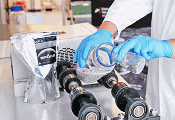 "Future lunar missions face a fundamental
challenge: the high cost and difficult transport of materials from Earth. Now, a
new project supported by the European Space Agency (ESA) will demonstrate how lunar
soil -- after releasing its oxygen for rocket propulsion and potentially air for
astronauts -- can also be converted into metal-rich compounds which can conduct
electricity. This compound can either be transformed to inks for
printing electronic circuits or powder for 3D printing of larger components.
Danish Technological Institute..." "Future lunar missions face a fundamental
challenge: the high cost and difficult transport of materials from Earth. Now, a
new project supported by the European Space Agency (ESA) will demonstrate how lunar
soil -- after releasing its oxygen for rocket propulsion and potentially air for
astronauts -- can also be converted into metal-rich compounds which can conduct
electricity. This compound can either be transformed to inks for
printing electronic circuits or powder for 3D printing of larger components.
Danish Technological Institute..."
A mathematics professor explained to students through various lectures and examples:

It became obvious not everyone understood after one student submitted the following
on a pop quiz:

- originator unknown.
 It seemed weird to read of
microelectronics device density expressed in parts per cubic foot
of semiconductor substrate. Describing density that way makes some sense when considering
3-dimensional devices with vertically stacked elements, but this was in a 1963 article
in Electronics World, so that could not have been the case. The motivation, evidently
was to be able to compare microcircuit density with that of the human brain in terms
of neuron density. In fact, there is an interesting chart presented that shows the
evolution in circuit density beginning with vacuum tube circuits, progressing through
the state of the art in 1963, projecting for future years, and finally peaking with
the brain's density. Interestingly, the brain density shows as about 5x10¹¹/ft3,
while the "nonredundant semiconductor device" limit is... It seemed weird to read of
microelectronics device density expressed in parts per cubic foot
of semiconductor substrate. Describing density that way makes some sense when considering
3-dimensional devices with vertically stacked elements, but this was in a 1963 article
in Electronics World, so that could not have been the case. The motivation, evidently
was to be able to compare microcircuit density with that of the human brain in terms
of neuron density. In fact, there is an interesting chart presented that shows the
evolution in circuit density beginning with vacuum tube circuits, progressing through
the state of the art in 1963, projecting for future years, and finally peaking with
the brain's density. Interestingly, the brain density shows as about 5x10¹¹/ft3,
while the "nonredundant semiconductor device" limit is...
 LadyBug Technologies was founded in 2004
by two microwave engineers with a passion for quality microwave test instrumentation.
Our employees offer many years experience in the design and manufacture of the worlds
best vector network analyzers, spectrum analyzers, power meters and associated components.
The management team has additional experience in optical power testing, military
radar and a variety of programming environments including LabVIEW, VEE and other
languages often used in programmatic systems. Extensive experience in a broad spectrum
of demanding measurement applications. You can be assured that our Power Sensors
are designed, built, tested and calibrated without compromise. LadyBug Technologies was founded in 2004
by two microwave engineers with a passion for quality microwave test instrumentation.
Our employees offer many years experience in the design and manufacture of the worlds
best vector network analyzers, spectrum analyzers, power meters and associated components.
The management team has additional experience in optical power testing, military
radar and a variety of programming environments including LabVIEW, VEE and other
languages often used in programmatic systems. Extensive experience in a broad spectrum
of demanding measurement applications. You can be assured that our Power Sensors
are designed, built, tested and calibrated without compromise.
 Breaking News!
Espresso Engineering Workbook™ v2.2.2026 has just been released. This makes
the 49th worksheet added. It calculates magnitude, phase, and group delay for Chebyshev
Type 1 lowpass, highpass, bandpass, and bandstop filters. Outside of the kilobuck
simulators, finding a calculator for phase and group delay is extremely difficult
- believe me, I've searched extensively for years. It also has a Butterworth filter
for the same. Espresso Engineering Workbook™ can be downloaded free of charge. All
you need is Excel™ v2007 or newer. It is provided compliments of my advertisers.
Contact me if you would like your company added to the next release. Breaking News!
Espresso Engineering Workbook™ v2.2.2026 has just been released. This makes
the 49th worksheet added. It calculates magnitude, phase, and group delay for Chebyshev
Type 1 lowpass, highpass, bandpass, and bandstop filters. Outside of the kilobuck
simulators, finding a calculator for phase and group delay is extremely difficult
- believe me, I've searched extensively for years. It also has a Butterworth filter
for the same. Espresso Engineering Workbook™ can be downloaded free of charge. All
you need is Excel™ v2007 or newer. It is provided compliments of my advertisers.
Contact me if you would like your company added to the next release.
These archive pages are provided in order to make it easier for you to find items
that you remember seeing on the RF Cafe homepage. Of course probably the easiest
way to find anything on the website is to use the "Search
RF Cafe" box at the top of every page. Some quoted items have been shortened
to save space. About RF Cafe.
Homepage Archive Pages
2026:
Jan |
Feb |
Mar |
Apr |
May |
Jun |
Jul |
Aug | Sep | Oct | Nov | Dec
2025:
Jan |
Feb |
Mar |
Apr |
May |
Jun |
Jul |
Aug |
Sep |
Oct |
Nov |
Dec
2024:
Jan |
Feb |
Mar |
Apr |
May |
Jun |
Jul |
Aug |
Sep |
Oct |
Nov |
Dec
2023:
Jan |
Feb |
Mar |
Apr |
May |
Jun |
Jul |
Aug |
Sep |
Oct |
Nov |
Dec
2022:
Jan |
Feb |
Mar |
Apr |
May |
Jun |
Jul |
Aug |
Sep |
Oct |
Nov |
Dec
2021:
Jan |
Feb |
Mar |
Apr |
May |
Jun |
Jul |
Aug |
Sep |
Oct |
Nov |
Dec
2020:
Jan |
Feb |
Mar |
Apr |
May |
Jun |
Jul |
Aug |
Sep |
Oct |
Nov |
Dec
2019:
Jan |
Feb |
Mar |
Apr |
May |
Jun |
Jul |
Aug |
Sep |
Oct |
Nov |
Dec
2018:
Jan |
Feb |
Mar |
Apr |
May |
Jun |
Jul |
Aug |
Sep |
Oct |
Nov |
Dec
2017:
Jan | Feb |
Mar |
Apr |
May |
Jun |
Jul |
Aug |
Sep |
Oct |
Nov |
Dec
2016:
Jan | Feb |
Mar |
Apr |
May |
Jun |
Jul |
Aug |
Sep |
Oct |
Nov |
Dec
2015:
Jan | Feb |
Mar |
Apr |
May |
Jun |
Jul |
Aug | Sep |
Oct |
Nov |
Dec
2014:
Jan | Feb |
Mar |
Apr |
May |
Jun |
Jul |
Aug |
Sep |
Oct |
Nov |
Dec
2013:
Jan | Feb |
Mar |
Apr |
May |
Jun |
Jul |
Aug |
Sep |
Oct |
Nov |
Dec
2012: 1 |
2 | 3
| 4 | 5
| 6 | 7
| 8 | 9
| 10 | 11
| 12 | 13
(no archives before 2012)
- Christmas-themed
items
|