|
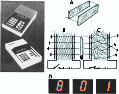 Liquid crystals have been with us for so
long now that it is hard to imagine a time when they were considered a scientific
laboratory entity. Before being controlled by electric fields for use in alpha-numeric
displays, the thermal properties of
liquid crystals of the cholesteric type found applications in
temperature and power measurements. Since the colors scattered by cholesteric liquid
crystals under incandescent light are unique to a given temperature, measurement
of temperature is possible to an accuracy of better than 0.1 °C. Bendix manufactured
a liquid crystal microwave power density meter. Nematic liquid crystals are the
type found in displays (twisted nematic LCD's) and are controlled by an electric
field which causes light to be transmitted or blocked at varying levels. In 1973
when this article appeared in Popular Electronics magazine, Seiko... Liquid crystals have been with us for so
long now that it is hard to imagine a time when they were considered a scientific
laboratory entity. Before being controlled by electric fields for use in alpha-numeric
displays, the thermal properties of
liquid crystals of the cholesteric type found applications in
temperature and power measurements. Since the colors scattered by cholesteric liquid
crystals under incandescent light are unique to a given temperature, measurement
of temperature is possible to an accuracy of better than 0.1 °C. Bendix manufactured
a liquid crystal microwave power density meter. Nematic liquid crystals are the
type found in displays (twisted nematic LCD's) and are controlled by an electric
field which causes light to be transmitted or blocked at varying levels. In 1973
when this article appeared in Popular Electronics magazine, Seiko...
Axiom Test Equipment allows you to
rent or
buy test equipment,
repair
test equipment, or sell or trade test equipment. They are committed to providing
superior customer service and high quality electronic test equipment. Axiom offers
customers several practical, efficient, and cost effective solutions for their projects'
TE needs and is committed to providing superior customer service and high quality
electronic test equipment. For anyone seeking a way to offload surplus or obsolete
equipment, they offer a trade-in program or they will buy the equipment from you.
Some vintage items are available fully calibrated. Please check out Axiom Test Equipment
today!
 "U.S. military scientists are reaching out
to industry for enabling technologies to advance the performance of
atomic vapors for electric field sensing for applications ranging
from airborne electronic warfare (EW) to naval anti-submarine warfare (ASW). Officials
of the U.S. Defense Advanced Research Projects Agency (DARPA) in Arlington, Va.,
issued a broad agency announcement Wednesday for the Science of Atomic Vapors for
New Technologies (SAVaNT) project. DARPA researchers are looking for high-performance
atomic vapors for electric field sensing and imaging, magnetic field sensing, and
quantum information science (QIS)..." "U.S. military scientists are reaching out
to industry for enabling technologies to advance the performance of
atomic vapors for electric field sensing for applications ranging
from airborne electronic warfare (EW) to naval anti-submarine warfare (ASW). Officials
of the U.S. Defense Advanced Research Projects Agency (DARPA) in Arlington, Va.,
issued a broad agency announcement Wednesday for the Science of Atomic Vapors for
New Technologies (SAVaNT) project. DARPA researchers are looking for high-performance
atomic vapors for electric field sensing and imaging, magnetic field sensing, and
quantum information science (QIS)..."
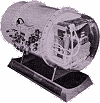 When you think of typical primary battery
cells (non-rechargeable by definition), something like the standard Ray-O-Vac carbon
(actually zinc-carbon) model probably comes to mind. The reason primary cells cannot
be recharged is that the cathodes are consumed in the reaction with the electrolyte
during current flow. Secondary cells are rechargeable because the current-producing
reaction does not consume the cathode (at least not as rapidly), so applying a reverse
voltage drives the electrons back from whence they came allowing the discharge process
to happen again. There is another type of primary cell - the
fuel cell - that never really discharges but is constantly fed
with a chemical (or combination of chemicals) that facilitates a reaction between
electrodes and the electrolyte. Therefore it never needs to be recharged in the
traditional sense... When you think of typical primary battery
cells (non-rechargeable by definition), something like the standard Ray-O-Vac carbon
(actually zinc-carbon) model probably comes to mind. The reason primary cells cannot
be recharged is that the cathodes are consumed in the reaction with the electrolyte
during current flow. Secondary cells are rechargeable because the current-producing
reaction does not consume the cathode (at least not as rapidly), so applying a reverse
voltage drives the electrons back from whence they came allowing the discharge process
to happen again. There is another type of primary cell - the
fuel cell - that never really discharges but is constantly fed
with a chemical (or combination of chemicals) that facilitates a reaction between
electrodes and the electrolyte. Therefore it never needs to be recharged in the
traditional sense...
 Anatech Electronics (AEI) manufactures and
supplies RF and microwave filters for military and commercial communication
systems, providing standard LP, HP, BP, BS, notch, diplexer, and custom RF filters,
and RF products. Standard RF filter and cable assembly products are published in
our website database for ease of procurement. Custom RF filters designs are used
when a standard cannot be found, or the requirements dictate a custom approach for
your military and commercial communications needs. Sam Benzacar's monthly newsletters
address contemporary wireless subjects. Please visit Anatech today to see how they
can help your project succeed. Anatech Electronics (AEI) manufactures and
supplies RF and microwave filters for military and commercial communication
systems, providing standard LP, HP, BP, BS, notch, diplexer, and custom RF filters,
and RF products. Standard RF filter and cable assembly products are published in
our website database for ease of procurement. Custom RF filters designs are used
when a standard cannot be found, or the requirements dictate a custom approach for
your military and commercial communications needs. Sam Benzacar's monthly newsletters
address contemporary wireless subjects. Please visit Anatech today to see how they
can help your project succeed.
 September 6th's custom
Antennas themed crossword puzzle contains only only words from
my custom-created lexicon related to engineering, science, mathematics, chemistry,
physics, astronomy, etc. (1,000s of them). Clues with an asterisk (*) are specifically
antenna-related. You will never find among the words names of politicians, mountain
ranges, exotic foods or plants, movie stars, or anything of the sort. You might,
however, find someone or something in the otherwise excluded list directly related
to this puzzle's technology theme, such as Hedy Lamarr or the Bikini Atoll, respectively.
The technically inclined cruciverbalists amongst us will appreciate the effort. September 6th's custom
Antennas themed crossword puzzle contains only only words from
my custom-created lexicon related to engineering, science, mathematics, chemistry,
physics, astronomy, etc. (1,000s of them). Clues with an asterisk (*) are specifically
antenna-related. You will never find among the words names of politicians, mountain
ranges, exotic foods or plants, movie stars, or anything of the sort. You might,
however, find someone or something in the otherwise excluded list directly related
to this puzzle's technology theme, such as Hedy Lamarr or the Bikini Atoll, respectively.
The technically inclined cruciverbalists amongst us will appreciate the effort.
 Belden Manufacturing, have been founded in
1902 by Joseph Belden, has had a wild history of acquisitions and re-naming. It
merged with Crouse-Hinds Company in 1980, and was soon after acquired by Cooper
Industries in 1981. Then, in 1993 Belden was spun off as an independent company
in order to capitalize on the respected brand name. In 2004, Belden merged with
Cable Design Technologies forming Belden CDT. Since then, Belden has acquired Hirschmann,
Lumberg Automation, and Telecast Fiber Systems, all while retaining the Belden identity.
Smart move. It is regretful that so many of America's great companies have given
up their good names - Radio Corporation of America (RCA) and Hewlett-Packard (HP)
test equipment come to mind. This 1955-era advertisement in Radio & Television
News magazine reminds readers of the wide spectrum... Belden Manufacturing, have been founded in
1902 by Joseph Belden, has had a wild history of acquisitions and re-naming. It
merged with Crouse-Hinds Company in 1980, and was soon after acquired by Cooper
Industries in 1981. Then, in 1993 Belden was spun off as an independent company
in order to capitalize on the respected brand name. In 2004, Belden merged with
Cable Design Technologies forming Belden CDT. Since then, Belden has acquired Hirschmann,
Lumberg Automation, and Telecast Fiber Systems, all while retaining the Belden identity.
Smart move. It is regretful that so many of America's great companies have given
up their good names - Radio Corporation of America (RCA) and Hewlett-Packard (HP)
test equipment come to mind. This 1955-era advertisement in Radio & Television
News magazine reminds readers of the wide spectrum...
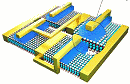 "So far, silicon has been the primary material
for the fabrication of ICs and other electronic components. Recently, however, researchers
have been trying to identify new
high-mobility semiconductors that could replace silicon in electronics
applications, as it appears to be approaching its limit in terms of the computational
efficiency and speeds it can produce. Past studies have explored the potential of
two distinct types of materials, namely bulk materials (e.g. silicon-germanium)
and low-dimensional nanomaterials (e.g., 1-D carbon nanotubes, 2-D transition metal
dichalcogenides). While some of these materials have proved to be promising alternatives
to silicon, they typically suffer from the absence of a high-quality native oxide
as a dielectric counterpart, which can significantly limit their compatibility with
other electronic components..." "So far, silicon has been the primary material
for the fabrication of ICs and other electronic components. Recently, however, researchers
have been trying to identify new
high-mobility semiconductors that could replace silicon in electronics
applications, as it appears to be approaching its limit in terms of the computational
efficiency and speeds it can produce. Past studies have explored the potential of
two distinct types of materials, namely bulk materials (e.g. silicon-germanium)
and low-dimensional nanomaterials (e.g., 1-D carbon nanotubes, 2-D transition metal
dichalcogenides). While some of these materials have proved to be promising alternatives
to silicon, they typically suffer from the absence of a high-quality native oxide
as a dielectric counterpart, which can significantly limit their compatibility with
other electronic components..."
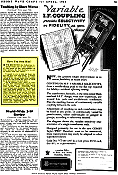 Today we have
missing persons notices printed on milk cartons and computer-aged
pictures of missing kids on bulletin boards at Walmart, and of course the Internet
with all its various forms of publicity. In 1935, evidently, an electronics magazine
was a proper venue for placing a missing person ad. At the time there was no convenient
and accessible way for family members to reach out to a nationwide audience other
than to place ads in magazines and/or newspapers in remote locations. I thought
it odd to see such a placement in this edition of Short Wave Craft magazine,
but considering the aforementioned, doing so is entirely reasonable for a worried
family. I wonder how much it cost to place the notice? It's heartbreaking, really... Today we have
missing persons notices printed on milk cartons and computer-aged
pictures of missing kids on bulletin boards at Walmart, and of course the Internet
with all its various forms of publicity. In 1935, evidently, an electronics magazine
was a proper venue for placing a missing person ad. At the time there was no convenient
and accessible way for family members to reach out to a nationwide audience other
than to place ads in magazines and/or newspapers in remote locations. I thought
it odd to see such a placement in this edition of Short Wave Craft magazine,
but considering the aforementioned, doing so is entirely reasonable for a worried
family. I wonder how much it cost to place the notice? It's heartbreaking, really...
 RF Cafe typically receives 8,000-15,000
website visits each weekday and about half that on weekends.
RF Cafe is a favorite of engineers, technicians, hobbyists, and students all
over the world. With more than 11,000 pages in the Google search index,
RF Cafe returns
in favorable positions on many types of key searches, both for text and images.
New content is added on a daily basis, which keeps the major search engines interested
enough to spider it multiple times each day. Items added on the homepage often can
be found in a Google search within a few hours of being posted. If you need your
company news to be seen, RF Cafe is the place to be.
Advertising begins at $40/month. RF Cafe typically receives 8,000-15,000
website visits each weekday and about half that on weekends.
RF Cafe is a favorite of engineers, technicians, hobbyists, and students all
over the world. With more than 11,000 pages in the Google search index,
RF Cafe returns
in favorable positions on many types of key searches, both for text and images.
New content is added on a daily basis, which keeps the major search engines interested
enough to spider it multiple times each day. Items added on the homepage often can
be found in a Google search within a few hours of being posted. If you need your
company news to be seen, RF Cafe is the place to be.
Advertising begins at $40/month.
 Maybe I have been missing them, but it seems
EDN magazine's "Tales from the Cube" feature, formerly appearing very frequently,
has been fairly rare over the last couple years. A new episode entitled, "The Load That Was
Not," is now posted by Konstantin Stefanov [I always think of
thermocouples when I see that name ;-) ]. It begins: "A few years
ago, I inherited two systems at work used to drive and readout charge coupled devices
(CCD). They were mostly for training people how to use a CCD, but the same systems
were used for proper science applications too. It was well known that the systems
were noisy, and instead of the expected 5 electrons RMS, as per the datasheet, the
noise was regularly above 60 electrons. Most people using the system were accustomed
to the high noise and just shrugged..." Maybe I have been missing them, but it seems
EDN magazine's "Tales from the Cube" feature, formerly appearing very frequently,
has been fairly rare over the last couple years. A new episode entitled, "The Load That Was
Not," is now posted by Konstantin Stefanov [I always think of
thermocouples when I see that name ;-) ]. It begins: "A few years
ago, I inherited two systems at work used to drive and readout charge coupled devices
(CCD). They were mostly for training people how to use a CCD, but the same systems
were used for proper science applications too. It was well known that the systems
were noisy, and instead of the expected 5 electrons RMS, as per the datasheet, the
noise was regularly above 60 electrons. Most people using the system were accustomed
to the high noise and just shrugged..."
"Empower-RF-Systems-Liquid-Cooled-Hot-Swappable-SSPA-9-2-2020.htm" target="_top">
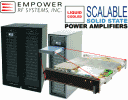 A new technologically advanced liquid cooled
and scalable architecture is available from "Empower-RF-Systems-Liquid-Cooled-Hot-Swappable-SSPA-9-2-2020.htm"
target="_top"> Empower RF Systems. This breakthrough solid state design replaces
tube technology to bring new capabilities to applications where tens and hundreds
of kilowatts of CW and pulse power are required. Available frequency coverage from
HF to X-band. This remarkable architecture brings together four major technology
advancements. First is the fully digital peak and RMS detection providing waveform
flexibility and accurate metering allowing asymmetrical and random pulse width and
duty cycle operation on pulse amplifiers... A new technologically advanced liquid cooled
and scalable architecture is available from "Empower-RF-Systems-Liquid-Cooled-Hot-Swappable-SSPA-9-2-2020.htm"
target="_top"> Empower RF Systems. This breakthrough solid state design replaces
tube technology to bring new capabilities to applications where tens and hundreds
of kilowatts of CW and pulse power are required. Available frequency coverage from
HF to X-band. This remarkable architecture brings together four major technology
advancements. First is the fully digital peak and RMS detection providing waveform
flexibility and accurate metering allowing asymmetrical and random pulse width and
duty cycle operation on pulse amplifiers...
Res-Net Microwave has a complete line of precision
RF &
microwave components including attenuators, terminations, resistors, and diode
detectors for commercial, military, and space applications. Products range from
the small flange type to large 2,000 watt connectorized power attenuators and/or
terminations at frequencies up to 26.5 GHz. In-house photo etch and laser trim
capability. The company is a leader in development and production of the films required
for these type of RF/microwave components. Please check out Res-Net Microwave's
website to see how they can help with your current project.
 The mystery of the
origin of the term "ham" for amateur radio operators never has,
after more than a century, been absolutely settled. Be thankful, though, for being
this day referred to as a "ham" and not a "plug." Waaaay back in 1976, the year
I graduated from high school (wow), Mr. Bill Johnston wrote this article for
QST magazine which presented his research into the etymology of "ham."
According to his information, both "ham" and "plug" were terms applied to fledgling
wireless operators on trains and ships. "Plug" is a term often applied to a worn
out horse or defective item, so it was an appropriate enough derogatory word for
a newbie. The author claims that as of 1976, some dictionaries list as an alternate
definition of plug, "an inexperienced telegrapher." I just checked my c1976
Webster's New Collegiate Dictionary and it does not include that definition.
None of the most prominent online dictionaries... The mystery of the
origin of the term "ham" for amateur radio operators never has,
after more than a century, been absolutely settled. Be thankful, though, for being
this day referred to as a "ham" and not a "plug." Waaaay back in 1976, the year
I graduated from high school (wow), Mr. Bill Johnston wrote this article for
QST magazine which presented his research into the etymology of "ham."
According to his information, both "ham" and "plug" were terms applied to fledgling
wireless operators on trains and ships. "Plug" is a term often applied to a worn
out horse or defective item, so it was an appropriate enough derogatory word for
a newbie. The author claims that as of 1976, some dictionaries list as an alternate
definition of plug, "an inexperienced telegrapher." I just checked my c1976
Webster's New Collegiate Dictionary and it does not include that definition.
None of the most prominent online dictionaries...
 "New research from the University of Southampton
has successful discovered a way to bind two negatively charged electron-like particles
which could create opportunities to form novel materials for use in new technological
developments. Positive and negative electric charges attract each other, forming
atoms, molecules, and all that we usually refer as matter. However, negative charges
repel each other, and in order to form atom-like bound objects some extra glue is
needed to compensate this electrostatic repulsion and bind the particles together.
Prof De Liberato and co-workers fabricated a
nano-device, trapping electrons into nanoscopic wells. They started
by showing that photons that struck the device with high enough energy extracted
electrons from the wells..." "New research from the University of Southampton
has successful discovered a way to bind two negatively charged electron-like particles
which could create opportunities to form novel materials for use in new technological
developments. Positive and negative electric charges attract each other, forming
atoms, molecules, and all that we usually refer as matter. However, negative charges
repel each other, and in order to form atom-like bound objects some extra glue is
needed to compensate this electrostatic repulsion and bind the particles together.
Prof De Liberato and co-workers fabricated a
nano-device, trapping electrons into nanoscopic wells. They started
by showing that photons that struck the device with high enough energy extracted
electrons from the wells..."
 Believe it or not,
cathode ray tubes (CRT's) are still manufactured for specialty
products and for replacement parts. Even with a high level of automation, there
are still steps in the manufacturing process that require human handling. A comparison
between CRT plants in the USA and Germany show the similarity but distinctly different
processes in Sylvania and Telefunken operations, respectively. The photos shown
are from an article in a 1958 edition of Popular Electronics. At the bottom of this
page are videos of a modern CRT manufacturing process and a CRT recycling effort.
As you will see, properly recycling a CRT is about as manually intensive as manufacturing
one (but with no quality control and functionality concerns). I am not sure where
the profit is in recycling unless inflation over the 10-20 years since manufacturing
makes the value of materials worth the effort. A très cool documentary film on the
designing... Believe it or not,
cathode ray tubes (CRT's) are still manufactured for specialty
products and for replacement parts. Even with a high level of automation, there
are still steps in the manufacturing process that require human handling. A comparison
between CRT plants in the USA and Germany show the similarity but distinctly different
processes in Sylvania and Telefunken operations, respectively. The photos shown
are from an article in a 1958 edition of Popular Electronics. At the bottom of this
page are videos of a modern CRT manufacturing process and a CRT recycling effort.
As you will see, properly recycling a CRT is about as manually intensive as manufacturing
one (but with no quality control and functionality concerns). I am not sure where
the profit is in recycling unless inflation over the 10-20 years since manufacturing
makes the value of materials worth the effort. A très cool documentary film on the
designing...
"Exodus-Advanced-Communications-AMP2085C-SSPA-9-2-2020.htm" target="_top">
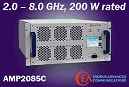 Exodus Advanced Communications' "Exodus-Advanced-Communications-AMP2085C-SSPA-9-2-2020.htm"
target="_top"> AMP2085C is designed for broadband EMI-Lab, EW, Communication and
general industry applications. Ultra-broadband frequency range, class A/AB linear
design for all modulations & industry test standards. Suitable for pulse and
all single channel modulation standards. It covers 2.0 GHz - 8.0 GHz,
produces 200 W Minimum, 250 W typical, 100 W P1dB with a minimum
gain of 53 dB. Excellent gain flatness, optional monitoring parameters for
Forward/Reflected power, VSWR, voltage, current & temperature sensing for superb
reliability and ruggedness. Rack-mountable system has a nominal weight of 75 lbs.,
and dimensions of 19" W x 24" L x 8.75" H... Exodus Advanced Communications' "Exodus-Advanced-Communications-AMP2085C-SSPA-9-2-2020.htm"
target="_top"> AMP2085C is designed for broadband EMI-Lab, EW, Communication and
general industry applications. Ultra-broadband frequency range, class A/AB linear
design for all modulations & industry test standards. Suitable for pulse and
all single channel modulation standards. It covers 2.0 GHz - 8.0 GHz,
produces 200 W Minimum, 250 W typical, 100 W P1dB with a minimum
gain of 53 dB. Excellent gain flatness, optional monitoring parameters for
Forward/Reflected power, VSWR, voltage, current & temperature sensing for superb
reliability and ruggedness. Rack-mountable system has a nominal weight of 75 lbs.,
and dimensions of 19" W x 24" L x 8.75" H...
Axiom Test Equipment allows you to
rent or
buy test equipment,
repair
test equipment, or sell or trade test equipment. They are committed to providing
superior customer service and high quality electronic test equipment. Axiom offers
customers several practical, efficient, and cost effective solutions for their projects'
TE needs and is committed to providing superior customer service and high quality
electronic test equipment. For anyone seeking a way to offload surplus or obsolete
equipment, they offer a trade-in program or they will buy the equipment from you.
Some vintage items are available fully calibrated. Please check out Axiom Test Equipment
today!
 By 1955, two years after the official adoption
of the NTSC (National Television System Committee ) standard for
commercial color television broadcasts and just one year since
the first sets were put on sale, the industry was concerned that "only" 30,000 color
TVs had been sold. That seems like a pretty good number to me given that the median
family income was $4,400 per year ($42.5k in 2020 dollars) in 1955. With an initial
$1,000 price tag ($9.7k in 2020 - the cost of 10 iPhone 11 Pro's) for a 12"
set that represented nearly a quarter of a year's pay. Black & white (B&W)
TV sets ran around $200-300. One of the cost-adders for color TVs was the requirement
to be backward compatible with B&W broadcast signals. 25 to 30 vacuum tubes
were needed to handle all the signal demodulation, processing, and presentation.
Prices started dropping pretty quickly as more manufacturers... By 1955, two years after the official adoption
of the NTSC (National Television System Committee ) standard for
commercial color television broadcasts and just one year since
the first sets were put on sale, the industry was concerned that "only" 30,000 color
TVs had been sold. That seems like a pretty good number to me given that the median
family income was $4,400 per year ($42.5k in 2020 dollars) in 1955. With an initial
$1,000 price tag ($9.7k in 2020 - the cost of 10 iPhone 11 Pro's) for a 12"
set that represented nearly a quarter of a year's pay. Black & white (B&W)
TV sets ran around $200-300. One of the cost-adders for color TVs was the requirement
to be backward compatible with B&W broadcast signals. 25 to 30 vacuum tubes
were needed to handle all the signal demodulation, processing, and presentation.
Prices started dropping pretty quickly as more manufacturers...
"ConductRF-VITA67d3-RF-Solutions-VPX-9-1-2020.htm" target="_top">
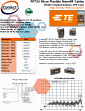 ConductRF's close partnership with TE in its
development of its new Nano-miniature RF Solutions for "ConductRF-VITA67d3-RF-Solutions-VPX-9-1-2020.htm"
target="_top"> VITA67.3 has put us in a great position to support your VPX RF cable
assembly needs. Modular solution supports 8 to 18 positions, flexible 0.047" diameter
cable, supports frequency up to 70 GHz, use with standard solutions (SMA, SMPM,
etc.), 2x density of Vita67.1. ConductRF's PFT33 Series of Micro Flexible Cable
Assemblies has been designed directly with TE Connectivity involvement and in partnership
to maximize the capabilities of TE's new Vita67.3 NanoRF VPX modular connector system.
ConductRF offers its soft FEP jacketed ø0.047" cable to facilitate maximum flexibility
and provides solutions for jumper cables... ConductRF's close partnership with TE in its
development of its new Nano-miniature RF Solutions for "ConductRF-VITA67d3-RF-Solutions-VPX-9-1-2020.htm"
target="_top"> VITA67.3 has put us in a great position to support your VPX RF cable
assembly needs. Modular solution supports 8 to 18 positions, flexible 0.047" diameter
cable, supports frequency up to 70 GHz, use with standard solutions (SMA, SMPM,
etc.), 2x density of Vita67.1. ConductRF's PFT33 Series of Micro Flexible Cable
Assemblies has been designed directly with TE Connectivity involvement and in partnership
to maximize the capabilities of TE's new Vita67.3 NanoRF VPX modular connector system.
ConductRF offers its soft FEP jacketed ø0.047" cable to facilitate maximum flexibility
and provides solutions for jumper cables...
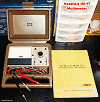 When preparing this webpage from the 1982
Heathkit Christmas catalog, I decided it was a good excuse to clean and re-calibrate
my personal
IM-17 Utility Solid-State Voltmeter. It is still in good-as-new
condition. The accuracy and precision is very good, with consistent meter readings
when changing scales. The manual suggests using a 1.5 V dry cell battery for
the DC calibration and the 120 V wall socket for the AC calibration, if no
better sources exist. A kit-built 10 MHz bandwidth oscilloscope I assembled
many moons ago specified the same two types of calibration sources. Fortunately,
I had sources a little better than a battery and a wall socket, and unlike the earlier
exercises, I now have a good quality digital multimeter to verify the voltage levels
(and better sources). The IM-17 is a strange beast in that the AC and resistance
measurements... When preparing this webpage from the 1982
Heathkit Christmas catalog, I decided it was a good excuse to clean and re-calibrate
my personal
IM-17 Utility Solid-State Voltmeter. It is still in good-as-new
condition. The accuracy and precision is very good, with consistent meter readings
when changing scales. The manual suggests using a 1.5 V dry cell battery for
the DC calibration and the 120 V wall socket for the AC calibration, if no
better sources exist. A kit-built 10 MHz bandwidth oscilloscope I assembled
many moons ago specified the same two types of calibration sources. Fortunately,
I had sources a little better than a battery and a wall socket, and unlike the earlier
exercises, I now have a good quality digital multimeter to verify the voltage levels
(and better sources). The IM-17 is a strange beast in that the AC and resistance
measurements...
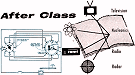 Servomechanisms are all around us in the
form of electronically actuated controls for our cars, stepper motors in our ink
jet printers, overhead garage door openers, and anywhere else you can identify where
a combination of electricity and mechanics operates with some form of positional
sensing and feedback. The author of this circa 1959 article titled "What Is a Servomechanism?" in one instance declares a control
circuit with a human operator being part of the operation as an "open loop," but
I contend that the human element is actually part of the loop and therefore constitutes
a component which closes the feedback loop. A human-in-the-loop system can still
be considered an electromechanical entity. Those of us who operate radio-controlled
model airplanes, boats, cars, etc., are very familiar with servos for moving control
surfaces... Servomechanisms are all around us in the
form of electronically actuated controls for our cars, stepper motors in our ink
jet printers, overhead garage door openers, and anywhere else you can identify where
a combination of electricity and mechanics operates with some form of positional
sensing and feedback. The author of this circa 1959 article titled "What Is a Servomechanism?" in one instance declares a control
circuit with a human operator being part of the operation as an "open loop," but
I contend that the human element is actually part of the loop and therefore constitutes
a component which closes the feedback loop. A human-in-the-loop system can still
be considered an electromechanical entity. Those of us who operate radio-controlled
model airplanes, boats, cars, etc., are very familiar with servos for moving control
surfaces...
"3D-Directory-Largest-Online-Listing-Printing-Companies-9-1-2020.htm" target="_top">
 3D Directory is the Internet's largest directory
of 3D Printing companies. The website makes it easy for users to find 3D Printing
companies based on their location and printing capabilities. Users can specify the
3D service they need (Printing, Scanning or Design), the material, the technology
that they want to use, the industry for which they want to print and much more.
3D Printing is becoming a requirement in a wide range of industries, including the
electronic component industry and RF/Microwave industry where antennas and other
components are being 3D Printed. The 3d.directory website has listed over 1,000
3D Printing companies who provide 3D Printing services, 3D Scanning Services and
3D Design Services... 3D Directory is the Internet's largest directory
of 3D Printing companies. The website makes it easy for users to find 3D Printing
companies based on their location and printing capabilities. Users can specify the
3D service they need (Printing, Scanning or Design), the material, the technology
that they want to use, the industry for which they want to print and much more.
3D Printing is becoming a requirement in a wide range of industries, including the
electronic component industry and RF/Microwave industry where antennas and other
components are being 3D Printed. The 3d.directory website has listed over 1,000
3D Printing companies who provide 3D Printing services, 3D Scanning Services and
3D Design Services...
 Centric RF is a company offering from stock
various RF and
Microwave coaxial components, including attenuators, adapters, cable assemblies,
terminations, power dividers, and more. We believe in offering high performance
parts from stock at a reasonable cost. Frequency ranges of 0-110 GHz at power
levels from 0.5-500 watts are available off the shelf. Order today, ship today!
Centric RF is currently looking for vendors to partner with them. Please visit Centric
RF today. Centric RF is a company offering from stock
various RF and
Microwave coaxial components, including attenuators, adapters, cable assemblies,
terminations, power dividers, and more. We believe in offering high performance
parts from stock at a reasonable cost. Frequency ranges of 0-110 GHz at power
levels from 0.5-500 watts are available off the shelf. Order today, ship today!
Centric RF is currently looking for vendors to partner with them. Please visit Centric
RF today.
 The Hewlett Packard
HP-25 programmable scientific calculator was initially introduced
in 1975 at a retail price of $195. It was considered ground-breaking because of
its size and the number of functions available. Thirty pushbutton keys including
two second function keys provided more than seventy-two overall types of inputs,
most of which could be incorporated in program steps (up to 49 operations). This
was not HP's first programmable calculator, but the price point put it in reach
of hobbyists and school kids. The original model would lose its program at power
down, but the HP-25C, which came out in 1976, had battery-backed memory (called
"continuous memory by HP) that was retained even when turned off. By the time this
product review appeared in a 1976 issue of QST magazine, the price had dropped to
around $135. Here is the HP Museum entry for the HP-25 calculator. A functional
HP-25 calculator can be purchased on eBay... The Hewlett Packard
HP-25 programmable scientific calculator was initially introduced
in 1975 at a retail price of $195. It was considered ground-breaking because of
its size and the number of functions available. Thirty pushbutton keys including
two second function keys provided more than seventy-two overall types of inputs,
most of which could be incorporated in program steps (up to 49 operations). This
was not HP's first programmable calculator, but the price point put it in reach
of hobbyists and school kids. The original model would lose its program at power
down, but the HP-25C, which came out in 1976, had battery-backed memory (called
"continuous memory by HP) that was retained even when turned off. By the time this
product review appeared in a 1976 issue of QST magazine, the price had dropped to
around $135. Here is the HP Museum entry for the HP-25 calculator. A functional
HP-25 calculator can be purchased on eBay...
 "Military leaders have been warning of the
fragility of GPS for years and researchers have been working on a variety of solutions,
from quantum clocks to inertial navigation. The Air Force is adding a new one, using
the
earth's magnetic fields as a secure way to detect location for
aircraft and possibly other vehicles. Magnetic fields emanating from the earth's
surface vary in intensity, just like topography, and so-called magnetic anomaly
maps of those fields have existed for years. Back in 2017, Aaron Canciani, an assistant
professor of electrical engineering at the Air Force Institute of Technology, set
out to see if magnetic sensors (magnetometers) affixed to aircraft could measure
the intensity of those magnetic fields and, thus, locate the plane based on where
it was in relation to those landmarks..." "Military leaders have been warning of the
fragility of GPS for years and researchers have been working on a variety of solutions,
from quantum clocks to inertial navigation. The Air Force is adding a new one, using
the
earth's magnetic fields as a secure way to detect location for
aircraft and possibly other vehicles. Magnetic fields emanating from the earth's
surface vary in intensity, just like topography, and so-called magnetic anomaly
maps of those fields have existed for years. Back in 2017, Aaron Canciani, an assistant
professor of electrical engineering at the Air Force Institute of Technology, set
out to see if magnetic sensors (magnetometers) affixed to aircraft could measure
the intensity of those magnetic fields and, thus, locate the plane based on where
it was in relation to those landmarks..."
 Reading trade journals is always given as
one of the main ways cited by engineers on career surveys for continuing education.
Engineering whitepapers, pamphlets, books, magazines, and chapter examples listed
here are a small sample of a lot of new items that are offered for FREE through
TradePub. The publishers make them available to qualifying people as a promotional
campaign for their full line of offerings. Whitepaper topics include careers, manufacturing,
and engineering, while magazine titles include Microwave Engineering Europe, Electronic
Design, and Microwave Product Digest. Reading trade journals is always given as
one of the main ways cited by engineers on career surveys for continuing education.
Engineering whitepapers, pamphlets, books, magazines, and chapter examples listed
here are a small sample of a lot of new items that are offered for FREE through
TradePub. The publishers make them available to qualifying people as a promotional
campaign for their full line of offerings. Whitepaper topics include careers, manufacturing,
and engineering, while magazine titles include Microwave Engineering Europe, Electronic
Design, and Microwave Product Digest.
 Here in one short editorial article, Hugo
Gernsback outlines the
application of shortwaves in "the next war" to maintain wireless
surveillance of the airspace over towns and cities via what is essentially radar,
to detonate explosive devices by means of a powerful "special combination impulse,"
and long-distance wireless communications via radios "so small that one man can
easily carry it." This might seem rather moot in today's world, but in 1935 it required
a certain amount of knowledge of wireless communications and a vision regarding
its potential. In my readings of a great many early- to mid-20th-century technical
articles on electronics, aeronautics, physics, etc., it is interesting to notice
how authors of the pre-WWII era referred to what we now call "World War I"
as simply... Here in one short editorial article, Hugo
Gernsback outlines the
application of shortwaves in "the next war" to maintain wireless
surveillance of the airspace over towns and cities via what is essentially radar,
to detonate explosive devices by means of a powerful "special combination impulse,"
and long-distance wireless communications via radios "so small that one man can
easily carry it." This might seem rather moot in today's world, but in 1935 it required
a certain amount of knowledge of wireless communications and a vision regarding
its potential. In my readings of a great many early- to mid-20th-century technical
articles on electronics, aeronautics, physics, etc., it is interesting to notice
how authors of the pre-WWII era referred to what we now call "World War I"
as simply...
 RF Cafe's raison d'être is and always has
been to provide useful, quality content for engineers, technicians, engineering
managers, students, and hobbyists. Part of that mission is offering to post applicable
job openings. HR department employees and/or managers of hiring companies are welcome
to submit opportunities for posting at no charge (of course a gratuity will be graciously
accepted). 3rd party recruiters and temp agencies are not included so as to assure
a high quality of listings. Please read through the easy procedure to benefit from
RF Cafe's high quality visitors... RF Cafe's raison d'être is and always has
been to provide useful, quality content for engineers, technicians, engineering
managers, students, and hobbyists. Part of that mission is offering to post applicable
job openings. HR department employees and/or managers of hiring companies are welcome
to submit opportunities for posting at no charge (of course a gratuity will be graciously
accepted). 3rd party recruiters and temp agencies are not included so as to assure
a high quality of listings. Please read through the easy procedure to benefit from
RF Cafe's high quality visitors...
"Berkeley-Nucleonics-Academy-Continuing-Education-Program-Free-Admission-Offer-9-1-2020.htm"
target="_top">
 Berkeley Nucleonics Corporation (BNC - like the
connector) offers several short courses on RF, Test & Measurement, and Nuclear
technology to allow students and technical staff entering the field to quickly develop
a basic understanding of the principles involved. For a limited time, RF Cafe visitors
can receive "Berkeley-Nucleonics-Academy-Continuing-Education-Program-Free-Admission-Offer-9-1-2020.htm"
target="_top"> Free admission to the "RF Boot Camp 101," "MRF 02 - Demystifying
Phase Noise Measurements," and "TMI 01 - Precision Timing Terminology and Fundamentals"
courses (a total savings of $497) by following these steps. Instruction is presented
as a combination of slides, videos, and downloadable PDF files. Note that a couple
courses are available for free even without the special code. Berkeley Nucleonics Corporation (BNC - like the
connector) offers several short courses on RF, Test & Measurement, and Nuclear
technology to allow students and technical staff entering the field to quickly develop
a basic understanding of the principles involved. For a limited time, RF Cafe visitors
can receive "Berkeley-Nucleonics-Academy-Continuing-Education-Program-Free-Admission-Offer-9-1-2020.htm"
target="_top"> Free admission to the "RF Boot Camp 101," "MRF 02 - Demystifying
Phase Noise Measurements," and "TMI 01 - Precision Timing Terminology and Fundamentals"
courses (a total savings of $497) by following these steps. Instruction is presented
as a combination of slides, videos, and downloadable PDF files. Note that a couple
courses are available for free even without the special code.
Since 1961, MECA Electronics has designed and manufactured an extensive line
of RF & microwave
components for in-building, satellite, radar, radio, telemetry, mobile radio,
aviation & ATC. Attenuators, directional & hybrid couplers, isolators &
circulators, power dividers & combiners, loads, DC blocks, bias-Ts and adapters &
cables. MECA has long been the 'backbone' of high performance wired and air-interfaced
networks such as in-building applications, satellite communications, radar, radio
communications, telemetry applications, mobile radio, aviation & air traffic
communications.
|