|
|||||||||||||
 |
|||||||||||||
Lorentz Force - Engineering Principles, Derivation, and Applications |
|||||||||||||
|
Sources for Non-Copyrighted Images of Lorentz Force Public domain (PD) or Creative Commons Zero (CC0) images are free of copyright restrictions and ideal for commercial/educational use without attribution (though crediting is courteous). Below are vetted sources with direct links to diagrams showing a charged particle (e.g., electron) in a magnetic field, illustrating velocity v, field B, and force F (note: reverse F direction for negative electron charge via left-hand rule).
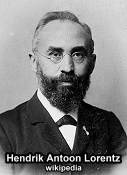
Biography of Hendrik Antoon LorentzHendrik Antoon Lorentz (1853-1928) was a Dutch physicist whose contributions to theoretical physics earned him the Nobel Prize in Physics in 1902 (shared with Pieter Zeeman). Born on July 18, 1853, in Arnhem, Netherlands, Lorentz experienced early hardship: his mother died when he was eight years old, and his father, a horticulturist, remarried soon after. Raised primarily by his uncle, the headmaster of a local school, Lorentz developed a strong foundation in mathematics and classics at the Arnhem gymnasium. He entered the University of Utrecht in 1870, studying physics and mathematics under Frederik Kaiser. In 1875, at age 22, Lorentz completed his PhD at Leiden University with a thesis titled Sur la théorie de la réflexion et de la réfraction de la lumière, focusing on optical phenomena. His academic career advanced rapidly: appointed professor extraordinarius at Leiden in 1877 and full professor in 1878, making him one of the youngest professors in Dutch history. Lorentz's research centered on electromagnetism, electron theory, and relativity precursors. He developed the Lorentz transformation equations (1895), crucial for Einstein's special relativity. Despite initial adherence to the luminiferous ether, Lorentz collaborated with emerging theorists. Politically neutral, he advised the Dutch government during World War I and later chaired the League of Nations' Intellectual Cooperation Committee. Knighted and internationally revered, Lorentz died on February 4, 1928, in Haarlem—exactly 98 years ago as of February 4, 2026. Einstein described him as "the greatest of physicists of all time." Historical Context and Discovery EventThe Lorentz force emerged amid 19th-century electromagnetic discoveries. Building on Ørsted's 1820 observation of current-magnet deflection, Ampère's force law (1827), Faraday's induction (1831), and Maxwell's equations (1865), the need for a force law on moving charges arose with cathode ray experiments and the Zeeman effect. The pivotal discovery occurred in 1892-1895 during Lorentz's investigation of the Zeeman effect, discovered by his student Pieter Zeeman in 1896 (anticipated theoretically). Zeeman observed spectral line splitting in magnetic fields, explained by Lorentz as forces on orbiting electrons in atoms. Lorentz hypothesized discrete charges ("ions") experiencing forces in combined fields. Publication followed in Lorentz's 1895 monograph Versuch einer Theorie der electrischen und optischen Erscheinungen in bewegten Körpern, where he first stated the force on a moving charge. Presented at scientific academies in Leiden and Amsterdam, it gained traction via papers in Archives Neerlandaises (1892-1895). The community embraced it post-J.J. Thomson's 1897 electron discovery, confirming e/m ratios via deflections matching Lorentz's predictions. Definition and Detailed Description of the Lorentz ForceThe Lorentz force F is the total electromagnetic force acting on a point charge q (in coulombs) moving with velocity v (m/s) in an electric field E (V/m or N/C) and magnetic field B (tesla). It decomposes into electric (FE = qE) and magnetic (FB = q (v × B)) components. Key characteristics:
F = q (E + v × B) Mathematical Formulation and DerivationThe vector form is derived from Maxwell's equations and experimental force laws. Start with the magnetic force on a current element (Biot-Savart/Ampère): for wire, dF = I dl × B. For a point charge q, current density J = ρ v where ρ is charge density. In the continuum limit, force density f = ρ E + J × B. For a single charge, ρ = q δ(r - rq), J = q v δ(r - rq), yielding F = q E + q v × B. Lorentz postulated this microscopically for electrons in 1895, confirmed empirically. Cartesian components (x, y, z): Fx = q (Ex + vy Bz
- vz By) |FB| = q v B sin θ Equation of motion: m dv/dt = q (E + v × B), where m is mass (kg). Early and Modern Engineering ApplicationsEarly Applications (1890s-1940s): Thomson's 1897 e/m measurement used magnetic deflection of cathode rays. Cyclotron (Lawrence, 1930s): perpendicular B-fields circularize ions, RF E-fields accelerate. Hall effect (1880, formalized by Lorentz): voltage VH = (I B)/(n e t) measures B or carrier density. Modern Applications:
Real-World Example ProblemsThese examples illustrate practical computations. Verify units: force in newtons (N), consistent with F = ma for dynamics. Problem 1: Electron Beam Deflection in a CRT (Cathode Ray Tube)
Solution: 1. Since v ⊥ B, sin θ = 1: 2. Centripetal force = FB: m v2/r = |q| v B Problem 2: Proton in a Cyclotron (Particle Accelerator)
Solution: 1. ω = |q| B / m = (1.60 × 10-19 × 2.0) / (1.67 ×
10-27) = 1.92 × 10⁸ rad/s 2. r = m v / (q B) = (1.67 × 10-27 × 1.0 × 107)
/ (1.60 × 10-19 × 2.0) = 5.22 × 10⁻³ m =
5.22 mm Problem 3: Force on a Loudspeaker Voice Coil Solution: For wire: F = I L B sin θ = 1.0 × 0.050 × 0.50 × 1 =
0.025 N (25 mN) |
|||||||||||||
 |
|||||||||||||
|
|||||||||||||
 Here is a layman's analysis of the Lorentz force,
a fundamental principle in electromagnetism governing the interaction of charged
particles with electric and magnetic fields. Named after Hendrik Lorentz, the force
law underpins numerous engineering systems from electric motors to particle accelerators.
The document details Lorentz's biography, the discovery context, precise definition,
mathematical derivation, equations, and both historical and contemporary applications.
All formulations employ SI units for engineering applicability.
Here is a layman's analysis of the Lorentz force,
a fundamental principle in electromagnetism governing the interaction of charged
particles with electric and magnetic fields. Named after Hendrik Lorentz, the force
law underpins numerous engineering systems from electric motors to particle accelerators.
The document details Lorentz's biography, the discovery context, precise definition,
mathematical derivation, equations, and both historical and contemporary applications.
All formulations employ SI units for engineering applicability.
|
||||||||||||||||||||||||||||||||||||