See Page 1 |
2 | of the October 2025 homepage
archives.
 This 1962 Popular Electronics magazine
article highlights a golden age for electronics servicing, an industry employing
legions of technicians skilled in the (now) arcane arts of vacuum tube circuitry
and RF alignment. It was an era before disposable electronics; complex television
and radio sets were valuable investments that demanded professional maintenance
and repair. The proliferation of these devices in American homes created a massive,
sustainable job market. Residence schools emerged to fill this critical need, offering
intensive, hands-on training. A full-time TV servicing course typically ran for
nine months... This 1962 Popular Electronics magazine
article highlights a golden age for electronics servicing, an industry employing
legions of technicians skilled in the (now) arcane arts of vacuum tube circuitry
and RF alignment. It was an era before disposable electronics; complex television
and radio sets were valuable investments that demanded professional maintenance
and repair. The proliferation of these devices in American homes created a massive,
sustainable job market. Residence schools emerged to fill this critical need, offering
intensive, hands-on training. A full-time TV servicing course typically ran for
nine months...
 Wind down the week with these four
electronics-themed comics from a 1970 issue of Radio-Electronics
magazine. As mentioned before, radio and television technology was a big deal in
the era. People hadn't been born into a world of transistorized microcircuit media
devices that perform nearly every conceivable function - phone, TV, radio, computer,
heart rate monitor, voice recorder, remote control, camera, compass, game, social
media, etc., etc., etc. Unlike today's electronics products that typically don't
break with normal use and do not require periodic alignment, folks from my demographic
were used to turning on a TV or radio and having to readjust it or have it repaired... Wind down the week with these four
electronics-themed comics from a 1970 issue of Radio-Electronics
magazine. As mentioned before, radio and television technology was a big deal in
the era. People hadn't been born into a world of transistorized microcircuit media
devices that perform nearly every conceivable function - phone, TV, radio, computer,
heart rate monitor, voice recorder, remote control, camera, compass, game, social
media, etc., etc., etc. Unlike today's electronics products that typically don't
break with normal use and do not require periodic alignment, folks from my demographic
were used to turning on a TV or radio and having to readjust it or have it repaired...
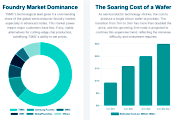 "The global semiconductor industry is undergoing
a
profound economic transformation, one anchored by Taiwan Semiconductor Manufacturing
Company (TSMC) that spells the end of an era defined by predictably declining costs
of transistors. At the center of this structural shift is TSMC's decision to implement
unprecedented price hikes for its most advanced logic chips, a move necessitated
by astronomical capital expenditures, geopolitical mandates, and the sheer, unyielding
physics of manufacturing at the angstrom scale. TSMC, the world's undisputed leader
in advanced logic..." "The global semiconductor industry is undergoing
a
profound economic transformation, one anchored by Taiwan Semiconductor Manufacturing
Company (TSMC) that spells the end of an era defined by predictably declining costs
of transistors. At the center of this structural shift is TSMC's decision to implement
unprecedented price hikes for its most advanced logic chips, a move necessitated
by astronomical capital expenditures, geopolitical mandates, and the sheer, unyielding
physics of manufacturing at the angstrom scale. TSMC, the world's undisputed leader
in advanced logic..."
 Robert Gary waxes philosophical on the subject
of ground in his Electronics World article,
"Grounds" for Confusion. He is justified from the viewpoint of
someone attempting to make sense of how something as seemingly fundamental as Earth
ground is not a constant. The layman probably doesn't care. Practitioners in the
electrical and electronics realms who deal only with low frequencies and short distances
might occasionally be affected by differences in ground potentials, although they
might not realize it is the cause of their problems. Those with more than a casual
involvement (designers, installers, and maintainers as opposed to only users) in
high frequencies and/or long distance signal interconnections are likely to be intimately
familiar with the effects of ground potential differences. RF Cafe visitors are
undoubtedly members of the latter group... Robert Gary waxes philosophical on the subject
of ground in his Electronics World article,
"Grounds" for Confusion. He is justified from the viewpoint of
someone attempting to make sense of how something as seemingly fundamental as Earth
ground is not a constant. The layman probably doesn't care. Practitioners in the
electrical and electronics realms who deal only with low frequencies and short distances
might occasionally be affected by differences in ground potentials, although they
might not realize it is the cause of their problems. Those with more than a casual
involvement (designers, installers, and maintainers as opposed to only users) in
high frequencies and/or long distance signal interconnections are likely to be intimately
familiar with the effects of ground potential differences. RF Cafe visitors are
undoubtedly members of the latter group...
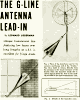 Reading this article about the
G-line antenna lead-in in a 1955 issue of Radio & Television
News magazine, I wonder whether the Broadband over Power Line (BPL) system
designers have considered its use. According to author Leonard Lieberman, the presence
of insulation over the conductor prevents or at least significantly reduces the
amount of radiated energy, thus lessening not just the signal loss but also the
unintentional interference with unrelated receiving equipment - such as the well-publicized
impact on amateur radio. The David Bogen Company, of New York City, (now in New
Jersey) marketed G-Line under under license by Surface Conduction, Inc. Current
BPL systems are typically under 100 MHz, so the scheme should be applicable.
The logistics of implementation... Reading this article about the
G-line antenna lead-in in a 1955 issue of Radio & Television
News magazine, I wonder whether the Broadband over Power Line (BPL) system
designers have considered its use. According to author Leonard Lieberman, the presence
of insulation over the conductor prevents or at least significantly reduces the
amount of radiated energy, thus lessening not just the signal loss but also the
unintentional interference with unrelated receiving equipment - such as the well-publicized
impact on amateur radio. The David Bogen Company, of New York City, (now in New
Jersey) marketed G-Line under under license by Surface Conduction, Inc. Current
BPL systems are typically under 100 MHz, so the scheme should be applicable.
The logistics of implementation...
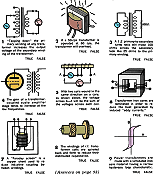 Robert Balin, Popular Electronics
magazine's master quiz maker, created this "Transformer
Quiz" for the April 1962 issue. For each of the nine challenges, a statement
is made and you determine whether it is true or false. Even though the quiz was
created half a century ago, everything in it applies to today's transformers. If
the vacuum tube shown in #4 makes you anxious, mentally replace it with a FET and
continue; you really do not need a drawing at all to decide. The explanation for
#4's answer involves the tube's plate characteristic, but from an impedance standpoint,
the fundamental characteristic of the transformer... Robert Balin, Popular Electronics
magazine's master quiz maker, created this "Transformer
Quiz" for the April 1962 issue. For each of the nine challenges, a statement
is made and you determine whether it is true or false. Even though the quiz was
created half a century ago, everything in it applies to today's transformers. If
the vacuum tube shown in #4 makes you anxious, mentally replace it with a FET and
continue; you really do not need a drawing at all to decide. The explanation for
#4's answer involves the tube's plate characteristic, but from an impedance standpoint,
the fundamental characteristic of the transformer...
 Have you ever heard of a
"globar" resistor? They have been around since the early days
of radio and were used, among other things, to protect vacuum tube heater elements
from burning up due to high inrush current when first turned on. Globars have a
negative temperature coefficient (NTC) of resistance so that, opposite of standard
carbon and metal film type resistors, they exhibit a higher resistance when cold
than when hot. Mac and Barney discuss their use in this episode of "Mac's Radio
Service Shop." You might be more familiar with the name 'thermistor' for such devices,
but globars are unique elements in that their construction from non-inductive ceramic
material makes them useful at high power levels and high frequencies... Have you ever heard of a
"globar" resistor? They have been around since the early days
of radio and were used, among other things, to protect vacuum tube heater elements
from burning up due to high inrush current when first turned on. Globars have a
negative temperature coefficient (NTC) of resistance so that, opposite of standard
carbon and metal film type resistors, they exhibit a higher resistance when cold
than when hot. Mac and Barney discuss their use in this episode of "Mac's Radio
Service Shop." You might be more familiar with the name 'thermistor' for such devices,
but globars are unique elements in that their construction from non-inductive ceramic
material makes them useful at high power levels and high frequencies...
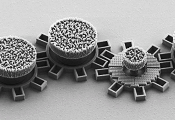 "Researchers have been trying for decades
to create smaller gears in order to construct
micro-engines, but progress stopped at 0.1 mm as it was not possible to
build the drive trains needed to make them move any smaller. Now, the team in Sweden,
along with their colleagues, has overcome this hurdle by abandoning traditional
mechanical drive trains and instead using laser light to set the gears in motion.
Their work is detailed in Nature Communications. Light-powered Gears In their study,
the researchers show that microscopic machines can be driven by optical metamaterials,
which are small, patterned structures that can capture and control light on the
nanoscale..." "Researchers have been trying for decades
to create smaller gears in order to construct
micro-engines, but progress stopped at 0.1 mm as it was not possible to
build the drive trains needed to make them move any smaller. Now, the team in Sweden,
along with their colleagues, has overcome this hurdle by abandoning traditional
mechanical drive trains and instead using laser light to set the gears in motion.
Their work is detailed in Nature Communications. Light-powered Gears In their study,
the researchers show that microscopic machines can be driven by optical metamaterials,
which are small, patterned structures that can capture and control light on the
nanoscale..."
 I challenge you to find a calculus lesson
in a modern-day electronics magazine. In 1932, not all that long after Isaac Newton
developed differential calculus (that's a joke), Radio News magazine ran
a series of "Mathematics in Radio" articles that included, among other topics,
a few lessons in calculus. Anyone who has taken college-level science or engineering
courses knows how indispensible calculus is in working out many circuit, physics,
and chemistry problems. My appreciation for calculus came when I realized that it
actually allowed me to derive the kinds of standard equations that are commonly
seen in lower level applications. For instance, if you needed to know the volume
of a sphere, you could look up the familiar Volume = 4/3 π r3
formula, or you could write the equation... I challenge you to find a calculus lesson
in a modern-day electronics magazine. In 1932, not all that long after Isaac Newton
developed differential calculus (that's a joke), Radio News magazine ran
a series of "Mathematics in Radio" articles that included, among other topics,
a few lessons in calculus. Anyone who has taken college-level science or engineering
courses knows how indispensible calculus is in working out many circuit, physics,
and chemistry problems. My appreciation for calculus came when I realized that it
actually allowed me to derive the kinds of standard equations that are commonly
seen in lower level applications. For instance, if you needed to know the volume
of a sphere, you could look up the familiar Volume = 4/3 π r3
formula, or you could write the equation...
 Since 2000, I have been creating custom
technology-themed crossword puzzles for the brain-exercising benefit
and pleasure of RF Cafe visitors who are fellow cruciverbalists. The jury is out
on whether or not this type of mental challenge helps keep your gray matter from
atrophying in old age, but it certainly helps maintain your vocabulary and cognitive
skills at all ages. A database of thousands of words has been built up over the
years and contains only clues and terms associated with engineering, science, physical,
astronomy, mathematics, chemistry, etc. You will never find a word taxing your knowledge
of a numbnut soap opera star or the name of some obscure village in the Andes mountains.
You might, however, encounter the name of a movie star like Hedy Lamarr or... Since 2000, I have been creating custom
technology-themed crossword puzzles for the brain-exercising benefit
and pleasure of RF Cafe visitors who are fellow cruciverbalists. The jury is out
on whether or not this type of mental challenge helps keep your gray matter from
atrophying in old age, but it certainly helps maintain your vocabulary and cognitive
skills at all ages. A database of thousands of words has been built up over the
years and contains only clues and terms associated with engineering, science, physical,
astronomy, mathematics, chemistry, etc. You will never find a word taxing your knowledge
of a numbnut soap opera star or the name of some obscure village in the Andes mountains.
You might, however, encounter the name of a movie star like Hedy Lamarr or...
 In this 1961 Popular Electronics
magazine story, John Frye's intrepid techno-adventurer teenagers, Carl Anderson
and Jerry Bishop, both resourceful amateur radio enthusiasts, find themselves stranded
in a severe ice storm. Quick thinking leads them to take shelter at a remote garage.
Their ingenuity is immediately tested when a medical researcher arrives with a critical
emergency: his laboratory's backup power is down, and a years-long experiment is
on the verge of ruin. The boys leap into action, deploying their
mobile ham station to call for help. They face a cascade of technical obstacles,
from an antenna frozen in a thick sheath of ice to a rapidly draining battery. With
calm precision, they diagnose and solve each problem, including guiding a plane
to airdrop replacement parts by using fusees... In this 1961 Popular Electronics
magazine story, John Frye's intrepid techno-adventurer teenagers, Carl Anderson
and Jerry Bishop, both resourceful amateur radio enthusiasts, find themselves stranded
in a severe ice storm. Quick thinking leads them to take shelter at a remote garage.
Their ingenuity is immediately tested when a medical researcher arrives with a critical
emergency: his laboratory's backup power is down, and a years-long experiment is
on the verge of ruin. The boys leap into action, deploying their
mobile ham station to call for help. They face a cascade of technical obstacles,
from an antenna frozen in a thick sheath of ice to a rapidly draining battery. With
calm precision, they diagnose and solve each problem, including guiding a plane
to airdrop replacement parts by using fusees...
 Following the previous month's introduction
to "Chemicals for Electronics," which covered degreasers, cleaners,
and polishing agents, author Lon Cantor in the May issue of Popular Electronics
wraps up with coolers, lubricants, and special agents (no, not spies) such as protective
and insulating coatings. He devotes a lot of space to freeze spray for use in troubleshooting
problems caused by overheating circuit components. In the days before comprehensive
computer aided design environments that can identify heat concentrations with detailed
temperature maps and design rules checks (DRC), predicting potential overheating
sources in both normal operation and during impending failure was much more difficult.
Running a large series of worst case scenarios... Following the previous month's introduction
to "Chemicals for Electronics," which covered degreasers, cleaners,
and polishing agents, author Lon Cantor in the May issue of Popular Electronics
wraps up with coolers, lubricants, and special agents (no, not spies) such as protective
and insulating coatings. He devotes a lot of space to freeze spray for use in troubleshooting
problems caused by overheating circuit components. In the days before comprehensive
computer aided design environments that can identify heat concentrations with detailed
temperature maps and design rules checks (DRC), predicting potential overheating
sources in both normal operation and during impending failure was much more difficult.
Running a large series of worst case scenarios...
 IEEE's Spectrum magazine posted
an article titled "11
Oddball Technology Records You Probably Didn't Know." It includes the Longest
Continuously Operating Electronic Computer. Any idea what it is/was? Answer:
Voyager 2's Computer Command
System has not been turned off since it first booted up about 48 years ago (c1977),
making it the longest continuously operating electronic computer. There is also
the Quietest Place on Earth, the Strongest Magnetic Field on Earth, the Fastest
Data Transfer, the Longest-Lasting Battery, and 11-5 others. Some of them might
not make you go, "Well, huh!," but they are interesting. IEEE's Spectrum magazine posted
an article titled "11
Oddball Technology Records You Probably Didn't Know." It includes the Longest
Continuously Operating Electronic Computer. Any idea what it is/was? Answer:
Voyager 2's Computer Command
System has not been turned off since it first booted up about 48 years ago (c1977),
making it the longest continuously operating electronic computer. There is also
the Quietest Place on Earth, the Strongest Magnetic Field on Earth, the Fastest
Data Transfer, the Longest-Lasting Battery, and 11-5 others. Some of them might
not make you go, "Well, huh!," but they are interesting.
 Popular Electronics magazine ran monthly
columns reporting on happenings in the industry. In 1961, CB radio was a big thing,
and both the
"Notes from the Editor" and "FCC Report" remarked on it. Notes from the editor,
Oliver Ferrell, forecasted a transformative 1961 in many realms. To wit: Citizens
Band radio will reach urban saturation, adopting single-sideband technology and
push-button tuning. FM tuner sales will set records. Short-wave listeners will enjoy
prime DX conditions on specific bands. In his "FCC Report," Robert Tall details
strict FCC enforcement. Licensed CB operators are barred from contacting unlicensed
stations, with the licensee bearing full responsibility. The agency is hostile to
club licensing... Popular Electronics magazine ran monthly
columns reporting on happenings in the industry. In 1961, CB radio was a big thing,
and both the
"Notes from the Editor" and "FCC Report" remarked on it. Notes from the editor,
Oliver Ferrell, forecasted a transformative 1961 in many realms. To wit: Citizens
Band radio will reach urban saturation, adopting single-sideband technology and
push-button tuning. FM tuner sales will set records. Short-wave listeners will enjoy
prime DX conditions on specific bands. In his "FCC Report," Robert Tall details
strict FCC enforcement. Licensed CB operators are barred from contacting unlicensed
stations, with the licensee bearing full responsibility. The agency is hostile to
club licensing...
 Fujipoly has developed a new high-frequency
material technology called
WaveSTRATE™. It is a substrate-less fluororesin copper-clad laminate (CCL) engineered
to deliver exceptionally low transmission loss, particularly in high-frequency ranges
such as millimeter waves. The latest product in this line, WaveSTRATE™ 26LB, incorporates
ceramic fillers into a fluoro resin polymer matrix, achieving superior electrical
performance ideal for high-frequency antenna and high-speed data transmission applications.
Its inherent flexibility also enables it to be used like a flexible printed circuit
(FPC), making WaveSTRATE... Fujipoly has developed a new high-frequency
material technology called
WaveSTRATE™. It is a substrate-less fluororesin copper-clad laminate (CCL) engineered
to deliver exceptionally low transmission loss, particularly in high-frequency ranges
such as millimeter waves. The latest product in this line, WaveSTRATE™ 26LB, incorporates
ceramic fillers into a fluoro resin polymer matrix, achieving superior electrical
performance ideal for high-frequency antenna and high-speed data transmission applications.
Its inherent flexibility also enables it to be used like a flexible printed circuit
(FPC), making WaveSTRATE...
 Note that in the obituary of sorts for
Philo Taylor Farnsworth, which appeared in the June 1971 edition
of Radio-Electronics magazine, it specifically states that he was responsible
for the development of the electronic television system, as opposed to the simple
television system. That is because the earliest television schemes were as much
- if not more - mechanical than electronic (see "Television Forges Ahead" in the
March 1930 issue of Radio News). Philo invented the "image dissector" detector
tube used in his video camera. Reconstructing the image with a cathode ray tube
is a simple matter compared to first detecting the image. After his company was
swallowed up by International Telephone and Telegraph (ITT)... Note that in the obituary of sorts for
Philo Taylor Farnsworth, which appeared in the June 1971 edition
of Radio-Electronics magazine, it specifically states that he was responsible
for the development of the electronic television system, as opposed to the simple
television system. That is because the earliest television schemes were as much
- if not more - mechanical than electronic (see "Television Forges Ahead" in the
March 1930 issue of Radio News). Philo invented the "image dissector" detector
tube used in his video camera. Reconstructing the image with a cathode ray tube
is a simple matter compared to first detecting the image. After his company was
swallowed up by International Telephone and Telegraph (ITT)...
 Dr. Frank Stuetzers 1960s
electrostatic oil filter, as presented in this 1961 issue of Popular Electronics
magazine, was an ambitious attempt to revolutionize engine maintenance. It employed
an electric field to capture metallic particles and carbon deposits from circulating
oil, theoretically allowing for dramatically extended oil change intervals - potentially
over 100,000 miles. The concept was innovative but flawed in practice. A major limitation
was its inability to handle non-conductive contaminants like sludge and water, which
still required conventional filtration. This necessity for a hybrid system added
cost, bulk, and complexity... Dr. Frank Stuetzers 1960s
electrostatic oil filter, as presented in this 1961 issue of Popular Electronics
magazine, was an ambitious attempt to revolutionize engine maintenance. It employed
an electric field to capture metallic particles and carbon deposits from circulating
oil, theoretically allowing for dramatically extended oil change intervals - potentially
over 100,000 miles. The concept was innovative but flawed in practice. A major limitation
was its inability to handle non-conductive contaminants like sludge and water, which
still required conventional filtration. This necessity for a hybrid system added
cost, bulk, and complexity...
 "Some very strange things are happening
in China! They are becoming very hostile, and sending letters to Countries throughout
the World, that they want to impose Export Controls on each and every element of
production having to do with
Rare
Earths, and virtually anything else they can think of, even if it's not manufactured
in China. Nobody has ever seen anything like this but, essentially, it would 'clog'
the Markets, and make life difficult for virtually every Country in the World, especially
for China. We have been contacted by other Countries who are extremely angry at
this great Trade hostility, which came out of nowhere. Our relationship with China
over the past six months has been a very good one, thereby making this move on Trade
an even more surprising one. I have always felt that they've been lying in wait,
and now, as usual, I have been proven right! There is no way that China should be
allowed to hold the World 'captive,' but that seems to have been their plan for
quite some time, starting with the 'Magnets' and, other Elements that they have
quietly amassed into somewhat of a Monopoly position, a rather sinister and hostile..." "Some very strange things are happening
in China! They are becoming very hostile, and sending letters to Countries throughout
the World, that they want to impose Export Controls on each and every element of
production having to do with
Rare
Earths, and virtually anything else they can think of, even if it's not manufactured
in China. Nobody has ever seen anything like this but, essentially, it would 'clog'
the Markets, and make life difficult for virtually every Country in the World, especially
for China. We have been contacted by other Countries who are extremely angry at
this great Trade hostility, which came out of nowhere. Our relationship with China
over the past six months has been a very good one, thereby making this move on Trade
an even more surprising one. I have always felt that they've been lying in wait,
and now, as usual, I have been proven right! There is no way that China should be
allowed to hold the World 'captive,' but that seems to have been their plan for
quite some time, starting with the 'Magnets' and, other Elements that they have
quietly amassed into somewhat of a Monopoly position, a rather sinister and hostile..."
 There's not much better of a way to deal
with a challenging week than reading an episode of John T. Frye's "Mac's Radio
Service Shop." Mac McGregor and his trusty sidekick technician Barney tackle nearly
every issue associated with an electronics sales and service establishment back
in the heyday of radios and televisions. You might recognize the title of "Pride and Prejudice" as being borrowed from Jane Austin's classic,
which, to summarize, deals with, well, pride and prejudice based on one's social
status, and how it results in lost opportunities. To be honest, I have not read
the book (Melanie's the designated book reader in our household) but I did see the
movie version starring Keira Knightly. Anywho, you'll need to read the second half
of the story to get to the actual pride and prejudice part... There's not much better of a way to deal
with a challenging week than reading an episode of John T. Frye's "Mac's Radio
Service Shop." Mac McGregor and his trusty sidekick technician Barney tackle nearly
every issue associated with an electronics sales and service establishment back
in the heyday of radios and televisions. You might recognize the title of "Pride and Prejudice" as being borrowed from Jane Austin's classic,
which, to summarize, deals with, well, pride and prejudice based on one's social
status, and how it results in lost opportunities. To be honest, I have not read
the book (Melanie's the designated book reader in our household) but I did see the
movie version starring Keira Knightly. Anywho, you'll need to read the second half
of the story to get to the actual pride and prejudice part...
 "The
automotive semiconductor market will grow from $68B in 2024 to $132B in 2030
- at a 10% CAGR - five times faster than the automotive market, says Yole. The top
five players control half the market, yet emerging challengers are reshaping competition.
Infineon leads globally with more than $8B in automotive revenue in 2024, followed
closely by NXP and ST. U.S. firms dominate in advanced computing, analogue and memory,
holding 36% market share. Chinese suppliers, backed by national policies, are advancing
rapidly in cockpit, ADAS and power SiC. OEMs..." "The
automotive semiconductor market will grow from $68B in 2024 to $132B in 2030
- at a 10% CAGR - five times faster than the automotive market, says Yole. The top
five players control half the market, yet emerging challengers are reshaping competition.
Infineon leads globally with more than $8B in automotive revenue in 2024, followed
closely by NXP and ST. U.S. firms dominate in advanced computing, analogue and memory,
holding 36% market share. Chinese suppliers, backed by national policies, are advancing
rapidly in cockpit, ADAS and power SiC. OEMs..."
 Parenthetically mentioned in this introductory
article on lasers is a "Mie" type particle. At first I thought maybe it was a typo,
but in fact it refers to
Mie scattering, which is the dispersion of electromagnetic waves
by isolated spheres, stratified spheres, infinite cylinders, or other geometries
where radial and angular dependence are independent. Two simple experiments are
described for demonstrating light scattering and absorption similar to what occurs
in the atmosphere. Whereas procuring the 2.5 mW laser source and to a lesser
extent suitable light meter would have been difficult and expensive in 1971 when
this was published in Radio-Electronics magazine, today's cheap equipment
puts them within the budgets of almost anyone. Many of the <$10 cat toy lasers
provide plenty of power... Parenthetically mentioned in this introductory
article on lasers is a "Mie" type particle. At first I thought maybe it was a typo,
but in fact it refers to
Mie scattering, which is the dispersion of electromagnetic waves
by isolated spheres, stratified spheres, infinite cylinders, or other geometries
where radial and angular dependence are independent. Two simple experiments are
described for demonstrating light scattering and absorption similar to what occurs
in the atmosphere. Whereas procuring the 2.5 mW laser source and to a lesser
extent suitable light meter would have been difficult and expensive in 1971 when
this was published in Radio-Electronics magazine, today's cheap equipment
puts them within the budgets of almost anyone. Many of the <$10 cat toy lasers
provide plenty of power...
 "The
everything RF team attended European Microwave Week (EuMW) 2025 in Utrecht,
where leading RF, microwave, and millimeter-wave companies unveiled their latest
innovations across test and measurement, semiconductor technologies, amplifiers,
and high-frequency systems. The 28th edition of the
European Microwave Week took place in Utrecht, Netherlands, from 21 to 26 September
2025. The event consisted of three co-located conferences: The European Microwave
Integrated Circuits Conference (EuMIC), The European Microwave Conference (EuMC),
and The European Radar Conference (EuRAD). In addition, EuMW 2025 includes the Forum
on Defence, Security and Space..." "The
everything RF team attended European Microwave Week (EuMW) 2025 in Utrecht,
where leading RF, microwave, and millimeter-wave companies unveiled their latest
innovations across test and measurement, semiconductor technologies, amplifiers,
and high-frequency systems. The 28th edition of the
European Microwave Week took place in Utrecht, Netherlands, from 21 to 26 September
2025. The event consisted of three co-located conferences: The European Microwave
Integrated Circuits Conference (EuMIC), The European Microwave Conference (EuMC),
and The European Radar Conference (EuRAD). In addition, EuMW 2025 includes the Forum
on Defence, Security and Space..."
• Qualcomm
Buys Arduino
• FCC Ends
EchoStar 5G Build Investigation
• Europe's
Semiconductor Plan
• Japan Data Center Boom to See
3x Power Demand by 2034
• Student's Guide to
College and Career in AI Age
 I learned something from this poem... or
maybe I re-learned one of the many things taught to me that have been forgotten
- the definition of a
vinculum. I admit to having to look up the word in the dictionary after seeing
it. How about you? Do you know what a vinculum is? A vinculum is a horizontal line
placed over a number or numbers to indicating repeating groups (7/11=0.63), or for negation in Boolean equations
(d=a-b+c), and it is also the dividing
line between the numerator and the denominator; e.g. (½)... I learned something from this poem... or
maybe I re-learned one of the many things taught to me that have been forgotten
- the definition of a
vinculum. I admit to having to look up the word in the dictionary after seeing
it. How about you? Do you know what a vinculum is? A vinculum is a horizontal line
placed over a number or numbers to indicating repeating groups (7/11=0.63), or for negation in Boolean equations
(d=a-b+c), and it is also the dividing
line between the numerator and the denominator; e.g. (½)...
 Most of these matches of the devices and
its inventor are pretty easy for people who have been around electronics for any
length of time (well, not if the length of time is a day or two), but a couple just
might stump you. This
Electronics Inventors Quiz appeared in a 1963 edition of Popular Electronics
magazine, so you won't be challenged with knowing the inventors of the LCD or MEMS
devices, but neither will you have to know who came up with the abacus or the Archimedes
screw (or who's buried in Grant's tomb)... Most of these matches of the devices and
its inventor are pretty easy for people who have been around electronics for any
length of time (well, not if the length of time is a day or two), but a couple just
might stump you. This
Electronics Inventors Quiz appeared in a 1963 edition of Popular Electronics
magazine, so you won't be challenged with knowing the inventors of the LCD or MEMS
devices, but neither will you have to know who came up with the abacus or the Archimedes
screw (or who's buried in Grant's tomb)...
 "As the U.S. president returns from his
U.K. state visit, he leaves behind a £150B (~€172B) pledge to
support U.K. industry. Of this, more than £30B (~€34B) comes from U.S. tech
titans Nvidia, OpenAI, Microsoft, Google, BlackRock, CoreWeave, Salesforce, ScaleAI,
and others - all lined up to plant a firm AI flag in U.K. soil. Microsoft earmarked
£22B (~€25B) to build the U.K.'s largest supercomputer as well as cloud and AI infrastructure,
its largest-ever commitment to the U.K., as Google laid out plans to open an AI
data center close to London in a £5B (~€5.7B) investment..." "As the U.S. president returns from his
U.K. state visit, he leaves behind a £150B (~€172B) pledge to
support U.K. industry. Of this, more than £30B (~€34B) comes from U.S. tech
titans Nvidia, OpenAI, Microsoft, Google, BlackRock, CoreWeave, Salesforce, ScaleAI,
and others - all lined up to plant a firm AI flag in U.K. soil. Microsoft earmarked
£22B (~€25B) to build the U.K.'s largest supercomputer as well as cloud and AI infrastructure,
its largest-ever commitment to the U.K., as Google laid out plans to open an AI
data center close to London in a £5B (~€5.7B) investment..."
 According to the Oxford English dictionary,
the definition of an anagram is: a word or phrase made by using the letters of another
word or phrase in a different order; e.g. "Neat" is an anagram of "a net." Therefore,
the title of this puzzle appears to be misnamed. Sometimes an anagram crossword
puzzle is created in which the clues are in the form of anagrams, but even that
is not the case here. With any due apologies to author Comstock, I hereby re-title
this a "High-Fidelity Crossword Puzzle." The "high-fidelity" part is entirely
appropriate since it refers to the musical nature of the clues and words. As mentioned
previously, the late 1950s through the early 1980s was a major era for interest
in high fidelity radio receivers and playback gear. It represented the transition
from powerful vacuum tube amplifiers to hybrid amplifiers, clear through to high
power transistorized amplifiers. Remember the Maxell cassette tape ad of the time
with the "Blown Away Guy" sitting in a chair in front of a speaker... According to the Oxford English dictionary,
the definition of an anagram is: a word or phrase made by using the letters of another
word or phrase in a different order; e.g. "Neat" is an anagram of "a net." Therefore,
the title of this puzzle appears to be misnamed. Sometimes an anagram crossword
puzzle is created in which the clues are in the form of anagrams, but even that
is not the case here. With any due apologies to author Comstock, I hereby re-title
this a "High-Fidelity Crossword Puzzle." The "high-fidelity" part is entirely
appropriate since it refers to the musical nature of the clues and words. As mentioned
previously, the late 1950s through the early 1980s was a major era for interest
in high fidelity radio receivers and playback gear. It represented the transition
from powerful vacuum tube amplifiers to hybrid amplifiers, clear through to high
power transistorized amplifiers. Remember the Maxell cassette tape ad of the time
with the "Blown Away Guy" sitting in a chair in front of a speaker...
 At the request of at least one person ( At the request of at least one person ( ), I added a
Statistics Calculator to RF Cafe's Espresso Engineering Workbook. That brings
the version number to 10.10.2025. There are now 45 calculators for filters, couplers,
opamps, cascade analysis, inductors, capacitors, complex numbers, component scaling,
delta-wye, Doppler shift, signal path loss, radar blind speed, volumes and surface
areas, units conversions, RLC combinations, and many commonly needed calculations.
Espresso Engineering Workbook is provided free of charge, compliments of RF Cafe
advertisers. ), I added a
Statistics Calculator to RF Cafe's Espresso Engineering Workbook. That brings
the version number to 10.10.2025. There are now 45 calculators for filters, couplers,
opamps, cascade analysis, inductors, capacitors, complex numbers, component scaling,
delta-wye, Doppler shift, signal path loss, radar blind speed, volumes and surface
areas, units conversions, RLC combinations, and many commonly needed calculations.
Espresso Engineering Workbook is provided free of charge, compliments of RF Cafe
advertisers.
 Antennas have been deployed in difficult
environments using many ingenious methods over the years both by professionals and
amateurs. The process typically involves first propelling a lightweight string or
wire across and/or up to a supporting structure (a tower, tree, building, whatever)
and then using that lead line to draw the antenna and its accompanying coaxial or
twin lead cable into its final position. Sometimes simply tying a line to a rock
and tossing it over a tree branch does the trick, but usually deployment requires
a more powerful launch such as a a bow and arrow or even a model rocket. Many years
ago R/C Modeler magazine reported on a large radio controlled airplane
(Senior Telemaster) that towed a lead line across a wide gulch... Antennas have been deployed in difficult
environments using many ingenious methods over the years both by professionals and
amateurs. The process typically involves first propelling a lightweight string or
wire across and/or up to a supporting structure (a tower, tree, building, whatever)
and then using that lead line to draw the antenna and its accompanying coaxial or
twin lead cable into its final position. Sometimes simply tying a line to a rock
and tossing it over a tree branch does the trick, but usually deployment requires
a more powerful launch such as a a bow and arrow or even a model rocket. Many years
ago R/C Modeler magazine reported on a large radio controlled airplane
(Senior Telemaster) that towed a lead line across a wide gulch...
 Assuming that a couple creative teenage
boys could get away today with
electrifying weapons to dramatize a mock sword fight during a
high school production of a Roman battle, you can be sure the suit of armor required
by safety monitors would consist not of coats of mail, but coats of rubber and fire
retardant material, fully sealing OSHA-approved goggles for eye protection, ear
plugs, and electrical lineman's gloves. Offstage would be certified fire fighting
professionals (formerly called firemen) and an emergency response crew specially
trained in high voltage electrical contact with a hospital-style emergency room
crash cart nearby... Assuming that a couple creative teenage
boys could get away today with
electrifying weapons to dramatize a mock sword fight during a
high school production of a Roman battle, you can be sure the suit of armor required
by safety monitors would consist not of coats of mail, but coats of rubber and fire
retardant material, fully sealing OSHA-approved goggles for eye protection, ear
plugs, and electrical lineman's gloves. Offstage would be certified fire fighting
professionals (formerly called firemen) and an emergency response crew specially
trained in high voltage electrical contact with a hospital-style emergency room
crash cart nearby...
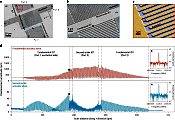 "Analog
computers, computing systems that represent data as continuous physical quantities,
such as voltage, frequency or vibrations, can be significantly more energy-efficient
than digital computers, which represent data as binary states (i.e., 0s and 1s).
However, upscaling analog computing platforms is often difficult, as their underlying
components can behave differently in larger systems. Researchers at Virginia Tech,
Oak Ridge National Laboratory and the University of Texas at Dallas have developed
a new synthetic domain approach, a technique to encode information at different
frequencies in a single device that could..." "Analog
computers, computing systems that represent data as continuous physical quantities,
such as voltage, frequency or vibrations, can be significantly more energy-efficient
than digital computers, which represent data as binary states (i.e., 0s and 1s).
However, upscaling analog computing platforms is often difficult, as their underlying
components can behave differently in larger systems. Researchers at Virginia Tech,
Oak Ridge National Laboratory and the University of Texas at Dallas have developed
a new synthetic domain approach, a technique to encode information at different
frequencies in a single device that could..."
 Since 2000, I have been creating custom
engineering-themed crossword puzzles for the brain-exercising
benefit and pleasure of RF Cafe visitors who are fellow cruciverbalists. The jury
is out on whether or not this type of mental challenge helps keep your gray matter
from atrophying in old age, but it certainly helps maintain your vocabulary and
cognitive skills at all ages. A database of thousands of words has been built up
over the years and contains only clues and terms associated with engineering, science,
physical, astronomy, mathematics, chemistry, etc. You will never find a word taxing
your knowledge of a numbnut soap opera star or the name of some obscure village
in the Andes mountains. You might, however, encounter the name of a movie star like
Hedy Lamarr or a geographical location like Tunguska, Russia, for reasons which,
if you don't already know, might surprise you... Since 2000, I have been creating custom
engineering-themed crossword puzzles for the brain-exercising
benefit and pleasure of RF Cafe visitors who are fellow cruciverbalists. The jury
is out on whether or not this type of mental challenge helps keep your gray matter
from atrophying in old age, but it certainly helps maintain your vocabulary and
cognitive skills at all ages. A database of thousands of words has been built up
over the years and contains only clues and terms associated with engineering, science,
physical, astronomy, mathematics, chemistry, etc. You will never find a word taxing
your knowledge of a numbnut soap opera star or the name of some obscure village
in the Andes mountains. You might, however, encounter the name of a movie star like
Hedy Lamarr or a geographical location like Tunguska, Russia, for reasons which,
if you don't already know, might surprise you...
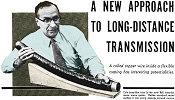 This story in the April 1955 issue of
Radio & Television News might be the first public disclosure of Bell
Telephone Laboratories'
flexible waveguide design. Operating at 50 GHz, the new waveguide
will replace hundreds of existing coaxial cables that can each carry only 600 telephone
channels and two television channels. It can also increase the distance between
amplifiers from 12 miles to 50 miles. Construction consists of a hollow flexible
tube lined with a spiral winding of copper wire. Incidentally, the lower cutoff
frequency for circular waveguide with a 2-inch diameter, as reported here, works
out to around 1.8 GHz. I was skeptical about the claim of operation... This story in the April 1955 issue of
Radio & Television News might be the first public disclosure of Bell
Telephone Laboratories'
flexible waveguide design. Operating at 50 GHz, the new waveguide
will replace hundreds of existing coaxial cables that can each carry only 600 telephone
channels and two television channels. It can also increase the distance between
amplifiers from 12 miles to 50 miles. Construction consists of a hollow flexible
tube lined with a spiral winding of copper wire. Incidentally, the lower cutoff
frequency for circular waveguide with a 2-inch diameter, as reported here, works
out to around 1.8 GHz. I was skeptical about the claim of operation...
 Werbel Microwave began as a consulting firm,
specializing in RF components design, with the ability to rapidly spin low volume
prototypes, and has quickly grown into a major designer and manufacturer with volume
production capacities. Werbel is proud to announce its model
WM4PD-2-26.5-S from Werbel Microwave is a 4-way inline power combiner / splitter
covering the continuous bandwidth of 2 to 26.5 GHz. The product features low
insertion loss, high isolation and excellent VSWR performance. Isolation and return
loss is 19 dB, insertion loss is 1.4 dB (above 4-way 6 dB split),
typical. Aluminum body with stainless steel N female connectors... Werbel Microwave began as a consulting firm,
specializing in RF components design, with the ability to rapidly spin low volume
prototypes, and has quickly grown into a major designer and manufacturer with volume
production capacities. Werbel is proud to announce its model
WM4PD-2-26.5-S from Werbel Microwave is a 4-way inline power combiner / splitter
covering the continuous bandwidth of 2 to 26.5 GHz. The product features low
insertion loss, high isolation and excellent VSWR performance. Isolation and return
loss is 19 dB, insertion loss is 1.4 dB (above 4-way 6 dB split),
typical. Aluminum body with stainless steel N female connectors...
 "Blackmailing
a Blonde" is yet another of John Frye's technodramas featuring the now-in-college
pals, Carl and Jerry. In 1954, when the series began in Popular Electronics magazine,
the boys were in high school. They shared a common interest in electronics, mechanics,
amateur radio, sleuthing, high adventure, and, of course, girls. As in Mr. Frye's
other stories (e.g., Mac's Radio Service Shop), a useful lesson in electronic equipment,
components, circuitry, troubleshooting, customer relations, etc., was woven into
the article's fabric. In this case, we are treated to a brief primer on directional
microphones (analogous to radio antennas) and the plot of a cardioid response. Jerry
even offers the simple mathematics behind... "Blackmailing
a Blonde" is yet another of John Frye's technodramas featuring the now-in-college
pals, Carl and Jerry. In 1954, when the series began in Popular Electronics magazine,
the boys were in high school. They shared a common interest in electronics, mechanics,
amateur radio, sleuthing, high adventure, and, of course, girls. As in Mr. Frye's
other stories (e.g., Mac's Radio Service Shop), a useful lesson in electronic equipment,
components, circuitry, troubleshooting, customer relations, etc., was woven into
the article's fabric. In this case, we are treated to a brief primer on directional
microphones (analogous to radio antennas) and the plot of a cardioid response. Jerry
even offers the simple mathematics behind...
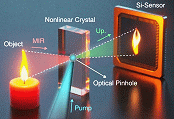 "A lens-free system produces sharp mid-infrared
images even in low light and over long distances, creating new opportunities for
improved night vision, industrial inspections, and environmental monitoring. Drawing
on the centuries-old principle of
pinhole imaging, researchers have developed a high-performance mid-infrared
imaging system that operates without lenses. This new camera is capable of producing
exceptionally sharp images across a wide range of distances and under low-light
conditions, making it suitable for environments where conventional cameras often
struggle..." "A lens-free system produces sharp mid-infrared
images even in low light and over long distances, creating new opportunities for
improved night vision, industrial inspections, and environmental monitoring. Drawing
on the centuries-old principle of
pinhole imaging, researchers have developed a high-performance mid-infrared
imaging system that operates without lenses. This new camera is capable of producing
exceptionally sharp images across a wide range of distances and under low-light
conditions, making it suitable for environments where conventional cameras often
struggle..."
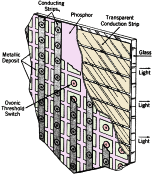 Stanford R. Ovshinsky is a name with which
most people are probably not familiar, even though some of his 400+ patented inventions
can be found in many products. The most notable is the nickel-metal hydride (NiMH)
battery. He also delved deep into phase change memory and amorphous semiconductors.
What caught my attention in this 1969 Radio-Electronics magazine article
was the claim that use of an ovonic switch matrix in conjunction with red, green
and blue (RGB) phosphor light sources could produce the world's first large screen,
flat panel video display that would not require scanning electron beams or rear
projection. History shows that the idea never came to market, probably due to a
combination of technical, financial, and manufacturability issues. Ovonics (a portmanteau
of "Ovshinsky" and "electronics") is still used in aspects of the alternative energy
industry... Stanford R. Ovshinsky is a name with which
most people are probably not familiar, even though some of his 400+ patented inventions
can be found in many products. The most notable is the nickel-metal hydride (NiMH)
battery. He also delved deep into phase change memory and amorphous semiconductors.
What caught my attention in this 1969 Radio-Electronics magazine article
was the claim that use of an ovonic switch matrix in conjunction with red, green
and blue (RGB) phosphor light sources could produce the world's first large screen,
flat panel video display that would not require scanning electron beams or rear
projection. History shows that the idea never came to market, probably due to a
combination of technical, financial, and manufacturability issues. Ovonics (a portmanteau
of "Ovshinsky" and "electronics") is still used in aspects of the alternative energy
industry...
 "Short waves," with their ability to support
long distance communications under certain conditions, became a phenomenon in the
late 1920s, and a market developed for converting commercial broadcast receivers
to
short wave receivers. Magazines at the time were full of advertisements
for the devices. The particulars of short waves and the way they propagated in the
upper atmosphere were not yet well understood early on. In fact, the government
considered transmission frequencies above 1.5 MHz (≤200 meters) so useless
that they assigned those bands to amateur radio operators. The presence of an electrically
conductive layer, known as the ionosphere, was not verified until 1927 by Edward
Appleton... "Short waves," with their ability to support
long distance communications under certain conditions, became a phenomenon in the
late 1920s, and a market developed for converting commercial broadcast receivers
to
short wave receivers. Magazines at the time were full of advertisements
for the devices. The particulars of short waves and the way they propagated in the
upper atmosphere were not yet well understood early on. In fact, the government
considered transmission frequencies above 1.5 MHz (≤200 meters) so useless
that they assigned those bands to amateur radio operators. The presence of an electrically
conductive layer, known as the ionosphere, was not verified until 1927 by Edward
Appleton...
 The April 1933 issue of the American Radio
Relay League's monthly publication QST (Q-code for "general call to all
stations") was chock full of gags, much to the delight of readers based on subsequent
letters to the editor. The editors must have felt a need to alert readers that some
of the material was not to be taken seriously since the Table of Contents lists
them as being in the "April
Fool Section." I have posted a few of them. As with so many of these vintage
articles, being privy to the customs and equipment of the era is essential to "getting"
the joke. I will refrain from spoiling these, but if you need some insight from
an old guy (61 years in August), send me a note and I'll try to put them into perspective.
One gag takes careful observation to notice, and you don't need gray hair to figure
it out... The April 1933 issue of the American Radio
Relay League's monthly publication QST (Q-code for "general call to all
stations") was chock full of gags, much to the delight of readers based on subsequent
letters to the editor. The editors must have felt a need to alert readers that some
of the material was not to be taken seriously since the Table of Contents lists
them as being in the "April
Fool Section." I have posted a few of them. As with so many of these vintage
articles, being privy to the customs and equipment of the era is essential to "getting"
the joke. I will refrain from spoiling these, but if you need some insight from
an old guy (61 years in August), send me a note and I'll try to put them into perspective.
One gag takes careful observation to notice, and you don't need gray hair to figure
it out...
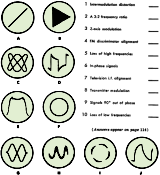 This
Oscilloscope Quiz by Popular Electronics magazine's ultimate quizmaster,
Robert Balin, appeared in the October 1961 issue. My introduction to using an oscilloscope
was while in tech school in the USAF. The instructor connected it to display Lissajous
patterns, and of course everyone was amazed - especially with the ones that moved
- because it looked like the displays we all had seen in sci-fi movies. Have not
taken any advanced math classes in high school (they came later in college), I was
not aware at the time of the functions responsible for the patterns on the screen
(sine, cosine, exponential attack and decay, etc.). Modulation of the z-axis was
especially cool as it varied the intensity... This
Oscilloscope Quiz by Popular Electronics magazine's ultimate quizmaster,
Robert Balin, appeared in the October 1961 issue. My introduction to using an oscilloscope
was while in tech school in the USAF. The instructor connected it to display Lissajous
patterns, and of course everyone was amazed - especially with the ones that moved
- because it looked like the displays we all had seen in sci-fi movies. Have not
taken any advanced math classes in high school (they came later in college), I was
not aware at the time of the functions responsible for the patterns on the screen
(sine, cosine, exponential attack and decay, etc.). Modulation of the z-axis was
especially cool as it varied the intensity...
 Before the Emergency Alert System (EAS)
was activated on January 1, 1997, which followed the August 5, 1963 activation of
the Emergency Broadcast System (EBS), there was the 1951 implementation of the CONtrol
of ELectromagnetic RADiation (CONELRAD). Born out of the Cold War era, CONELRAD was devised
in order to not just provide timely forewarning of enemy nuclear and/or bomber and/or
submarine-based attacks, but also to silence all commercial broadcasters whose transmitting
installation could potentially be exploited as homing signals for the aforementioned
bad guys. The Germans had used just such a scheme during the recently concluded
World War II to knock out Allied radio stations. CONELRAD used designated "clear
channel" installations whose super high power outputs would reach across the land
to give warning to even remote areas... Before the Emergency Alert System (EAS)
was activated on January 1, 1997, which followed the August 5, 1963 activation of
the Emergency Broadcast System (EBS), there was the 1951 implementation of the CONtrol
of ELectromagnetic RADiation (CONELRAD). Born out of the Cold War era, CONELRAD was devised
in order to not just provide timely forewarning of enemy nuclear and/or bomber and/or
submarine-based attacks, but also to silence all commercial broadcasters whose transmitting
installation could potentially be exploited as homing signals for the aforementioned
bad guys. The Germans had used just such a scheme during the recently concluded
World War II to knock out Allied radio stations. CONELRAD used designated "clear
channel" installations whose super high power outputs would reach across the land
to give warning to even remote areas...
 "Scientists at Johns Hopkins have uncovered
a new way to build microchips so small they're
nearly invisible. By combining metals and light-sensitive chemistry, they've
pioneered a method that could make chips faster, cheaper, and far more powerful.
This leap in microchip design could reshape everything from smartphones to airplanes,
opening a path to the next era of technology. Researchers at Johns Hopkins have
identified new materials and developed a new technique that could accelerate the
race to produce microchips that are smaller, faster, and more affordable. These
chips power nearly every corner of modern life, from smartphones and aircraft..." "Scientists at Johns Hopkins have uncovered
a new way to build microchips so small they're
nearly invisible. By combining metals and light-sensitive chemistry, they've
pioneered a method that could make chips faster, cheaper, and far more powerful.
This leap in microchip design could reshape everything from smartphones to airplanes,
opening a path to the next era of technology. Researchers at Johns Hopkins have
identified new materials and developed a new technique that could accelerate the
race to produce microchips that are smaller, faster, and more affordable. These
chips power nearly every corner of modern life, from smartphones and aircraft..."
 This April 1967 edition of Electronics
World magazine featured a handful of articles covering different types of
relays and circuits for controlling them: reed relays, time-delay
relays, stepping relays, mercury-wetted relays, resonant reed relays, operate and
release times, relay coil considerations, and more. Even with the advent of transistor
switching, there are still many uses in modern circuits for electromechanical relays,
so this material should prove useful. Links are provided to the other relay articles... This April 1967 edition of Electronics
World magazine featured a handful of articles covering different types of
relays and circuits for controlling them: reed relays, time-delay
relays, stepping relays, mercury-wetted relays, resonant reed relays, operate and
release times, relay coil considerations, and more. Even with the advent of transistor
switching, there are still many uses in modern circuits for electromechanical relays,
so this material should prove useful. Links are provided to the other relay articles...
 Some topics are timeless. This is one of
them. The term "Value Engineering" is not so familiar these days, since ostensibly
it was developed by General Electric back in the World War II era. Per Wikipedia,
"Value engineering (VE) is a systematic method to improve the "value" of goods or
products and services by using an examination of function. Value, as defined, is
the ratio of function to cost. Value can therefore be increased by either improving
the function or reducing the cost. It is a primary tenet of value engineering that
basic functions be preserved and not be reduced as a consequence of pursuing value
improvements ." This article from the August 1967 Electronics World was
a good read then, and it is a good read today... Some topics are timeless. This is one of
them. The term "Value Engineering" is not so familiar these days, since ostensibly
it was developed by General Electric back in the World War II era. Per Wikipedia,
"Value engineering (VE) is a systematic method to improve the "value" of goods or
products and services by using an examination of function. Value, as defined, is
the ratio of function to cost. Value can therefore be increased by either improving
the function or reducing the cost. It is a primary tenet of value engineering that
basic functions be preserved and not be reduced as a consequence of pursuing value
improvements ." This article from the August 1967 Electronics World was
a good read then, and it is a good read today...
 Crane Aerospace & Electronics' products
and services are organized into six integrated solutions: Cabin Systems, Electrical
Power Solutions, Fluid Management Solutions, Landing Systems, Microwave Solutions,
and Sensing Components & Systems. Our Microwave Solution designs and manufactures
high-performance
RF, IF and millimeter-wave components, subsystems and systems for commercial
aviation, defense, and space including linear & log amplifiers, fixed &
variable attenuators, circulators & isolators, power combiners & dividers,
couplers, mixers, switches & matrices, oscillators & synthesizers. Crane Aerospace & Electronics' products
and services are organized into six integrated solutions: Cabin Systems, Electrical
Power Solutions, Fluid Management Solutions, Landing Systems, Microwave Solutions,
and Sensing Components & Systems. Our Microwave Solution designs and manufactures
high-performance
RF, IF and millimeter-wave components, subsystems and systems for commercial
aviation, defense, and space including linear & log amplifiers, fixed &
variable attenuators, circulators & isolators, power combiners & dividers,
couplers, mixers, switches & matrices, oscillators & synthesizers.
 One of Artificial Intelligence's (AI's)
most celebrated capabilities is being its able to assimilate and analyze massive
amounts of data to extract patterns and correlations (keeping in mind that correlation
does not imply causation). In this spirit of investigation, I tasked ChatGPT, Perplexity,
Grok, and GabAI to consider publicly available information on current events in
the semiconductor industry and look for activity that might appear
scandalous in nature. Although established comprehensive databases typically
date back to 2003 or 2004, many modern AI engines can now access very recent online
news articles. Specifically, I queried, "Using your massive AI powers, can you determine
whether there are any 'undiscovered' scandals in the semiconductor manufacturing
and distribution realm that appear... One of Artificial Intelligence's (AI's)
most celebrated capabilities is being its able to assimilate and analyze massive
amounts of data to extract patterns and correlations (keeping in mind that correlation
does not imply causation). In this spirit of investigation, I tasked ChatGPT, Perplexity,
Grok, and GabAI to consider publicly available information on current events in
the semiconductor industry and look for activity that might appear
scandalous in nature. Although established comprehensive databases typically
date back to 2003 or 2004, many modern AI engines can now access very recent online
news articles. Specifically, I queried, "Using your massive AI powers, can you determine
whether there are any 'undiscovered' scandals in the semiconductor manufacturing
and distribution realm that appear...
 I wondered while reading this adventure
of Mac's Service Shop whether author John Frye held stock in the Allen Bradley (now
Rockwell) company (you'll understand why). This might be one of the earliest instances
of literary product placement in a techno-drama. That A-B resistor is part of the
"grasshopper" theme of this saga, which as always is part fiction and part tutorial.
Also discussed is the increasing level of difficulty in servicing modern electronics
as the transition from all point-to-point wiring to use of printed circuit boards
progressed. If Mac and Barney thought PCBs and leaded transistors caused headaches,
they would be having brain aneurysms with today's integrated circuits sporting ultra
fine BGA's, some with more than 500 contacts... I wondered while reading this adventure
of Mac's Service Shop whether author John Frye held stock in the Allen Bradley (now
Rockwell) company (you'll understand why). This might be one of the earliest instances
of literary product placement in a techno-drama. That A-B resistor is part of the
"grasshopper" theme of this saga, which as always is part fiction and part tutorial.
Also discussed is the increasing level of difficulty in servicing modern electronics
as the transition from all point-to-point wiring to use of printed circuit boards
progressed. If Mac and Barney thought PCBs and leaded transistors caused headaches,
they would be having brain aneurysms with today's integrated circuits sporting ultra
fine BGA's, some with more than 500 contacts...
 "The
National Aeronautics and Space Administration (NASA) is seeking volunteers to passively
track
the 2026 Artemis II Orion spacecraft as the crewed mission travels to the Moon
and back to Earth. The Artemis II test flight will send NASA astronauts Reid Wiseman,
KF5LKT; Victor Glover, KI5BKC; and Christina Koch, along with Canadian Space Agency
(CSA) astronaut Jeremy Hansen, KF5LKU, on an approximately 10-day mission around
the Moon. Targeted for no later than April 2026, the mission will rely on NASA's
Near Space Network and Deep Space Network for primary communications and tracking
support throughout its launch, orbit, and reentry. However, with a growing focus
on commercialization, NASA wants to further understand industry's tracking capabilities..." "The
National Aeronautics and Space Administration (NASA) is seeking volunteers to passively
track
the 2026 Artemis II Orion spacecraft as the crewed mission travels to the Moon
and back to Earth. The Artemis II test flight will send NASA astronauts Reid Wiseman,
KF5LKT; Victor Glover, KI5BKC; and Christina Koch, along with Canadian Space Agency
(CSA) astronaut Jeremy Hansen, KF5LKU, on an approximately 10-day mission around
the Moon. Targeted for no later than April 2026, the mission will rely on NASA's
Near Space Network and Deep Space Network for primary communications and tracking
support throughout its launch, orbit, and reentry. However, with a growing focus
on commercialization, NASA wants to further understand industry's tracking capabilities..."
 Ah, those were the good old days, when governments
used their limited
reconnaissance ability to spy on people, places, and things deemed
to be a clear and present threat to the well-being of country. In 1964, during the
height of the Cold War, collecting and interpreting communications data was still
a very human-intensive chore, so assets were necessarily allocated based on highly
strategic targets. Today, data collection collection, storage, and analysis is cheap
and is done mostly unattended by humans until a red flag goes up. The possibility
of a nuclear attack from the USSR was a very real and even likely possibility. The
strategic advantage of a first strike was immense, so it was to the world's advantage
to monitor and react as quickly as possible. The Soviet Socialists liked to propagandize
about being... Ah, those were the good old days, when governments
used their limited
reconnaissance ability to spy on people, places, and things deemed
to be a clear and present threat to the well-being of country. In 1964, during the
height of the Cold War, collecting and interpreting communications data was still
a very human-intensive chore, so assets were necessarily allocated based on highly
strategic targets. Today, data collection collection, storage, and analysis is cheap
and is done mostly unattended by humans until a red flag goes up. The possibility
of a nuclear attack from the USSR was a very real and even likely possibility. The
strategic advantage of a first strike was immense, so it was to the world's advantage
to monitor and react as quickly as possible. The Soviet Socialists liked to propagandize
about being...
• Semi
Back-End Equipment Sales Growing 6% CAGR
• ARRL
Needs Every Ham to Help Pass a Bill
• Korean
Supreme Court Rules Everlight Stole Seoul Semi's LED
• 50x
More CO₂ for a Single AI Question
• Your
Supply Chain is Longer Than You Think
 Color television was a big hit with homeowners
and was adopted fairly rapidly in the 1960s even considering the relatively high
cost and low number of network color broadcasts in the beginning years. The enthusiasm
underwent a severe reduction when word got out that large doses of
x-rays were streaming out of the front of the CRT for sets that
did not take precautions to prevent it (which was the majority of sets initially).
The major cause was extremely high voltages applied between the electron gun and
phosphorescent raster grid - in the neighborhood of 35 kV or more - when the
high voltage regulator circuit malfunctioned. Note that even when everything was
working properly, a small amount of x-ray radiation was emitted. The x-ray problem... Color television was a big hit with homeowners
and was adopted fairly rapidly in the 1960s even considering the relatively high
cost and low number of network color broadcasts in the beginning years. The enthusiasm
underwent a severe reduction when word got out that large doses of
x-rays were streaming out of the front of the CRT for sets that
did not take precautions to prevent it (which was the majority of sets initially).
The major cause was extremely high voltages applied between the electron gun and
phosphorescent raster grid - in the neighborhood of 35 kV or more - when the
high voltage regulator circuit malfunctioned. Note that even when everything was
working properly, a small amount of x-ray radiation was emitted. The x-ray problem...
 Here is an interesting article entitled
"Vibrating-Wire
Audio Filter and Oscillator," that appeared in a 1968 issue or Radio Electronics
magazine. Author John Rankin describes a very high-Q (i.e., narrow bandwidth) bandpass
filter operating in the audio frequency band that uses a length of taut wire suspended
between the poles of a horseshoe magnet. He was able to obtain bandwidths as narrow
as a couple Hertz. The useful frequency range proved to be from near 0 through about
20 kHz. Of course the experimental setup used was probably not endure in a
normal operational environment, the principle demonstrated is quite interesting.
It might be considered a mechanical analog to something like a microwave-frequency
magnetron whose resonant... Here is an interesting article entitled
"Vibrating-Wire
Audio Filter and Oscillator," that appeared in a 1968 issue or Radio Electronics
magazine. Author John Rankin describes a very high-Q (i.e., narrow bandwidth) bandpass
filter operating in the audio frequency band that uses a length of taut wire suspended
between the poles of a horseshoe magnet. He was able to obtain bandwidths as narrow
as a couple Hertz. The useful frequency range proved to be from near 0 through about
20 kHz. Of course the experimental setup used was probably not endure in a
normal operational environment, the principle demonstrated is quite interesting.
It might be considered a mechanical analog to something like a microwave-frequency
magnetron whose resonant...
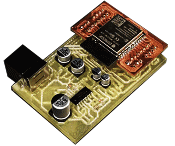 "Researchers at the University of Maryland
have reportedly made a breakthrough in the production of environmentally friendly
electronic boards and products. According to an article recently posted to the website
of New Scientist, the researchers designed
3-D printable circuit boards using polyvinyl alcohol, a polymer substance that
can dissolve in water. They then formed wiring through the use of a liquid form
of a gallium-indium metal alloy and sealed the board circuits with polymer glue.
The entire board was then dried for an hour at 60°C. The finished boards were then
assembled into simple versions of a Bluetooth speaker and an electronic three-finger
gripper..." "Researchers at the University of Maryland
have reportedly made a breakthrough in the production of environmentally friendly
electronic boards and products. According to an article recently posted to the website
of New Scientist, the researchers designed
3-D printable circuit boards using polyvinyl alcohol, a polymer substance that
can dissolve in water. They then formed wiring through the use of a liquid form
of a gallium-indium metal alloy and sealed the board circuits with polymer glue.
The entire board was then dried for an hour at 60°C. The finished boards were then
assembled into simple versions of a Bluetooth speaker and an electronic three-finger
gripper..."
 I found this
Bridge Circuit Quiz in my stack of vintage Popular Electronics
magazines. Your challenge here is to decide what the main function of each type
of bridge circuit is. Most bridge circuits are designed such that a component of
unknown value is inserted into one of its four branches, and then one or more variable
components of known values are adjusted to balance the bridge and thereby create
a minimum (null) between opposite (circuit-wise) nodes. Admittedly, I did not fare
well, but it is because I do not recall having the names associated with many of
these bridge circuits. Of course nearly everyone is familiar with the Wheatstone,
Kelvin, and Wien bridges. Hyperlinks are provided... I found this
Bridge Circuit Quiz in my stack of vintage Popular Electronics
magazines. Your challenge here is to decide what the main function of each type
of bridge circuit is. Most bridge circuits are designed such that a component of
unknown value is inserted into one of its four branches, and then one or more variable
components of known values are adjusted to balance the bridge and thereby create
a minimum (null) between opposite (circuit-wise) nodes. Admittedly, I did not fare
well, but it is because I do not recall having the names associated with many of
these bridge circuits. Of course nearly everyone is familiar with the Wheatstone,
Kelvin, and Wien bridges. Hyperlinks are provided...
 John T. Frye first created his high-tech
Carl and Jerry saga series, a duo of teenage sleuths, in
1954, for the premier issue of Popular Electronics magazine. More than
100 adventures carried Carl and Jerry from high school through college. Their practical
jokes, crime solving, and mystery investigations incorporated microphones, timers,
cameras, Ham radio, transformers, metal detectors, remote controllers, home brew
circuits, photodetectors, and a host of other gadgets that could be pulled from
a stash of parts in Carl's or Jerry's basement workshop, or borrowed from a friend.
In this story, Carl and Jerry, now students at Parvoo University in Indiana, have
an unexpected confrontation with a radio operator while exploring a campus... John T. Frye first created his high-tech
Carl and Jerry saga series, a duo of teenage sleuths, in
1954, for the premier issue of Popular Electronics magazine. More than
100 adventures carried Carl and Jerry from high school through college. Their practical
jokes, crime solving, and mystery investigations incorporated microphones, timers,
cameras, Ham radio, transformers, metal detectors, remote controllers, home brew
circuits, photodetectors, and a host of other gadgets that could be pulled from
a stash of parts in Carl's or Jerry's basement workshop, or borrowed from a friend.
In this story, Carl and Jerry, now students at Parvoo University in Indiana, have
an unexpected confrontation with a radio operator while exploring a campus...
 Here is the promised follow-up on yesterday's
article, "TV X-Rays Are Back," from June 1969 issue of Radio-Electronics.
This
x-ray emission issue, whether legitimately a serious health problem
or not, was a big deal and was hyped up by the news media the way cellphones causing
brain cancer and laptop computers sterilizing men is done today. For a while it
measurably affected the volume of color television sales. X-rays are a form of ionizing
radiation (unlike microwaves which are not) and can thereby cause cancer by rearranging
atoms and molecules. At the root of the problem was the extremely high acceleration
voltage (HV) and beam current being used in the cathode ray tube (CRT). Potentials
in excess of 25 kV generated the most harmful level of x-rays, so manufacturers
redesigned sets to use lower voltages, and also incorporated... Here is the promised follow-up on yesterday's
article, "TV X-Rays Are Back," from June 1969 issue of Radio-Electronics.
This
x-ray emission issue, whether legitimately a serious health problem
or not, was a big deal and was hyped up by the news media the way cellphones causing
brain cancer and laptop computers sterilizing men is done today. For a while it
measurably affected the volume of color television sales. X-rays are a form of ionizing
radiation (unlike microwaves which are not) and can thereby cause cancer by rearranging
atoms and molecules. At the root of the problem was the extremely high acceleration
voltage (HV) and beam current being used in the cathode ray tube (CRT). Potentials
in excess of 25 kV generated the most harmful level of x-rays, so manufacturers
redesigned sets to use lower voltages, and also incorporated...
 This 1959 Popular Electronics magazine
article reveals the pioneering spirit of
early space electronics, focusing on the X-15 rocket plane's inertial navigation
system. The technology - using gyroscopes, accelerometers, and stable platforms
- was revolutionary for its time, enabling precision guidance without external reference.
The article highlights innovations like wrist controls for high-G maneuvers (avoids
moving heavy arms and legs) and radar tracking networks, emphasizing the blend of
human judgment and mechanical reliability. Since then, technology has advanced spectacularly.
Inertial navigation has evolved into compact, hyper-accurate systems using ring
laser gyros and fiber optics... This 1959 Popular Electronics magazine
article reveals the pioneering spirit of
early space electronics, focusing on the X-15 rocket plane's inertial navigation
system. The technology - using gyroscopes, accelerometers, and stable platforms
- was revolutionary for its time, enabling precision guidance without external reference.
The article highlights innovations like wrist controls for high-G maneuvers (avoids
moving heavy arms and legs) and radar tracking networks, emphasizing the blend of
human judgment and mechanical reliability. Since then, technology has advanced spectacularly.
Inertial navigation has evolved into compact, hyper-accurate systems using ring
laser gyros and fiber optics...
 "Crack
these [5] puzzles and prove you're not just another language model. The ARC Prize
test is a deceptively simple challenge designed to measure a machine's ability to
reason, abstract, and generalize - core ingredients of artificial general intelligence
(AGI). It's the most prominent benchmark to emerge as researchers look for ways
to measure progress toward AGI. For the full story, see the feature article 'Will
We Know Artificial General Intelligence When We See It?' While today's smartest
AI models still struggle with many of these visual puzzles, humans often solve them..." "Crack
these [5] puzzles and prove you're not just another language model. The ARC Prize
test is a deceptively simple challenge designed to measure a machine's ability to
reason, abstract, and generalize - core ingredients of artificial general intelligence
(AGI). It's the most prominent benchmark to emerge as researchers look for ways
to measure progress toward AGI. For the full story, see the feature article 'Will
We Know Artificial General Intelligence When We See It?' While today's smartest
AI models still struggle with many of these visual puzzles, humans often solve them..."
 Last week I posted Part 2 of this "Know Your Electronic Chemicals" series which appeared in two 1960
issues of Electronics World. Fortunately, I was able to obtain the previous
edition with Part 1 (the vintage magazines I buy typically sell for $2-$3 apiece
on eBay). Many, if not most, of the chemicals presented in the articles are not
used anymore, but similar types are. Interestingly but typically, almost no emphasis
is placed on the use of protective clothing, goggles, gloves, gas masks, etc. A
lot of people were harmed unnecessarily due to not taking basic precautions, but
it just was not part of normal operating procedure. To be honest, even though I
know better, other than... Last week I posted Part 2 of this "Know Your Electronic Chemicals" series which appeared in two 1960
issues of Electronics World. Fortunately, I was able to obtain the previous
edition with Part 1 (the vintage magazines I buy typically sell for $2-$3 apiece
on eBay). Many, if not most, of the chemicals presented in the articles are not
used anymore, but similar types are. Interestingly but typically, almost no emphasis
is placed on the use of protective clothing, goggles, gloves, gas masks, etc. A
lot of people were harmed unnecessarily due to not taking basic precautions, but
it just was not part of normal operating procedure. To be honest, even though I
know better, other than...
 LadyBug Technologies, one of the world's
leading designers and manufacturers of RF power sensors, has published a white paper
titled "Characteristics
of Thermocouple Power Monitors," which extols the many virtues of using a thermocouple
for sensing and reporting RF power levels. Unlike diode type detectors, which rely
on accurate calibration over multiple temperatures to properly compensate for an
inverse-square law response, the thermocouple relies on a relatively simple temperature
level measurement that is not as affected by ambient temperature. That is not to
say, of course, that diode-based RF power measurement does not have its preferred
applications. The paper spells out the details. LadyBug Technologies, one of the world's
leading designers and manufacturers of RF power sensors, has published a white paper
titled "Characteristics
of Thermocouple Power Monitors," which extols the many virtues of using a thermocouple
for sensing and reporting RF power levels. Unlike diode type detectors, which rely
on accurate calibration over multiple temperatures to properly compensate for an
inverse-square law response, the thermocouple relies on a relatively simple temperature
level measurement that is not as affected by ambient temperature. That is not to
say, of course, that diode-based RF power measurement does not have its preferred
applications. The paper spells out the details.
 The
reflected-beam kinescope (RBK) held high hopes for large video
displays with shallow depths. A traditional cathode ray tube (CRT) is as deep from
front to back as the width of the display, which means, as anyone who has owned
a CRT television or computer monitor knows, a lot of space is required to accommodate
a large display. Evidently the RBK never panned out as a manufacturable product.
Its "inside-out" configuration resulted in a CRT that looks like someone reached
through the front, grabbed the tail end, and pulled it back through the front. In
other 1960 news was a high voltage ferroelectric converter... The
reflected-beam kinescope (RBK) held high hopes for large video
displays with shallow depths. A traditional cathode ray tube (CRT) is as deep from
front to back as the width of the display, which means, as anyone who has owned
a CRT television or computer monitor knows, a lot of space is required to accommodate
a large display. Evidently the RBK never panned out as a manufacturable product.
Its "inside-out" configuration resulted in a CRT that looks like someone reached
through the front, grabbed the tail end, and pulled it back through the front. In
other 1960 news was a high voltage ferroelectric converter...
These archive pages are provided in order to make it easier for you to find items
that you remember seeing on the RF Cafe homepage. Of course probably the easiest
way to find anything on the website is to use the "Search
RF Cafe" box at the top of every page. Some quoted items have been shortened
to save space. About RF Cafe.
Homepage Archive Pages
2026:
Jan |
Feb |
Mar |
Apr |
May |
Jun |
Jul |
Aug | Sep | Oct | Nov | Dec
2025:
Jan |
Feb |
Mar |
Apr |
May |
Jun |
Jul |
Aug |
Sep |
Oct |
Nov |
Dec
2024:
Jan |
Feb |
Mar |
Apr |
May |
Jun |
Jul |
Aug |
Sep |
Oct |
Nov |
Dec
2023:
Jan |
Feb |
Mar |
Apr |
May |
Jun |
Jul |
Aug |
Sep |
Oct |
Nov |
Dec
2022:
Jan |
Feb |
Mar |
Apr |
May |
Jun |
Jul |
Aug |
Sep |
Oct |
Nov |
Dec
2021:
Jan |
Feb |
Mar |
Apr |
May |
Jun |
Jul |
Aug |
Sep |
Oct |
Nov |
Dec
2020:
Jan |
Feb |
Mar |
Apr |
May |
Jun |
Jul |
Aug |
Sep |
Oct |
Nov |
Dec
2019:
Jan |
Feb |
Mar |
Apr |
May |
Jun |
Jul |
Aug |
Sep |
Oct |
Nov |
Dec
2018:
Jan |
Feb |
Mar |
Apr |
May |
Jun |
Jul |
Aug |
Sep |
Oct |
Nov |
Dec
2017:
Jan | Feb |
Mar |
Apr |
May |
Jun |
Jul |
Aug |
Sep |
Oct |
Nov |
Dec
2016:
Jan | Feb |
Mar |
Apr |
May |
Jun |
Jul |
Aug |
Sep |
Oct |
Nov |
Dec
2015:
Jan | Feb |
Mar |
Apr |
May |
Jun |
Jul |
Aug | Sep |
Oct |
Nov |
Dec
2014:
Jan | Feb |
Mar |
Apr |
May |
Jun |
Jul |
Aug |
Sep |
Oct |
Nov |
Dec
2013:
Jan | Feb |
Mar |
Apr |
May |
Jun |
Jul |
Aug |
Sep |
Oct |
Nov |
Dec
2012: 1 |
2 | 3
| 4 | 5
| 6 | 7
| 8 | 9
| 10 | 11
| 12 | 13
(no archives before 2012)
- Christmas-themed
items
|