|
|||||||||||||
 |
|||||||||||||
Carl & Jerry: The Tele-Tattletale
|
|||||||||||||
Teenage technophiles Carl Anderson and Jerry Bishop were up to their old tricks again in this "The Tele-Tattletale" episode of John Frye's monthly adventure in Popular Electronics magazine. The boys were bitten by the Space Race bug that was in full swing at the time (1958). Jerry cleverly built himself a telemetering device to mimic some of the functions being employed on missiles and, soon to be, manned spacecraft (1961). His setup involved a lot of different technologies and homemade electromechanical sensors and electronic paraphernalia - all stuff that can be bought for peanuts on Amazon for use with Arduino configurations. At first I thought maybe Mr. Frye had slipped in his writing, because in the beginning Jerry had the remote sensor unit inside a metal freezer to calibrate and test it, then later they monitored its output using a radio set (both boys were licensed Hams). Then, I realized it was I who slipped whilst reading. As usual, the technodrama included a lot of useful scientific and engineering information in explaining how the system functioned. Carl & Jerry: The Tele-Tattletale
The cool interior of the basement laboratory was empty as Carl stepped in out of the June heat, but he noticed that the door leading into the other part of the basement was open, and he heard the voice of his chum, Jerry, calling: "Come on in here, Carl." Jerry was kneeling on the floor in front of the deep-freeze. A couple of tiny wires coming from beneath the lid of the unit were connected to a pair of earphones lying on the floor. Another pair of phones led to a variable-frequency audio oscillator, and Jerry was adjusting this instrument until the tones from the two sets of phones were of the same frequency. When he was satisfied that the frequencies were zero beat with each other, he carefully noted the reading of the oscillator dial in a notebook. Carl said nothing, but his eyebrows arched above the horn rims of his glasses were shouting questions. "I'm calibrating the temperature-reporting unit of our Tele-Tattletale," Jerry explained, with a teasing grin on his round face. "Oh, fine! I didn't know we had one!" ejaculated Carl.
. . . "I'm calibrating the temperature-reporting unit of our Tele-Tattletale," Jerry explained, with a teasing grin on his round face . . .
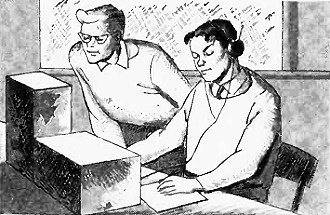
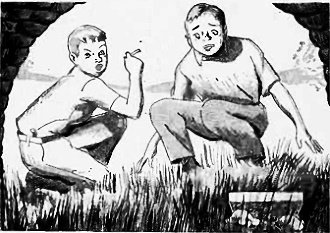
. . . Jerry reset the dial of the oscillator each time one of the brief notes was heard . . . "Certainly we have," Jerry replied, opening the lid of the deep-freeze and lifting out a small wooden box with flat sides and rounded ends. The sides had large numbers painted on them, and one end was painted blue while the other was red. "This it is. I've been reading a lot about telemetering - or measuring at a distance - in connection with the satellites," he explained as he gathered up the equipment and started back into the laboratory; "so I decided we ought to get a little experience with that sort of thing-even though we have to do it in a pretty crude way. "This little box," he continued, "can be placed anywhere so that its small, self-contained transmitter is within range of that transceiver on the bench. We can determine four things by listening to the signals from the Tele-Tattletale: (1) the temperature of the interior of the box; (2) the amount of light falling on both the red and blue ends; (3) if it is resting on side 1, 2, 3, or 4; and (4), what sounds are to be heard in its vicinity." "Interesting, if true," Carl said doubtfully. "It's true and really rather simple," Jerry insisted, as he removed some screws and took off one side of the box. "I use the spiral hi-metal unit out of an advertising thermometer to turn this easily working variable resistor. The resistor determines the frequency of a transistorized oscillator. I've calibrated the oscillator's frequency as a function of the surrounding temperature; so I know from the note it puts out how warm the box is. Photocells are mounted behind the openings in each end of the box. The resistance of each cell depends on the amount of light falling on it, and the cells are connected in twin oscillator circuits so that their varying resistances separately control the frequencies of the oscillators. By noting the frequencies of these oscillators, I can tell how much light is falling on either end of the box." "You said you could tell on which side the box was resting. How do you do that?" "That's easiest of all. I just fastened a sort of pendulum rod with a ball of lead on the end to the shaft of a variable resistor that can turn around and around. The weight always hangs down; so there is a different amount of frequency-determining resistance placed in still another oscillator circuit for every position of the box. And this little speaker here is used as a microphone driving a simple amplifier as the modulator so that the carrier of the transmitter is modulated by any sounds near the Tele-Tattletale." "Surely you don't use a different transmitter on a different frequency for each of these information-reporting units." "Oh, no; that would be wasteful and unscientific. There's just one transmitter whose output is modulated in sequence by each of the information sources.. I use a tiny electric motor with a gear train to drive a cam at a speed of one revolution per minute. Here's the cam right here. As it goes around, it closes in order these five microswitches, each for a preset length of time. As switch #1 is closed, the temperature-indicating oscillator modulates the transmitter; switches #2 and #3 feed the light-indicating oscillators to the transmitter; #4 samples the position-indicating oscillator; and #5 connects the microphone. Each of the oscillators is on for five seconds out of every minute, with two-second separations between them; then the mike is on for thirty seconds before the whole thing starts over." "She's a gabby little thing, but it's going to be a one-sided conversation," Carl observed with a grin. "Not necessarily," Jerry remarked, pushing the transmit button on the transceiver. "How are you, Carl?" he asked with his lips close to the microphone, and his voice issued clearly from the speaker in the box. "The carrier from this transceiver operates a remote-control relay that connects the speaker-mike to the tail-end of the amplifier and feeds the output of the superregenerative receiver into the amplifier input. Since the two transmitters work on quite different frequencies, we can do this. Later, I intend to work it so that the Tele-Tattletale is silent until I command it to speak with a carrier from the transceiver." "So what are going to do with the blabbermouth now?" "Test it. I want you to take that box anywhere within a radius of three-quarters of a mile, leave it, and then come back here. We'll listen to the signals from it, and I'll try to tell you all I can about the surroundings in which you left the box. You can check me and see how close I come. Before you start back, just twist these two wires together; and that will start the Tele-Tattletale to talking." Carl clicked his heels together and gave an exaggerated salute. "Start the countdown," he said, tucking the box under his arm and heading for the stairs. "As soon as I get my bicycle, T-T and I are going into orbit!" Jerry busied himself cleaning up the littered workbench, and he had just finished When the little speaker of the transceiver began to emit a regular series of musical notes of different pitches. Jerry spread out on the bench some graphs of the calibration of the different oscillators, and he ran a couple of leads from the transceiver speaker to the vertical input terminals of his scope. Then he connected the variable-frequency audio oscillator to the horizontal input terminals. As this was completed, Carl came clattering down the steps and burst into, the laboratory, wiping the perspiration from his red face. When he heard the beeping from the receiver, he relaxed with a pleased grin. "Okay," he challenged; "what do you hear from outer space?" Jerry was busy resetting the dial of the oscillator each time one of the brief notes was heard, so that the trace on the face of the scope settled down to what looked like a crudely drawn circle. With his left hand, he wrote down the dial settings of the oscillator. "When the oscillator frequency is exactly the same as that coming over the receiver, the 1 to 1 ratio between the frequencies produces the circular or elliptical pattern, just like it said in that article on Lissajous figures in the March, 1957, Popular Electronics," he pointed out. "Now let's look at the graphs and see what we have. Hm-m-m-m, the temperature is about 86° for a tone of 470 cycles; so the box must be in the shade. The red end is 'seeing' light of around 200 foot-candles per square foot, and that is what a light meter shows looking to the north in open shade; but the blue end only reads about 25 foot-candles. The box must be lying with one end out in the open and the other end back in some sort of enclosure." Jerry paused in puzzled fashion for a moment and then demanded: "You dog, did you prop that box up edge?" Carl chuckled an admission. "I used a couple of rocks to do it." "Okay, but you have it lying on the edge separating sides #1 and #4. The tone is just halfway between the ones it would have if the box were lying on either of these sides. Be quiet now and let's see if we can hear any sounds picked up by the mike." As the sequence of tones ceased, the steady hiss of the carrier was modulated by some faint tinkling sounds. Jerry listened carefully for the full thirty seconds and then exclaimed: "That's rippling water! Let's see; the box is in the shade, near water, and it's half in and half out of some sort of enclosure. I've got it. I'll bet you parked the Tele-Tattletale at the mouth of the culvert where the highway crosses Tick Creek!" "You're just too good," Carl said, in pretended disgust. "That's exactly where it is. I hid it in a clump of grass growing at the north end of the culvert---" He was interrupted by the sudden sound of boyish voices echoing hollowly and coming from the speaker of the transceiver: "This is a dandy place," one voice was saying. "No one can see us here. You got the fags? Here are the matches." "Sure, I sneaked them out last night."
. . . "Someone always knows when you try something as foolish as you boys are doing now" . . . The conversation was cut off as the Tele-Tattletale started reporting on the temperature, etc. "I'll bet anything that's the pair of little kids I met as I started back," Carl declared. "They were acting kind of sneaky." The mike cut in again. ". . . green onions are to take the cigarette smell off our breath," a boyish voice said. "My old man uses an electric razor, but he's still got a razor strop, you know." "He'll never know about this," the other voice replied. "Come on; give me a light." As the mike cut off again, Carl suddenly reached for the transceiver. With a smile crinkling the corners of his blue eyes, he pitched his voice as low as he could and spoke in sepulchral tones directly into the mike of the transceiver: "That is what you think. Someone always knows when you try something as foolish as you boys are doing now." That was all he said. The transceiver was switched back to the receive position. The Tele-Tattletale turned on the microphone, but at first not a sound could be heard except the rippling of the stream; then, suddenly, just before the mike cut off, there was a scrambling, scuffling sound followed by rapidly retreating footsteps. "Come on," Carl said, heading for the door. "We'd better go rescue that precious little electronic snitcher before someone finds it. I don't want to lose that thing. It's got too many possibilities." The culvert was less than a half-mile away, and Carl and Jerry were there on their bicycles in no time at all. The Tele-Tattletale was still purring quietly away where Carl had hidden it in the tall grass. The boys walked along the narrow bank near the huge culvert; and soon they found four freshly pulled green onions, several wooden matches, and the contents of a broken package of cigarettes strewn over the narrow walkway. "I'll bet we really made believers out of those two," Carl said with a chuckle as he kicked the cigarettes into the stream with the toe of his shoe and carefully picked up the matches. "As long as they live, those little boys will probably always feel that somebody - or something - is watching every bad move they make." "I guess somebody or something really is," Jerry said thoughtfully, looking down at the little box he held in his hands. "You can call it 'conscience' or 'electronic Tele-Tattletale' or whatever you like, but it adds up to the same thing. Someone knows.
Posted September 27, 2019 |
|||||||||||||
 |
|||||||||||||
|
|||||||||||||

 By John T. Frye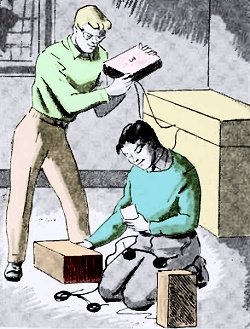



|
||||||||||||||||||||||||||||||||||||