|
|||||||||||||
 |
|||||||||||||
Carl and Jerry: Togetherness
|
|||||||||||||
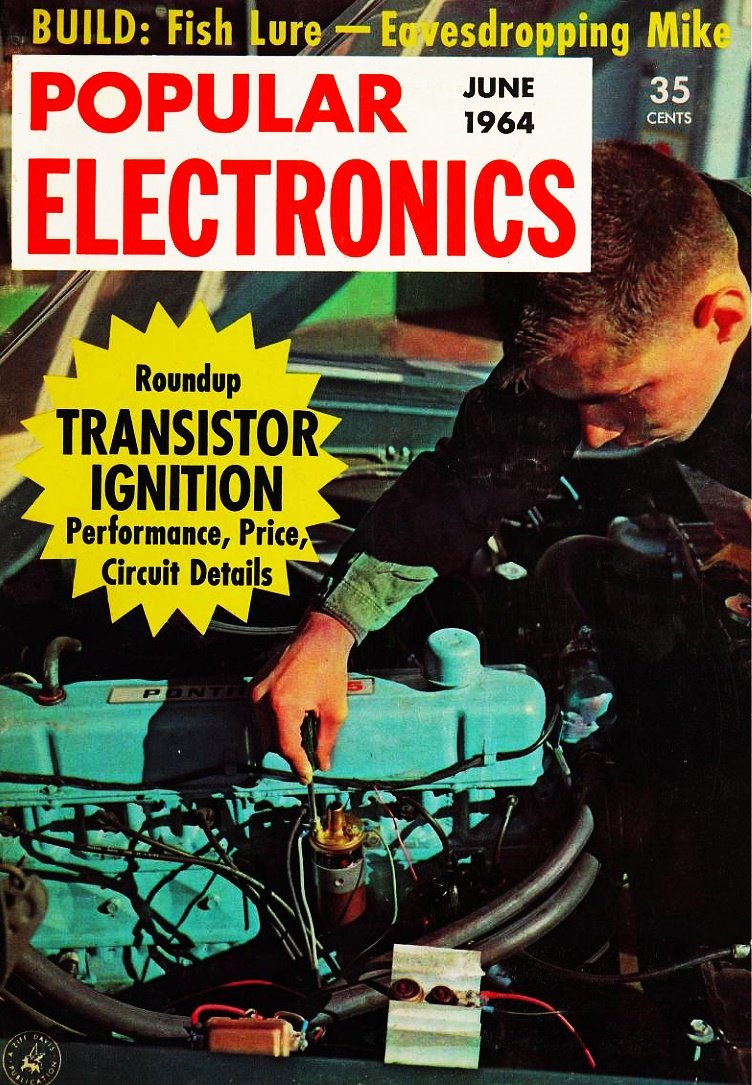
Carl and Jerry stories have always had a mixture of entertainment and technical content, with the emphasis on entertainment. This "Togetherness" technodrama was loaded with intrigue and technical content. The boys, now in college, mustered up their radio experience to assist themselves and their neighbors during a severe rain downpour event that caused major flooding along the local river. It purposed also to lower the social barrier between "Chicken-Band Radio;" i.e., "CB Radio" operators and "real" amateur radio operators by melding the two groups - whose operators often engaged in both forms of communications - into a synergistic force. As time went on, John Frye's artistic style progressed from rather cartoonish look (beginning in 1954 Popular Electronics magazine) to a more realistic genre as apparent in this 1964 issue. I colorized the Mr. Frye's drawing for you. BTW, CB radio required a radio operator's license back then. I had to get one one for my first CB radio in 1975, and also to operate my 27 MHz band model airplane radio control system. Note the mention of mercury batteries (1.35 V nominal) in the handheld CB radio. Mercury batteries have excellent energy storage density, hold up well over temperature extremes, and have a flat discharge curve. I still have a Heathkit multimeter that takes a mercury battery (which of course I don't have). Manufacturing was largely discontinued following the Mercury-Containing and Rechargeable Battery Management Act of 1996. A comprehensive list of all the Carl & Jerry episodes is posted on RF Cafe is at the bottom of the page. Carl & Jerry: Togetherness
School was out for the summer, and Carl and Jerry were hurrying home from Parvoo University through a torrential downpour. It had been raining heavily for almost a week, and the previous night a series of terrific thunderstorms accompanied by tornado-like winds had marched across the state leaving heavy damage in their wake. Unable to call home because the telephone lines were out, the boys were understandably worried about their parents. "Wonder if we'll be able to get across the river," Jerry muttered, gripping the steering wheel and peering through the rain-drenched windshield. "I've seen the old Wabash flood with less rain than this, and the low approaches to the bridges are covered even before the water gets into town. Well, we'll soon know. We've just got about four miles to go." "We'll know sooner than you think," Carl said. "Pull over on the side at the top of that next knoll and cut the motor." While talking, he opened the glove compartment and lifted out a device enclosed in a hand-sized two-toned gray plastic case. From one end he stretched out a telescoping antenna. "What's that?" Jerry demanded, eyeing the object suspiciously as he pulled off the road. "You're probably going to have a fit, but it's a Cadre Model C-75 hand-held CB transceiver," Carl said in a small voice. Jerry recoiled as though Carl had pulled a live cobra from its basket. "I never thought I'd see the day when you, a self-respecting ham, would touch chicken-band equipment," he said bitterly. "You don't have a license to use that thing - I hope." "But I have," Carl confessed. "You see, when the folks and I go up north fishing, we need something to enable those out in the boat to keep in touch with camp. Since Dad and Mom can't - or won't - get ham licenses, CB seemed like a good idea. I got the license, and Dad bought the equipment. We have a five-watt unit that can operate either in the car or from house current and this little transistorized gem. Right now the 'big job' is set up at home on a ground plane antenna. I brought this little thing along to school to show it to you, but I never got up enough nerve to do it." "You'd probably do a better job of getting out with a megaphone than with that toy," Jerry sneered. "That's what you think !" Carl retorted. "Don't get the idea that this eleven-transistor-and-two-diode unit is the same as those little hundred-milliwatt jobs or like the typical home-brew ham transceiver. The plug-in modular boards inside this case give you a very sophisticated little rig. An r.f. stage and two i.f. stages with a ceramic filter account for the receiver's sensitivity and selectivity. Only one microvolt of signal will produce ten db or better signal-to-noise ratio and a full half-watt of power from the speaker. The receiver has variable volume control, a.g.c., adjustable squelch, and an automatic noise limiter." "How about transmitter output?" Jerry asked, sounding intrigued in spite of himself. "The transmitter input is a watt and a half, and the output to the antenna is about nine-tenths of a watt. That's only about six db, or one S-unit less than a Class D CB transmitter puts out. It has speech clipping and TVI suppression. There are jacks for external speaker, antenna, and microphone. Right now the transceiver is being powered by nine mercury penlight cells which are supposed to give about fifty hours of service, but ordinary penlight cells or two miniature six-volt rechargeable nickel cadmium batteries can be used instead. I can select either of two crystal-controlled transmit and receive channels." "Sounds like an awful lot in such a small case," Jerry said doubtingly. "Is Cadre the only outfit producing high-powered hand-held transceivers?" "Not at all. Heath, Allied Radio, E. F. Johnson, Telcon, and Lafayette Radio produce transceivers with at least one watt input. Each type has different features. The beauty of all of these jobs is that they will work in a car or boat, on foot, on horseback, or as a base station at home. Well, let's give it a try." Carl rolled down his window, which fortunately was on the downwind side, and thrust the short whip antenna outside. When he turned up the volume control with his thumb, only a faint rushing sound could be heard. Jerry smiled mockingly. Carl's strong fingers tightened around the case, pushing in the push-to-talk lever on the left side. He spoke in a normal voice directly into the speaker louvre in the upper part of the case: "KHD4167 base, this is mobile Unit 1 calling." Even as his fingers relaxed, the voice of his mother could be heard coming clearly and with surprising volume from the speaker: "Ten-two, Carl. This is KHD4167 base. Let's move off calling channel eight to channel eleven." Carl flipped a little slide switch on top of the transceiver, and there was his mother's voice asking: "What's your ten-twenty, Carl ?" "We're on highway twenty-five about a mile west of the state hospital." "Ten-four. The only way you can get home is to cross on the new bypass bridge west of town and circle around and come in from the north. The town is in bad shape, but we're fine and so are Jerry's folks. The storm knocked out almost everybody's telephones, and many houses have no power. We still have both, thank goodness. The river is already flooding many parts of the town and is rising fast. The CD director wants you boys to put your ham station on the air just as quickly as you can. I'll stay here on channel eleven instead of returning to eight until you get home. Ten-four ?" "Ten-four, Mom. KHD4167 mobile out," Carl answered, grinning broadly as he placed the little transceiver on the dash against the windshield. "She sounds like a veteran, doesn't she?" he asked Jerry. "Just like Broderick Crawford in Highway Patrol," Jerry agreed, grinning back. "Say, that's darned good performance for that short little whip. It must be better than four miles to your house." "I've talked slightly better than five miles with it, and I've copied stations twenty miles away," Carl replied. "We better get going. We'll pick up plenty of ignition noise with this ungrounded transceiver, but I'll leave it on anyway. We'll still be able to copy strong stations." Crossing the bypass bridge high above the swirling water, the boys realized from inundated landmarks that the flood threatened to outdo even the 1913 disaster the old-timers still talked about. From the speaker of the little transceiver came a steady chatter of CB stations working base to base, mobile to base, and mobile to mobile. "Hey, I thought CB stations weren't supposed to work anyone except their own units," Jerry remarked. "That's their primary purpose under ordinary circumstances, but they can communicate with units of other stations when necessary to exchange messages related to the business or personal activities of the individuals concerned. And in an emergency like this one, many of the restrictions are temporarily lifted." Following the directions Carl's mother had given them, the boys were soon home, and they immediately put Carl's ham station on the air. When they checked into the state emergency net, already in full swing, they quickly discovered their own city was not the only one in trouble. Towns all up and down the river were being flooded, and important emergency traffic relating to the availability of boats and power supplies and shelter equipment was being passed quickly and efficiently by hams who had drilled day after day, year in and year out, for just such a situation. Their first assignment from the local CD director was to gather information about weather and river conditions upstream. A single request on the net frequency was all that was needed. One by one affected stations called in with river-stage and rainfall data. Other stations filled in with weather conditions over a three-hundred-mile radius. A station in the capital city obtained a river forecast from the state weather bureau. Armed with this information, the local officials realized they must brace themselves for much worse flooding. The mayor called and asked if the boys could contact the governor for him. A call to the capital city station brought an immediate response, and in a matter of minutes the mayor was talking to the governor over phone-patch facilities at both ham stations. Informed of the seriousness of the situation, the governor promised to send national guard units equipped with amphibious jeeps and trucks. By means of the little transceiver perched on a corner of their operating desk, the boys could hear the CB stations operating. The CB'ers had at least forty mobile units in the field, and they were doing yeoman work in guiding trucks to families needing evacuation, in patrolling flooded areas, in keeping sight-seers out of the city, and in furnishing communications between disaster units without telephone facilities. Carl and Jerry soon realized that there should be some sort of liaison between the CB stations and the hams, so they called a strong nearby CB station that seemed to be more or less directing activities on that band and made the suggestion. The CB operator quickly agreed, and the details were worked out: each group was to continue to operate independently, but Carl and the CB operator would both monitor channel eleven. When something came up that needed cooperation, a call would be made on this channel. This arrangement worked out beautifully. By now anxious inquiries were beginning to pour in on the ham bands concerning the safety of relatives and friends in the flooded city. When the people in question could not be reached by telephone, the receiving ham station relayed the message to Carl and he called the CB station and asked to have a mobile unit check on the addressee. In a matter of minutes a reassuring reply could usually be sent to the inquiring party. And when the word got around, the CB people were quick to avail themselves of the hams' ability to send reassuring messages hundreds and thousands of miles to friends and relatives. Both groups kept at their stations around the clock, and a mutual respect was quickly established. The hams realized that the CB boys and their large number of mobile units could not be equaled for local coverage and for doing the "footwork" of communications. On their part, the CB fellows respected the way in which the hams, with their greater power, their multiple bands, and their long-established nets, could reach out to great distances to bring in help from areas unaffected by the local disaster. Finally the rains stopped, and after forty-eight hours the river crested and began to subside quickly. The weary CD director and the operator of the CB station with whom the boys had kept in touch during the long vigil dropped in for a cup of coffee and to talk over the operation. "This has been a rough time," Mr. Shaver, the CD director, said slowly, "but I think we've learned a lot from the experience. I'm sure I have. For one thing, I know that when the chips are down I don't have to worry about either the hams or the CB boys. Both groups have done a wonderful job of providing communications during this entire emergency. And I hope you both realize that working together you have done a much better job than either group could have done separately. Do you read me?" he asked with a twinkle in his eye. "Roger!" Jerry said promptly.
|
|||||||||||||
 |
|||||||||||||
|
|||||||||||||



|
||||||||||||||||||||||||||||||||||||