|
|||||||||||||
 |
|||||||||||||
Carl and Jerry: Whirling Wheel Magic
|
|||||||||||||
In this 1960 Popular Electronics magazine technodrama, teenage inventors Carl and Jerry explore the mechanics of Space Inertial Reference Equipment (SPIRE), a sophisticated navigation system using gyroscopes, pendulums, and clocks to track position autonomously. Inspired by a television program featuring Dr. Charles S. Draper, Jerry demonstrates how a gyro-stabilized platform maintains spatial orientation regardless of external movement. The duo soon applies this scientific knowledge to a practical mystery when a local factory manager seeks their help in catching an employee stealing expensive alternators. By placing a timer-controlled, battery-operated gyroscope inside a bait package, they successfully trap the thief. As the culprit exits the factory, the activated gyroscope creates unexpected torque during a turn, causing the lunch box to move erratically and reveal the stolen goods. The story concludes with the boys reclaiming their device, leaving the factory manager delighted by his opportunity to experiment with the powerful "toy." This plot is a lot like "The Hot Hot Meter" story. Carl & Jerry: Whirling Wheel Magic
Carl came through the outside door of the basement laboratory stamping the wet snow from his boots. Jerry, busy at the bench, waved a greeting without looking up. A semicircle of wire arched up from the top of the bench in front of him. At the center of the semicircle was fastened a powerful alnico magnet salvaged from a PM speaker. In Jerry's hand was a two-inch square of cardboard with a thread fastened to its center. A small iron nut vas attached to the end of the thread, and the attraction of the nut to the magnet kept the thread taut as Jerry slowly moved the piece of cardboard in a tangential position around the edge of the semicircle.
"You'd better get those eye crutches changed," Jerry advised sarcastically. "There's only one nut on that thread." "I see one on both ends of it!" Carl chortled as he thumped his pal lustily between the shoulder blades. Jerry decided to ignore this, display of so-called humor. "Before you ask," he said, "I'm trying to understand. SPIRE, or Space Inertial Reference Equipment. Last fall I saw a Conquest program on TV about it that has been haunting me ever since. Dr. Charles S. Draper, Director of the Instrumentation Laboratory of the Department of Aeronautics and Astronautics of M.I.T. and the inventor of SPIRE, together with Eric Severeid as commentator, gave a demonstration to curl your hair. They made a trip in a B29 from the East Coast to Los Angeles, some 2250 nautical miles, in which the pilot never touched the controls after take-off until the plane arrived directly over Los Angeles, its pre-set destination, some twelve hours later. SPIRE controlled the plane during the entire trip and kept them informed as to their exact location every minute of the time." "Dr. Draper gave a simplified description of the apparatus in which he said it basically consisted of a gyroscope, a pendulum, and a clock," Jerry continued as he walked to the other end of the bench and flipped a switch. An electric motor, about the size and shape of one used on a large electric fan, began to hum; and as the seconds ticked away, this hum kept climbing in pitch as the motor increased its speed. "This is a gyroscope out of a surplus bomb sight that's supposed to operate on 28 volts d.c.," Jerry explained. "I'm running it off this storage battery substitute that will only put out 20 volts maximum; so the motor won't come up to full speed; but it's going fast enough to acquire strong gyroscopic characteristics. Take hold of the top of it and try to twist it around." Carl grasped the top of the whining motor with his large strong hand and tried to twist it in a clockwise direction. Instead of moving in that direction, the motor very, very slowly began to tip backward. When he tried to turn it counterclockwise, it slowly straightened up. "The important thing about a gyroscope," Jerry said as he went back and picked up his piece of cardboard, "is that it lends to keep its spin axis fixed in one position with regard to space. You can move it about all you wish without resistance until you try to twist that spin axis out of position; then you meet with a lot of stubborn resistance. "Now suppose we have a platform, represented by this little piece of cardboard, with three gyroscopes mounted on it, each with its spin axis at right angles to the other two; and suppose the platform is' gimbal-mounted so that the twisting and turning of the device on which the platform is carried will not be imparted to the platform. Do you see that the combined action of the gyroscopes will keep this platform in exactly the, same position with regard to space that it had when the gyroscopes were started ?
"Gotcha, Professor!" Carl encouraged. "Okay. Now note that as our plane flies along the great-circle path to Los Angeles, our gyro-stabilized platform keeps its exact position. in space so that it seems to be revolving slowly on an axis through the plane's wings, and our center-of-the-earth-pointing pendulum makes a decreasing angle with the "back" of the platform. Quarter -way around the earth the angle between the pendulum and the back of the platform would be zero; half-way around, the pendulum would again be perpendicular to the platform on the opposite side." "I think I get the idea!" Carl interrupted. "To find where you are on the earth's surface at a given moment, all you have to do is measure the angle the pendulum makes with the platform!" "Almost right!" Jerry applauded; "but keep in mind that the earth is turning all the time you're flying. That's where the January, 1960 clock comes in. It keeps track of the turning globe beneath the plane. Information from both the clock and the platform-pendulum combination is fed into a computer that keeps track of the plane's position on the face of the globe. Moreover, if the plane veers to the right or left of the proper great-circle path, the pendulum shows this and a correcting command is given to the plane. "Of course, the pendulum is not a simple thing like this nut hanging on a thread, or it would be thrown off proper indication by the plane's acceleration. A 'Schuler tuned' pendulum is used that simulates a pendulum with an 84 -minute period of oscillation. Such a pendulum will indicate properly on board a plane. The gyros, too, are a far cry from that crude affair on the other end of the bench. The least unbalance' in the rotor of a gyro or the smallest amount of friction on the gimbal bearings will cause a gyro to 'drift.' Dr. Draper's gyros run in helium, and their cases are floated in a liquid to take the weight off the jeweled gimbal bearings. Their drift rates have been cut to a fantastically small figure." "This has been so interesting I almost forgot why I came over," Carl remarked as he took an apparently heavy package from beneath his coat and set it on the bench. "Here's a very expensive alternator which was made in that big factory on the south side of town. Someone has been stealing these things from the shipping room of the factory at the rate of one a day for several weeks. Police Chief Morton sent the manager, a Mr. Deck, to us to see if we could help him find who's doing the grabbing. You were out of town yesterday; so Mr. Deck talked to me and took me to the factory to see the layout."
"A good question, and one that I asked. Factory management doesn't want to upset the employees with any kind of shakedown or general search because a touchy new contract ís being negotiated with the union. They want to find the thief with a minimum of publicity and without putting spies in the factory or doing anything else that might make honest employees feel they were distrusted." "Hm-m-m-m, no wonder the chief sicked Mr. Deck on us. What did you find out at the factory?" "Well, it's not going to be easy. Almost anyone in the plant could be the thief. Most of the fellows carry their lunch and eat in the shipping room. At that time the thief apparently slips one of these packaged alternators into his roomy lunch box, in which it fits perfectly. Then at night he simply walks out the gate with the loot." "Tell me: don't the employees come out that gate on .Brown Street and then turn right to go to the factory parking lot?" "Yeah, but what's that got to do with the price of hay in China?" "You'll soon see - I hope. Hop on your hike and get us "five of those compact six-volt lantern batteries at the store while I hunt u that little alarm clock we made into a. timer. Go, man, go!" Bright and early the next morning Carl and Jerry were in Mr. Deck's office. "All you have to do," Jerry was explaining, "is to arrange for this boxed alternator to he very easy to steal. Place it where it will be easier than any other to pick up without being noticed. Can you do that?" "Sure," Mr. Deck replied; "but how's that going to help?" "Suppose you trust us for right now. I can tell you, though, that we've made some changes in the contents of this particular package. You had better give us a check for the contents, so if the thief takes this package out of the factory he will really be stealing from you. Here's the bill." "That's shrewd thinking," Mr. Deck observed as he reached for his checkbook. "What else must I do?" "Just have Chief Morton parked across the street from the gate tonight when the factory closes. We'll be there, too; and if the thief takes our bait, we'll be able to pick him out without any doubt."
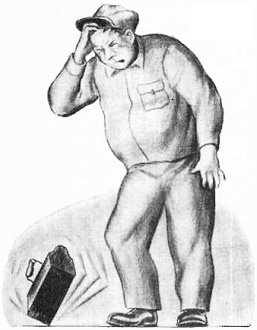
At five that evening Carl, Jerry, Chief Morton, and Mr. Deck were all seated in Chief Morton's personal car parked, across from the factory gate. At about five minutes after the hour, the laughing, jostling crowd of men began pouring 'out the gate and turning to the right as they headed for their parked cars. "Keep your eyes on the lunch boxes," Jerry breathed. Several minutes later almost all of the men had passed through the gate, and the boys were beginning to think the thief had foiled them. Then a short, heavy -set man sauntered through. As he turned, his right arm carrying his lunch box twisted at a strange angle, and he looked down in amazement at the lunch pail that seemed to be suddenly possessed of a demon. In spite of the effort of his straining muscles, the box was slowly tilting away from the horizontal. With a cry of fear the man let go of the handle, and the box fell to the pavement. There it stood on one corner, defying the law of gravity, and waltzed solemnly around in a circle. Police Chief Morton snapped handcuffs on the unresisting man as he continued to stare in horror and amazement at the strangely behaving lunch box. When the chief told him why he was being arrested, the man readily admitted his guilt and said the other °alternators would be found in his garage. Carl and Jerry picked up the "live" lunch box and accompanied Mr. Deck back into his office. "It's really quite simple," Jerry explained as he lifted the package out of the lunch box and opened it. "As you can see, we just substituted a gyroscope for the alternator. It runs off these five batteries wired in series. When the gyro starts, it draws about two or three amperes; but as the speed winds up, this comes down to less than half an amp; so these small batteries can take care of that easily for a short while. We put in this timer clock to turn on the gyro at three minutes after five. We wanted the thief to get the lunch box out of his locker and be headed for the gate before the gyro motor started. It runs so smoothly that he wouldn't notice the vibration, and it takes a few minutes for it to come up to speed; so we figured he wouldn't notice anything funny until he made that right-angle turn after passing through the gate. It worked beautifully. I'll never forget how the poor guy looked when he discovered his lunch box had developed a mind of its own." "I can imagine how he felt," Mr. Deck said as he tried in vain to jerk the still - coasting gyro motor about. "According to our agreement, I've got to sell this thing back to you two; but will you do me a favor? Can I keep it until tomorrow? When I was a boy I always wanted a gyroscope top and never got one. This is my chance to play with a really king-size top. How about it? Please!" "Sure, Mr. Deck," Carl spoke up with genuine sympathy in his voice. "Every man ought to have a chance to play with a gyroscope!"
|
|||||||||||||
 |
|||||||||||||
|
|||||||||||||

 By John T. Frye W9EGV
 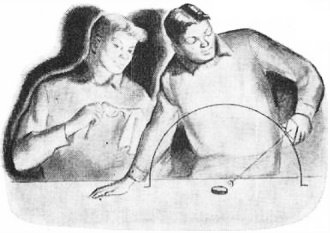 "What's the significance of the two nuts on
the thread?" Carl asked as he wiped the steam from his glasses.
"What's the significance of the two nuts on
the thread?" Carl asked as he wiped the steam from his glasses. 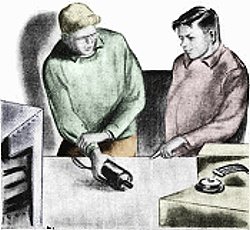 "Suppose," Jerry continued, "that we pointed
this front edge exactly at Los Angeles and leveled the platform perfectly at our
East Coast starting point. Let's say the top of this semicircle of wire, representing
the curved surface of the earth, is that point. Note that our pendulum, which gravity,
represented by the magnet, always pulls toward the center of the earth, is hanging
straight down and so is perpendicular to the plane of the platform."
"Suppose," Jerry continued, "that we pointed
this front edge exactly at Los Angeles and leveled the platform perfectly at our
East Coast starting point. Let's say the top of this semicircle of wire, representing
the curved surface of the earth, is that point. Note that our pendulum, which gravity,
represented by the magnet, always pulls toward the center of the earth, is hanging
straight down and so is perpendicular to the plane of the platform."  "How come the police don't handle it?"
  "Okay, boys; I hope you know what you're doing,"
Mr. Deck said with a sigh. "The chief said I could rely on you, and I guess that's
what I'll have to do."
"Okay, boys; I hope you know what you're doing,"
Mr. Deck said with a sigh. "The chief said I could rely on you, and I guess that's
what I'll have to do." 

|
||||||||||||||||||||||||||||||||||||