|
|||||||||||||
 |
|||||||||||||
Carl and Jerry - The Hot Hot Meter
|
|||||||||||||
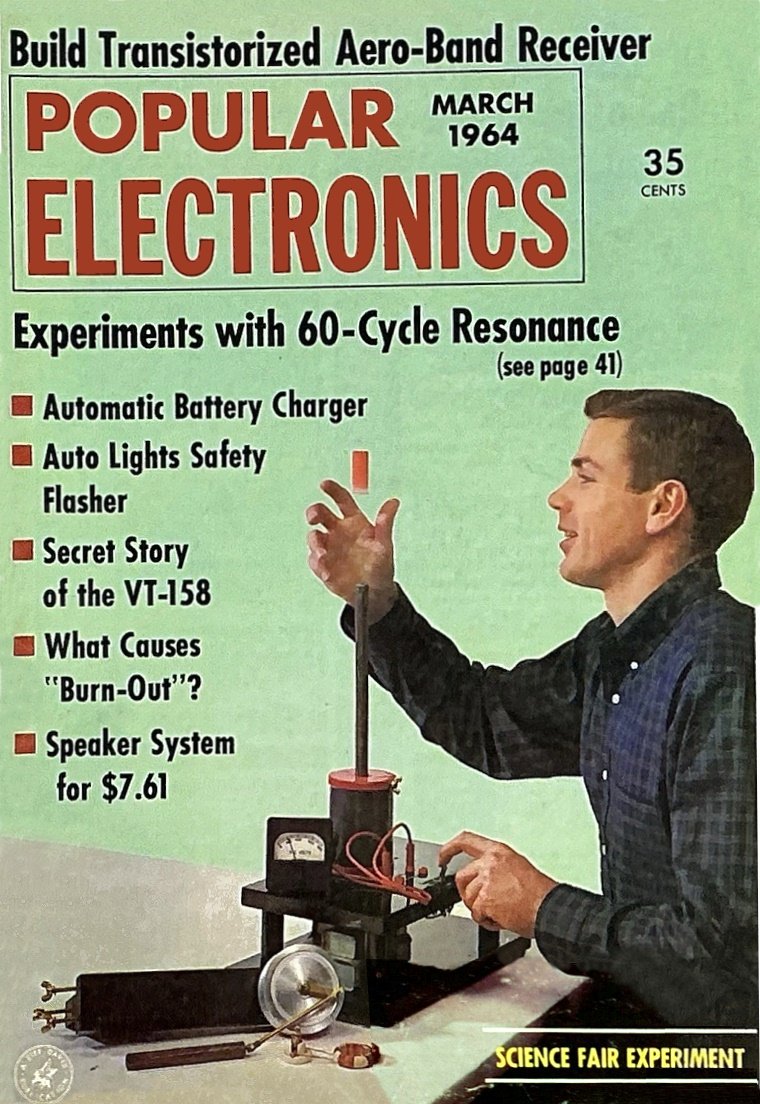
By 1964, John Frye's technology-obsessed long-time friends and Indiana natives Carl Anderson and Jerry Bishop were working on electrical engineering degrees at nearby Parvoo University (a sideways allusion to Purdue U.). As is Frye's M.O., he weaves a useful technical lesson into his stories - this time an introduction to nuclear reactors. Whenever a proper noun is introduced, I suspect it is also a sideways allusion to a real person, place, or thing, in Indiana. The Tuncan Meter Company at the center of "The Hot, Hot Meter" tale is, in all likelihood, a play on the Duncan Meter Company, from Lafayette, Indiana. Oddly, Mr. Frye uses the term "SCRAM" when describing the emergency shut-down of the reactor, but he does not explain that it is an acronym. The most widely accepted origin is "Safety Control Rod Axe Man," dating back to the early days of nuclear research during the Manhattan Project. The original emergency shutdown procedure for the Chicago Pile-1 reactor involved a scientist standing ready with an axe to cut a rope, which would swiftly insert the safety control rods into the core to stop the nuclear reaction. See "Whirling Wheel Magic" for a similar theme. Carl and Jerry - The Hot Hot Meter
Four-thirty A.M. on a raw March morning found Carl and Jerry walking briskly along the dark campus of Parvoo University toward the electrical engineering building. "There's gotta be some good reason why I'm staggering around in the dark at this unholy hour." Carl muttered, turning up his coat collar to ward off the cold, damp wind, "but you better spell it out again. I was pretty sleepy when you explained it to me last night." "The local Tuncan Meter Company is making very compact, highly accurate running-time meters for a government agency - possibly NASA," Jerry said. "These meters record the running time of an electrical device to which they are connected down to a small fraction of a second and cost almost a thousand dollars each - and they're no bigger than biscuits. For the past two weeks someone has been stealing them at the rate of about one a day. The plant manager dropped in last night while you were on a Coke date with Jodi and said the police chief suggested we might help catch the thief. I went with him to the factory to look the setup over." "What would anyone want with the things?" "They could be easily converted into very accurate electric stop watches for timing just about anything. Anyway, I found out why they're having so much trouble keeping track of them. They've got a crash program going, and the meters are practically built by hand in one small section of a large factory. Thirty-three men assemble, paint, calibrate, test, and box them. The meters are simply handed from one operator to another. If a test shows that something is wrong with a meter, that meter is taken back to the station which has the equipment to fix it. "In other words, the meters are constantly moving back and forth and up and down the whole line. Watching all of them would be like trying to keep track of the disappearing peas in a dozen shell games all going at the same time. The only thing the management has found out is that the meters disappear between four and five in the afternoon, just before quitting time, when things are the most hectic." "Why not search the men on their way out?" "That's a ticklish business. Honest workers would resent the implication. Besides, with only a little warning, the guilty one could easily get rid of something as small as one of those meters. Even if he didn't, he couldn't technically be charged with stealing the instrument until he took it out of the plant. The company needs a way of knowing that the thief has the meter with him when he passes through the gate. Then they can arrest him and try to recover the rest of the loot. The manager thought maybe we could rig up an electronic metal detector at the gate that would show when the thief went through with a meter, but the trouble is that a gadget sensitive enough to react to the small amount of metal in the meter would also react to lunch buckets, keys, or even pocket change." "So what did you suggest?"
"Why so early?" Carl asked, but before Jerry could answer they saw Professor Dailey and two young men waiting for them at the door. "Mr. Johnson and Mr. Selden here are graduate students," the professor said, as he led the way down a flight of steps to where the reactor was housed in the old high-voltage lab. "Two people, one licensed by the AEC, must be present when the reactor is activated." Jerry estimated that the windowless room they entered would measure about 30 by 35 feet with at least a 20-foot ceiling. Rising waist-high from the floor was a thick-walled circular concrete basin some eight feet in diameter filled with clear, glass-blue water. At one side a cluster of large-diameter metal tubes emerged vertically from the water. Moving closer, the boys saw that the bottom of the tank was several feet below the floor level. "This is called a 'swimming pool' reactor," the supervisor explained. "You can see the reactor core, about the size of an egg crate, there at the bottom of this seventeen-foot-deep tank with the control rods inside their guide tubes going down into it. Six thousand four hundred gallons of crystal-clear pure water provide effective shielding against radiation released by the core, yet leave the core clearly visible. "The core itself consists of sixteen fuel assemblies, each containing uranium two thirty-five [U235 - KRB] in the form of long, thin plates. Outside the core are the isotope tubes in which materials to be irradiated are placed. Surrounding the entire assembly are twenty pieces of high-purity graphite that reflect neutrons back into the core to prevent their escape from the system." "Is it working now?" Jerry asked. "No. Three of those tubes going down to the core contain stainless steel rods which can be raised or lowered by electric motors. Two of the rods also contain boron, which is an even better absorber of neutrons than stainless steel. When the rods are shoved all the way into the core, as they are now, they absorb enough neutrons emitted by random fission to prevent any chain reaction. However, when the rods are pulled far enough out of the core, a mixture of plutonium and beryllium contained in that other long guide tube furnishes sufficient neutrons to start a chain reaction, and the reactor becomes critical. Once started, this chain reaction is self-sustaining, and its energy level is controlled by how far the rods are pulled from the core. "While the reactor is rated at ten kw.," Professor Dailey continued, "we are only licensed for one kw., so that's the maximum amount of nuclear energy we generate. Four neutron detectors near the core constantly monitor the rate at which the uranium is fissioning. This information is displayed on meters and also operates recording devices in that cabinet next to the control console to keep a detailed record of the core's activity." "Is the thing pretty safe?" Carl asked a little nervously from where he stood near the console. "Three scintillation detectors - over the pool, under the console, and there by the water processing system - monitor radiation continuously, and the radiation level in this room is always about equal to that from a luminous -dial wrist watch. Many cities at high elevations receive far more radiation from space. All air entering and leaving this room is filtered. Water in the pool is continually filtered by a process that removes all dirt particles which might eventually interfere with a clear view of the core, become irradiated, or corrode the aluminum parts. A demineralizer also removes salts. You could fall into the pool without receiving a lethal dose of radiation. Actually, you're safer standing here than you are crossing the street." "Then how come this big red button on the console says SCRAM ?" "It's not what you think," Professor Dailey said, grinning. "It doesn't mean 'Head for the hills, the dam's busted!' Automatic controls hold the radiation energy at any desired, preset level; but if the operator, for any reason, wants to stop the reactor quickly, he can do so by pushing that button. It drops the two boron rods into the core and stops the chain reaction immediately." "Well, we'd better get on with our little project," the professor declared. "I decided we should irradiate about a tenth of a gram of indium powder and mix it with paint used on the meter cases. We often use indium foil for measuring neutron flux. It has a half-life of sixty-four minutes, which is to say, its induced radioactivity is halved every sixty-four minutes. I estimate that with the reactor running at one kw. the indium powder will be saturated in eight to ten hours. It should remain sufficiently radioactive for your purposes for at least five hours. "So we'll start the reactor now. Then, at about three p.m., we'll mix the radioactive indium powder into a small amount of the quick-drying lacquer used on the meter cases. You'll rush this to the factory. The meter painter has been stalling so as to have a good batch of painted meters in his booth. He'll brush some of the blending radioactive paint on the back of each meter case and start the specially painted meters down the line before four o'clock. If one is stolen, it should be from this batch; and when it's carried through the gate shortly after five, it will still be sufficiently radioactive to register strongly on a scintillator." While speaking, the professor picked up a powder-filled medicine capsule and placed it in a watertight aluminum container. As the rest watched, he used a long handling tool to lower the container to the reactor and place it in one of the cylindrical tubes surrounding the core. Then he sat down at the console and began to throw switches and turn knobs while his assistants called out meter readings. Motors inched the control rods from the core until suddenly jumping meter pointers indicated that the reactor was critical. Carefully, the energy level was raised to the one-kw. maximum. "Now," Professor Dailey said, "I'm going to get breakfast, and I presume you two want to do the same. Johnson and Selden will keep things cooking here until we come back at three." Carl continued to stare down into the pool for a few seconds before turning toward the door. "You can't tell that a thing's going on down there," he said. "It seems like there ought to be a loud humming sound, metal glowing red hot, lights flashing, or something. This thing's spooky!" The boys were back at the reactor promptly at three with a quarter-pint of paint from the factory. The reactor was shut down, and Professor Dailey removed the aluminum container from the isotope cylinder, took out the powder-filled capsule, and dropped it into the paint. "The capsule will dissolve quickly and release the radioactive powder beneath the surface of the paint," he explained. "That way there's no danger of radioactive particles getting into the air and possibly being inhaled. Now you better take off; but let us know what happens." Carl and Jerry drove along the speedy highway bypass to the Tuncan Meter plant and delivered the paint to the plant manager. They waited around until nearly five and then took up positions near the exit gate, each with his own theatrical "props." Jerry, wearing dark sunglasses, stood to the right of the gate cradling what was ostensibly a bag of groceries in his arms - at least a stalk of celery was sticking out of the top. In the bottom, though, where he could easily see its meter, was a sensitive radiation detector borrowed from the nuclear engineering department. Carl idly dribbled a basketball about the parking lot close by. While the men filed past, Jerry kept his eyes, hidden behind the dark lenses, glued to the meter of the scintillator, but almost all the workers passed through and the line began to thin out without the meter giving any indication, and he began to fear that something had gone wrong. Then a sallow-complexioned man wearing a heavy Mackinaw and a pair of ill-fitting large white cotton gloves came through carrying a dinner bucket in his left hand, and the meter pointer swung over sharply. Thinking that the meter was probably in the dinner bucket, Jerry casually lowered his meter to waist level and walked to the left side of the man. The meter reading was much lower. When he moved back to the right side, the original reading was restored; and when the man raised his hand to settle his hat on his head, the meter pointer dipped sharply. "He must have the meter in the palm of his hand inside that oversize glove!" Jerry thought to himself. Carl, who had been dribbling the basketball along in front of the man to distract his attention from Jerry's maneuvering, was watching out of the corner of his eye. When he saw Jerry staring pointedly at the big glove on the man's right hand, he began to dribble, feint, and wheel madly. Suddenly he lurched backwards and crashed into the sallow -complexioned man, knocking him to the asphalt-covered parking lot. "Oh, I'm sorry!" Carl exclaimed, reaching down to help the man up. The latter instinctively reached for Carl's outstretched hand, but Carl managed to clutch only the tips of the glove fingers and give them a jerk. The glove slid off the man's hand, and a dove-colored running-time meter fell from the empty cuff and went bouncing across the lot. As if by magic, but actually through careful planning, a plain-clothes detective appeared out of the crowd and placed the man under arrest. "Well," Carl remarked as they watched the detective hustling his prisoner into a waiting squad car, "the man knew that meter he stole was hot, but he didn't know how hot! You know I kind of go for this nuclear engineering jazz. It seems to fit in mighty well with electronics. We can't work around the reactor until we're at least seniors, but let's go see if Professor Dailey won't suggest some books we can be reading to sort of bone up on it!"
|
|||||||||||||
 |
|||||||||||||
|
|||||||||||||




|
||||||||||||||||||||||||||||||||||||