|
|||||||||||||
 |
|||||||||||||
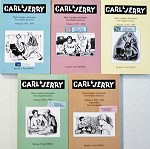
Carl and Jerry: Hello-o-o-o There
|
|||||||||||||
At Parvoo University, amid relentless November rain, H-3 dormmates Carl and Jerry pursue H-2's prank: a stolen bronze trophy plaque hurled into a half-mile muddy stretch of river. Cold, turbid waters bar preclude dives for a search; non-magnetic bronze defies current-day metal detectors. Jerry repurposes his cousin's boat depth-finder as an enhanced sonar, exploiting echo signatures. A motor rotates a neon tube across a depth-calibrated dial; at zero, contacts trigger a 200-kc ultrasonic pulse from the transducer in transmit (speaker) mode, flashing initial glow. Bottom echo reflects to transducer in receive (microphone) mode, amplifying for a secondary brighter flash; dial arc between flashes - proportional to round-trip time via sound velocity in water - indicates depth. Soft bottom mud scatters pulses into diffuse, weak echoes from multiple reflections; plaque's flat surface yields specular, sharp, intense returns. Gain adjustment enhanced soft/hard contrast, as demonstrated to Carl by Jerry. You'll need to read the story to find out if it worked (of course you already know). Hello-o-o-o There - A Carl and Jerry Adventure
A cold November rain beat against the windows of the room Carl and Jerry occupied in the H-3 Residence Hall of Parvoo University. Jerry was studying alone in the room, but now the door opened and Carl came in wearing a glistening wet yellow slicker. He stood expectantly just inside the door until his chum turned around in his chair and looked at him curiously. Carl deserved the curious stare. A rapid squeaking sound like the voice of a bat came from him, and little objects of some sort darted rhythmically back and forth across the lenses of his horn-rimmed glasses. "What on earth is the matter with your glasses?" Jerry demanded. Oh, so you noticed my lens-wiper invention," Carl said casually, reaching into his pocket and doing something that stilled the sound and the flickering movement in front of his eyes. "I thought you might not," he added as he carefully unclipped a spidery mechanism from the heavy frames of his glasses. It's really quite simple, something any near-genius could have thought up," he said modestly.
"I think you better throw that thing on the floor and let me hit it with a shovel," Jerry retorted. "Our reputation for sanity on this campus is not too good anyway, and it will never stand the strain of something like that. You've not been wearing the goofy thing around the campus, I hope." "I was wearing it on plaque patrol down along the river, but if the students and faculty can get used to seeing those seniors sporting their scraggly beards, they shouldn't flinch at any idiosyncrasy," Carl retorted. "What kind of patrol were you on?" "Plaque, spelled p - l - a - q - u - e. Oh, I forgot you didn't know about that. Last night some guys from H-2 stole a big bronze plaque out of our trophy case. Someone spotted them going out the door with it, and a gang of H-3 boys set off in pursuit. The 'thieves' took off in their car with our men in another car right behind them. Finally, they were cornered down along the river; but the plaque was not with them. They had ditched it somewhere. "Fellows from H-3 went over the route the thieves had followed almost inch by inch without finding the plaque," Carl continued, "and it was decided that the jokers must have heaved it into the river which runs parallel to the road for a half mile or so. We're keeping a constant patrol of that stretch to make sure the thieves don't recover the thing before we have a chance to find it. They probably know exactly where they threw it, but we don't. Given a chance, they could sneak in there, fish it out, and be one up on us." "How do you intend to locate it? A half mile of swollen muddy river is quite a haystack." "That's what's bugging us. We've messed around some with rakes and grab-hooks, but that's pretty discouraging. The thieves were in a convertible, and a fellow standing up in it could have sailed the plaque quite a distance out into the river. If the plaque lit on its face, there would be a good chance of hooking the wire across the back of it; but the odds are 50-50 it lit on its back in that soft mud at the bottom, and a rake would pass right over it." "How about diving?" Jerry suggested. "The water is too cold and too muddy. You can't see in more than a couple of inches of the stuff; so you'd just have to feel for the plaque. Remember: it can be anywhere along that half-mile stretch and anywhere from five to seventy-five feet from the bank. Several fellows say they will dive for it when we locate it, but they simply can't invite pneumonia searching for it."
"Yeah, we thought of that. I guess what we need is some sort of cheap and dirty sonar." "Say that again!" Jerry exclaimed as his eyes took on their glazed, deep-thought appearance. "I said I guessed we needed some sort of cheap and dirty sonar." "Precisely! And I know exactly where we can get it. Come on. Let's find someone with a car who can drive us to my cousin's about twenty miles east of here." When you are in your late teens, the thought is father to the deed and the gestation period is very short. A little more than two hours later Carl and Jerry were back in their room checking out a piece of compact electronic gear Jerry had wheedled out of his cousin. "My cousin uses this electronic depth-finder on his boat," Jerry explained. "He and I were playing around with it on the Tippecanoe River last summer. It's really a simple form of echo-ranging sonar. That's why your remark reminded me of it." "How does it work ?" Carl wanted to know. "Behind the rim of this circular transparent screen, as you can see now that I've taken the cover off, a motor whirls a neon tube on the end of a radial arm. The circular path of the neon bulb is marked off in feet. See these contacts that close briefly every time the neon bulb passes behind the '0' mark here at the top of the dial? When they close, they feed a short pulse of 200-kc. signal through a cable to this transducer that's mounted to the boat so it's in the water and pointing downward. The pulse is simultaneously fed through a transistorized amplifier to the neon bulb and makes it flash behind the '0.' "Sound from the transducer travels down to the bottom of the lake or stream and then is reflected back up into the transducer that now makes like a microphone instead of a speaker. The resulting electrical pulse feeds through the amplifier to the neon bulb and causes it to flash a second time, Since the neon bulb travels around the face of the dial at a controlled and known speed, the angular rotation between the first and second flashes is a function of the time it takes the sound to go from the transducer to the bottom of the lake and back. The speed of the motor and the markings on the dial are such that the depth of the water is indicated directly in feet by the location of the second flash of light." "How fast does the motor turn ?" Carl asked.
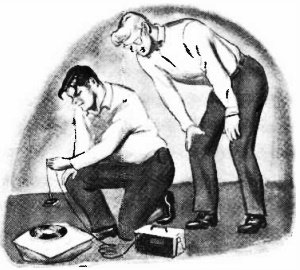
"I understand how the thing yells 'Hello - o - o - o -there' at the bottom and times the echo coming back to see how deep the water is, but I don't see how it's going to help us much." "Don't be too sure about that. Put a pillow on the floor and lay that 45-rpm record on top of it." By the time Carl had done this, Jerry had the instrument working; and when he held the transducer a foot or so from the floor, it indicated around five feet. "Get that disgusted look off your face," he told Carl. "Remember that sound travels more than four times as fast in water as it does in air; so the instrument is indicating correctly. Now watch that second light closely as I move the transducer over the end of the pillow and finally pass it directly over the record." As the transducer moved over the pillow, the sharply defined echo light became wider and less sharp. Jerry reduced the gain of the amplifier until this effect was even more pronounced. However, when the beam of sound reached the record, the light became much sharper and brighter with the more distinct echo returned from the hard surface of the plastic. "Fine!" Jerry exulted. "It works exactly as I hoped. When my cousin and I were fooling around in the clear water of the Tippecanoe, I noticed that any large rock on the bottom gave a clearer, sharper echo than did mud or soft sand. Results with the record and pillow confirm this. Tomorrow morning we'll hook the thing on a boat and see what we shall see." It was still raining in a desultory fashion the next morning, which was Sunday; but that didn't stop the plaque hunters. The depth-finder was installed on a small wooden boat powered by a quiet electric outboard motor. Carl operated the boat; Jerry kept watch on the depth-finder; and another boy, Frank, was along to do the diving. Several other fellows from H-3 followed along on the bank as Carl zigzagged back and forth, slowly moving downstream. They had been operating less than fifteen minutes when Jerry gave a sharp cry: "I'm getting an echo!" Carl worked the boat back and forth across the spot until it was determined that the object on the bottom was about the size of the plaque. Then Frank peeled off hiss clothes down to his swimming shorts and dove into the muddy water; in a few seconds he came up gasping for air and brandishing the top off a garbage can. "You and the gadget have to do better than that," he exclaimed to Jerry through chattering teeth as they helped him over the side. They continued working the stream like a bird dog while the boat was allowed to move gradually backward down the river. In the next hour they had three more false alarms from, respectively, a discarded license plate, an old pie tin, and a metal STOP sign. It began to rain harder, and a cold wind sprang up out of the northeast. "I dunno if we're going to do any good or not," Frank said dejectedly. "There's a lot of trash down there. Maybe those clowns never threw the plaque into the river at all." "Hold it!" Jerry interrupted. "Move back to the right a bit, Carl." As Carl maneuvered the boat according to Jerry's instructions, Frank punched around on the bottom with a long pole at the point where the depth-finder was returning a hard echo. "Well, it could be the plaque - or a thousand other things," he finally said as he crossed his arms and grabbed the bottom of his sweat shirt. A few seconds later he went over the side and was gone for what seemed a long time. Then a strong arm shot up out of the water beside the boat, and the hand brandished the missing plaque as though it were Excalibur! A gleeful shout went up from the boys on the bank who had stuck faithfully with them all the while. As the boat headed for the bank, the three passengers had forgotten all about the cold and the rain and the mud. Success was theirs! The "enemy" had been vanquished! They were savoring the wise words of Emerson: "Success in your work, the finding of a better method, the better understanding that insures the better performing is hat and coat, is food and wine, is fire and horse and holiday! At least I find that any success in my work has the effect on my spirits of all these."
|
|||||||||||||
 |
|||||||||||||
|
|||||||||||||

 By John T. Frye W9EGV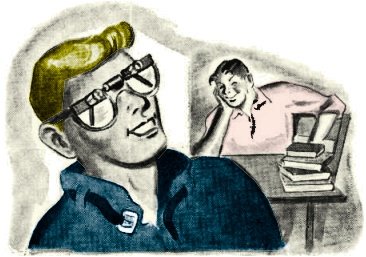
 "Hm - m - m, it seems we have ourselves a challenging
problem. Since the thing is bronze, of course no sort of magnetic detection will
work."
"Hm - m - m, it seems we have ourselves a challenging
problem. Since the thing is bronze, of course no sort of magnetic detection will
work." 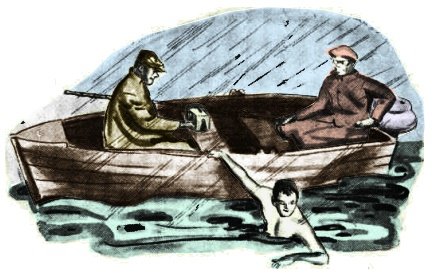


|
||||||||||||||||||||||||||||||||||||