|
|||||||||||||
 |
|||||||||||||
Carl and Jerry - The Girl Detector
|
|||||||||||||
Ah, they grow up so fast... It seems like just yesterday Carl and Jerry were two high schoolers who spent their spare time thinking up and building electromechanical gadgets to satisfy their primal instincts. Whether it was for Ham radio, school projects, helping police catch bad guys, flying radio-controlled airplanes, or troubleshooting appliances, John Frye's technical dynamic duo filled every day with adventure. Graduation day is a couple years behind the boys (men?) by the time this Popular Electronics story was published in 1964. Girls were now a recurring theme in their escapades, as the title suggests. It is part of the natural process. As always, woven within the main theme is a lesson on aspects of electronics and mechanics. The "Girl Detector" scheme could actually have worked. Mr. Frye had a habit of doing that - and was darned good at it. Carl and Jerry - The Girl Detector
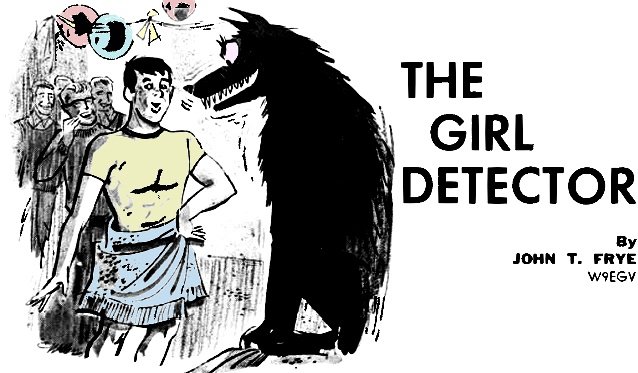
A late hour of an evening in January found Carl and Jerry busy in the electronics laboratory of Parvoo University. Carl was seated in front of a TV set looking intently at the glowing screen. The picture that interested him so much was ne of the back of his own head. He was cutting his own hair, aided by Jerry, who was manipulating the camera of the laboratory closed-circuit TV system so that it was kept focused on the point where Carl was gingerly and awkwardly using the electric clippers. "How'm I doing?" Carl mumbled without raising his chin. "I've seen worse jobs - I just can't remember where or when," Jerry replied. "What started you on this do-it-yourself haircutting kick?" "Two things. First, the local barber shops have upped haircuts another two bits; second, my friend Ray Thompson gave me this idea for beating them out of it. I can't see paying a barber, who learns the business in nine months, more dough per hour than I'll be able to make when I finish four grinding, expensive years in college." "Yeah, but don't forget that your extra work and education will start paying off fast as soon as you get a little experience, and there's no ceiling on how much you can make - if you're good, that is. The barber can only make so much - he's got a ceiling." "A darned high ceiling, if you ask me! Well, I guess I'd better quit while I'm ahead. Let's see how it looks over my left ear. Hmmm. All kidding aside, this doesn't look too bad, does it?" "Not if you keep your hat on," Jerry replied mercilessly. "Say, how about coming over to the Union with me and helping me check out my Girl Detector?" "Your what? It sounded like you said 'Girls Detector.'" "That's what I did say. While you were in Chicago at your cousin's wedding last week end, the Triangle fraternity boys asked me to dream up an interesting gadget for their dance tomorrow night. They wanted something scientific, but simple enough to intrigue the non-engineers in the crowd. Come along and see what I worked out." A few minutes later the boys were standing in the nearly empty ballroom on the third floor of the Memorial Union Building. Four or five Triangle fraternity men were putting finishing touches on the decorations. Jerry led Carl over to a corner of the room in which a man-size papier-máché "wolf" was seated on a raised platform. "Walk up to the platform, stand there a few seconds, then push down on that button near the wolf's foot," Jerry instructed. Carl did as he was told, and instantly the wolf's bulging eyeballs scanned Carl's figure up and down twice with deliberation. Then a voice that seemed to come from the lecherous-looking creature said contemptuously, "Go away, boy!" Jerry turned to a hulking youth standing nearby and said pleadingly, "Please, Buzz; just once more?" "Aw, not again, fellows!" the 240-pound varsity tackle protested, but he good-naturedly allowed himself to be propelled out of the room by his fraternity brothers who closed in on him. A few minutes later he came back, his powerful hairy legs protruding from beneath a skirt improvised from a towel. With one hand on his hip, he minced toward the wolf with a ludicrous, affected feminine walk that brought howls of laughter from the watchers. After standing at the edge of the platform for a few seconds, he reached over and pushed down on the button. Instantly the papier-máché creature's eyes began boldly sweeping up and down the brawny figure of the football player; then its eyes lighted up with a bright red glow, and it emitted the longest, most admiring, most libidinous wolf-whistle Carl had ever heard. As his fraternity brothers collapsed with laughter, the towel-clad youth turned around and walked away, and in a few seconds the red light disappeared from the eyes of the wolf. "Neat, neat!" Carl exclaimed. "How are you doing it'? Is it really automatic, or is somebody hiding around here and pushing buttons?" "It's automatic. Some of the guys taking art courses did the nice job on the wolf. His eyes are painted on the ends of little red light bulbs, and a motor and cam setup makes them sweep up and down a couple of times whenever the button is pushed. It works just like the motor arrangement on those Westminister doorbell chimes you have at home. Every time the button is pushed, the motor and cams make one complete cycle and stop." "Tell him about the voice," one of the fraternity members suggested. "Well," Jerry began. "at the end of the cam's movement, a vane passes through a beam of light and momentarily cuts it off. Normally, this beam of light shines through a hole in an endless loop of tape on a stereo tape recorder onto a photocell. As long as the light shines on the cell, current through it and a solenoid holds the recorder's 'pause' control depressed, and the tape doesn't move. When the light is interrupted, the solenoid releases the 'pause' button. and the tape recorder plays the tape loop through to the point where the light shines through the hole again and actuates the solenoid to stop it. "The wolf-whistle and the brush-off speech are recorded on separate tracks of the loop of tape. One track amplifier or the other is selected by a relay to drive a small speaker mounted in the wolf's head. When a fellow pushes the button, the relay is not actuated, and the top contacts feed the brush-off bit into the speaker. But when a girl hits the switch, the relay closes, and the speaker is transferred to the wolf-whistle amplifier. Also, when this relay is actuated, an extra set of contacts cause the eyes to light up." "But how does the wolf know whether a guy or a gal is pushing the button?" Carl demanded impatiently. "That's the gimmick I'm proud of," Jerry said. "Notice that the bottom edge of the platform holding the wolf is just about level with the bottom of a skirt. A thermistor is mounted behind the front edge of the platform, and another matched thermistor is hooked up away back in the corner. The two thermistors and two resistors form a bridge, both legs of which have the same resistance as long as they are at the same temperature. When one thermistor gets warmer, the bridge is unbalanced, current flows, and is amplified by a transistor. This cuts in a sensitive relay that operates the speaker-transfer relay I was telling you about." "But how on earth ... ?" Carl started to ask, but Jerry cut him short. "It's simple. When a fellow stands in front of the platform, his heavy trousers keep his body heat from escaping and materially affecting the thermistor just in front of his knees; but this is not true when a girl wearing a dress and sheer stockings is standing there. When the temperature of the thermistor changes, the bridge but you know what happens from there on." "That's doggone clever - I couldn't have done better myself!" Carl said admiringly. "I'd like to see what happens at the dance." "You will," Jerry promised. "As part payment for my help, the Triangle boys have invited us and our dates. I've already fixed things up with Jodi and Thelma - hey, are you listening to me? Why the faraway look ?" "Sure I'm listening," Carl retorted thoughtfully, feeling his rough, do-it-yourself haircut. "I was just wondering how I was going to squeeze in a visit to the barber shop between now and tomorrow night." When the boys and their dates arrived at the dance the next evening, a red velvet curtain stretched across the corner hid the wolf from view. A card fastened to the front of the curtain said simply: "Girl Detector." Naturally this aroused considerable curiosity among the uninformed - especially among the female uninformed - but the few boys in on the secret would only promise that the curtain would be pulled before the dance was over.
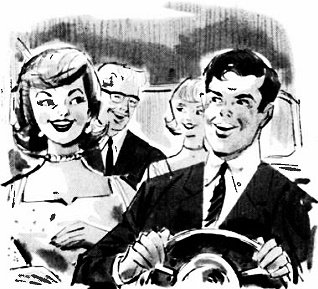
The president explained that those wishing to test the wolf were to approach it and to read aloud an invocation fastened to the platform. The invocation consisted of the word "ABRACADABRA" written as an inverted pyramid in which each lower word dropped the first letter of the word written above until the last word pronounced was only "A." The invocation was positioned and written in sufficiently small type so that the reader had to stand very close to the platform to see it. The time it took to read it, of course, gave the thermistors time to respond to minute temperature variations. The wolf was an immediate hit. Each wolf-whistle and every curt dismissal was greeted with laughter. The engineers in the group immediately tried to figure out how the wolf determined the difference. Some thought the size of the hand pushing the button had something to do with it, so they tried pushing the button with a stick. Others decided that the pitch of the voice reading the in vocation was the clue, and they tried reading the magic words in a high-pitched voice. Still others concluded that light beams were being cut off by the girls' wide skirts, so they improvised skirts out of suit coats. But none of these ruses, naturally, fooled the wolf. When the dance broke up, not a single person had guessed how the trick was performed. Car, Jerry, Jodi, and Thelma were scarcely back in the car when the girls went to work on the boys to learn the secret. Carl and Jerry held out teasingly for a while, but when the girls started delivering ultimatums, the boys gave in. "You know," Jodi remarked in her rich Southern accent, "it's fun knowing things that other folks don't - I mean scientific things. When I go shopping in the supermarket and an electric eye opens the door at my approach, it makes me feel very superior to realize I know something probably not another woman in the store knows exactly how the door operates." "Listen to the confessions of a technical snob!" Jerry gibed. "I must admit, though, I feel a little the same way when I hear people marveling at the 'mystery' of how radio, color TV, radar, remote control, or even garage door openers work. I guess all of us have got a streak like that just like the little boy shouting 'yah, yah, yah!' I know something you don't know!' " "When you stop to think about it," Carl chimed in, "you realize that somebody with no knowledge of electronics today is just about as puzzled by the gadgets he comes in contact with as the caveman must have been by thunder and lightning. It's O.K. to be proud about what you know, but, on the other hand, there are times when I feel very humble and grateful for the education I'm getting. I want to share my knowledge and do something with my education to deserve this privilege." "Hear! hear!" Jerry exclaimed. "So how do they share their knowledge?" Thelma asked rhetorically after a long silence. "They build Girl Detectors!" The four of them immediately burst out laughing.
|
|||||||||||||
 |
|||||||||||||
|
|||||||||||||
 At ten o'clock the president of Triangle made
a little speech explaining that the fraternity had created, at terrific expenditure
of time and money, a creature "half scientific, half magic" that could unerringly
tell girls from boys. The curtain was pulled, and a gasp went up from the crowd
as they saw the leering wolf illuminated by a small spotlight. Ropes formed a narrow
aisle that permitted access to the platform at only one spot-the spot where the
front thermistor was concealed.
At ten o'clock the president of Triangle made
a little speech explaining that the fraternity had created, at terrific expenditure
of time and money, a creature "half scientific, half magic" that could unerringly
tell girls from boys. The curtain was pulled, and a gasp went up from the crowd
as they saw the leering wolf illuminated by a small spotlight. Ropes formed a narrow
aisle that permitted access to the platform at only one spot-the spot where the
front thermistor was concealed. 

|
||||||||||||||||||||||||||||||||||||