See Page 1 |
2 | of the May 2025 homepage
archives.
 This week's
crossword puzzle, as with all RF Cafe puzzles, uses only words
pertaining to engineering, science, mathematics, mechanics, chemistry, astronomy,
etc. You will never find a reference to some obscure geological feature or city,
or be asked to recall the name of some numbnut movie star or fashion designer. Enjoy! This week's
crossword puzzle, as with all RF Cafe puzzles, uses only words
pertaining to engineering, science, mathematics, mechanics, chemistry, astronomy,
etc. You will never find a reference to some obscure geological feature or city,
or be asked to recall the name of some numbnut movie star or fashion designer. Enjoy!
 "Global demand for semiconductors continues
to strengthen even
amid the tariff uncertainty and other events that are impacting the electronics
sector. According to the Semiconductor Industry Association (SIA), global sales
were $167.7B for semiconductors during the first quarter of 2025 - an increase of
18.8% compared to the first quarter of 2024. For the month of March, SIA reported
total global semiconductor sales of $55.9B - an increase of 1.8% compared to February's
total of $54.9B. 'Global semiconductor demand remains high, with first-quarter sales
substantially outpacing the first quarter..." "Global demand for semiconductors continues
to strengthen even
amid the tariff uncertainty and other events that are impacting the electronics
sector. According to the Semiconductor Industry Association (SIA), global sales
were $167.7B for semiconductors during the first quarter of 2025 - an increase of
18.8% compared to the first quarter of 2024. For the month of March, SIA reported
total global semiconductor sales of $55.9B - an increase of 1.8% compared to February's
total of $54.9B. 'Global semiconductor demand remains high, with first-quarter sales
substantially outpacing the first quarter..."
• Amateur
Spectrum Addressed in U.S. House
• Boosters Could
Fully Replace Main Transmitters
• Taiwan Tightens
Tech Export Law
• Intel
Financial Risks, Massive Layoffs
• Google
AI Overviews Hurting Click-Through Rates
 Nationwide survey shows a
decline in opportunities for engineers. Although jobs are fewer
and requirements tougher, certain specialists are still in demand. An employment-agency
official on Long Island says, "If it weren't for Grumman (Aircraft Corp.), you could
just cut Long Island off and let it float into the Atlantic." A Chicago agency that
specializes in jobs for engineers advises applicants to relocate and be prepared
to drop out of the five-figure salary range. These are typical findings in a coast-to-coast
employment survey. Don't panic; these statements are from a 1964 issue of Electronics
magazine. Prior to our current Era of Wireless, which, unbeknownst to most people,
is a nomenclature that harkens back to a century earlier... Nationwide survey shows a
decline in opportunities for engineers. Although jobs are fewer
and requirements tougher, certain specialists are still in demand. An employment-agency
official on Long Island says, "If it weren't for Grumman (Aircraft Corp.), you could
just cut Long Island off and let it float into the Atlantic." A Chicago agency that
specializes in jobs for engineers advises applicants to relocate and be prepared
to drop out of the five-figure salary range. These are typical findings in a coast-to-coast
employment survey. Don't panic; these statements are from a 1964 issue of Electronics
magazine. Prior to our current Era of Wireless, which, unbeknownst to most people,
is a nomenclature that harkens back to a century earlier...
 A short article in the June issue of
QST magazine "Ham Media Playlist" featured Jeff Geerling (KF0MYB), of
Geeriling Engineer, and his father, Joe, with a tour of a 1 MW commercial
radio broadcast station. Operating wavelengths in the AM (555-176 m) and FM (2.78-3.41 m)
bands, where the wavelengths are long enough to preclude use of waveguides and distributed
element components, means low loss coaxial cables, power combiners, RF switches,
etc., are huge. The complexity of the equipment and layout is utterly amazing. A
nicely done video gives
a guided tour of the facility. Be sure to also watch the "Cooking with AM radio" short.
The more of this stuff I become aware of demonstrating the high-capability people
responsible for it, the less I think of my own lifetime of accomplishments ;-) A short article in the June issue of
QST magazine "Ham Media Playlist" featured Jeff Geerling (KF0MYB), of
Geeriling Engineer, and his father, Joe, with a tour of a 1 MW commercial
radio broadcast station. Operating wavelengths in the AM (555-176 m) and FM (2.78-3.41 m)
bands, where the wavelengths are long enough to preclude use of waveguides and distributed
element components, means low loss coaxial cables, power combiners, RF switches,
etc., are huge. The complexity of the equipment and layout is utterly amazing. A
nicely done video gives
a guided tour of the facility. Be sure to also watch the "Cooking with AM radio" short.
The more of this stuff I become aware of demonstrating the high-capability people
responsible for it, the less I think of my own lifetime of accomplishments ;-)
 "Japan-based Fujitsu Ltd has reported gallium
nitride (GaN) high-electron-mobility transistors (HEMTs) on
free-standing GaN substrates operating at 2.45 GHz in the industrial, scientific &
medical (ISM, 2.4-2.5 GHz) reserved band with 85.2% power-added efficiency
(PAE) and 89.0% drain efficiency (DE). The team reports: 'To the best of our knowledge,
our device sets a new record for the highest power-added efficiency and drain efficiency
among discrete GaN HEMTs, highlighting the superior potential of GaN-on-GaN HEMTs
for highly efficient RF power amplifiers.' Fujitsu had also claimed the previous
record set in 2021 of 82.8% PAE at 2.45 GHz. The researchers believe the methods
used to boost efficiency could benefit performance at other frequencies, even in
the 100 GHz ..." "Japan-based Fujitsu Ltd has reported gallium
nitride (GaN) high-electron-mobility transistors (HEMTs) on
free-standing GaN substrates operating at 2.45 GHz in the industrial, scientific &
medical (ISM, 2.4-2.5 GHz) reserved band with 85.2% power-added efficiency
(PAE) and 89.0% drain efficiency (DE). The team reports: 'To the best of our knowledge,
our device sets a new record for the highest power-added efficiency and drain efficiency
among discrete GaN HEMTs, highlighting the superior potential of GaN-on-GaN HEMTs
for highly efficient RF power amplifiers.' Fujitsu had also claimed the previous
record set in 2021 of 82.8% PAE at 2.45 GHz. The researchers believe the methods
used to boost efficiency could benefit performance at other frequencies, even in
the 100 GHz ..."
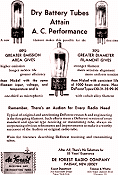 Lee de Forest, inventor of the Audion vacuum
tube, created a business called De Forest Radio Company (although I hear he didn't
build that). This advertisement for his company's electron tubes appeared in the
December 1931 edition of the ARRL's QST magazine. If you research Lee de Forest,
you will find his name spelled incorrectly in many different forms: de Forest, De
Forest, de Forest, de Forest, to give a few. When in doubt, go straight to the source,
which in this case is the signature that de Forest placed on his patent applications
- he used "de Forest." Note that the official company name, according to the advertisement
address at the bottom, is "De Forest Radio Company," (space used) yet the text of
the copy uses the form... Lee de Forest, inventor of the Audion vacuum
tube, created a business called De Forest Radio Company (although I hear he didn't
build that). This advertisement for his company's electron tubes appeared in the
December 1931 edition of the ARRL's QST magazine. If you research Lee de Forest,
you will find his name spelled incorrectly in many different forms: de Forest, De
Forest, de Forest, de Forest, to give a few. When in doubt, go straight to the source,
which in this case is the signature that de Forest placed on his patent applications
- he used "de Forest." Note that the official company name, according to the advertisement
address at the bottom, is "De Forest Radio Company," (space used) yet the text of
the copy uses the form...
 This is an example of what can be done when
a non-DEI team works on a problem - no token managers in the photo.
Carl &
Jerry would be proud! I first solved a Rubik's Cube way back around
1980 whilst in the USAF.
"A team of Purdue engineering students built a lightning-fast robot -
Purdubik's Cube - that now holds the Guinness World Record for solving a Rubik's
Cube in just 0.103 seconds. Fueled by co-op experiences, personal inspiration, and
university support, the students combined machine vision, custom algorithms, and
industrial hardware to create a robotic system so fast it finishes before you can
blink. For most people, solving a Rubik's Cube is a brain-teasing challenge. But
for a group of engineering students at Purdue University, it became something much
bigger - a chance to push the boundaries of speed, precision, and automation, and
officially make history..." This is an example of what can be done when
a non-DEI team works on a problem - no token managers in the photo.
Carl &
Jerry would be proud! I first solved a Rubik's Cube way back around
1980 whilst in the USAF.
"A team of Purdue engineering students built a lightning-fast robot -
Purdubik's Cube - that now holds the Guinness World Record for solving a Rubik's
Cube in just 0.103 seconds. Fueled by co-op experiences, personal inspiration, and
university support, the students combined machine vision, custom algorithms, and
industrial hardware to create a robotic system so fast it finishes before you can
blink. For most people, solving a Rubik's Cube is a brain-teasing challenge. But
for a group of engineering students at Purdue University, it became something much
bigger - a chance to push the boundaries of speed, precision, and automation, and
officially make history..."
 Our two intrepid techno-sleuths,
Carl Anderson and Jerry Bishop, are in college by now, but that does not keep
them from applying their well-honed mystery solving skills to hometown situations
while on spring break. The boys invoke the scientific method of Mr. R.R. Dibble,
a New Zealand scientist, to help prove to county commissioners that a certain part
of their critical infrastructure was in need of repair. An nth-generation farmer's
observation was not proof enough, so indisputable empirical data would be needed.
Real-life inventors and company's unique instruments are often incorporated into
the Carl & Jerry series by John T. Frye that ran for many years in
Popular Electronics magazine... Our two intrepid techno-sleuths,
Carl Anderson and Jerry Bishop, are in college by now, but that does not keep
them from applying their well-honed mystery solving skills to hometown situations
while on spring break. The boys invoke the scientific method of Mr. R.R. Dibble,
a New Zealand scientist, to help prove to county commissioners that a certain part
of their critical infrastructure was in need of repair. An nth-generation farmer's
observation was not proof enough, so indisputable empirical data would be needed.
Real-life inventors and company's unique instruments are often incorporated into
the Carl & Jerry series by John T. Frye that ran for many years in
Popular Electronics magazine...
 That is the question I (Kirt B) put
to Google's Gemini AI machine, et al. It's
response (condensed, similar to ChatGPT, Grok, DeepSeek, etc.): "Yes, AI is
ultimately at the beck and call of its human programmers, with certain nuances
depending on the AI's complexity and deployment. Here's a breakdown of why and the
caveats: That is the question I (Kirt B) put
to Google's Gemini AI machine, et al. It's
response (condensed, similar to ChatGPT, Grok, DeepSeek, etc.): "Yes, AI is
ultimately at the beck and call of its human programmers, with certain nuances
depending on the AI's complexity and deployment. Here's a breakdown of why and the
caveats:
Why AI is Ultimately Controlled by Programmers: * Foundation
in Code: AI systems are built upon lines of code written by human programmers. The
code defines the algorithms, data structures, and logic that govern the AI's behavior.
Without this code, the AI wouldn't exist or function.
* Training Process:
Programmers control the training process, including the selection of the training
data, the choice of the learning algorithm, and the optimization of the model's
parameters. These choices fundamentally shape AI's capabilities and biases.
* Hardcoded Constraints and Safeguards
* Update and Modification: Programmers
update, modify, or even shut down the AI system.
* Defining the 'Objective':
Even with reinforcement learning, programmers define the reward function, dictat[ing]
what AI ultimately optimizes for. This gives programmers significant control over
the AI's direction."
 Empower RF Systems is the technological
leader in RF & microwave power amplifier solutions for EW, Radar, Satcom, Threat
Simulation, Communications, and Product Testing. Our air and liquid cooled amplifiers
incorporate the latest semiconductor and power combining technologies and with a
patented architecture we build the most sophisticated and flexible COTS system amplifiers
in the world. Solutions range from tens of watts to hundreds of kilowatts and includes
basic PA modules to scalable rack systems. Empower RF Systems is the technological
leader in RF & microwave power amplifier solutions for EW, Radar, Satcom, Threat
Simulation, Communications, and Product Testing. Our air and liquid cooled amplifiers
incorporate the latest semiconductor and power combining technologies and with a
patented architecture we build the most sophisticated and flexible COTS system amplifiers
in the world. Solutions range from tens of watts to hundreds of kilowatts and includes
basic PA modules to scalable rack systems.
 Being the old guy I am, seeing the tag line
"No
Sweater Girls, Please" in this 1944 National Union Radio and Tubes company advertisement
in Radio News magazine reminded me of a comedian's bit about Sweater Girls.
The reference could be interpreted as a slight to women of certain physical attributes,
but in this case it was a play on a popular theme in Hollywood. The actual message
pertained to how contaminant-free National Union kept its vacuum tube assembly areas.
Radio News, being by default a men's magazine since in the day most electronics
professional and hobbyists were male, and seeing what would today be considered
sexist or misogynistic was not uncommon. Take a look at some of the comics that
appeared to see what I mean. Most of the jokes were on men though; that kind of
humor was also OK back then. Now jokes about men (dare I also specify White men?)
are the only socially acceptable... Being the old guy I am, seeing the tag line
"No
Sweater Girls, Please" in this 1944 National Union Radio and Tubes company advertisement
in Radio News magazine reminded me of a comedian's bit about Sweater Girls.
The reference could be interpreted as a slight to women of certain physical attributes,
but in this case it was a play on a popular theme in Hollywood. The actual message
pertained to how contaminant-free National Union kept its vacuum tube assembly areas.
Radio News, being by default a men's magazine since in the day most electronics
professional and hobbyists were male, and seeing what would today be considered
sexist or misogynistic was not uncommon. Take a look at some of the comics that
appeared to see what I mean. Most of the jokes were on men though; that kind of
humor was also OK back then. Now jokes about men (dare I also specify White men?)
are the only socially acceptable...
 The Federal Communications Commission voted
unanimously to instate new rules meant to ensure that the hundreds of labs which
test and certify electronic devices for use in the United States don't represent
national security risks. The move to close a loophole for so-called 'bad labs'
began last year with bipartisan support, spearheaded jointly by then-FCC Chairwoman
Jessica Rosenworcel and then- Commissioner Brendan Carr, the longest-serving Republican
on the FCC who is now the agency's chairman. The FCC emphasized that the new 'bad
labs' rules will ensure that the test laboratories and telecommunications certification
bodies (TCBs) which test and verify the compliance of devices such as smartphones,
computers, fitness... The Federal Communications Commission voted
unanimously to instate new rules meant to ensure that the hundreds of labs which
test and certify electronic devices for use in the United States don't represent
national security risks. The move to close a loophole for so-called 'bad labs'
began last year with bipartisan support, spearheaded jointly by then-FCC Chairwoman
Jessica Rosenworcel and then- Commissioner Brendan Carr, the longest-serving Republican
on the FCC who is now the agency's chairman. The FCC emphasized that the new 'bad
labs' rules will ensure that the test laboratories and telecommunications certification
bodies (TCBs) which test and verify the compliance of devices such as smartphones,
computers, fitness...
 Werbel Microwave's Model
WM2PD-20-530M-N is a 2-way splitter and combiner that covers 20 MHz to
530 MHz, HF, VHF and low UHF. It handles 50 watts input power as a splitter
or 5 watts per port as a combiner. Note that because of the transformer-based
design it does not pass DC to the output. Made in USA with lead free solder, but
63/37 is available on special request for military customers. Highly detailed
datasheet includes plots for variation over multiple production devices, and over
temperature. Werbel Microwave's Model
WM2PD-20-530M-N is a 2-way splitter and combiner that covers 20 MHz to
530 MHz, HF, VHF and low UHF. It handles 50 watts input power as a splitter
or 5 watts per port as a combiner. Note that because of the transformer-based
design it does not pass DC to the output. Made in USA with lead free solder, but
63/37 is available on special request for military customers. Highly detailed
datasheet includes plots for variation over multiple production devices, and over
temperature.
 This is the second of a two-part series
discussing the
propagation of shortwaves, the first part having appeared in the
December 1931 / January 1932 edition of Short Wave Craft. Keep in mind
that at the time of the writing, no instrumented sounding rockets had been sent
into the upper atmosphere for empirical measurements, so the author's conjectures
being inaccurate are forgivable. Mr. Meyer's supposition that there are "cosmically-located
network of conductive lines" that influence seasonal propagation as the earth moves
through them during its revolution around the sun is actually not an unreasonable
theory for its era. It certainly is no more outlandish than a modern-day celebrated
astrophysical genius proposing a series of vibrating "strings" in an 11-dimensional
universe... This is the second of a two-part series
discussing the
propagation of shortwaves, the first part having appeared in the
December 1931 / January 1932 edition of Short Wave Craft. Keep in mind
that at the time of the writing, no instrumented sounding rockets had been sent
into the upper atmosphere for empirical measurements, so the author's conjectures
being inaccurate are forgivable. Mr. Meyer's supposition that there are "cosmically-located
network of conductive lines" that influence seasonal propagation as the earth moves
through them during its revolution around the sun is actually not an unreasonable
theory for its era. It certainly is no more outlandish than a modern-day celebrated
astrophysical genius proposing a series of vibrating "strings" in an 11-dimensional
universe...
 "Researchers have created a flexible semiconductor
that efficiently converts body heat into electricity through
atomic vacancy engineering. This innovation opens new possibilities for wearable
devices, combining flexibility and high thermoelectric performance. Researchers
at Queensland University of Technology (QUT) have discovered a new material that
could serve as a flexible semiconductor for wearable devices. Their approach centers
on manipulating the spaces between atoms, known as 'vacancies,' within a crystal
structure. In a study published in the prestigious journal Nature Communications,
the team demonstrated how 'vacancy engineering' significantly improves the performance
of an AgCu(Te,Se,S) semiconductor, an alloy composed..." "Researchers have created a flexible semiconductor
that efficiently converts body heat into electricity through
atomic vacancy engineering. This innovation opens new possibilities for wearable
devices, combining flexibility and high thermoelectric performance. Researchers
at Queensland University of Technology (QUT) have discovered a new material that
could serve as a flexible semiconductor for wearable devices. Their approach centers
on manipulating the spaces between atoms, known as 'vacancies,' within a crystal
structure. In a study published in the prestigious journal Nature Communications,
the team demonstrated how 'vacancy engineering' significantly improves the performance
of an AgCu(Te,Se,S) semiconductor, an alloy composed..."
 "ARRL interacted with thousands of members
at 2025
Dayton Hamvention®, held May 16-18 in Xenia, Ohio. There were many ARRL programs
and services available to visitors to the ARRL Expo area. The ARRL Youth Lounge
was busy throughout the event, and "the kids were loving it," according to Education
and Learning Manager Steve Goodgame, K5ATA, who pointed out that the young visitors
were building code keys from 3D-printed kits and testing them out by sending messages.
Saturday's ARRL Youth Rally saw several dozen young people get engaged with a day
of ham radio fun. The Youth Rally actually extended into..." "ARRL interacted with thousands of members
at 2025
Dayton Hamvention®, held May 16-18 in Xenia, Ohio. There were many ARRL programs
and services available to visitors to the ARRL Expo area. The ARRL Youth Lounge
was busy throughout the event, and "the kids were loving it," according to Education
and Learning Manager Steve Goodgame, K5ATA, who pointed out that the young visitors
were building code keys from 3D-printed kits and testing them out by sending messages.
Saturday's ARRL Youth Rally saw several dozen young people get engaged with a day
of ham radio fun. The Youth Rally actually extended into..."
 Here be another brain teaser from quizmaster
Robert P. Balin. The "Amplifier Quiz" is one of sixty or so I have posted thus far from
vintage issues of Popular Electronics magazine. Having been created in
1964, the circuit schematics use vacuum tubes, but don't let that inhibit you from
taking the test. Enhancement mode field effect transistors (FETs) are an apt analogy
to tubes for determining function, so I added symbols for FETs next to the vacuum
tube symbols to help you visualize the equivalence. I usually do a respectable job
on these quizzes, but have to admit to only getting 4 out of 6 this time (67%),
and one of those was just a lucky, semi-educated guess. Shameful. Here be another brain teaser from quizmaster
Robert P. Balin. The "Amplifier Quiz" is one of sixty or so I have posted thus far from
vintage issues of Popular Electronics magazine. Having been created in
1964, the circuit schematics use vacuum tubes, but don't let that inhibit you from
taking the test. Enhancement mode field effect transistors (FETs) are an apt analogy
to tubes for determining function, so I added symbols for FETs next to the vacuum
tube symbols to help you visualize the equivalence. I usually do a respectable job
on these quizzes, but have to admit to only getting 4 out of 6 this time (67%),
and one of those was just a lucky, semi-educated guess. Shameful.
 "A new University of Zurich study shows
that people are more concerned about the immediate
risks of AI, like bias and misinformation, than about distant existential threats.
Most people are more concerned about the immediate risks of artificial intelligence
than about distant, theoretical threats to humanity's survival. A new study from
the University of Zurich highlights that respondents clearly distinguish between
abstract future scenarios and specific, tangible problems and tend to take the latter
much more seriously. While there is broad agreement..." "A new University of Zurich study shows
that people are more concerned about the immediate
risks of AI, like bias and misinformation, than about distant existential threats.
Most people are more concerned about the immediate risks of artificial intelligence
than about distant, theoretical threats to humanity's survival. A new study from
the University of Zurich highlights that respondents clearly distinguish between
abstract future scenarios and specific, tangible problems and tend to take the latter
much more seriously. While there is broad agreement..."
• GaN
HEMT Hits 85.2% PAE at 2.45GHz
• NAB
Submits Sweeping Broadcast Deregulation to FCC
• Ham
Radio Open House Events Making Headlines
• Waivers Sought for
UWB System Rules
• Telcos
Struggling to Go Gully Autonomous
 Sam Benzacar, of Anatech Electronics, an
RF and microwave filter company, has published his May 2025 newsletter that, along
with timely news items, features his short op-ed titled "America's
Outdated Airport Radar: A Preventable Crisis." Sam's pieces are always very
thoughtful and address major topics in the communications industry. This one has
been very much on the public's mind lately with multiple fatal and near-misses at
America's busy busiest airports. "...many of our busiest airports rely on radar
technology developed in the 1970s and 1980s, as the FAA has repeatedly deferred
critical infrastructure upgrades." Nearly all government equipment suffer such unforgivable
neglect. As with the military, a few pieces of shiny new hardware with amazing capabilities
are headlined while the vast... Sam Benzacar, of Anatech Electronics, an
RF and microwave filter company, has published his May 2025 newsletter that, along
with timely news items, features his short op-ed titled "America's
Outdated Airport Radar: A Preventable Crisis." Sam's pieces are always very
thoughtful and address major topics in the communications industry. This one has
been very much on the public's mind lately with multiple fatal and near-misses at
America's busy busiest airports. "...many of our busiest airports rely on radar
technology developed in the 1970s and 1980s, as the FAA has repeatedly deferred
critical infrastructure upgrades." Nearly all government equipment suffer such unforgivable
neglect. As with the military, a few pieces of shiny new hardware with amazing capabilities
are headlined while the vast...
 In the June 2025 issue of the ARRL's flagship
QST magazine, long-time
amateur radio operator Chip Lohman (NN4U), wrote to the "Correspondence" column
regarding his newly acquired appreciation for digital modes of communication. Just
as a lot of old-timers rued and resisted the transition from vacuum tubes to transistors,
many have eschewed adoption of 1's and 0's when plying the Ham trade (except, of
course, for CW mode). Mr. Lohman's letter begins thusly, "My first impression
of operating FT8 was that you turn
on your computer, go to bed, and wake up to learn what contacts your computer had
made." I got a good laugh out of that! In the June 2025 issue of the ARRL's flagship
QST magazine, long-time
amateur radio operator Chip Lohman (NN4U), wrote to the "Correspondence" column
regarding his newly acquired appreciation for digital modes of communication. Just
as a lot of old-timers rued and resisted the transition from vacuum tubes to transistors,
many have eschewed adoption of 1's and 0's when plying the Ham trade (except, of
course, for CW mode). Mr. Lohman's letter begins thusly, "My first impression
of operating FT8 was that you turn
on your computer, go to bed, and wake up to learn what contacts your computer had
made." I got a good laugh out of that!
 Anritsu has been a global provider of innovative
communications test and measurement solutions for more than 120 years. Anritsu manufactures
a full line of innovative components and accessories for
RF and Microwave Test and Measurement
Equipment including attenuators & terminations; coaxial cables, connectors &
adapters; o-scopes; power meters & sensors; signal generators; antenna, signal,
spectrum, & vector network analyzers (VNAs); calibration kits; Bluetooth &
WLAN testers; PIM testers; amplifiers; power dividers; antennas. "We've Got You
Covered." Anritsu has been a global provider of innovative
communications test and measurement solutions for more than 120 years. Anritsu manufactures
a full line of innovative components and accessories for
RF and Microwave Test and Measurement
Equipment including attenuators & terminations; coaxial cables, connectors &
adapters; o-scopes; power meters & sensors; signal generators; antenna, signal,
spectrum, & vector network analyzers (VNAs); calibration kits; Bluetooth &
WLAN testers; PIM testers; amplifiers; power dividers; antennas. "We've Got You
Covered."
 Empower RF Systems'
1212 solid state power amplifier (SSPA) module is a popular choice for fielded
C-UAS applications. This SSPA operates from 2000 to 6000 MHz with 50 W
minimum output and showcases Empower RF's expertise in designing compact and reliable
HPA's for EW systems. The 1212 is part of Empower's smart module family offering
digital controls and reporting, simplifying integration for cutting-edge Counter-Unmanned
Aerial Systems (C-UAS) solutions. Its compact design, utilizing GaN on SiC technology,
ensures high reliability and performance in demanding electromagnetic response scenarios... Empower RF Systems'
1212 solid state power amplifier (SSPA) module is a popular choice for fielded
C-UAS applications. This SSPA operates from 2000 to 6000 MHz with 50 W
minimum output and showcases Empower RF's expertise in designing compact and reliable
HPA's for EW systems. The 1212 is part of Empower's smart module family offering
digital controls and reporting, simplifying integration for cutting-edge Counter-Unmanned
Aerial Systems (C-UAS) solutions. Its compact design, utilizing GaN on SiC technology,
ensures high reliability and performance in demanding electromagnetic response scenarios...
 Werbel Microwave's Model
WMHPBDC-80-520M-6dB-N is a high-power bidirectional coupler that operates over
the 80-520 MHz band, covering FM radio, upper VHF and lower UHF applications.
Conservatively rated for 100 watts CW. Useful for amplification and signal distribution
applications including radio and television broadcasting, public safety and emergency
broadcasting and distributed antenna systems. There exists a roll down of 2 dB
at the low frequency, making the nominal coupling value 8 dB within the FM
radio band. Mainline loss 1.2 dB typical which includes the loss due to coupling.
Typical return loss 24.9 dB. Typical directivity 24.5 dB... Werbel Microwave's Model
WMHPBDC-80-520M-6dB-N is a high-power bidirectional coupler that operates over
the 80-520 MHz band, covering FM radio, upper VHF and lower UHF applications.
Conservatively rated for 100 watts CW. Useful for amplification and signal distribution
applications including radio and television broadcasting, public safety and emergency
broadcasting and distributed antenna systems. There exists a roll down of 2 dB
at the low frequency, making the nominal coupling value 8 dB within the FM
radio band. Mainline loss 1.2 dB typical which includes the loss due to coupling.
Typical return loss 24.9 dB. Typical directivity 24.5 dB...
 TotalTemp Technologies has more than 40
years of combined experience providing thermal platforms.
Thermal Platforms are
available to provide temperatures between -100°C and +200°C for cryogenic cooling,
recirculating & circulating coolers, temperature chambers and temperature controllers,
thermal range safety controllers, space simulation chambers, hybrid benchtop chambers,
custom systems and platforms. Manual and automated configurations for laboratory
and production environments. Please contact TotalTemp Technologies today to learn
how they can help your project. TotalTemp Technologies has more than 40
years of combined experience providing thermal platforms.
Thermal Platforms are
available to provide temperatures between -100°C and +200°C for cryogenic cooling,
recirculating & circulating coolers, temperature chambers and temperature controllers,
thermal range safety controllers, space simulation chambers, hybrid benchtop chambers,
custom systems and platforms. Manual and automated configurations for laboratory
and production environments. Please contact TotalTemp Technologies today to learn
how they can help your project.
 It seems like just last week that I was
sitting in my first circuits class at the University of Vermont, learning about
the Fairchild Electronics-designed μA741
operational amplifier. That was 1987, only a mere two decades after the 741
was first released commercially. The professor told us that if we remembered the
basic characteristics of the ideal opamp that we could easily derive equations for
the circuit which controlled it. Those characteristics are: Infinite input impedance,
zero output impedance, infinite bandwidth, infinite open-loop gain, zero noise,
infinite slew rate, and a virtual short between the "+" and "-" inputs (did I miss
any?). I'm guessing that still holds true of today's classrooms. The virtual short
between the inputs, while not necessarily intuitive, is the most important point
for making analysis easier. There were actually vacuum tube versions of opamps (hybrids)
before ICs came along, the most notable of which was the Philbrick K2-W (c1950). It seems like just last week that I was
sitting in my first circuits class at the University of Vermont, learning about
the Fairchild Electronics-designed μA741
operational amplifier. That was 1987, only a mere two decades after the 741
was first released commercially. The professor told us that if we remembered the
basic characteristics of the ideal opamp that we could easily derive equations for
the circuit which controlled it. Those characteristics are: Infinite input impedance,
zero output impedance, infinite bandwidth, infinite open-loop gain, zero noise,
infinite slew rate, and a virtual short between the "+" and "-" inputs (did I miss
any?). I'm guessing that still holds true of today's classrooms. The virtual short
between the inputs, while not necessarily intuitive, is the most important point
for making analysis easier. There were actually vacuum tube versions of opamps (hybrids)
before ICs came along, the most notable of which was the Philbrick K2-W (c1950).
 "U.S. energy officials are reassessing the
risk posed by Chinese-made devices that play a critical role in renewable energy
infrastructure after
unexplained communication equipment was found inside some of them, two people
familiar with the matter said. Power inverters, which are predominantly produced
in China, are used throughout the world to connect solar panels and wind turbines
to electricity grids. They are also found in batteries, heat pumps and electric
vehicle chargers. While inverters are built to allow remote access for updates and
maintenance, the utility companies that use them typically install firewalls to
prevent direct communication back to China. However, rogue... "U.S. energy officials are reassessing the
risk posed by Chinese-made devices that play a critical role in renewable energy
infrastructure after
unexplained communication equipment was found inside some of them, two people
familiar with the matter said. Power inverters, which are predominantly produced
in China, are used throughout the world to connect solar panels and wind turbines
to electricity grids. They are also found in batteries, heat pumps and electric
vehicle chargers. While inverters are built to allow remote access for updates and
maintenance, the utility companies that use them typically install firewalls to
prevent direct communication back to China. However, rogue...
 There is no "e" missing on the "Not-Worthy
Circuits" title of this April 1966 Radio-Electronics feature. Tak not of th
month in which it appard (read that again). As with other columns like "What's Your
EQ?," these entries were submitted (maybe) by readers. It could be a coincidence,
but the last name of the designer of the first circuit is V. "Dorftrottel,"
which is a German insult that roughly translates to “village idiot” or "country
bumpkin" in English. Entrant number two is Mr. Strom "Kurzschluss," a family
name which in German means "short circuit." I'm bginning to smll a rat hr. It's
up to you to decide whether, based on the foregoing... There is no "e" missing on the "Not-Worthy
Circuits" title of this April 1966 Radio-Electronics feature. Tak not of th
month in which it appard (read that again). As with other columns like "What's Your
EQ?," these entries were submitted (maybe) by readers. It could be a coincidence,
but the last name of the designer of the first circuit is V. "Dorftrottel,"
which is a German insult that roughly translates to “village idiot” or "country
bumpkin" in English. Entrant number two is Mr. Strom "Kurzschluss," a family
name which in German means "short circuit." I'm bginning to smll a rat hr. It's
up to you to decide whether, based on the foregoing...
 Carl Kohler strikes again with this 1959
Popular Electronics magazine techno-story entitled, "My Guided Missile."
His alter ego, self-proclaimed "genius-type engineer" protoself faces off against
an exasperated wife over his latest ambitious creation - the
Kohler Komet homemade guided missile. Undeterred by his wife's concerns about
past radio-control mishaps, he takes the rocket to Bonneville Flats for testing,
assuring her of its safety features, including a parachute recovery system. However,
disaster strikes when the launch startles him, causing him to crush the transmitter.
The missile spirals out of control, narrowly missing the group before obliterating
a police car in a spectacular crash... Carl Kohler strikes again with this 1959
Popular Electronics magazine techno-story entitled, "My Guided Missile."
His alter ego, self-proclaimed "genius-type engineer" protoself faces off against
an exasperated wife over his latest ambitious creation - the
Kohler Komet homemade guided missile. Undeterred by his wife's concerns about
past radio-control mishaps, he takes the rocket to Bonneville Flats for testing,
assuring her of its safety features, including a parachute recovery system. However,
disaster strikes when the launch startles him, causing him to crush the transmitter.
The missile spirals out of control, narrowly missing the group before obliterating
a police car in a spectacular crash...
 Hugo Gernsback's editorial in Radio-Electronics
(1964) argues that despite temporary setbacks - like defense industry layoffs and
Japanese competition -
electronics is poised for unprecedented growth. He traces the field’s volatile
history, from World War I radio bans to post-WWII booms, emphasizing how military
demand shaped its trajectory. Gernsback predicts a resurgence fueled by microminiaturization,
which he believes will end Japan's dominance in cheap components. He envisions breakthroughs
like atomic-level magnification (for virus research), TV wristwatches, and medical
micro-TVs by 1970, alongside space exploration driving massive government investment.
Asserting that electronics will become America's top industry, he declares outer
space... Hugo Gernsback's editorial in Radio-Electronics
(1964) argues that despite temporary setbacks - like defense industry layoffs and
Japanese competition -
electronics is poised for unprecedented growth. He traces the field’s volatile
history, from World War I radio bans to post-WWII booms, emphasizing how military
demand shaped its trajectory. Gernsback predicts a resurgence fueled by microminiaturization,
which he believes will end Japan's dominance in cheap components. He envisions breakthroughs
like atomic-level magnification (for virus research), TV wristwatches, and medical
micro-TVs by 1970, alongside space exploration driving massive government investment.
Asserting that electronics will become America's top industry, he declares outer
space...
• ARRL
Responds to FCC Request for Input
• Next-Gen Copper Alloy Pushes Past Limits
• FCC
to Investigate CCP-Aligned Entities
• Beware the
Open-Source
Licensing Gap
• Tesla
Backlash Helps EVs Finally Go Mainstream?
 This "Multiple-Beam
Klystron Pushes Back Microwave Frontiers" article in a 1964 issue of Radio-Electronics
magazine explores the klystron, a revolutionary vacuum tube capable of operating
at ultra-high frequencies (UHF to gigacycles) where conventional tubes fail. Unlike
standard designs, klystrons use internal resonant cavities instead of external coils,
enabling efficient velocity modulation - bunching electrons into pulsating AC for
microwave generation. The piece details GE's breakthrough multiple-beam klystron
(6601), which integrates 10 electron beams with shared cavities to deliver 45 kW
at 8.4 GHz while maintaining redundancy... This "Multiple-Beam
Klystron Pushes Back Microwave Frontiers" article in a 1964 issue of Radio-Electronics
magazine explores the klystron, a revolutionary vacuum tube capable of operating
at ultra-high frequencies (UHF to gigacycles) where conventional tubes fail. Unlike
standard designs, klystrons use internal resonant cavities instead of external coils,
enabling efficient velocity modulation - bunching electrons into pulsating AC for
microwave generation. The piece details GE's breakthrough multiple-beam klystron
(6601), which integrates 10 electron beams with shared cavities to deliver 45 kW
at 8.4 GHz while maintaining redundancy...
 Werbel Microwave is a manufacturer of RF
directional and bidirectional couplers (6 dB to 50 dB) and RF power dividers
/ combiners (2- to 16-way) with select models operating up to 26.5 GHz and
100 W of CW power (3 kW peak). All are RoHS and REACH compliant and are
designed and manufactured in our Whippany, NJ, location. Custom products and private
label service available. Please take a couple minutes to visit their website and
see how Werbel Microwave can help you today. Werbel Microwave is a manufacturer of RF
directional and bidirectional couplers (6 dB to 50 dB) and RF power dividers
/ combiners (2- to 16-way) with select models operating up to 26.5 GHz and
100 W of CW power (3 kW peak). All are RoHS and REACH compliant and are
designed and manufactured in our Whippany, NJ, location. Custom products and private
label service available. Please take a couple minutes to visit their website and
see how Werbel Microwave can help you today.
 In 1966, Radio-Electronics editor
Forest Belt reflects on the impossibility of singling out the "most spectacular"
communications achievement amid rapid advancements. He highlights Surveyor 1's lunar
landing, emphasizing its resilience in extreme temperatures and its transmission
of moon surface images back to Earth. The editorial also praises NASA's Mariner
4 for relaying Mars close-ups and responding to signals from 749 million miles away
- a two-hour round-trip feat. While
space breakthroughs dominate headlines, Belt notes quieter terrestrial progress:
military communications networks, navigation satellites, and experiments with lasers
and undersea cables. He predicts satellite-to-home TV and underscores the need to
expand communication planning beyond Earth, encompassing oceans and deep space.
Belt concludes... In 1966, Radio-Electronics editor
Forest Belt reflects on the impossibility of singling out the "most spectacular"
communications achievement amid rapid advancements. He highlights Surveyor 1's lunar
landing, emphasizing its resilience in extreme temperatures and its transmission
of moon surface images back to Earth. The editorial also praises NASA's Mariner
4 for relaying Mars close-ups and responding to signals from 749 million miles away
- a two-hour round-trip feat. While
space breakthroughs dominate headlines, Belt notes quieter terrestrial progress:
military communications networks, navigation satellites, and experiments with lasers
and undersea cables. He predicts satellite-to-home TV and underscores the need to
expand communication planning beyond Earth, encompassing oceans and deep space.
Belt concludes...
 Laser holography was a new science when
this 1967 Radio-Electronics magazine article was published. It explores
the groundbreaking technique of producing three-dimensional images viewable without
special glasses. Unlike traditional photography, holography records not just light
intensity but also phase and direction, enabling near-perfect reconstructions of
objects. Early attempts by Gabor using impure light yielded poor results, but the
advent of lasers - emitting coherent, single-wavelength light - revolutionized the
field. Key principles include interferometry (converting phase data into recordable
patterns) and wavefront reconstruction (recreating the original light waves to form
lifelike images). Practical setups require extreme stability, as even microscopic... Laser holography was a new science when
this 1967 Radio-Electronics magazine article was published. It explores
the groundbreaking technique of producing three-dimensional images viewable without
special glasses. Unlike traditional photography, holography records not just light
intensity but also phase and direction, enabling near-perfect reconstructions of
objects. Early attempts by Gabor using impure light yielded poor results, but the
advent of lasers - emitting coherent, single-wavelength light - revolutionized the
field. Key principles include interferometry (converting phase data into recordable
patterns) and wavefront reconstruction (recreating the original light waves to form
lifelike images). Practical setups require extreme stability, as even microscopic...
 Copper Mountain Technologies' Brian Walker
has published a new white paper titled "Near
and Far-Field Antenna Measurements: A Concise Overview." He asserts that accurate
antenna testing is essential for validating key design parameters like gain, beamwidth,
radiation pattern, polarization, and sidelobe levels. Measurements can be conducted
in either the far-field or near-field regions, each with distinct advantages and
challenges. Far-field testing, ideal for well-defined angular patterns, includes
methods such as outdoor ranges, compact ranges, and anechoic chambers, though it
requires significant space and environmental control. Near-field testing, which
involves scanning... Copper Mountain Technologies' Brian Walker
has published a new white paper titled "Near
and Far-Field Antenna Measurements: A Concise Overview." He asserts that accurate
antenna testing is essential for validating key design parameters like gain, beamwidth,
radiation pattern, polarization, and sidelobe levels. Measurements can be conducted
in either the far-field or near-field regions, each with distinct advantages and
challenges. Far-field testing, ideal for well-defined angular patterns, includes
methods such as outdoor ranges, compact ranges, and anechoic chambers, though it
requires significant space and environmental control. Near-field testing, which
involves scanning...
 Forest H. Belt's 1966 editorial envisions
a near-future where families experience immersive, wide-screen 3D television with
stereophonic sound, painting a vivid scene of viewers reacting to
life-sized, hyper-realistic action. Though fictional, the scenario is grounded
in emerging tech: holographic projection, multi-signal channel transmission, and
FCC-reviewed stereo-TV proposals already exist in prototype stages. Belt acknowledges
technical hurdles - merging 3D, color, and wide-screen formats requires redesigning
signals and receivers - but argues innovation is inevitable. He cites color TV and
stereo FM, once deemed impractical, as proof the industry will push boundaries.
The editorial challenges manufacturers to pioneer this "worthy hurdle," teasing... Forest H. Belt's 1966 editorial envisions
a near-future where families experience immersive, wide-screen 3D television with
stereophonic sound, painting a vivid scene of viewers reacting to
life-sized, hyper-realistic action. Though fictional, the scenario is grounded
in emerging tech: holographic projection, multi-signal channel transmission, and
FCC-reviewed stereo-TV proposals already exist in prototype stages. Belt acknowledges
technical hurdles - merging 3D, color, and wide-screen formats requires redesigning
signals and receivers - but argues innovation is inevitable. He cites color TV and
stereo FM, once deemed impractical, as proof the industry will push boundaries.
The editorial challenges manufacturers to pioneer this "worthy hurdle," teasing...
These archive pages are provided in order to make it easier for you to find items
that you remember seeing on the RF Cafe homepage. Of course probably the easiest
way to find anything on the website is to use the "Search
RF Cafe" box at the top of every page. Some quoted items have been shortened
to save space. About RF Cafe.
Homepage Archive Pages
2026:
Jan |
Feb |
Mar |
Apr |
May |
Jun |
Jul | Aug
| Sep | Oct | Nov | Dec
2025:
Jan |
Feb |
Mar |
Apr |
May |
Jun |
Jul |
Aug |
Sep |
Oct |
Nov |
Dec
2024:
Jan |
Feb |
Mar |
Apr |
May |
Jun |
Jul |
Aug |
Sep |
Oct |
Nov |
Dec
2023:
Jan |
Feb |
Mar |
Apr |
May |
Jun |
Jul |
Aug |
Sep |
Oct |
Nov |
Dec
2022:
Jan |
Feb |
Mar |
Apr |
May |
Jun |
Jul |
Aug |
Sep |
Oct |
Nov |
Dec
2021:
Jan |
Feb |
Mar |
Apr |
May |
Jun |
Jul |
Aug |
Sep |
Oct |
Nov |
Dec
2020:
Jan |
Feb |
Mar |
Apr |
May |
Jun |
Jul |
Aug |
Sep |
Oct |
Nov |
Dec
2019:
Jan |
Feb |
Mar |
Apr |
May |
Jun |
Jul |
Aug |
Sep |
Oct |
Nov |
Dec
2018:
Jan |
Feb |
Mar |
Apr |
May |
Jun |
Jul |
Aug |
Sep |
Oct |
Nov |
Dec
2017:
Jan | Feb |
Mar |
Apr |
May |
Jun |
Jul |
Aug |
Sep |
Oct |
Nov |
Dec
2016:
Jan | Feb |
Mar |
Apr |
May |
Jun |
Jul |
Aug |
Sep |
Oct |
Nov |
Dec
2015:
Jan | Feb |
Mar |
Apr |
May |
Jun |
Jul |
Aug | Sep |
Oct |
Nov |
Dec
2014:
Jan | Feb |
Mar |
Apr |
May |
Jun |
Jul |
Aug |
Sep |
Oct |
Nov |
Dec
2013:
Jan | Feb |
Mar |
Apr |
May |
Jun |
Jul |
Aug |
Sep |
Oct |
Nov |
Dec
2012: 1 |
2 | 3
| 4 | 5
| 6 | 7
| 8 | 9
| 10 | 11
| 12 | 13
(no archives before 2012)
- Christmas-themed
items
|