|
|||||||||||||
 |
|||||||||||||
Anatech Electronics May 2025 Newsletter |
|||||||||||||

Press Release Archives: Content is copyright of company represented. Page format, custom text and images are RF Cafe copyright - do not distribute. Note: Posting of press releases costs $100 each for non-advertisers.
Sam Benzacar, of Anatech Electronics, an RF and microwave filter company, has published his May 2025 newsletter that, along with timely news items, features his short op-ed titled "America's Outdated Airport Radar: A Preventable Crisis." Sam's pieces are always very thoughtful and address major topics in the communications industry. This one has been very much on the public's mind lately with multiple fatal and near-misses at America's busy busiest airports. "...many of our busiest airports rely on radar technology developed in the 1970s and 1980s, as the FAA has repeatedly deferred critical infrastructure upgrades." Nearly all government equipment suffer such unforgivable neglect. As with the military, a few pieces of shiny new hardware with amazing capabilities are headlined while the vast infrastructure suffers. "Outdated radar systems struggle to provide accurate aircraft positioning during severe weather, creating dangerous blind spots that force controllers to increase separation distances between flights. The result is cascading delays, canceled flights, and frustrated passengers." This, while we shell out trillion$ around the world - much of which comes back into politicians' and bureaucrats' personal bank accounts and campaign war chests (my comment, not Sam's). A Word from Sam Benzacar - America's Outdated Airport Radar: A Preventable Crisis
The Federal Aviation Administration has boasted that the U.S. is the gold standard in aviation safety and technology. Still, as recent incidents have revealed, our nation's airport radar systems remain outdated. In fact, many of our busiest airports rely on radar technology developed in the 1970s and 1980s, as the FAA has repeatedly deferred critical infrastructure upgrades. Outdated radar systems struggle to provide accurate aircraft positioning during severe weather, creating dangerous blind spots that force controllers to increase separation distances between flights. The result is cascading delays, canceled flights, and frustrated passengers. When multiplied across thousands of daily flights, these inefficiencies cost airlines billions annually while needlessly increasing carbon emissions. More concerning are the safety implications. Modern radar systems offer capabilities our aging infrastructure cannot match – enhanced detection of wind shear, better tracking in precipitation, and superior identification of potential runway incursions. Every day we operate without these advancements represents an unconscionable risk.
Aviation experts have warned for years about this growing technological gap. Former FAA administrators, airline executives, and safety advocates have all sounded alarms about our deteriorating radar infrastructure. These warnings have been met with promises of future upgrades and modernization initiatives that repeatedly fail to materialize or face years of delays. The solution requires both immediate action and long-term commitment. Congress must provide dedicated funding for radar modernization while implementing strict oversight to prevent further delays. The FAA needs leadership willing to prioritize infrastructure over bureaucracy, with clear timelines and accountability measures. Our aviation system has long been the envy of the world, but this reputation is increasingly at risk. Unless the FAA commits to and performs these upgrades, the situation will only worsen. Combined with a lack of trained air traffic controllers, we face a future of preventable safety risks. We shouldn't be using systems built when disco was still in fashion. World's Largest Steerable Radio Telescope
Advanced Satcom System Enhanced
UK Makes EW Upgrades
New Antenna Operates in GPS-Denied Environments
Anatech Electronics Introduces a New Line of Suspended Stripline and Waveguide Type RF Filters
Check out Our Filter Products
Cavity Band Pass Filters LC Band Pass Filters Cavity Bandstop/Notch Filter About Anatech Electronics Anatech Electronics, Inc. (AEI) specializes in the design and manufacture of standard and custom RF and microwave filters and other passive components and subsystems employed in commercial, industrial, and aerospace and applications. Products are available from an operating frequency range of 10 kHz to 30 GHz and include cavity, ceramic, crystal, LC, and surface acoustic wave (SAW), as well as power combiners/dividers, duplexers and diplexers, directional couplers, terminations, attenuators, circulators, EMI filters, and lightning arrestors. The company's custom products and capabilities are available at www.anatechelectronics.com. Contact: Anatech Electronics, Inc. |
|||||||||||||
 |
|||||||||||||
|
|||||||||||||

 By Sam Benzacar
 So, why has the FAA failed to deliver after decades of promises? The usual explanation
is budgetary constraints, even though the agency spends billions on administrative
overhauls and consultant fees. Technical complexities certainly exist, but other
nations with far fewer resources have successfully modernized their systems.
So, why has the FAA failed to deliver after decades of promises? The usual explanation
is budgetary constraints, even though the agency spends billions on administrative
overhauls and consultant fees. Technical complexities certainly exist, but other
nations with far fewer resources have successfully modernized their systems.  China is building the world's largest fully steerable radio telescope in Huadian,
northeastern China. The telescope is 120-m in diameter, about the area of 30 football
fields, and will enhance scientists' ability to study planets and asteroids with
greater precision. The project complements China's 500-m aperture spherical radio
telescope (FAST) in Guizhou Province, currently the world's largest single-dish
and most sensitive radio telescope. FAST's reflector consists of 4,450 equilateral
triangular panels, each with 11-meter sides. Unlike fixed radio telescopes of comparable
size, fully steerable radio telescopes can observe larger portions of the sky. Similar
capabilities exist in other facilities worldwide, including NASA's Goldstone Deep
Space Communications Complex and the Very Large Array (VLA) in New Mexico.
China is building the world's largest fully steerable radio telescope in Huadian,
northeastern China. The telescope is 120-m in diameter, about the area of 30 football
fields, and will enhance scientists' ability to study planets and asteroids with
greater precision. The project complements China's 500-m aperture spherical radio
telescope (FAST) in Guizhou Province, currently the world's largest single-dish
and most sensitive radio telescope. FAST's reflector consists of 4,450 equilateral
triangular panels, each with 11-meter sides. Unlike fixed radio telescopes of comparable
size, fully steerable radio telescopes can observe larger portions of the sky. Similar
capabilities exist in other facilities worldwide, including NASA's Goldstone Deep
Space Communications Complex and the Very Large Array (VLA) in New Mexico.  L3Harris Technologies has selected Honeywell's JetWave X satellite communication
system to upgrade the U.S. Army's Airborne Reconnaissance and Electronic Warfare
System (ARES). This technology will deliver higher data transmission speeds and
enhanced connectivity resilience through multi-network architecture, enabling continuous
global communication. The JetWave X system supports multiple Ka-band satellite networks,
including Inmarsat Global Xpress and ViaSat-3, and features an open-architecture
framework designed for seamless integration with future satellite constellations.
L3Harris Technologies has selected Honeywell's JetWave X satellite communication
system to upgrade the U.S. Army's Airborne Reconnaissance and Electronic Warfare
System (ARES). This technology will deliver higher data transmission speeds and
enhanced connectivity resilience through multi-network architecture, enabling continuous
global communication. The JetWave X system supports multiple Ka-band satellite networks,
including Inmarsat Global Xpress and ViaSat-3, and features an open-architecture
framework designed for seamless integration with future satellite constellations.  Britain's Royal Navy is set to receive upgraded EW capabilities, including launchable
decoys, to enhance vessel protection against modern threats such as anti-ship missiles.
This enhancement, called the Maritime EW Program (MEWP), a major overhaul of EW
surveillance and defense systems. The program has two key components: the Maritime
EW System Integrated Capability (MEWSIC), which delivers improved sensing and advanced
command and control functionality; and EW Counter Measures (EWCM). As part of the
EWCM initiative, Royal Navy ships will be equipped with Ancilia decoy launchers,
providing rapid protection against hostile threats, including modern anti-ship missiles
and directed energy weapons.
Britain's Royal Navy is set to receive upgraded EW capabilities, including launchable
decoys, to enhance vessel protection against modern threats such as anti-ship missiles.
This enhancement, called the Maritime EW Program (MEWP), a major overhaul of EW
surveillance and defense systems. The program has two key components: the Maritime
EW System Integrated Capability (MEWSIC), which delivers improved sensing and advanced
command and control functionality; and EW Counter Measures (EWCM). As part of the
EWCM initiative, Royal Navy ships will be equipped with Ancilia decoy launchers,
providing rapid protection against hostile threats, including modern anti-ship missiles
and directed energy weapons.  Persistent Systems' York Multi-Band Tracking Antenna enhances ground-based communication
with friendly manned and unmanned aircraft, even during electronic warfare jamming
and in GPS-denied environments. This system can locate and track aircraft without
relying on satellite-based tracking systems like GNSS or GPS, maintaining connectivity
with intelligence and surveillance (ISR) aircraft when conventional systems are
disrupted, denied, or spoofed. The antenna system accommodates two MPU5 MANET radios
operating on different radio frequency bands, automatically switching to the band
with optimal performance when interference is detected.
Persistent Systems' York Multi-Band Tracking Antenna enhances ground-based communication
with friendly manned and unmanned aircraft, even during electronic warfare jamming
and in GPS-denied environments. This system can locate and track aircraft without
relying on satellite-based tracking systems like GNSS or GPS, maintaining connectivity
with intelligence and surveillance (ISR) aircraft when conventional systems are
disrupted, denied, or spoofed. The antenna system accommodates two MPU5 MANET radios
operating on different radio frequency bands, automatically switching to the band
with optimal performance when interference is detected. 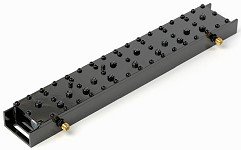




|
||||||||||||||||||||||||||||||||||||