See Page 1 | 2 | of the March 2025 homepage
archives.
 This letter was sent to Hugo Gernsback,
publisher of Radio-Electronics magazine, in response to the "30-Day
Record Response" article penned by noted scientist and inventor Mohammed Ulysses
Fips. In it, Stephen A. Kallis, Jr. heaped laud upon the "Most Revered and Esteemed
Fips" for his long-term recording device (remember, 1961 was many decades before
microminiature terabyte memory and microprocessors) were available, and chastises
Mr. Gernsback for evidently calling into question the authenticity of the recorder.
Kallis, a self-proclaimed stereo enthusiast, bolsters Fips' case by citing "A Proposed
Listening Area," by the Institute of Synergistic Statics Proceedings... This letter was sent to Hugo Gernsback,
publisher of Radio-Electronics magazine, in response to the "30-Day
Record Response" article penned by noted scientist and inventor Mohammed Ulysses
Fips. In it, Stephen A. Kallis, Jr. heaped laud upon the "Most Revered and Esteemed
Fips" for his long-term recording device (remember, 1961 was many decades before
microminiature terabyte memory and microprocessors) were available, and chastises
Mr. Gernsback for evidently calling into question the authenticity of the recorder.
Kallis, a self-proclaimed stereo enthusiast, bolsters Fips' case by citing "A Proposed
Listening Area," by the Institute of Synergistic Statics Proceedings...
 Raise your hand if you're old enough to
remember doing printed circuit board layout using
Rubylith tape. My hand is up. Back in the early 1980s, I did prototype
PCB designs in an engineering development lab at Westinghouse Electric's Oceanic
Division. Most of it was for analog and RF substrates that would be photographically
reduced in size for use with bare integrated circuit die and surface mount passive
components (Rs, Ls, and Cs), upon which I would later epoxy-mount those components
and wire-bond everything using 1-mil gold wire. However, there were projects where
full-size leaded components were used on a through-hole PCB that used not only the
Rubylith tapes but also sheets with special electronics shapes for solder pads around
the holes for components leads, ground and power planes, board-edge connectors... Raise your hand if you're old enough to
remember doing printed circuit board layout using
Rubylith tape. My hand is up. Back in the early 1980s, I did prototype
PCB designs in an engineering development lab at Westinghouse Electric's Oceanic
Division. Most of it was for analog and RF substrates that would be photographically
reduced in size for use with bare integrated circuit die and surface mount passive
components (Rs, Ls, and Cs), upon which I would later epoxy-mount those components
and wire-bond everything using 1-mil gold wire. However, there were projects where
full-size leaded components were used on a through-hole PCB that used not only the
Rubylith tapes but also sheets with special electronics shapes for solder pads around
the holes for components leads, ground and power planes, board-edge connectors...
 "Quantum
systems don't just transition between phases - they do so in ways that defy classical
intuition. A new experiment has directly observed these
dissipative phase transitions (DPTs), revealing how quantum states shift under
carefully controlled conditions. This breakthrough could unlock powerful new techniques
for stabilizing quantum computers and sensors, making them more resilient and precise
than ever before. A new frontier phase transitions, like water freezing into ice,
are a familiar part of everyday life. In quantum systems, however, these transitions
can be far more extreme, governed by principles like Heisenberg's uncertainty..." "Quantum
systems don't just transition between phases - they do so in ways that defy classical
intuition. A new experiment has directly observed these
dissipative phase transitions (DPTs), revealing how quantum states shift under
carefully controlled conditions. This breakthrough could unlock powerful new techniques
for stabilizing quantum computers and sensors, making them more resilient and precise
than ever before. A new frontier phase transitions, like water freezing into ice,
are a familiar part of everyday life. In quantum systems, however, these transitions
can be far more extreme, governed by principles like Heisenberg's uncertainty..."
 In this November
1940 issue of the Boy Scouts Boys' Life magazine, amateur radio operators,
or "hams," are described as having the ability to communicate across vast distances,
connecting far-flung locations such as Goulds, Florida, Cali, Colombia, Cairo, Kenilworth,
England, Bombay, and Brisbane. These operators, licensed by the Federal Communications
Commission, engage in various activities such as talking to distant stations, participating
in contests, and providing emergency communication during natural disasters. With
call letters assigned by international treaty, these stations use a combination
of code and phone to make contact, exchanging reports and QSL cards. The
Radio merit badge was first offered in 1918 and has been... In this November
1940 issue of the Boy Scouts Boys' Life magazine, amateur radio operators,
or "hams," are described as having the ability to communicate across vast distances,
connecting far-flung locations such as Goulds, Florida, Cali, Colombia, Cairo, Kenilworth,
England, Bombay, and Brisbane. These operators, licensed by the Federal Communications
Commission, engage in various activities such as talking to distant stations, participating
in contests, and providing emergency communication during natural disasters. With
call letters assigned by international treaty, these stations use a combination
of code and phone to make contact, exchanging reports and QSL cards. The
Radio merit badge was first offered in 1918 and has been...
 ConductRF is continually innovating and
developing new and improved solutions for RF Interconnect needs. See the latest
TESTeCON RF Test Cables
for labs. ConductRF makes production and test coax cable assemblies for amplitude
and phased matched VNA applications as well as standard & precision RF connectors.
Over 1,000 solutions for low PIM in-building to choose from in the iBwave component
library. They also provide custom coax solutions for applications where some standard
just won't do. A partnership with Newark assures fast, reliable access. Please visit
ConductRF today to see
how they can help your project! ConductRF is continually innovating and
developing new and improved solutions for RF Interconnect needs. See the latest
TESTeCON RF Test Cables
for labs. ConductRF makes production and test coax cable assemblies for amplitude
and phased matched VNA applications as well as standard & precision RF connectors.
Over 1,000 solutions for low PIM in-building to choose from in the iBwave component
library. They also provide custom coax solutions for applications where some standard
just won't do. A partnership with Newark assures fast, reliable access. Please visit
ConductRF today to see
how they can help your project!
 The date approacheth when, according to
Western customs, every body needs to stand a vigil against the attempt of another
body to make him or her a fool. That date is of course April 1st, aka, April
Fools' Day. Many of the technical magazine we grew up with - and some still today
- engage in the ruse. Innovator and publisher Hugo Gernsback, who's long list of
accomplishments includes this Radio-Electronics magazine, often contributed
his own wit to the April editions. The usual scheme is to make the article just
authentic enough to be possibly real, while including features outrageous enough
to clue the read that he is being "had." Experienced subscribers knew that the Mohammed
Ulysses Fips byline was sure to deliver an April Fools delight. Here, Mr. Fips
expounds on the newfangled "Electronics
Razor..." The date approacheth when, according to
Western customs, every body needs to stand a vigil against the attempt of another
body to make him or her a fool. That date is of course April 1st, aka, April
Fools' Day. Many of the technical magazine we grew up with - and some still today
- engage in the ruse. Innovator and publisher Hugo Gernsback, who's long list of
accomplishments includes this Radio-Electronics magazine, often contributed
his own wit to the April editions. The usual scheme is to make the article just
authentic enough to be possibly real, while including features outrageous enough
to clue the read that he is being "had." Experienced subscribers knew that the Mohammed
Ulysses Fips byline was sure to deliver an April Fools delight. Here, Mr. Fips
expounds on the newfangled "Electronics
Razor..."
 "Quantum computing has long struggled with
creating
entangled photons efficiently, but a team of researchers has discovered a game-changing
method using metasurfaces - flat, engineered structures that control light. By leveraging
these metasurfaces, they can generate and manipulate entangled photons more easily
and compactly than ever before. This breakthrough could open the door to smaller,
more powerful quantum computers and even pave the way for quantum networks that
deliver entangled photons to multiple users..." "Quantum computing has long struggled with
creating
entangled photons efficiently, but a team of researchers has discovered a game-changing
method using metasurfaces - flat, engineered structures that control light. By leveraging
these metasurfaces, they can generate and manipulate entangled photons more easily
and compactly than ever before. This breakthrough could open the door to smaller,
more powerful quantum computers and even pave the way for quantum networks that
deliver entangled photons to multiple users..."
 Here is a chart you don't see every day
- "Temperature Rise in Rigid Waveguide." The company, Engineering
Antenna Systems, of Manchester, New Hampshire, that published the chart in a 1965
edition of Engineering magazine, does not exist anymore. They were probably
bought by someone else, but I could not even find an honorable mention of them in
a Google search. Given the very low attenuation of properly sized and installed
waveguide, it is hard to imagine a temperature rise of 500°F; however, when megawatts
are pumped into it even a couple tenths of a decibel of attenuation per 100 feet
results in a lot of power loss. Noted is how attenuation - and therefore temperature
rise - is greater for frequencies at the lower end of the waveguide's operational
range. Temperature rise numbers are for natural convection in free air... Here is a chart you don't see every day
- "Temperature Rise in Rigid Waveguide." The company, Engineering
Antenna Systems, of Manchester, New Hampshire, that published the chart in a 1965
edition of Engineering magazine, does not exist anymore. They were probably
bought by someone else, but I could not even find an honorable mention of them in
a Google search. Given the very low attenuation of properly sized and installed
waveguide, it is hard to imagine a temperature rise of 500°F; however, when megawatts
are pumped into it even a couple tenths of a decibel of attenuation per 100 feet
results in a lot of power loss. Noted is how attenuation - and therefore temperature
rise - is greater for frequencies at the lower end of the waveguide's operational
range. Temperature rise numbers are for natural convection in free air...
 Here is an inspiring interview of
Werbel Microwave's Ernest Werbel - a case of pulling oneself up by one's own
bootstraps --- everything RF recently interviewed Ernest Werbel, the Chief Design
Engineer of Werbel Microwave. He is from Livingston, NJ, and got his associates
in EE Technology, at County College of Morris. Ernest completed his Bachelors in
Electronics and Computer Engineering Technology from NJ Institute of Technology.
He founded Werbel Microwave in 2014. Q. Can you tell us about Werbel Microwave?
When did you start the company and how has it evolved over the years? Ernest T.
Werbel: Firstly, thank you for the opportunity to participate in the everything
RF community. I appreciate everything that Raghav and his team have done for us
since the beginning, getting our products listed on everything RF and featuring
our products in the email blasts... As a child and teen in the 90s, I was always
interested in electronics. When I was very young, a radio was a magical box with
a voice. Later, when my grandparents passed in '97, my parents and I were cleaning
out their home in Brooklyn. Among other things were many old and broken consumer
electronic items... Here is an inspiring interview of
Werbel Microwave's Ernest Werbel - a case of pulling oneself up by one's own
bootstraps --- everything RF recently interviewed Ernest Werbel, the Chief Design
Engineer of Werbel Microwave. He is from Livingston, NJ, and got his associates
in EE Technology, at County College of Morris. Ernest completed his Bachelors in
Electronics and Computer Engineering Technology from NJ Institute of Technology.
He founded Werbel Microwave in 2014. Q. Can you tell us about Werbel Microwave?
When did you start the company and how has it evolved over the years? Ernest T.
Werbel: Firstly, thank you for the opportunity to participate in the everything
RF community. I appreciate everything that Raghav and his team have done for us
since the beginning, getting our products listed on everything RF and featuring
our products in the email blasts... As a child and teen in the 90s, I was always
interested in electronics. When I was very young, a radio was a magical box with
a voice. Later, when my grandparents passed in '97, my parents and I were cleaning
out their home in Brooklyn. Among other things were many old and broken consumer
electronic items...
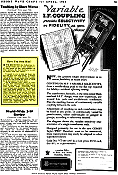 Today we have
missing persons notices printed on milk cartons and computer-aged
pictures of missing kids on bulletin boards at Walmart, and of course the Internet
with all its various forms of publicity. In 1935, evidently, an electronics magazine
was a proper venue for placing a missing person ad. At the time there was no convenient
and accessible way for family members to reach out to a nationwide audience other
than to place ads in magazines and/or newspapers in remote locations. I thought
it odd to see such a placement in this edition of Short Wave Craft magazine,
but considering the aforementioned, doing so is entirely reasonable for a worried
family. I wonder how much it cost to place the notice? It's heartbreaking, really... Today we have
missing persons notices printed on milk cartons and computer-aged
pictures of missing kids on bulletin boards at Walmart, and of course the Internet
with all its various forms of publicity. In 1935, evidently, an electronics magazine
was a proper venue for placing a missing person ad. At the time there was no convenient
and accessible way for family members to reach out to a nationwide audience other
than to place ads in magazines and/or newspapers in remote locations. I thought
it odd to see such a placement in this edition of Short Wave Craft magazine,
but considering the aforementioned, doing so is entirely reasonable for a worried
family. I wonder how much it cost to place the notice? It's heartbreaking, really...
• 2025 Tech Jobs Expected
to Take Off
• Semiconductor
Industry Faces a Seismic Shift
• 76% of
News Consumers Still Use AM/FM
• FCC
Spectrum Rules to Support Advanced Flight Technologies
• Radio
Attracts High Purchasing Power Consumers
 I'm always aware of the old saying that
it is better to remain silent and thought a fool, than to open your mouth and remove
all doubt, but I'll take the risk here. The ARRL's QST magazine has for
decades in the April issue published at least one unannounced "April Fool" item.
I think I found at least two for 2025. While enthusiastically reading "Turn Your
Vertical Antenna into a Rotatable Beam," (p60), it didn't occur to me that this
was the April issue, and I was in awe of Jay Kolinsky's (NE2Q) intuition and creativity
in devising a scheme to get directivity from his standard vertical whip antenna.
By sliding a carbon fiber tube with a narrow slit along the length over top of the
antenna, a 14 dB increase was realized in the direction of the slit. NE2Q has
named his invention the Loof Lirpa Slot (LLS). What's in a name -
Juliet?.
Is a patent in the works? I'm always aware of the old saying that
it is better to remain silent and thought a fool, than to open your mouth and remove
all doubt, but I'll take the risk here. The ARRL's QST magazine has for
decades in the April issue published at least one unannounced "April Fool" item.
I think I found at least two for 2025. While enthusiastically reading "Turn Your
Vertical Antenna into a Rotatable Beam," (p60), it didn't occur to me that this
was the April issue, and I was in awe of Jay Kolinsky's (NE2Q) intuition and creativity
in devising a scheme to get directivity from his standard vertical whip antenna.
By sliding a carbon fiber tube with a narrow slit along the length over top of the
antenna, a 14 dB increase was realized in the direction of the slit. NE2Q has
named his invention the Loof Lirpa Slot (LLS). What's in a name -
Juliet?.
Is a patent in the works?
 The other suspect is the CW Corp. of America's
"Snappy
Training Key," reported on page 95 by Ellwood Brem (K3YV). You need to log in
to read the articles, or borrow a hard copy from a Ham friend. The other suspect is the CW Corp. of America's
"Snappy
Training Key," reported on page 95 by Ellwood Brem (K3YV). You need to log in
to read the articles, or borrow a hard copy from a Ham friend.
 "A major scientific leap has been made with
the creation of the longest
ultra-secure quantum satellite link between China and South Africa, spanning
nearly 13,000 km. This unprecedented achievement, marking the first quantum satellite
link in the Southern Hemisphere, relied on real-time quantum key distribution to
transmit encrypted images between continents. World’s Longest Quantum Satellite
Link Established Scientists from South Africa and China have successfully created
the world’s longest intercontinental quantum satellite link, spanning 12,900 kilometers
(~8,000 miles). This ultra-secure connection was made possible using China's Jinan-1..." "A major scientific leap has been made with
the creation of the longest
ultra-secure quantum satellite link between China and South Africa, spanning
nearly 13,000 km. This unprecedented achievement, marking the first quantum satellite
link in the Southern Hemisphere, relied on real-time quantum key distribution to
transmit encrypted images between continents. World’s Longest Quantum Satellite
Link Established Scientists from South Africa and China have successfully created
the world’s longest intercontinental quantum satellite link, spanning 12,900 kilometers
(~8,000 miles). This ultra-secure connection was made possible using China's Jinan-1..."
 According to the science and mechanics magazine
I read during the 1960s through 1980s, we should all have personal nuclear power
generators powering our houses, watches, cars, and just about anything that runs
on electricity. Like with flying cars and robotic domestic servants, were not even
close to that a quarter of the way through the next century (2025). This news item
appears to be a good start on the promise. "Imagine never charging your phone again
or having a pacemaker that lasts a lifetime. Scientists are developing tiny
nuclear batteries powered by radiocarbon, a safe and abundant by-product of
nuclear plants. Unlike lithium-ion batteries, which degrade over time and harm the
environment, these new designs use beta radiation to trigger an electron avalanche
and generate electricity. The technology could one day make nuclear power as accessible
as your pocket device..." According to the science and mechanics magazine
I read during the 1960s through 1980s, we should all have personal nuclear power
generators powering our houses, watches, cars, and just about anything that runs
on electricity. Like with flying cars and robotic domestic servants, were not even
close to that a quarter of the way through the next century (2025). This news item
appears to be a good start on the promise. "Imagine never charging your phone again
or having a pacemaker that lasts a lifetime. Scientists are developing tiny
nuclear batteries powered by radiocarbon, a safe and abundant by-product of
nuclear plants. Unlike lithium-ion batteries, which degrade over time and harm the
environment, these new designs use beta radiation to trigger an electron avalanche
and generate electricity. The technology could one day make nuclear power as accessible
as your pocket device..."
 FM (frequency modulation) radio certainly
was a hot topic beginning in the middle to late 1940s. With the war out of the way,
energies and resources were being redirected back to peacetime production. Major
Edwin Armstrong announced his FM scheme in 1935, and as with many new inventions,
it was met with skepticism by many who doubted his claim of static interference
immunity. For many, it was a lack of understanding that caused the negative reaction,
caused primarily by the increased level of sophistication of the transmitter and
receiver circuitry. Amplitude modulation (AM) was so easy even a caveman could understand
it, but adding phase relationships into the equation (literally) left many in the
dust. This
FM Radio Quiz from a 1950 issue of Radio & Television
News magazine tests your grasp of frequency modulation principles... FM (frequency modulation) radio certainly
was a hot topic beginning in the middle to late 1940s. With the war out of the way,
energies and resources were being redirected back to peacetime production. Major
Edwin Armstrong announced his FM scheme in 1935, and as with many new inventions,
it was met with skepticism by many who doubted his claim of static interference
immunity. For many, it was a lack of understanding that caused the negative reaction,
caused primarily by the increased level of sophistication of the transmitter and
receiver circuitry. Amplitude modulation (AM) was so easy even a caveman could understand
it, but adding phase relationships into the equation (literally) left many in the
dust. This
FM Radio Quiz from a 1950 issue of Radio & Television
News magazine tests your grasp of frequency modulation principles...
 Stan Goldberg is a familiar name to comic
book aficionados for his artistry in Spider Man, the Incredible Hulk, and the Archie
series. QST magazine had him listed in the "Silent Keys" column in the
November 2014 issue because he passed away in August. A Silent Key, in Hamdom, is
usually a title reserved for a deceased licensed operator (the 'key' reference being
a Morse code key), but a search of the Internet and the FCC license database web
page did not turn up a call sign for him. Unless his record has been dropped from
the database, Mr. Goldberg might never have actually been a Ham, but earned the
Silent Key acknowledgement because of his involvement in a 1986 special edition
comic book titled "Archie's Ham Radio Adventure." It was quite an extensive story... Stan Goldberg is a familiar name to comic
book aficionados for his artistry in Spider Man, the Incredible Hulk, and the Archie
series. QST magazine had him listed in the "Silent Keys" column in the
November 2014 issue because he passed away in August. A Silent Key, in Hamdom, is
usually a title reserved for a deceased licensed operator (the 'key' reference being
a Morse code key), but a search of the Internet and the FCC license database web
page did not turn up a call sign for him. Unless his record has been dropped from
the database, Mr. Goldberg might never have actually been a Ham, but earned the
Silent Key acknowledgement because of his involvement in a 1986 special edition
comic book titled "Archie's Ham Radio Adventure." It was quite an extensive story...
 In a 1966 issue of Radio-Electronics
magazine, a revolutionary sodium-sulfur storage battery was demonstrated at a Detroit
press conference, suggesting that Ford could enter the electric car market within
the next ten years, and in the process "bring
back electric autos." That suggests there were EVs before, and in fact, there
were, at the turn of the 20th Century. The new battery, operating at 800° Fahrenheit,
was completely sealed and produced 15 times more power than a lead-acid battery
of the same weight, without the need to vent charging gases. The battery's design
featured sodium and sulfur separated by a ceramic partition, with sodium ions moving
through the ceramic to form sodium sulfide during discharge and reversing the process
during charging, producing no gases or byproducts... In a 1966 issue of Radio-Electronics
magazine, a revolutionary sodium-sulfur storage battery was demonstrated at a Detroit
press conference, suggesting that Ford could enter the electric car market within
the next ten years, and in the process "bring
back electric autos." That suggests there were EVs before, and in fact, there
were, at the turn of the 20th Century. The new battery, operating at 800° Fahrenheit,
was completely sealed and produced 15 times more power than a lead-acid battery
of the same weight, without the need to vent charging gases. The battery's design
featured sodium and sulfur separated by a ceramic partition, with sodium ions moving
through the ceramic to form sodium sulfide during discharge and reversing the process
during charging, producing no gases or byproducts...
 This
Electronics Current Quiz from the October 1963 edition of Popular Electronics
magazine is recent enough (if you consider more than half a century ago to be recent)
that it uses both transistors as well as vacuum tubes in the example circuits. I
have to admit to only scoring 60% on the quiz, which is pretty lame. You will probably
do better, especially if you are my age or older. I thought the names of the current
type would make the challenge a breeze, but not so in my case. Just as back in school
days when looking up the solution to problems in the back of the textbook and the
answers seem obvious (well, not always), so, too, do these... This
Electronics Current Quiz from the October 1963 edition of Popular Electronics
magazine is recent enough (if you consider more than half a century ago to be recent)
that it uses both transistors as well as vacuum tubes in the example circuits. I
have to admit to only scoring 60% on the quiz, which is pretty lame. You will probably
do better, especially if you are my age or older. I thought the names of the current
type would make the challenge a breeze, but not so in my case. Just as back in school
days when looking up the solution to problems in the back of the textbook and the
answers seem obvious (well, not always), so, too, do these...
 "Researchers at the University of Twente,
in collaboration with the City University of Hong Kong, have designed a cutting-edge
programmable
photonic chip in a thin-film lithium niobate platform, an important material
in photonics. Published in Nature Communications, this work paves the way for next-generation
high-performance radar and communication applications. An important material is
changing the way optical chips work, making them smaller, faster, and more efficient:
thin-film lithium niobate (TFLN). It offers exceptional properties for how light
and electrical signals can interact..." "Researchers at the University of Twente,
in collaboration with the City University of Hong Kong, have designed a cutting-edge
programmable
photonic chip in a thin-film lithium niobate platform, an important material
in photonics. Published in Nature Communications, this work paves the way for next-generation
high-performance radar and communication applications. An important material is
changing the way optical chips work, making them smaller, faster, and more efficient:
thin-film lithium niobate (TFLN). It offers exceptional properties for how light
and electrical signals can interact..."
 Alexander Graham Bell was born on March
3, 1847, in Edinburgh, Scotland, to Alexander Melville Bell and Eliza Grace Symonds.
His father was a professor of elocution and the inventor of Visible Speech, a system
designed to help deaf people communicate. His mother, Eliza, was an accomplished
pianist who lost her hearing later in life. Bell was the second of three children;
his brothers, Melville James and Edward Charles, both died of tuberculosis. Bell's
early education was influenced by his father's work in speech and elocution. He
attended the Royal High School in Edinburgh and later studied at the University
of Edinburgh, though he did not complete a degree. His family moved to London in
1865, where Bell continued his studies at University College London, focusing on
anatomy and physiology. In 1870, the Bell family emigrated to Canada to escape the
tuberculosis that had claimed Bell's brothers... Alexander Graham Bell was born on March
3, 1847, in Edinburgh, Scotland, to Alexander Melville Bell and Eliza Grace Symonds.
His father was a professor of elocution and the inventor of Visible Speech, a system
designed to help deaf people communicate. His mother, Eliza, was an accomplished
pianist who lost her hearing later in life. Bell was the second of three children;
his brothers, Melville James and Edward Charles, both died of tuberculosis. Bell's
early education was influenced by his father's work in speech and elocution. He
attended the Royal High School in Edinburgh and later studied at the University
of Edinburgh, though he did not complete a degree. His family moved to London in
1865, where Bell continued his studies at University College London, focusing on
anatomy and physiology. In 1870, the Bell family emigrated to Canada to escape the
tuberculosis that had claimed Bell's brothers...
 Here is a handy-dandy baker's dozen of "kinks,"
otherwise known as
tricks of the trade, shortcuts, or clever ideas, that could prove
useful while working in the lab at work or in your shop at home. They appeared in
a 1935 issue of Hugo Gernsback's Short Wave Craft magazine. One suggestion
is to place a sheet of tracing paper over your schematic while wiring a circuit
and draw each connection as it is completed, rather than mark up the original drawing.
That was definitely good for a time when making a spare copy of a magazine page
or assembly instruction from a kit was not as simple a matter as it is today. Whether
it be a schematic or a set of plans for a model airplane, I always make a copy to
work and draw notes on rather than defacing the original... Here is a handy-dandy baker's dozen of "kinks,"
otherwise known as
tricks of the trade, shortcuts, or clever ideas, that could prove
useful while working in the lab at work or in your shop at home. They appeared in
a 1935 issue of Hugo Gernsback's Short Wave Craft magazine. One suggestion
is to place a sheet of tracing paper over your schematic while wiring a circuit
and draw each connection as it is completed, rather than mark up the original drawing.
That was definitely good for a time when making a spare copy of a magazine page
or assembly instruction from a kit was not as simple a matter as it is today. Whether
it be a schematic or a set of plans for a model airplane, I always make a copy to
work and draw notes on rather than defacing the original...
 This quiz from a 1963 issue of Radio-Electronics
magazine tests readers'
familiarity with key electrical laws beyond the well-known Ohm's Law, including
Kirchhoff's voltage and current laws for circuit analysis, Joule's law for heat
in resistors, Poynting's theorem for energy flow, Lenz's law for induced forces,
Neumann's formula for transformers, Wien's displacement law impacting infrared electronics,
Helmholtz's theorem for vector fields, the Wiedemann-Franz-Lorentz law connecting
conductivity types, and Faraday's law of induction, challenging engineers to recall
these foundational principles and their discoverers. Well, it is not exactly a quiz
as much... This quiz from a 1963 issue of Radio-Electronics
magazine tests readers'
familiarity with key electrical laws beyond the well-known Ohm's Law, including
Kirchhoff's voltage and current laws for circuit analysis, Joule's law for heat
in resistors, Poynting's theorem for energy flow, Lenz's law for induced forces,
Neumann's formula for transformers, Wien's displacement law impacting infrared electronics,
Helmholtz's theorem for vector fields, the Wiedemann-Franz-Lorentz law connecting
conductivity types, and Faraday's law of induction, challenging engineers to recall
these foundational principles and their discoverers. Well, it is not exactly a quiz
as much...
 The electronics industry has long relied
on specialized publications to disseminate knowledge, share innovations, and connect
professionals within niche technical fields. One such publication,
RF Design, emerged as a cornerstone for engineers and designers working
in the realm of radio frequency (RF) and microwave technology. Under the stewardship
of Gary Breed (K9AY), who served as a key figure in its editorial direction,
RF Design became a vital resource for the RF engineering community. This paper
explores the history of RF Design, its evolution, and the significant role
played by Breed in shaping its legacy within the electronics industry. RF Design
was launched in 1978 by Penton Media, a prominent publisher of trade magazines catering
to various technical industries. The magazine was initially established under the
ISSN 0163-321X and targeted professionals involved in the design and application
of RF and microwave circuits... The electronics industry has long relied
on specialized publications to disseminate knowledge, share innovations, and connect
professionals within niche technical fields. One such publication,
RF Design, emerged as a cornerstone for engineers and designers working
in the realm of radio frequency (RF) and microwave technology. Under the stewardship
of Gary Breed (K9AY), who served as a key figure in its editorial direction,
RF Design became a vital resource for the RF engineering community. This paper
explores the history of RF Design, its evolution, and the significant role
played by Breed in shaping its legacy within the electronics industry. RF Design
was launched in 1978 by Penton Media, a prominent publisher of trade magazines catering
to various technical industries. The magazine was initially established under the
ISSN 0163-321X and targeted professionals involved in the design and application
of RF and microwave circuits...
 "These marvelous world records of electronics
focus on communications - from quantum bandwidth to longest distances. There's a
cottage industry of
world-record attempters - people or institutions who completely focus their
lives on world records ... Some world records showcase the peak of human achievement,
and I'm talking about the world of electronics. In an ongoing series of articles,
I hope to shed light on many of those accomplishments. The intent is to inspire,
educate, and (perhaps) surprise people with what we as engineers have accomplished.
In the first such showcase, I want to look at communications in both the terrestrial
and extraterrestrial (and not the Roswell type)..." "These marvelous world records of electronics
focus on communications - from quantum bandwidth to longest distances. There's a
cottage industry of
world-record attempters - people or institutions who completely focus their
lives on world records ... Some world records showcase the peak of human achievement,
and I'm talking about the world of electronics. In an ongoing series of articles,
I hope to shed light on many of those accomplishments. The intent is to inspire,
educate, and (perhaps) surprise people with what we as engineers have accomplished.
In the first such showcase, I want to look at communications in both the terrestrial
and extraterrestrial (and not the Roswell type)..."
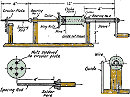 There are still a lot of people who
wind their own coils, whether it be for an amateur radio rig or
for work in the lab. I know I've wound many a coil around a drill bit or wooden
dowel. This simple coil winding machine that appeared in a 1931 edition of QST magazine
would be a handy addition to anyone's bag of tricks, especially if find yourself
winding single-layer coils that have a fixed space between the windings. The home
stores like Lowes and Home Depot sell small pieces of oak that would be perfect
for this kind of project. A little stain and a coat of varnish would give it a real
vintage look. Use your soldering iron to burn... There are still a lot of people who
wind their own coils, whether it be for an amateur radio rig or
for work in the lab. I know I've wound many a coil around a drill bit or wooden
dowel. This simple coil winding machine that appeared in a 1931 edition of QST magazine
would be a handy addition to anyone's bag of tricks, especially if find yourself
winding single-layer coils that have a fixed space between the windings. The home
stores like Lowes and Home Depot sell small pieces of oak that would be perfect
for this kind of project. A little stain and a coat of varnish would give it a real
vintage look. Use your soldering iron to burn...
 I, along with probably most other people
my age, habitually associate the brand name of Delco (Delco Electronics, technically) with General Motors (GM) electrical
and electronic products such as radios, storage batteries, alternators, and spark
plugs. Dayton Engineering Laboratories
Co., of Dayton, Ohio, merged with GM's AC spark plug division in
1974 to become AC-Delco. I bought many sets of AC-Delco spark plugs for my cars
over the years. Nowadays, GM's electronic products go by the name of ACDelco (no
hyphen now). Attempting to research the full provenance of the modern-day AC-Delco
is headache-inducing due to sell-offs to Delphi, Aptiv, and other entities. The
best I can determine is that the contemporary ACDelco is a brand name for products
that might be manufactured by many different companies. This advertisement searching
for electrical and mechanical engineers... I, along with probably most other people
my age, habitually associate the brand name of Delco (Delco Electronics, technically) with General Motors (GM) electrical
and electronic products such as radios, storage batteries, alternators, and spark
plugs. Dayton Engineering Laboratories
Co., of Dayton, Ohio, merged with GM's AC spark plug division in
1974 to become AC-Delco. I bought many sets of AC-Delco spark plugs for my cars
over the years. Nowadays, GM's electronic products go by the name of ACDelco (no
hyphen now). Attempting to research the full provenance of the modern-day AC-Delco
is headache-inducing due to sell-offs to Delphi, Aptiv, and other entities. The
best I can determine is that the contemporary ACDelco is a brand name for products
that might be manufactured by many different companies. This advertisement searching
for electrical and mechanical engineers...
 This 1963 Radio-Electronics magazine article
discusses the importance of the incoming signal vertical angle, or delta (from the
Greek letter, Δ), at which radio signals arrive for optimal
transoceanic short-wave reception. It highlights that most listeners are unaware
of this crucial factor and thus miss out on capturing signals from far-off stations.
The piece provides insights into how to calculate delta and suggests various antenna
setups, such as vertical wires with ground radials, to improve long-distance reception.
It also explains how existing structures like TV towers can be repurposed for superior
short-wave reception. The author emphasizes that understanding and utilizing the
concept of delta can significantly enhance... This 1963 Radio-Electronics magazine article
discusses the importance of the incoming signal vertical angle, or delta (from the
Greek letter, Δ), at which radio signals arrive for optimal
transoceanic short-wave reception. It highlights that most listeners are unaware
of this crucial factor and thus miss out on capturing signals from far-off stations.
The piece provides insights into how to calculate delta and suggests various antenna
setups, such as vertical wires with ground radials, to improve long-distance reception.
It also explains how existing structures like TV towers can be repurposed for superior
short-wave reception. The author emphasizes that understanding and utilizing the
concept of delta can significantly enhance...
 Here is a little
technology humor to help easy you into the week ahead, compliments of the April
1969 issue of Radio-Electronics magazine. Ironically, the themes of the
three comics (by three separate artists) represent an evolution of the electronics
realm over the past few decades, although almost certainly not planned by the editors.
The first has to do with a couple TV servicemen installing an antenna, the second
is of an out-of-work TV repairman, and the third is what might be considered a drone
by today's norms. There is a huge list of other comics at the bottom of the page.
I colorized them for you... Here is a little
technology humor to help easy you into the week ahead, compliments of the April
1969 issue of Radio-Electronics magazine. Ironically, the themes of the
three comics (by three separate artists) represent an evolution of the electronics
realm over the past few decades, although almost certainly not planned by the editors.
The first has to do with a couple TV servicemen installing an antenna, the second
is of an out-of-work TV repairman, and the third is what might be considered a drone
by today's norms. There is a huge list of other comics at the bottom of the page.
I colorized them for you...
 William Thomson, 1st Baron Kelvin, was born
on June 26, 1824, in Belfast, Ireland, to James Thomson and Margaret Gardner. His
father, James, was a professor of mathematics and engineering at the Royal Belfast
Academical Institution, and his mother, Margaret, was the daughter of a Glasgow
merchant. William was the fourth of seven children in the family. Unfortunately,
his mother passed away when he was just six years old, leaving a significant impact
on his early life. William's early education was largely influenced by his father,
who took a keen interest in his children's intellectual development. William showed
an early aptitude for mathematics and science, and by the age of ten, he was already
studying advanced calculus and geometry... William Thomson, 1st Baron Kelvin, was born
on June 26, 1824, in Belfast, Ireland, to James Thomson and Margaret Gardner. His
father, James, was a professor of mathematics and engineering at the Royal Belfast
Academical Institution, and his mother, Margaret, was the daughter of a Glasgow
merchant. William was the fourth of seven children in the family. Unfortunately,
his mother passed away when he was just six years old, leaving a significant impact
on his early life. William's early education was largely influenced by his father,
who took a keen interest in his children's intellectual development. William showed
an early aptitude for mathematics and science, and by the age of ten, he was already
studying advanced calculus and geometry...
 "Researchers based in China claim breakthrough
performance for
complementary logic (CL) circuits based on gallium nitride field-effect transistors
(FETs) in work presented at the International Electron Devices Meeting in December
2024. The team from Peking University, Beijing University of Technology, University
of Science and Technology of China, and Hong Kong University of Science and Technology,
comments: 'The work demonstrates the potential of GaN complementary logic for MHz
power integrated circuits (PICs) and harsh-environment electronics.' A key bottleneck
for GaN complementary logic performance is the p-channel..." "Researchers based in China claim breakthrough
performance for
complementary logic (CL) circuits based on gallium nitride field-effect transistors
(FETs) in work presented at the International Electron Devices Meeting in December
2024. The team from Peking University, Beijing University of Technology, University
of Science and Technology of China, and Hong Kong University of Science and Technology,
comments: 'The work demonstrates the potential of GaN complementary logic for MHz
power integrated circuits (PICs) and harsh-environment electronics.' A key bottleneck
for GaN complementary logic performance is the p-channel..."
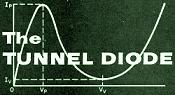 Leo Esaki invented the
tunnel diode (aka the Esaki diode) in 1957 while working at Sony
(Tokyo Tsushin Kogyo at the time). Tunnel diodes have a very narrow, heavily doped
p-n junction only around 10 nm (100 Å) wide that exhibits a broken bandgap,
where conduction band electrons on the n-side are approximately aligned with valence
band holes on the p-side and thereby facilitate the quantum mechanical tunneling
process after which the diode is named. A negative differential resistance in part
of their operating range makes them useful for high frequency oscillators. This
article in a 1960 edition of Popular Electronics introduces the device's characteristics
and potential uses. Interestingly, if you want to buy a tunnel diode today, you
will likely have to find old stock on on eBay... Leo Esaki invented the
tunnel diode (aka the Esaki diode) in 1957 while working at Sony
(Tokyo Tsushin Kogyo at the time). Tunnel diodes have a very narrow, heavily doped
p-n junction only around 10 nm (100 Å) wide that exhibits a broken bandgap,
where conduction band electrons on the n-side are approximately aligned with valence
band holes on the p-side and thereby facilitate the quantum mechanical tunneling
process after which the diode is named. A negative differential resistance in part
of their operating range makes them useful for high frequency oscillators. This
article in a 1960 edition of Popular Electronics introduces the device's characteristics
and potential uses. Interestingly, if you want to buy a tunnel diode today, you
will likely have to find old stock on on eBay...
 In 2003, the face of the Old Man of the
Mountain succumbed to the forces of nature, and fell to Earth. It was sad news.
An eons-old relic was suddenly gone, despite man's efforts to sustain it. Melanie
and the kids and I drove to New Hampshire in 1988 to see it. In 2020, the iconic
Arecibo radio telescope in Puerto Rico also succumbed to the forces of nature,
and fell to Earth. It was also sad news. Man's efforts (or lack thereof) to sustain
it were shameful. Most people, if they have ever seen it at all, probably know nothing
about it. The 1-kilometer diameter dish has been featured in multiple movies, including
James Bond's Golden Eye, Contact, and Species. In February 1964, this Radio-Electronics
magazine article introduced the amazing telescope to the world... In 2003, the face of the Old Man of the
Mountain succumbed to the forces of nature, and fell to Earth. It was sad news.
An eons-old relic was suddenly gone, despite man's efforts to sustain it. Melanie
and the kids and I drove to New Hampshire in 1988 to see it. In 2020, the iconic
Arecibo radio telescope in Puerto Rico also succumbed to the forces of nature,
and fell to Earth. It was also sad news. Man's efforts (or lack thereof) to sustain
it were shameful. Most people, if they have ever seen it at all, probably know nothing
about it. The 1-kilometer diameter dish has been featured in multiple movies, including
James Bond's Golden Eye, Contact, and Species. In February 1964, this Radio-Electronics
magazine article introduced the amazing telescope to the world...
 "There's a major difference between humans
and current artificial intelligence (AI) capabilities: common sense. According to
a new paper by Walid Saad, professor in the College of Engineering and the Next-G
Wireless Lead at the Virginia Tech Innovation Campus, a true revolution in wireless
technologies is only possible through endowing the system with the next generation
of AI that can think, imagine, and plan akin to humans. The missing link in the
wireless revolution is next-generation AI. The missing link in the next generation
of AI is wireless technologies. The solution is to bring AI closer to human intelligence
through common sense..." "There's a major difference between humans
and current artificial intelligence (AI) capabilities: common sense. According to
a new paper by Walid Saad, professor in the College of Engineering and the Next-G
Wireless Lead at the Virginia Tech Innovation Campus, a true revolution in wireless
technologies is only possible through endowing the system with the next generation
of AI that can think, imagine, and plan akin to humans. The missing link in the
wireless revolution is next-generation AI. The missing link in the next generation
of AI is wireless technologies. The solution is to bring AI closer to human intelligence
through common sense..."
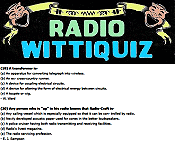 Mixing a little fun with learning has always
been a good motivation for students. I have written in the past about a particular
electronic circuits professor I had that liked to play practical jokes during lessons
and exams. Including gag options on a multiple choice test is a great way to inject
a bit of tension-easing levity while at the same time eliminating one or more opportunities
to guess at a wrong answer (although no relief for the truly clueless).
I sometimes do that on the RF Cafe
Quizzes that I generate. Radio Craft magazine printed a large bunch
of such quiz questions under the title "Radio WittiQuiz. This example from a 1938 edition is typical... Mixing a little fun with learning has always
been a good motivation for students. I have written in the past about a particular
electronic circuits professor I had that liked to play practical jokes during lessons
and exams. Including gag options on a multiple choice test is a great way to inject
a bit of tension-easing levity while at the same time eliminating one or more opportunities
to guess at a wrong answer (although no relief for the truly clueless).
I sometimes do that on the RF Cafe
Quizzes that I generate. Radio Craft magazine printed a large bunch
of such quiz questions under the title "Radio WittiQuiz. This example from a 1938 edition is typical...
 Exodus Advanced Communications, is a multinational
RF communication equipment and engineering service company serving both commercial
and government entities and their affiliates worldwide. Exodus' model
AMP20043 high power solid state power amplifier (SSHPA) is ideal for broadband
EMI-Lab, communications, and EW applications. Class A/AB linear design accommodates
all modulations & industry standards. Covers 1.0-6.0 GHz, producing 300 W
minimum, with a 200 W P1dB and 55 dB minimum gain. Excellent flatness,
optional monitoring parameters for forward/reflected power, VSWR, voltage, current &
temperature sensing for superb reliability and ruggedness... Exodus Advanced Communications, is a multinational
RF communication equipment and engineering service company serving both commercial
and government entities and their affiliates worldwide. Exodus' model
AMP20043 high power solid state power amplifier (SSHPA) is ideal for broadband
EMI-Lab, communications, and EW applications. Class A/AB linear design accommodates
all modulations & industry standards. Covers 1.0-6.0 GHz, producing 300 W
minimum, with a 200 W P1dB and 55 dB minimum gain. Excellent flatness,
optional monitoring parameters for forward/reflected power, VSWR, voltage, current &
temperature sensing for superb reliability and ruggedness...
 "Much of the world's web traffic is routed
through data centers, which also fuel power-guzzling artificial intelligence (AI)
applications. In the U.S. alone, data centers consumed around 4 percent of the country's
total electricity in 2023, and that number is projected to rise up to 12 percent
by 2028. Martin
Karsten, a professor of systems and networking at the University of Waterloo
in Canada, [is] enhancing current methods in the tiniest of ways to reduce data
center energy consumption. Martin Karsten, a Waterloo computer science professor,
and his collaborators fixed an inefficiency that can
save up to 30%
of data center energy use..." "Much of the world's web traffic is routed
through data centers, which also fuel power-guzzling artificial intelligence (AI)
applications. In the U.S. alone, data centers consumed around 4 percent of the country's
total electricity in 2023, and that number is projected to rise up to 12 percent
by 2028. Martin
Karsten, a professor of systems and networking at the University of Waterloo
in Canada, [is] enhancing current methods in the tiniest of ways to reduce data
center energy consumption. Martin Karsten, a Waterloo computer science professor,
and his collaborators fixed an inefficiency that can
save up to 30%
of data center energy use..."
 Today if you need a
printed circuit board (PCB) for prototyping, there is a good chance
you will look up a quick-turn company like those found on the PCB Directory website
like Bittelle, San Francisco Circuits, or a host of other providers. Costs can be
a little as $40 to $50 for three, 3" x 3", 2-layer PCBs and can be delivered in
a week or less. A 4-layer PCB of the same size would cost somewhere around $100.
Considering how much circuitry can be squeezed into a 9 inch2 board these
days, board with surface mounted components on both sides, that's a lot of board
for a little money. If you are really in a hurry for your boards, the fabrication
companies offer various levels of expedited service for more $$$. There are some
people who for one reason or another still prefer to make their own PCBs. For them,
this article from 1972 Popular Electronics magazine might be a good resource
for how... Today if you need a
printed circuit board (PCB) for prototyping, there is a good chance
you will look up a quick-turn company like those found on the PCB Directory website
like Bittelle, San Francisco Circuits, or a host of other providers. Costs can be
a little as $40 to $50 for three, 3" x 3", 2-layer PCBs and can be delivered in
a week or less. A 4-layer PCB of the same size would cost somewhere around $100.
Considering how much circuitry can be squeezed into a 9 inch2 board these
days, board with surface mounted components on both sides, that's a lot of board
for a little money. If you are really in a hurry for your boards, the fabrication
companies offer various levels of expedited service for more $$$. There are some
people who for one reason or another still prefer to make their own PCBs. For them,
this article from 1972 Popular Electronics magazine might be a good resource
for how...
• Semiconductor
Devices Industry to Reach $1T by 2030
• FCC Issues
PIRATE Radio Annual Report
• Sci-Fi Movie
Spark Interest in Amateur Radio
• Electronic
Product Sustainability Regulations
• NPR: "National
Propaganda Radio"
 According to a two-page spread in a 1963
issue of Radio-Electronics magazine, the Winegard Colortron antenna was
considered the world's best performing VHF all-channel TV antenna for its size and
price. It was designed specifically for color TV and featured a "genuine" gold anodized
finish for permanent protection. The Colortron model C-42, priced at $34.95 ($364
in 2025 money - an inflation factor of more than 10x), "is known for its near-perfect
performance, with high sensitivity, sharp directivity, and an
exact 300 Ω non-reactive impedance on every VHF channel from 2 to 13".
The Colortron amplifier, which employed two nuvistors, overcomes service problems
and limitations of other amplifiers, delivering clean, clear pictures without smear.
The buffering action of that amplifier is what provided... According to a two-page spread in a 1963
issue of Radio-Electronics magazine, the Winegard Colortron antenna was
considered the world's best performing VHF all-channel TV antenna for its size and
price. It was designed specifically for color TV and featured a "genuine" gold anodized
finish for permanent protection. The Colortron model C-42, priced at $34.95 ($364
in 2025 money - an inflation factor of more than 10x), "is known for its near-perfect
performance, with high sensitivity, sharp directivity, and an
exact 300 Ω non-reactive impedance on every VHF channel from 2 to 13".
The Colortron amplifier, which employed two nuvistors, overcomes service problems
and limitations of other amplifiers, delivering clean, clear pictures without smear.
The buffering action of that amplifier is what provided...
 This old man (Kirt Blattenberger) reaches
Social Security (SS) Full Retirement Age (FRA) on April 18th, so my benefits
will begin being paid on May 1st. Being the progenitor and webmaster of RF
Cafe, that makes the following information relevant. For those not familiar with
SS, for my birth year, 1958, full retirement age occurs at 66 years and 8 months
(66y8m). If I had begun collecting SS prior to now (eligible at 62y0m), my benefit
amount would be reduced to around 60% of the full FRA level. It would never go above
that level. The reduction linearly adjusted from 62y0m through 66y8m, but you are
forever locked in at the rate where you begin. Not only that, but there is a one-for-two
reduction where SS benefits are reduced by one dollar for every two dollars earned
over a specified threshold (currently $21,240). That means if, prior to FRA, I earned... This old man (Kirt Blattenberger) reaches
Social Security (SS) Full Retirement Age (FRA) on April 18th, so my benefits
will begin being paid on May 1st. Being the progenitor and webmaster of RF
Cafe, that makes the following information relevant. For those not familiar with
SS, for my birth year, 1958, full retirement age occurs at 66 years and 8 months
(66y8m). If I had begun collecting SS prior to now (eligible at 62y0m), my benefit
amount would be reduced to around 60% of the full FRA level. It would never go above
that level. The reduction linearly adjusted from 62y0m through 66y8m, but you are
forever locked in at the rate where you begin. Not only that, but there is a one-for-two
reduction where SS benefits are reduced by one dollar for every two dollars earned
over a specified threshold (currently $21,240). That means if, prior to FRA, I earned...
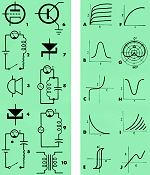 This
Electronics Curves Quiz will probably prove to be a little more
of a challenge than some of the ones previously appearing in a 1963 issue of
Popular Electronics magazine. Being a rocket scientist won't help you much
here, but being a seasoned electronics technician, hobbyist, or engineer will sure
come in handy. Be careful to note the axis unit labels - I got tripped up by that
from being lazy and missed one. Surely you won't be hindered by such an oversight. This
Electronics Curves Quiz will probably prove to be a little more
of a challenge than some of the ones previously appearing in a 1963 issue of
Popular Electronics magazine. Being a rocket scientist won't help you much
here, but being a seasoned electronics technician, hobbyist, or engineer will sure
come in handy. Be careful to note the axis unit labels - I got tripped up by that
from being lazy and missed one. Surely you won't be hindered by such an oversight.
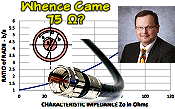 Mr. Conrad Young,
whom I have the pleasure of knowing from our days at RFMD and is now the Senior
Microwave Oven Design Engineer at TurboChef Technologies,
Inc., published this excellent whitepaper entitled, "Where
Does 75-Ohms Come from Anyway??" Much has been written on the origin of 50 Ω
coaxial cable (with some disagreement), but not so much about 75 Ω. Most of
us in the RF field know that 75 Ω coax has lower attenuation per unit length
than does 50 Ω (which has high power handling). A delve into 75 Ω's history
with the broadcast TV industry provides a segue into some high level theoretical
discussions and then finally presenting various coaxial cable and connector configurations.
It is a good read with lots of source references for further investigation if you
so desire. Mr. Conrad Young,
whom I have the pleasure of knowing from our days at RFMD and is now the Senior
Microwave Oven Design Engineer at TurboChef Technologies,
Inc., published this excellent whitepaper entitled, "Where
Does 75-Ohms Come from Anyway??" Much has been written on the origin of 50 Ω
coaxial cable (with some disagreement), but not so much about 75 Ω. Most of
us in the RF field know that 75 Ω coax has lower attenuation per unit length
than does 50 Ω (which has high power handling). A delve into 75 Ω's history
with the broadcast TV industry provides a segue into some high level theoretical
discussions and then finally presenting various coaxial cable and connector configurations.
It is a good read with lots of source references for further investigation if you
so desire.
 The
term "modern" in the title of any book or article never has set right with me because
it is utterly ambiguous about the era to which "modern" refers. Sure, it sounds
good at the time, but when applied to this 1966 QST magazine article, "modern"
should be replaced with "four-decade-old." However, in this case the content is
still relevant even thought it was written so long ago (or else I would not be reproducing
it here). It may well have been most people's first exposure to elliptical (Cauer)
filters. As you might expect, the rigorous, headache-inducing mathematics is omitted,
but the article does give an example of implementing an audio frequency bandpass
filter by cascading a lowpass filter and a highpass filter. If you are familiar
with filter design, you know that because of phasing and inband... The
term "modern" in the title of any book or article never has set right with me because
it is utterly ambiguous about the era to which "modern" refers. Sure, it sounds
good at the time, but when applied to this 1966 QST magazine article, "modern"
should be replaced with "four-decade-old." However, in this case the content is
still relevant even thought it was written so long ago (or else I would not be reproducing
it here). It may well have been most people's first exposure to elliptical (Cauer)
filters. As you might expect, the rigorous, headache-inducing mathematics is omitted,
but the article does give an example of implementing an audio frequency bandpass
filter by cascading a lowpass filter and a highpass filter. If you are familiar
with filter design, you know that because of phasing and inband...
 As reported in this 1960 Radio-Electronics
magazine infomercial, Bell Laboratories engineer Harold S. Black conceived of the
negative feedback principle while commuting to work, which revolutionized signal
amplification and enabled the expansion of telephone and TV networks, transoceanic
cables, and precise military radar and missile-control systems. Black's achievement,
along with his 60 U.S. patents, earned him the 1957 Lamme Medal from the American
Institute of Electrical Engineers. This accomplishment reflects the innovative spirit
shared by Bell Telephone Laboratories scientists and engineers... As reported in this 1960 Radio-Electronics
magazine infomercial, Bell Laboratories engineer Harold S. Black conceived of the
negative feedback principle while commuting to work, which revolutionized signal
amplification and enabled the expansion of telephone and TV networks, transoceanic
cables, and precise military radar and missile-control systems. Black's achievement,
along with his 60 U.S. patents, earned him the 1957 Lamme Medal from the American
Institute of Electrical Engineers. This accomplishment reflects the innovative spirit
shared by Bell Telephone Laboratories scientists and engineers...
 "RF coupling is one of the most important
and tricky issues that RFIC designers always must confront while developing wireless
SoCs.
Wireless system-on-chip (SoC) designs require implementing all circuit domains
on the same die. This enables manufacturers to reduce cost and support integrity.
On the other hand, crosstalk between these domains can be problematic and degrade
the overall performance. Electromagnetic interference (EMI) is caused by radiated
radio-frequency (RF) signals. Various techniques are available to lower EMI in system
design. For instance, radiated RF can be addressed..." "RF coupling is one of the most important
and tricky issues that RFIC designers always must confront while developing wireless
SoCs.
Wireless system-on-chip (SoC) designs require implementing all circuit domains
on the same die. This enables manufacturers to reduce cost and support integrity.
On the other hand, crosstalk between these domains can be problematic and degrade
the overall performance. Electromagnetic interference (EMI) is caused by radiated
radio-frequency (RF) signals. Various techniques are available to lower EMI in system
design. For instance, radiated RF can be addressed..."
 If you are a fan of John T. Frye's "Mac's
Service Shop" series of technodramas, then you might also appreciate this short-run
stories by Bob Eldridge titled, "Another Day in the Shop." Up through maybe the early 1980s, every
town had at least one electronics service shop for taking care of televisions, radios,
record players, tape recorders and players, cameras, computers, and just about anything
else that might be fixed at less cost than buying a replacement unit. In the 1940's
through the 1960's, there was often good money to be made not only with in-shop
repair but also with doing house calls for repair and installation. Electronics
magazines of the era were filled with both self-help and tips for the professionals
regarding troubleshooting, use of test equipment, how to deal with customers, etc.
Electronics World even ran for a while a feature that suggested types and
quantities of replacement tubes, capacitors..." If you are a fan of John T. Frye's "Mac's
Service Shop" series of technodramas, then you might also appreciate this short-run
stories by Bob Eldridge titled, "Another Day in the Shop." Up through maybe the early 1980s, every
town had at least one electronics service shop for taking care of televisions, radios,
record players, tape recorders and players, cameras, computers, and just about anything
else that might be fixed at less cost than buying a replacement unit. In the 1940's
through the 1960's, there was often good money to be made not only with in-shop
repair but also with doing house calls for repair and installation. Electronics
magazines of the era were filled with both self-help and tips for the professionals
regarding troubleshooting, use of test equipment, how to deal with customers, etc.
Electronics World even ran for a while a feature that suggested types and
quantities of replacement tubes, capacitors..."
 "Plasmonic
modulators are tiny components that convert electrical signals into optical
signals in order to transport them through optical fibers. A modulator of this kind
had never managed to transmit data at a frequency of over a terahertz. Now, researchers
have succeeded in doing just that. Previous modulators could only convert frequencies
up to 100 or 200 gigahertz - in other words, frequencies that are five to ten times
lower. Modulators of this kind could be used wherever large volumes of data are
transmitted, as a bridge between the electrical world and data transmission using
light..." "Plasmonic
modulators are tiny components that convert electrical signals into optical
signals in order to transport them through optical fibers. A modulator of this kind
had never managed to transmit data at a frequency of over a terahertz. Now, researchers
have succeeded in doing just that. Previous modulators could only convert frequencies
up to 100 or 200 gigahertz - in other words, frequencies that are five to ten times
lower. Modulators of this kind could be used wherever large volumes of data are
transmitted, as a bridge between the electrical world and data transmission using
light..."
 Directional
power couplers are key components in RF and microwave systems, designed to sample
a small portion of signal power traveling in one direction while minimizing interference
with the main signal path. They're widely used for monitoring, measurement, and
feedback in various electronic systems. This treatise explores their historical
development, types, construction methods, design principles, fabrication techniques,
and critical performance metrics, providing equations to support practical implementation.
The directional coupler emerged in the 1940s amid advancements in radar technology.
Early engineers needed ways to monitor signal power without invasive methods, leading
to innovations like slotted lines and waveguide-based... Directional
power couplers are key components in RF and microwave systems, designed to sample
a small portion of signal power traveling in one direction while minimizing interference
with the main signal path. They're widely used for monitoring, measurement, and
feedback in various electronic systems. This treatise explores their historical
development, types, construction methods, design principles, fabrication techniques,
and critical performance metrics, providing equations to support practical implementation.
The directional coupler emerged in the 1940s amid advancements in radar technology.
Early engineers needed ways to monitor signal power without invasive methods, leading
to innovations like slotted lines and waveguide-based...
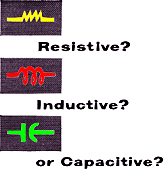 Here is a different type of quiz from
Popular Electronics magazine's master quiz-maker, Robert P. Balin.
In this October 1960 challenge, rather than the typical format where you need to
match a word or another picture with a picture, this one requires you to consider
each description and decide whether it best describes an inductive,
capacitive, or reactive circuit. I confess to messing up on question 20, because
I couldn't remember whether a lagging power factor referred to voltage lagging current
or current lagging voltage. Hint: It refers to current lagging voltage. Another
hint: Remember the ELI the ICE man mnemonic... Here is a different type of quiz from
Popular Electronics magazine's master quiz-maker, Robert P. Balin.
In this October 1960 challenge, rather than the typical format where you need to
match a word or another picture with a picture, this one requires you to consider
each description and decide whether it best describes an inductive,
capacitive, or reactive circuit. I confess to messing up on question 20, because
I couldn't remember whether a lagging power factor referred to voltage lagging current
or current lagging voltage. Hint: It refers to current lagging voltage. Another
hint: Remember the ELI the ICE man mnemonic...
 The "Mighty
7th War Loan" was a campaign initiated by the United States government during
World War II to raise funds for the war effort. It was the seventh in a series of
war bond drives, hence the name "Mighty 7th." War bonds were debt securities issued
by the government to finance military operations and other war-related expenses.
The campaign encouraged Americans to purchase these bonds, promoting them as both
a patriotic duty and a financial investment. This promotion appeared in the June
1945 issue of Radio News magazine. Maybe if we went back to funding wars
/ conflicts by the public purchase of war bonds, we wouldn't be running up trillion$
in debt to fund things like the Ukraine debacle and numerous... The "Mighty
7th War Loan" was a campaign initiated by the United States government during
World War II to raise funds for the war effort. It was the seventh in a series of
war bond drives, hence the name "Mighty 7th." War bonds were debt securities issued
by the government to finance military operations and other war-related expenses.
The campaign encouraged Americans to purchase these bonds, promoting them as both
a patriotic duty and a financial investment. This promotion appeared in the June
1945 issue of Radio News magazine. Maybe if we went back to funding wars
/ conflicts by the public purchase of war bonds, we wouldn't be running up trillion$
in debt to fund things like the Ukraine debacle and numerous...
 "The project is part of the EU's plan to
strengthen Europe's semiconductor industry and reduce reliance on foreign suppliers
The European Commission has approved €227 million in funding to help Austrian
semiconductor manufacturer ams Osram build a manufacturing plant in Premstätten,
Austria. The new facility will produce wafers used in various industries, including
automotive, consumer electronics, and healthcare. It will integrate advanced technologies
to improve chip performance and reliability. Expected to be fully operational by
2030, the plant will be the first in Europe to produce Grade 0 automotive-certified..." "The project is part of the EU's plan to
strengthen Europe's semiconductor industry and reduce reliance on foreign suppliers
The European Commission has approved €227 million in funding to help Austrian
semiconductor manufacturer ams Osram build a manufacturing plant in Premstätten,
Austria. The new facility will produce wafers used in various industries, including
automotive, consumer electronics, and healthcare. It will integrate advanced technologies
to improve chip performance and reliability. Expected to be fully operational by
2030, the plant will be the first in Europe to produce Grade 0 automotive-certified..."
 Popular Electronics began publishing
a monthly electronics detective story series, "Carl and Jerry: A New Company is
Launched," in the debut October 1954 issue. The two main characters,
Carl Anderson and Jerry Bishop, were the brainchild of John T.
Frye, who also authored the "Mac's Radio Service Shop." Carl and Jerry helped keep
the world safe from miscreants by way of their investigative prowess and deductive
skills, often with the assistance of their Ham radio skills. The Hardy Boys were
a couple of pikers in comparison. The theme and ultimately solving of each mystery
is centered around use of electrical and/or electronics devices and methods, with
a bit of intrigue and humor thrown in. If you enjoy short stories... Popular Electronics began publishing
a monthly electronics detective story series, "Carl and Jerry: A New Company is
Launched," in the debut October 1954 issue. The two main characters,
Carl Anderson and Jerry Bishop, were the brainchild of John T.
Frye, who also authored the "Mac's Radio Service Shop." Carl and Jerry helped keep
the world safe from miscreants by way of their investigative prowess and deductive
skills, often with the assistance of their Ham radio skills. The Hardy Boys were
a couple of pikers in comparison. The theme and ultimately solving of each mystery
is centered around use of electrical and/or electronics devices and methods, with
a bit of intrigue and humor thrown in. If you enjoy short stories...
 • "640k [of RAM] ought to be enough
for anybody." - Bill Gates, 1981 • "640k [of RAM] ought to be enough
for anybody." - Bill Gates, 1981
• "There is no reason anyone would want a computer in their home." - Ken Olson,
president/founder of Digital Equipment Corp., 1977
• "Heavier-than-air flying machines are impossible." - Lord Kelvin
• "Software is like entropy. It is difficult to grasp, weighs nothing, and obeys
the second law of thermodynamics; i.e. it always increases." - Norm Augustine
• "Counting in octal is just like counting in decimal, if you don't use your
thumbs." - Tom Lehrer
 everything RF is a product discovery platform
for RF & Microwave Products/Services. We currently have more than 344,923 RF &
Microwave products from over 2281 companies listed in 470 categories in our database
and enable engineers to search for them using our customized parametric search tool.
Highlighted here is the
Butler
Matrix, which is an analog beamforming network that is used to feed the phased
array antenna elements and control the directions of beams. Many modern wireless
technologies used phased array antennas to provide... everything RF is a product discovery platform
for RF & Microwave Products/Services. We currently have more than 344,923 RF &
Microwave products from over 2281 companies listed in 470 categories in our database
and enable engineers to search for them using our customized parametric search tool.
Highlighted here is the
Butler
Matrix, which is an analog beamforming network that is used to feed the phased
array antenna elements and control the directions of beams. Many modern wireless
technologies used phased array antennas to provide...
 Plenty of intrigue still surrounds the July
2, 1937, disappearance of
Amelia Earhart in the South Pacific on her way to completing an
around-the-world flight. This article appeared two years prior to that fateful flight
proclaiming the soundness (no pun intended) of her onboard radio. Back in the day,
shortwave radio installations in aircraft required long wires trailing behind, particularly
for long distance requirements like flying from the U.S. mainland to Hawaii. Those
wires were a constant source of trouble due to destructive mechanical oscillations
while waving in the airstream, airframe damage due to striking during the haul in/out
procedure, and breakage. According to an article that appeared in the January 2015
edition of Smithsonian magazine, it is suspected that Earhart's antenna broke early
in her flight... Plenty of intrigue still surrounds the July
2, 1937, disappearance of
Amelia Earhart in the South Pacific on her way to completing an
around-the-world flight. This article appeared two years prior to that fateful flight
proclaiming the soundness (no pun intended) of her onboard radio. Back in the day,
shortwave radio installations in aircraft required long wires trailing behind, particularly
for long distance requirements like flying from the U.S. mainland to Hawaii. Those
wires were a constant source of trouble due to destructive mechanical oscillations
while waving in the airstream, airframe damage due to striking during the haul in/out
procedure, and breakage. According to an article that appeared in the January 2015
edition of Smithsonian magazine, it is suspected that Earhart's antenna broke early
in her flight...
 In the midst of the transition from vacuum
tubes to semiconductors, this 1963 Radio-Electronics magazine infomercial
by Mallory offered guidance on
modernizing old selenium rectifiers with the latest silicon versions. This process,
commonplace at the time, symbolized the shift towards more efficient and compact
electronic components. The article provided a detailed walkthrough for replacing
these rectifiers in a standard TV voltage doubler circuit, recommending specific
models such as the Mallory VB500 or pairs of 1N2095's or A500's. It also cautioned
about potential increases in output voltage (B+) post-replacement, advising the
possible need for a dropping resistor. Furthermore, it highlighted that unchanged
B+ voltage could signal faulty filter capacitors, offering steps for their inspection
and substitution if needed... In the midst of the transition from vacuum
tubes to semiconductors, this 1963 Radio-Electronics magazine infomercial
by Mallory offered guidance on
modernizing old selenium rectifiers with the latest silicon versions. This process,
commonplace at the time, symbolized the shift towards more efficient and compact
electronic components. The article provided a detailed walkthrough for replacing
these rectifiers in a standard TV voltage doubler circuit, recommending specific
models such as the Mallory VB500 or pairs of 1N2095's or A500's. It also cautioned
about potential increases in output voltage (B+) post-replacement, advising the
possible need for a dropping resistor. Furthermore, it highlighted that unchanged
B+ voltage could signal faulty filter capacitors, offering steps for their inspection
and substitution if needed...
 "In August
last year Nokia and Axiom Space announced they were working to equip the latter's
next-generation lunar
spacesuits with 4G/LTE connectivity for the for NASA's Artemis III mission to
the moon. The idea is that arming the new spacesuit, called Axiom Extravehicular
Mobility Unit (AxEMU), with high-speed cellular-network capabilities means it can
support HD video, telemetry data and voice transmission over multiple kilometers
on the moon. This means the Artemis III crewmembers will then be able to capture
real-time video and communications..." "In August
last year Nokia and Axiom Space announced they were working to equip the latter's
next-generation lunar
spacesuits with 4G/LTE connectivity for the for NASA's Artemis III mission to
the moon. The idea is that arming the new spacesuit, called Axiom Extravehicular
Mobility Unit (AxEMU), with high-speed cellular-network capabilities means it can
support HD video, telemetry data and voice transmission over multiple kilometers
on the moon. This means the Artemis III crewmembers will then be able to capture
real-time video and communications..."
 Mrs. Helen McKee, XYL of W9ARK, knew exactly
what she was signing up for when she agreed to marry Mr. McKee. After all, she met
and got familiar with the guy over the air during some rag chewing sessions. This
story is a humorous (and true) account of what life can be like for the
spouses of enthusiastic Ham radio operators. We all hope for such
an understanding "significant other." Melanie has certainly endured and supported
a lot of my pastime endeavors over the past 4-plus years. It's a short read, so
take a break and put a smile on your face... Mrs. Helen McKee, XYL of W9ARK, knew exactly
what she was signing up for when she agreed to marry Mr. McKee. After all, she met
and got familiar with the guy over the air during some rag chewing sessions. This
story is a humorous (and true) account of what life can be like for the
spouses of enthusiastic Ham radio operators. We all hope for such
an understanding "significant other." Melanie has certainly endured and supported
a lot of my pastime endeavors over the past 4-plus years. It's a short read, so
take a break and put a smile on your face...
 As a leading supplier of high-performance
made-to-order RF coaxial cable assemblies, ConductRF is excited to announce the
availability of our complete suite of
VITA 67 RF coaxial cable assemblies and connectors. In line with our commitment
to providing customers with superior flexibility and performance, ConductRF offers
the option to select from all leading VITA 67 connector brands, ensuring optimal
system compatibility and customization. VITA 67 solutions are widely used in military,
aerospace, and other high-reliability applications where precision RF signal transmission... As a leading supplier of high-performance
made-to-order RF coaxial cable assemblies, ConductRF is excited to announce the
availability of our complete suite of
VITA 67 RF coaxial cable assemblies and connectors. In line with our commitment
to providing customers with superior flexibility and performance, ConductRF offers
the option to select from all leading VITA 67 connector brands, ensuring optimal
system compatibility and customization. VITA 67 solutions are widely used in military,
aerospace, and other high-reliability applications where precision RF signal transmission...
 English mathematician George Boole published
his "Formal Logic" syllogism system of deductive reasoning in 1847.
Fellow countryman Augustus De Morgan followed on Boole's work to develop the basic
combinational logic rules the AND gates, OR gates, and NOT (negation) operators.
What has become known as Boolean algebra and De Morgan's theorem forms the fundamental
foundation of everything related to digital logic. This second in a three-part series
from a 1974 issue of Popular Electronics introduces both concepts at a beginner's
level. Part 3 will present flip-flops and an overview of how all the parts come
together to build a simple computer... English mathematician George Boole published
his "Formal Logic" syllogism system of deductive reasoning in 1847.
Fellow countryman Augustus De Morgan followed on Boole's work to develop the basic
combinational logic rules the AND gates, OR gates, and NOT (negation) operators.
What has become known as Boolean algebra and De Morgan's theorem forms the fundamental
foundation of everything related to digital logic. This second in a three-part series
from a 1974 issue of Popular Electronics introduces both concepts at a beginner's
level. Part 3 will present flip-flops and an overview of how all the parts come
together to build a simple computer...
These archive pages are provided in order to make it easier for you to find items
that you remember seeing on the RF Cafe homepage. Of course probably the easiest
way to find anything on the website is to use the "Search
RF Cafe" box at the top of every page. Some quoted items have been shortened
to save space. About RF Cafe.
Homepage Archive Pages
2026:
Jan |
Feb |
Mar |
Apr |
May |
Jun |
Jul |
Aug | Sep | Oct | Nov | Dec
2025:
Jan |
Feb |
Mar |
Apr |
May |
Jun |
Jul |
Aug |
Sep |
Oct |
Nov |
Dec
2024:
Jan |
Feb |
Mar |
Apr |
May |
Jun |
Jul |
Aug |
Sep |
Oct |
Nov |
Dec
2023:
Jan |
Feb |
Mar |
Apr |
May |
Jun |
Jul |
Aug |
Sep |
Oct |
Nov |
Dec
2022:
Jan |
Feb |
Mar |
Apr |
May |
Jun |
Jul |
Aug |
Sep |
Oct |
Nov |
Dec
2021:
Jan |
Feb |
Mar |
Apr |
May |
Jun |
Jul |
Aug |
Sep |
Oct |
Nov |
Dec
2020:
Jan |
Feb |
Mar |
Apr |
May |
Jun |
Jul |
Aug |
Sep |
Oct |
Nov |
Dec
2019:
Jan |
Feb |
Mar |
Apr |
May |
Jun |
Jul |
Aug |
Sep |
Oct |
Nov |
Dec
2018:
Jan |
Feb |
Mar |
Apr |
May |
Jun |
Jul |
Aug |
Sep |
Oct |
Nov |
Dec
2017:
Jan | Feb |
Mar |
Apr |
May |
Jun |
Jul |
Aug |
Sep |
Oct |
Nov |
Dec
2016:
Jan | Feb |
Mar |
Apr |
May |
Jun |
Jul |
Aug |
Sep |
Oct |
Nov |
Dec
2015:
Jan | Feb |
Mar |
Apr |
May |
Jun |
Jul |
Aug | Sep |
Oct |
Nov |
Dec
2014:
Jan | Feb |
Mar |
Apr |
May |
Jun |
Jul |
Aug |
Sep |
Oct |
Nov |
Dec
2013:
Jan | Feb |
Mar |
Apr |
May |
Jun |
Jul |
Aug |
Sep |
Oct |
Nov |
Dec
2012: 1 |
2 | 3
| 4 | 5
| 6 | 7
| 8 | 9
| 10 | 11
| 12 | 13
(no archives before 2012)
- Christmas-themed
items
|