|
 Ironically, an RF Cafe visitor just within
the last couple days wrote about possibly getting his Amateur radio license in order
to permit live broadcasting of his
kite-borne video camera system (known as "Kite Aerial Video" [KAV]),
or Kite Aerial Photography [KAP]). Slow scan television SSTV has long been a popular
facet of Ham radio since prior to broadband Internet connections, it was the only
practical method available. Older equipment was large, heavy, power hungry, and
relatively expensive, but today you can buy a much improved camera for a few bucks
that transmits real-time via an unlicensed 2.4 GHz wireless link. That data
stream can be recorded for later use of streamed real-time to the Internet. As with
so many other things, easy availability take some of the challenge out of it, but
the world benefits from... Ironically, an RF Cafe visitor just within
the last couple days wrote about possibly getting his Amateur radio license in order
to permit live broadcasting of his
kite-borne video camera system (known as "Kite Aerial Video" [KAV]),
or Kite Aerial Photography [KAP]). Slow scan television SSTV has long been a popular
facet of Ham radio since prior to broadband Internet connections, it was the only
practical method available. Older equipment was large, heavy, power hungry, and
relatively expensive, but today you can buy a much improved camera for a few bucks
that transmits real-time via an unlicensed 2.4 GHz wireless link. That data
stream can be recorded for later use of streamed real-time to the Internet. As with
so many other things, easy availability take some of the challenge out of it, but
the world benefits from...
 "By now, it's no secret that utility companies
are struggling to meet the unprecedented surge on North America's aging power grids,
particularly due to rapidly rising demands for AI-based services from new data centers
popping up across the country. New energy plants, transmission lines, and faltering
coal plants are all leading to increased utility bills for ratepayers. In addition,
the AI boom is creating a second, less well-known crisis: The
data centers' thirst for cooling water strains the water supplies and water-related
infrastructures in many areas. It turns out that data centers' steadily growing
appetite for energy and water..." "By now, it's no secret that utility companies
are struggling to meet the unprecedented surge on North America's aging power grids,
particularly due to rapidly rising demands for AI-based services from new data centers
popping up across the country. New energy plants, transmission lines, and faltering
coal plants are all leading to increased utility bills for ratepayers. In addition,
the AI boom is creating a second, less well-known crisis: The
data centers' thirst for cooling water strains the water supplies and water-related
infrastructures in many areas. It turns out that data centers' steadily growing
appetite for energy and water..."
 As radio frequencies moved up into the UHF
realm of 30 MHz (through 3 GHz), designers
noticed that the old methods and equations for winding inductors
(aka coils and chokes) no longer performed as predicted.
The culprit was
stray capacitance created by the wire itself and the insulation
between windings. To some extent, the length of leads running from the inductor
windings to connection points (terminal strips and lugs at
first and then later printed circuit boards) generated enough extra inductance
to add noticeably to total inductance. New methods were developed to help mitigate
the effects of these stray (aka parasitic) reactances.
Much new knowledge in this area was gained through the war efforts with many radar... As radio frequencies moved up into the UHF
realm of 30 MHz (through 3 GHz), designers
noticed that the old methods and equations for winding inductors
(aka coils and chokes) no longer performed as predicted.
The culprit was
stray capacitance created by the wire itself and the insulation
between windings. To some extent, the length of leads running from the inductor
windings to connection points (terminal strips and lugs at
first and then later printed circuit boards) generated enough extra inductance
to add noticeably to total inductance. New methods were developed to help mitigate
the effects of these stray (aka parasitic) reactances.
Much new knowledge in this area was gained through the war efforts with many radar...
 Are you having a rough week? If so - and
even if not - take a few minutes to get a laugh from these
electronics-themed comics from the pages of vintage Radio
News magazines. Beginning sometime in the late 1930s and early 1940s, single-panel
topical comics began appearing frequently in many hobby and even professional magazines.
Sure, comics showed up in magazine before that time, but they generally did not
necessarily have to do with the main subject of the publication. The Saturday
Evening Post, for example, had many single-panel comics, but they were on any
random theme. The Saturday Evening Post, for example, had many single-panel
comics, but they were on any random theme. I can't go without commenting on the
April 1946 comic since it reminds me of a situation... Are you having a rough week? If so - and
even if not - take a few minutes to get a laugh from these
electronics-themed comics from the pages of vintage Radio
News magazines. Beginning sometime in the late 1930s and early 1940s, single-panel
topical comics began appearing frequently in many hobby and even professional magazines.
Sure, comics showed up in magazine before that time, but they generally did not
necessarily have to do with the main subject of the publication. The Saturday
Evening Post, for example, had many single-panel comics, but they were on any
random theme. The Saturday Evening Post, for example, had many single-panel
comics, but they were on any random theme. I can't go without commenting on the
April 1946 comic since it reminds me of a situation...
 KR Electronics has been designing and manufacturing custom
filters for military and commercial radio, radar, medical, and communications
since 1973. KR Electronics' line of filters includes lowpass, highpass,
bandpass, bandstop, equalizer, duplexer, diplexer, and individually synthesized
filters for special applications - both commercial and military.
State-of-the-art computer synthesis, analysis, and test methods are used to meet
the most challenging specifications. All common connector types and package form
factors are available. Update: KR Electronics has been acquired by
NIC, where KR Electronics' legacy of quality
and innovation will continue to thrive, offering the same trusted products and
services under NIC's leadership. Designed
and manufactured in the USA. Please visit NIC
today to see how we might be of assistance. KR Electronics has been designing and manufacturing custom
filters for military and commercial radio, radar, medical, and communications
since 1973. KR Electronics' line of filters includes lowpass, highpass,
bandpass, bandstop, equalizer, duplexer, diplexer, and individually synthesized
filters for special applications - both commercial and military.
State-of-the-art computer synthesis, analysis, and test methods are used to meet
the most challenging specifications. All common connector types and package form
factors are available. Update: KR Electronics has been acquired by
NIC, where KR Electronics' legacy of quality
and innovation will continue to thrive, offering the same trusted products and
services under NIC's leadership. Designed
and manufactured in the USA. Please visit NIC
today to see how we might be of assistance.
 Arthur Hackman's 1967 Electronics World
magazine article provides a systematic guide for
selecting mechanical and manual switches, beginning with specifying the required
function through poles (circuits controlled) and throws (positions connected, excluding
"off"). Voltage and current ratings must not be exceeded to prevent contact welding
or catastrophic dielectric failure. Mechanically actuated switches include pressure-sensitive
types (with defined proof and burst pressures), temperature-sensitive switches,
and various limit switches (plunger, lever, roller), which require consideration
of mounting and environmental sealing for harsh conditions. Manually... Arthur Hackman's 1967 Electronics World
magazine article provides a systematic guide for
selecting mechanical and manual switches, beginning with specifying the required
function through poles (circuits controlled) and throws (positions connected, excluding
"off"). Voltage and current ratings must not be exceeded to prevent contact welding
or catastrophic dielectric failure. Mechanically actuated switches include pressure-sensitive
types (with defined proof and burst pressures), temperature-sensitive switches,
and various limit switches (plunger, lever, roller), which require consideration
of mounting and environmental sealing for harsh conditions. Manually...
 Isn't an anagram a word game where letters
of one word are rearranged to spell another word or series of words? For instance,
an anagram for "microwave" is "warm voice," one for "resistance" is "ancestries,"
and for "vector" is "covert." If so, then this puzzle is misnamed; it is really
a crossword puzzle. Maybe back in 1961 the word anagram included this type of puzzle.
Regardless of the naming error, I did learn a new word: "inertance," which means "the effect of inertia in an acoustic
system, an impeding of the transmission of sound through... Isn't an anagram a word game where letters
of one word are rearranged to spell another word or series of words? For instance,
an anagram for "microwave" is "warm voice," one for "resistance" is "ancestries,"
and for "vector" is "covert." If so, then this puzzle is misnamed; it is really
a crossword puzzle. Maybe back in 1961 the word anagram included this type of puzzle.
Regardless of the naming error, I did learn a new word: "inertance," which means "the effect of inertia in an acoustic
system, an impeding of the transmission of sound through...
 "Electronics have long been defined by their
permanence. Even when their useful life ends, their materials persist in landfills
for years or decades.
Transient electronics embrace impermanence with devices that are deliberately
engineered to function for a set period of time and then disappear, dissolving into
safe byproducts when exposed to water, heat, or light. Advances in electronics technology
moving at a faster pace than ever before, and, thus, older electronics become obsolete
or undesirable quickly. While there are obvious benefits to developments in electronic..." "Electronics have long been defined by their
permanence. Even when their useful life ends, their materials persist in landfills
for years or decades.
Transient electronics embrace impermanence with devices that are deliberately
engineered to function for a set period of time and then disappear, dissolving into
safe byproducts when exposed to water, heat, or light. Advances in electronics technology
moving at a faster pace than ever before, and, thus, older electronics become obsolete
or undesirable quickly. While there are obvious benefits to developments in electronic..."
 Magnetostriction is a term not seen very
often these days. It describes the physical shape change that takes place in certain
ferrous materials when subject to a magnetic field, and is responsible for most
of the familiar "hum" that comes from transformers. The effect is used in mechanical
filters as transducers between the electronic circuit and the mechanically resonant
disks that define filter bandpass characteristics. Elemental cobalt exhibits the
highest room temperature magnetostriction (units are "microstrains"). Nickel, with
about half the value as cobalt, is cheaper and more abundant and is therefor more
commonly used in modern magnetorestrictive transducers. Way back in the 1980s while... Magnetostriction is a term not seen very
often these days. It describes the physical shape change that takes place in certain
ferrous materials when subject to a magnetic field, and is responsible for most
of the familiar "hum" that comes from transformers. The effect is used in mechanical
filters as transducers between the electronic circuit and the mechanically resonant
disks that define filter bandpass characteristics. Elemental cobalt exhibits the
highest room temperature magnetostriction (units are "microstrains"). Nickel, with
about half the value as cobalt, is cheaper and more abundant and is therefor more
commonly used in modern magnetorestrictive transducers. Way back in the 1980s while...
 RF Cafe's spreadsheet-based engineering
and science calculator,
Espresso
Engineering Workbook™, is a collection of electrical engineering and physics
calculators for commonly needed design and problem solving work. A Transformer
Calculator worksheet has just been added, making for a total of 45 calculators.
It is an excellent tool for engineers, technicians, hobbyists, and students. Equally
excellent is that Espresso Engineering Workbook™ is
provided at no cost, compliments of my generous sponsors... RF Cafe's spreadsheet-based engineering
and science calculator,
Espresso
Engineering Workbook™, is a collection of electrical engineering and physics
calculators for commonly needed design and problem solving work. A Transformer
Calculator worksheet has just been added, making for a total of 45 calculators.
It is an excellent tool for engineers, technicians, hobbyists, and students. Equally
excellent is that Espresso Engineering Workbook™ is
provided at no cost, compliments of my generous sponsors...
 There was a time when having a career in any
field of electricity or electronics work was an enviable mark of a person's technical
prowess that conveyed a degree of respect. The whole
controlling of electrons thing boggled the minds of most people,
whether it meant wiring homes and buildings for lights, receptacles, and motors,
or designing "all wave" radio sets for listening to the evening broadcast of "The
Lone Ranger." Today, with nearly everyone alive having grown up with such conveniences,
the "wow factor" is pretty much gone, except maybe with those of us who still chose
to engage. If an electronics appliance... There was a time when having a career in any
field of electricity or electronics work was an enviable mark of a person's technical
prowess that conveyed a degree of respect. The whole
controlling of electrons thing boggled the minds of most people,
whether it meant wiring homes and buildings for lights, receptacles, and motors,
or designing "all wave" radio sets for listening to the evening broadcast of "The
Lone Ranger." Today, with nearly everyone alive having grown up with such conveniences,
the "wow factor" is pretty much gone, except maybe with those of us who still chose
to engage. If an electronics appliance...
 Substitute "cellphone" for "radio" in this
title ("Money
in Radio Gadgets"), and editorial by Hugo Gernsback and it would fit right in
with today's market of wondrous gadgetry. Prescient as always, Mr. Gernsback describes
in this 1933 issue of Radio-Craft magazine, among other things, what we now refer
to as energy harnessing to power ancillary devices and props. He also recommends
a scheme for causing "dancing dolls" on the surface of a table vibrated and mobilized
by the sonic waves of a large speaker - a lot like the way years later vibrating
football games were made (remember them?) where the men danced randomly across the
painted metal playing field. It sounded like a pair of electric... Substitute "cellphone" for "radio" in this
title ("Money
in Radio Gadgets"), and editorial by Hugo Gernsback and it would fit right in
with today's market of wondrous gadgetry. Prescient as always, Mr. Gernsback describes
in this 1933 issue of Radio-Craft magazine, among other things, what we now refer
to as energy harnessing to power ancillary devices and props. He also recommends
a scheme for causing "dancing dolls" on the surface of a table vibrated and mobilized
by the sonic waves of a large speaker - a lot like the way years later vibrating
football games were made (remember them?) where the men danced randomly across the
painted metal playing field. It sounded like a pair of electric...
 "Researchers at the Hebrew University of
Jerusalem have found that the
magnetic
component of light plays a direct part in the Faraday Effect, overturning a
180-year belief that only light's electric field was involved. Their work shows
that light can exert magnetic influence on matter, not simply illuminate it. This
insight could support advances in optics, spintronics, and emerging quantum technologies.
The team's findings, published in Nature's Scientific Reports, show that
the magnetic portion of light, not only its electric one, has a meaningful and measurable
influence on how light interacts with materials. This result contradicts..." "Researchers at the Hebrew University of
Jerusalem have found that the
magnetic
component of light plays a direct part in the Faraday Effect, overturning a
180-year belief that only light's electric field was involved. Their work shows
that light can exert magnetic influence on matter, not simply illuminate it. This
insight could support advances in optics, spintronics, and emerging quantum technologies.
The team's findings, published in Nature's Scientific Reports, show that
the magnetic portion of light, not only its electric one, has a meaningful and measurable
influence on how light interacts with materials. This result contradicts..."
 This
passive
RF limiter is a simple combination of cascaded "T" type resistive attenuators
that are switched in and out of the circuit based on the power level in the line.
The design takes a bit of thinking due to needing to retain a reasonable impedance
match at the input and output throughout various stages' conduction states. Arriving
at an optimal value for resistors would require a circuit simulator with a mathematically
based optimizer, but, especially for amateur radio work, close is good enough. That
is not to say Hams are a bunch of slackers - they're not - it's just that component
and software resources are not as readily available (aka "prohibitively expensive")
for doing the analysis and testing. In 1966 when... This
passive
RF limiter is a simple combination of cascaded "T" type resistive attenuators
that are switched in and out of the circuit based on the power level in the line.
The design takes a bit of thinking due to needing to retain a reasonable impedance
match at the input and output throughout various stages' conduction states. Arriving
at an optimal value for resistors would require a circuit simulator with a mathematically
based optimizer, but, especially for amateur radio work, close is good enough. That
is not to say Hams are a bunch of slackers - they're not - it's just that component
and software resources are not as readily available (aka "prohibitively expensive")
for doing the analysis and testing. In 1966 when...
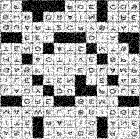 This
Electronic Crosswords puzzle appeared in the October 1963 edition of Electronics
World magazine. About half the words used are related directly in some way
to electronics or physics. It's a fairly small puzzle so it shouldn't take you too
long to complete. My RF Cafe crosswords, by the way, have 100% of the words directly
related to the sciences, from a custom lexicon I have created over 20 years of making
puzzles. Enjoy... This
Electronic Crosswords puzzle appeared in the October 1963 edition of Electronics
World magazine. About half the words used are related directly in some way
to electronics or physics. It's a fairly small puzzle so it shouldn't take you too
long to complete. My RF Cafe crosswords, by the way, have 100% of the words directly
related to the sciences, from a custom lexicon I have created over 20 years of making
puzzles. Enjoy...
 Avalanche breakdown in semiconductors, initially
viewed by engineers as a destructive limitation, was later discovered to be nondestructive
when peak power was controlled through external circuitry. This 1967 Electronics
World magazine article explains how
avalanche transistors evolved from being considered problematic to becoming
valuable components for high-speed pulse generation. Early adoption was hindered
by inconsistent performance between transistors, requiring careful selection for
reliability. Improved fabrication techniques reduced surface leakage currents, enabling
modern avalanche transistors to operate at high collector voltages... Avalanche breakdown in semiconductors, initially
viewed by engineers as a destructive limitation, was later discovered to be nondestructive
when peak power was controlled through external circuitry. This 1967 Electronics
World magazine article explains how
avalanche transistors evolved from being considered problematic to becoming
valuable components for high-speed pulse generation. Early adoption was hindered
by inconsistent performance between transistors, requiring careful selection for
reliability. Improved fabrication techniques reduced surface leakage currents, enabling
modern avalanche transistors to operate at high collector voltages...
 Until maybe 30 to 40 years ago, there was
still a certain amount of awe associated with new applications of technology. It
seems anymore people are so accustomed to new and amazing things - usually at affordable
prices - that the wonder is gone. Advancements are expected. The world is moving
so fast that it is difficult to absorb and fully appreciate all the work being done.
In 1947 when this "Sound
Broadcasting from Airplanes" article appeared in Radio News magazine,
both airplanes and electronics were still relatively new to a lot of people, especially
in more rural areas, so a whiz-bang scheme like broadcasting messages from an airplane
was a big deal to many. It was an area of science that had not yet been explored
to a large degree. BTW, the spell checker flagged a new word (for me, anyway): genemotor
which, as it turns out, is the generic name for the line of dynamos, generators,
engines, and motors manufactured by Pioneer Gen-E-Motor Corporation of Chicago,
Illinois... Until maybe 30 to 40 years ago, there was
still a certain amount of awe associated with new applications of technology. It
seems anymore people are so accustomed to new and amazing things - usually at affordable
prices - that the wonder is gone. Advancements are expected. The world is moving
so fast that it is difficult to absorb and fully appreciate all the work being done.
In 1947 when this "Sound
Broadcasting from Airplanes" article appeared in Radio News magazine,
both airplanes and electronics were still relatively new to a lot of people, especially
in more rural areas, so a whiz-bang scheme like broadcasting messages from an airplane
was a big deal to many. It was an area of science that had not yet been explored
to a large degree. BTW, the spell checker flagged a new word (for me, anyway): genemotor
which, as it turns out, is the generic name for the line of dynamos, generators,
engines, and motors manufactured by Pioneer Gen-E-Motor Corporation of Chicago,
Illinois...
 "Inside a secure facility overseen by the
Central Science and Technology Commission, Chinese engineers have activated an
Extreme Ultraviolet (EUV) lithography machine - a technology the U.S. spent
years attempting to block. A recent Reuters investigation confirms the EUV prototype
is now operational in Shenzhen. This development is not just a technical milestone;
it is a seismic structural realignment that effectively marks the end of the unified
global semiconductor market. Lack of access to the leading edge technology of ASML's
EUV lithography machines. Strict 'small yard, high fence' restrictions would keep
China several generations behind in technology..." "Inside a secure facility overseen by the
Central Science and Technology Commission, Chinese engineers have activated an
Extreme Ultraviolet (EUV) lithography machine - a technology the U.S. spent
years attempting to block. A recent Reuters investigation confirms the EUV prototype
is now operational in Shenzhen. This development is not just a technical milestone;
it is a seismic structural realignment that effectively marks the end of the unified
global semiconductor market. Lack of access to the leading edge technology of ASML's
EUV lithography machines. Strict 'small yard, high fence' restrictions would keep
China several generations behind in technology..."
 Remember when you could hold a telephone
conversation without having to allow a moment of time at the end of a sentence before
responding in order to keep from "stepping on" the person on the other end? It used
to be only overseas phone calls or maybe communicating to astronauts on the moon
suffered such inconveniences, but talking to someone across town was like having
a face-to-face discussion. More often than not - or so at least it seems - there
is a noticeable delay between the time someone actually stops talking on the transmitter
end and the time the audio stops at the receiver end. People who have never known
otherwise accommodate the delay with no appreciation for how good phone calls used
to be. This promotion by
Bell
Telephone Labs which appeared in a 1946 issue of Radio News magazine
extolls the virtues of its "scientific quality control" innovation that produced
repeatable... Remember when you could hold a telephone
conversation without having to allow a moment of time at the end of a sentence before
responding in order to keep from "stepping on" the person on the other end? It used
to be only overseas phone calls or maybe communicating to astronauts on the moon
suffered such inconveniences, but talking to someone across town was like having
a face-to-face discussion. More often than not - or so at least it seems - there
is a noticeable delay between the time someone actually stops talking on the transmitter
end and the time the audio stops at the receiver end. People who have never known
otherwise accommodate the delay with no appreciation for how good phone calls used
to be. This promotion by
Bell
Telephone Labs which appeared in a 1946 issue of Radio News magazine
extolls the virtues of its "scientific quality control" innovation that produced
repeatable...
 In 1935,
not much was yet known about the
ionosphere. Its existence was first theorized in 1902 by Arthur
Kennelly and Oliver Heaviside, and Edward Appleton proved its presence in 1924 by
conducting a series of broadcast experiments, but no direct measurements were possible
until rocket-borne instruments could be launched. An Aerobee-Hi sounding rocket
was launched in 1956 as part of the International Geophysical Year (IGY) project
that made the first actual detection of ionized particles in what is now referred
to as the D-layer. It is therefore forgivable that Hugo Gernsback, normally spot-on
in his theories and postulations regarding RF propagation, incorrectly suggested
in this editorial that based on observed time... In 1935,
not much was yet known about the
ionosphere. Its existence was first theorized in 1902 by Arthur
Kennelly and Oliver Heaviside, and Edward Appleton proved its presence in 1924 by
conducting a series of broadcast experiments, but no direct measurements were possible
until rocket-borne instruments could be launched. An Aerobee-Hi sounding rocket
was launched in 1956 as part of the International Geophysical Year (IGY) project
that made the first actual detection of ionized particles in what is now referred
to as the D-layer. It is therefore forgivable that Hugo Gernsback, normally spot-on
in his theories and postulations regarding RF propagation, incorrectly suggested
in this editorial that based on observed time...
 This 1967 Electronics World magazine
article highlights a potential revolution in microwave technology through new semiconductor
devices that could miniaturize and drastically reduce the cost of microwave sources.
The focus is on two promising devices: the Read p-n junction diode and the
Gunn bulk gallium arsenide oscillator. The Gunn device, discovered accidentally
by Dr. J.B. Gunn at IBM, operates on a radical principle - a bulk semiconductor
material oscillates at microwave frequencies without external tuned circuitry when
a threshold voltage is applied. Key to the Gunn effect is the unique property of
gallium arsenide, which features a second conduction band. Electrons entering this
high-energy, low-mobility band create "domains" that drift slowly from cathode to
anode, causing current... This 1967 Electronics World magazine
article highlights a potential revolution in microwave technology through new semiconductor
devices that could miniaturize and drastically reduce the cost of microwave sources.
The focus is on two promising devices: the Read p-n junction diode and the
Gunn bulk gallium arsenide oscillator. The Gunn device, discovered accidentally
by Dr. J.B. Gunn at IBM, operates on a radical principle - a bulk semiconductor
material oscillates at microwave frequencies without external tuned circuitry when
a threshold voltage is applied. Key to the Gunn effect is the unique property of
gallium arsenide, which features a second conduction band. Electrons entering this
high-energy, low-mobility band create "domains" that drift slowly from cathode to
anode, causing current...
 Most people have heard of the incredibly
accurate
Norden bombsight that was credited for revolutionizing accuracy
of heavy bombers like B-17s, B-25s, and B-29s. It was an electromechanical device
that took bombardier inputs of altitude, airspeed, heading, and wind speed and direction,
then calculated the impact point of the bomb. An accuracy of 75 feet was claimed
under ideal conditions - provided by a mechanical computing device. By 1956 when
this article was published, the Norden had been replaced by radar-integrated bombing
systems. Additionally,
ground-based radar measurement systems were... Most people have heard of the incredibly
accurate
Norden bombsight that was credited for revolutionizing accuracy
of heavy bombers like B-17s, B-25s, and B-29s. It was an electromechanical device
that took bombardier inputs of altitude, airspeed, heading, and wind speed and direction,
then calculated the impact point of the bomb. An accuracy of 75 feet was claimed
under ideal conditions - provided by a mechanical computing device. By 1956 when
this article was published, the Norden had been replaced by radar-integrated bombing
systems. Additionally,
ground-based radar measurement systems were...
 "On
Monday, December 22, 2025, the FCC released
DA 25-1086,
which adds
foreign-made drones and some components to security risk list. What the decision
actually means: "If you already own a DJI or other foreign-made drone, you can still
fly it. Stores can still sell previously approved models while inventory lasts.
New foreign-made drones and key components can no longer get FCC approval. In practical
terms, future DJI models are now cut off from the U.S. market. There are no true
low-cost, one-for-one replacements available today..." "On
Monday, December 22, 2025, the FCC released
DA 25-1086,
which adds
foreign-made drones and some components to security risk list. What the decision
actually means: "If you already own a DJI or other foreign-made drone, you can still
fly it. Stores can still sell previously approved models while inventory lasts.
New foreign-made drones and key components can no longer get FCC approval. In practical
terms, future DJI models are now cut off from the U.S. market. There are no true
low-cost, one-for-one replacements available today..."
Most people have heard of the incredibly
accurate
Norden bombsight that was credited for revolutionizing accuracy
of heavy bombers like B-17s, B-25s, and B-29s. It was an electromechanical device
that took bombardier inputs of altitude, airspeed, heading, and wind speed and direction,
then calculated the impact point of the bomb. An accuracy of 75 feet was claimed
under ideal conditions - provided by a mechanical computing device. By 1956 when
this article was published, the Norden had been replaced by radar-integrated bombing
systems. Additionally,
ground-based radar measurement systems were...
 If you need a cheap, quick
lightning arrestor for your antenna or just about any type of
wired system, this idea from Mr. Burgess Brownson looks like a good option.
He used an automotive spare plug. Voltage breakover points can be set by varying
the spark gap distance. The old vacuum tube transmitters and receivers had a better
of chance of surviving a lightning strike because the components were able to handle
much more of a shock than our modern semiconductor sets with miniature, closely
spaced components. Still, the spark plug setup is better than nothing, if for no
other reason than to protect the shelter. it should suffice. This and many
... If you need a cheap, quick
lightning arrestor for your antenna or just about any type of
wired system, this idea from Mr. Burgess Brownson looks like a good option.
He used an automotive spare plug. Voltage breakover points can be set by varying
the spark gap distance. The old vacuum tube transmitters and receivers had a better
of chance of surviving a lightning strike because the components were able to handle
much more of a shock than our modern semiconductor sets with miniature, closely
spaced components. Still, the spark plug setup is better than nothing, if for no
other reason than to protect the shelter. it should suffice. This and many
...
 Aircraft electronics has always been on
the bleeding edge of technology because of the ever-increasing need to fly in the
widest range of atmospheric conditions possible. Accordingly, skills needed by avionics
servicemen are amongst the highest required in any electronics field. There are
still many pieces of vintage equipment in service that need to be maintained, but
even 20- to 30-year-old airborne radars and navigational units require top-notch
techs to troubleshoot and align. One topic in particular that plagues electronics
operation even in modern airframes is that of static electricity build-up and lightning
strikes. We all face those kinds of static discharge hazards in non-aviation environments,
but for the most part a failure on the ground or water is not as imminently... Aircraft electronics has always been on
the bleeding edge of technology because of the ever-increasing need to fly in the
widest range of atmospheric conditions possible. Accordingly, skills needed by avionics
servicemen are amongst the highest required in any electronics field. There are
still many pieces of vintage equipment in service that need to be maintained, but
even 20- to 30-year-old airborne radars and navigational units require top-notch
techs to troubleshoot and align. One topic in particular that plagues electronics
operation even in modern airframes is that of static electricity build-up and lightning
strikes. We all face those kinds of static discharge hazards in non-aviation environments,
but for the most part a failure on the ground or water is not as imminently...
|
 • U.S.
Cuts EV Plans as Tax Credit Ends
• Fragmented 6 GHz Policy
Shapes Wi-Fi 8 Adoption
• Big 3 Have
Room for 32M FWA Customers
• FCC Simplifying
Broadband "Nutrition Labels"
• GSMA Pleads for
Yet More 6G Spectrum
 The
RF Cafe Homepage Archive
is a comprehensive collection of every item appearing daily on this website since
2008 - and many from earlier years. Many thousands of pages of unique content have
been added since then.
 If I told you that Lester William Polsfuss
is widely credited with being a major player in the pioneering of electric guitars
due to his solid-body (no acoustic resonance chamber) designs, you might wonder
where I came up with that claim. However, if you know that Mr. Polsfuss is the surname
of Les Paul, then you would quickly agree. As if being a popular musician and, along
with wife Mary Ford, selling millions of records wasn't enough, Les Paul was also
an experimenter and inventor in the electronic music realm. This article entitled
"Les
Paul: Technician and Musician" appeared in a 1958 article in Radio-Electronics
magazine, and was at the time a contemporary look inside his home-workshop-studio,
when he was first gaining popularity... If I told you that Lester William Polsfuss
is widely credited with being a major player in the pioneering of electric guitars
due to his solid-body (no acoustic resonance chamber) designs, you might wonder
where I came up with that claim. However, if you know that Mr. Polsfuss is the surname
of Les Paul, then you would quickly agree. As if being a popular musician and, along
with wife Mary Ford, selling millions of records wasn't enough, Les Paul was also
an experimenter and inventor in the electronic music realm. This article entitled
"Les
Paul: Technician and Musician" appeared in a 1958 article in Radio-Electronics
magazine, and was at the time a contemporary look inside his home-workshop-studio,
when he was first gaining popularity...
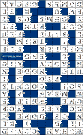 Working crossword puzzles can be contagious.
This April 12, 2020,
tech-themed crossword puzzle may even go viral - the second in a series. It
contains only clues and terms associated with engineering, science, physical, astronomy,
mathematics, chemistry, etc., which I have personally built over nearly two decades.
That includes the cause for our planet's current dilemma. Many new words and company
names have been added that had not even been created when I started in the year
2002. You will never find a word taxing your knowledge of a numbnut soap opera star
or the name of some obscure village in the Andes mountains. You might, however,
encounter the name of a movie star like Hedy Lamarr or a geographical location like
Tunguska, Russia... Working crossword puzzles can be contagious.
This April 12, 2020,
tech-themed crossword puzzle may even go viral - the second in a series. It
contains only clues and terms associated with engineering, science, physical, astronomy,
mathematics, chemistry, etc., which I have personally built over nearly two decades.
That includes the cause for our planet's current dilemma. Many new words and company
names have been added that had not even been created when I started in the year
2002. You will never find a word taxing your knowledge of a numbnut soap opera star
or the name of some obscure village in the Andes mountains. You might, however,
encounter the name of a movie star like Hedy Lamarr or a geographical location like
Tunguska, Russia...
 The "Rainy
Day Amusements" feature was not usually a mathematical challenge; for that,
see the "Old & New Mathematical Puzzles" section. Some years they were worthwhile,
end others not so much so. 1982 was a pretty good year for Rainy Day Amusements,
so they are included here. Each autumn I used to anxiously await the appearance
of the newest edition of The Old Farmer's Almanac on the store shelf, and such was
the case with this 1982 issue. It is not that I was/am an avid farmer, just that
I enjoy reading the anecdotes, tales, and interesting historical tidbits included
amongst the pages along with tables of high and low tides, moon and sun rising and
setting times... The "Rainy
Day Amusements" feature was not usually a mathematical challenge; for that,
see the "Old & New Mathematical Puzzles" section. Some years they were worthwhile,
end others not so much so. 1982 was a pretty good year for Rainy Day Amusements,
so they are included here. Each autumn I used to anxiously await the appearance
of the newest edition of The Old Farmer's Almanac on the store shelf, and such was
the case with this 1982 issue. It is not that I was/am an avid farmer, just that
I enjoy reading the anecdotes, tales, and interesting historical tidbits included
amongst the pages along with tables of high and low tides, moon and sun rising and
setting times...
 This handful of
Ham-related comics appeared in the November 1965 issue of Popular Electronics. One
of them has an operator using "oboe" as the phonetic alphabet version of the letter "O."
Having never seen that before, I did a search and learned that the British Forces in
World War II uniquely used "oboe" for the letter "O." Maybe the artist, Walt Miller,
was either a member of the British Forces or hung around (or served in the military)
with someone that was. For that matter, using "able" for the letter "A" is also a British
thing. This Silent English phonetic alphabet is interesting. I guarantee you'll appreciate
the others as well, or double your money back... This handful of
Ham-related comics appeared in the November 1965 issue of Popular Electronics. One
of them has an operator using "oboe" as the phonetic alphabet version of the letter "O."
Having never seen that before, I did a search and learned that the British Forces in
World War II uniquely used "oboe" for the letter "O." Maybe the artist, Walt Miller,
was either a member of the British Forces or hung around (or served in the military)
with someone that was. For that matter, using "able" for the letter "A" is also a British
thing. This Silent English phonetic alphabet is interesting. I guarantee you'll appreciate
the others as well, or double your money back...
 At least 10 clues with an asterisk (*)
in this
technology-themed crossword puzzle are pulled from this past week's (5/21
- 5/25) "Tech Industry Headlines" column on the RF Cafe homepage. For the sake
of all the avid cruciverbalists amongst us, each week I create a new
technology-themed crossword puzzle using only words from my custom-created
related to engineering, science, mathematics, chemistry, physics, astronomy,
etc. You will never find among the words names of politicians, mountain ranges,
exotic foods or plants, movie stars, or anything of the sort. You might,
however, see someone or something in the exclusion list who or that is directly
related to this puzzle's theme, such as Hedy Lamar... At least 10 clues with an asterisk (*)
in this
technology-themed crossword puzzle are pulled from this past week's (5/21
- 5/25) "Tech Industry Headlines" column on the RF Cafe homepage. For the sake
of all the avid cruciverbalists amongst us, each week I create a new
technology-themed crossword puzzle using only words from my custom-created
related to engineering, science, mathematics, chemistry, physics, astronomy,
etc. You will never find among the words names of politicians, mountain ranges,
exotic foods or plants, movie stars, or anything of the sort. You might,
however, see someone or something in the exclusion list who or that is directly
related to this puzzle's theme, such as Hedy Lamar...
 One aspect of advertising on the RF Cafe
website I have not covered is using
Google AdSense.
The reason is that I never took the time to explore how - or even whether it is
possible - to target a specific website for displaying your banner ads. A couple
display opportunities have always been provided for Google Ads to display, but the
vast majority of advertising on RF Cafe is done via private advertisers. That is,
companies deal with me directly and I handle inserting their banner ads into the
html page code that randomly selects and displays them. My advertising scheme is
what the industry refers to as a "Tenancy Campaign," whereby a flat price per month
is paid regardless of number of impressions or clicks. It is the simplest format
and has seemed to work well for many companies. With nearly 4 million pageviews
per year for RFCafe.com, the average impression rate per banner ad is about 225,000k per
year (in eight locations on each page, with >17k pages)... One aspect of advertising on the RF Cafe
website I have not covered is using
Google AdSense.
The reason is that I never took the time to explore how - or even whether it is
possible - to target a specific website for displaying your banner ads. A couple
display opportunities have always been provided for Google Ads to display, but the
vast majority of advertising on RF Cafe is done via private advertisers. That is,
companies deal with me directly and I handle inserting their banner ads into the
html page code that randomly selects and displays them. My advertising scheme is
what the industry refers to as a "Tenancy Campaign," whereby a flat price per month
is paid regardless of number of impressions or clicks. It is the simplest format
and has seemed to work well for many companies. With nearly 4 million pageviews
per year for RFCafe.com, the average impression rate per banner ad is about 225,000k per
year (in eight locations on each page, with >17k pages)...
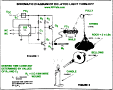 A couple days ago I posted an update on the
Watkins-Johnson databook page that had an unauthorized gag graph titled, "WJ-G1/SMG1
Phase vs. VCTL vs. Frequency vs. Phase of the Moon." When RF Cafe visitor and sometimes
contributor Dr. Marek Klemes* read
that, he sent me a note about remembering this "Delayed
Light Turn-Off" circuit from the Signetics 555/556 Timer Databook. It took a
bit of creative Googling, but he managed to find the datasheet (to the right). The
text was a bit washed out from the original low resolution scan, so I reproduced
the labels (green). This Rube Goldberg-ish contraption works thusly: After a delay
determined by the values selected for R1 and C1, the output
of the NE555 timer goes high and causes resistor RL to heat up enough
to ignite match M1. M1 subsequently lights the fuse on firecracker
FC1, which has tied to its body a string that wraps around a pulley and
holds a rock (which weighs precisely 2π pounds... A couple days ago I posted an update on the
Watkins-Johnson databook page that had an unauthorized gag graph titled, "WJ-G1/SMG1
Phase vs. VCTL vs. Frequency vs. Phase of the Moon." When RF Cafe visitor and sometimes
contributor Dr. Marek Klemes* read
that, he sent me a note about remembering this "Delayed
Light Turn-Off" circuit from the Signetics 555/556 Timer Databook. It took a
bit of creative Googling, but he managed to find the datasheet (to the right). The
text was a bit washed out from the original low resolution scan, so I reproduced
the labels (green). This Rube Goldberg-ish contraption works thusly: After a delay
determined by the values selected for R1 and C1, the output
of the NE555 timer goes high and causes resistor RL to heat up enough
to ignite match M1. M1 subsequently lights the fuse on firecracker
FC1, which has tied to its body a string that wraps around a pulley and
holds a rock (which weighs precisely 2π pounds...
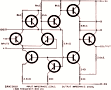 There is no such thing as too many introductory
articles on
operational amplifiers (opamps). Of course, when this story was
written for Electronics World back in 1967, opamps were relatively new to the scene.
Prior to the advent of opamps, circuit design for controllers, filter, comparators,
isolators, and just plain old amplification was much more involved. Opamps suddenly
allowed designers to not worry as much about biasing, variations in power supply
voltages, and other annoyances, and instead focus on function. Even from the very
beginning with the μa741 operational amplifier, the parameters came close to those
of an ideal device: infinite input impedance, zero output impedance, perfect isolation
between ports, and infinite bandwidth. OK, the bandwidth spec was more constrained
compared to the other three, but still, with frequencies... There is no such thing as too many introductory
articles on
operational amplifiers (opamps). Of course, when this story was
written for Electronics World back in 1967, opamps were relatively new to the scene.
Prior to the advent of opamps, circuit design for controllers, filter, comparators,
isolators, and just plain old amplification was much more involved. Opamps suddenly
allowed designers to not worry as much about biasing, variations in power supply
voltages, and other annoyances, and instead focus on function. Even from the very
beginning with the μa741 operational amplifier, the parameters came close to those
of an ideal device: infinite input impedance, zero output impedance, perfect isolation
between ports, and infinite bandwidth. OK, the bandwidth spec was more constrained
compared to the other three, but still, with frequencies...
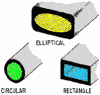 That portion of the electromagnetic spectrum
which falls between 1000 megahertz and 100,000 megahertz is referred to as the
Microwave region. Before discussing the principles and applications of microwave
frequencies, the meaning of the term microwave as it is used in this module must
be established. On the surface, the definition of a microwave would appear to be
simple because, in electronics, the prefix "micro" normally means a millionth part
of a unit. Micro also means small, which is a relative term, and it is used in that
sense in this module. Microwave is a term loosely applied to identify electromagnetic
waves above 1000 megahertz in frequency because of the short physical wavelengths
of these frequencies. Short wavelength energy offers distinct advantages in many
applications... That portion of the electromagnetic spectrum
which falls between 1000 megahertz and 100,000 megahertz is referred to as the
Microwave region. Before discussing the principles and applications of microwave
frequencies, the meaning of the term microwave as it is used in this module must
be established. On the surface, the definition of a microwave would appear to be
simple because, in electronics, the prefix "micro" normally means a millionth part
of a unit. Micro also means small, which is a relative term, and it is used in that
sense in this module. Microwave is a term loosely applied to identify electromagnetic
waves above 1000 megahertz in frequency because of the short physical wavelengths
of these frequencies. Short wavelength energy offers distinct advantages in many
applications...
 These couple
tech-themed comics appeared in the November and December issues of Electronics
World magazine - one apiece. The November comic presents what would have been
considered a futuristic mega-size television that required technology nowhere near
reality at the time. The only type of display available then was a cathode ray tube
(CRT), which would require a cabinet many times deeper than the one shown to accommodate.
Maybe artist G. Lyons foresaw plasma, LCD, or LED flat screen displays - but
I doubt it. The salesman's comment is somewhat prescient in that an Internet search
will find many examples of larger vintage TV cabinets which have been modified to
serve as pet houses, bookcases, liquor cabinets, etc. The other comic is a pun on
the overly-enthusiastic antennas home-bewer... These couple
tech-themed comics appeared in the November and December issues of Electronics
World magazine - one apiece. The November comic presents what would have been
considered a futuristic mega-size television that required technology nowhere near
reality at the time. The only type of display available then was a cathode ray tube
(CRT), which would require a cabinet many times deeper than the one shown to accommodate.
Maybe artist G. Lyons foresaw plasma, LCD, or LED flat screen displays - but
I doubt it. The salesman's comment is somewhat prescient in that an Internet search
will find many examples of larger vintage TV cabinets which have been modified to
serve as pet houses, bookcases, liquor cabinets, etc. The other comic is a pun on
the overly-enthusiastic antennas home-bewer...
 This quad of
electronics-related comics appeared in the March 1967 issue of Radio-Electronics
magazine. Their themes reflect the norms and issues of the era. If you have ever
had to re-string the dial cord on a radio where the path turned a few corners and
ran around three or four tuning element pulleys, then you will appreciate the comic
from page 101. My most challenging dial cord adventure was on a Realistic Patrolman-50
portable radio. It was bought on eBay, and the dial cord broke shortly after I received
it. Without a routing diagram, it took a bit of head scratching to get figure out
the correct direction for wraps around dials and pulleys. The oscilloscope display
on the page 59 comic is pretty funny... This quad of
electronics-related comics appeared in the March 1967 issue of Radio-Electronics
magazine. Their themes reflect the norms and issues of the era. If you have ever
had to re-string the dial cord on a radio where the path turned a few corners and
ran around three or four tuning element pulleys, then you will appreciate the comic
from page 101. My most challenging dial cord adventure was on a Realistic Patrolman-50
portable radio. It was bought on eBay, and the dial cord broke shortly after I received
it. Without a routing diagram, it took a bit of head scratching to get figure out
the correct direction for wraps around dials and pulleys. The oscilloscope display
on the page 59 comic is pretty funny...
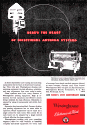 Westinghouse is yet another of the original
stalwart titans of companies that helped build America to her state of greatness,
but is now mostly a footnote in the historical notes of the many companies which
over the past few decades have bought out portions of the business. Founded in the
late 1800s by George Westinghouse as a locomotive air brake manufacturer, the company
added other markets including, notably, electric power generation and distribution.
Emerging as the winner in the famous "War of the Currents" fought between Westinghouse
and Thomas Edison secured George's place in history. Westinghouse also got into
the commercial, military, and domestic electronics and appliance markets. I worked
at the Westinghouse Oceanic Division in Annapolis, MD, from 1982 through 1986 and
though it was a great company to work for. This advertisement for "Westinghouse
Directional Equipment;" i.e., antennas, appeared in a 1945 issue of Radio News
magazine. Westinghouse is yet another of the original
stalwart titans of companies that helped build America to her state of greatness,
but is now mostly a footnote in the historical notes of the many companies which
over the past few decades have bought out portions of the business. Founded in the
late 1800s by George Westinghouse as a locomotive air brake manufacturer, the company
added other markets including, notably, electric power generation and distribution.
Emerging as the winner in the famous "War of the Currents" fought between Westinghouse
and Thomas Edison secured George's place in history. Westinghouse also got into
the commercial, military, and domestic electronics and appliance markets. I worked
at the Westinghouse Oceanic Division in Annapolis, MD, from 1982 through 1986 and
though it was a great company to work for. This advertisement for "Westinghouse
Directional Equipment;" i.e., antennas, appeared in a 1945 issue of Radio News
magazine.
 Would you work a 44-hour week for $127? That's
$6,600/yr, or $2.89/hr for a highly skilled
electronics technician in 1969. According to the U.S. Bureau of Labor Statistics'
Inflation Calculator, the equivalent pay in 2017 would be $45,703.89/yr, or $19.98/hr. A
quick look at the current pay rate for an E4 pay grade in the USAF is $2,139/mo ($25,668/yr).
That does not factor in free housing, meals, and medical care (including for all dependents)
- which has significant value. GlassDoor reports the average salary for an
electronics technician in 2017 was $42,390. That amount is actually a bit lower
than the 1969 average. Assuming the present... Would you work a 44-hour week for $127? That's
$6,600/yr, or $2.89/hr for a highly skilled
electronics technician in 1969. According to the U.S. Bureau of Labor Statistics'
Inflation Calculator, the equivalent pay in 2017 would be $45,703.89/yr, or $19.98/hr. A
quick look at the current pay rate for an E4 pay grade in the USAF is $2,139/mo ($25,668/yr).
That does not factor in free housing, meals, and medical care (including for all dependents)
- which has significant value. GlassDoor reports the average salary for an
electronics technician in 2017 was $42,390. That amount is actually a bit lower
than the 1969 average. Assuming the present...
 In a continuing effort to provide archival
material for researchers and for anyone seeking information on a particular radio
restoration project, this Radio Service Data Sheet for the
Zenith Model 430/440 radio from a 1933 edition of Radio-Craft magazine
is being posted. An Internet search will show that there are many people engaging
in such activities. Restoring my Crosley Model 03BC console radio would have been
more difficult if not for others who have done similar work to assist the "community."
I generally despise the phrase "giving back" because it is usually uttered by people
that really owe nothing to anyone, but somehow feel obligated to do so or are conditioned
to automatically say such things. This is a case where I benefitted from somebody
else's work and there is an opportunity to return the favor... In a continuing effort to provide archival
material for researchers and for anyone seeking information on a particular radio
restoration project, this Radio Service Data Sheet for the
Zenith Model 430/440 radio from a 1933 edition of Radio-Craft magazine
is being posted. An Internet search will show that there are many people engaging
in such activities. Restoring my Crosley Model 03BC console radio would have been
more difficult if not for others who have done similar work to assist the "community."
I generally despise the phrase "giving back" because it is usually uttered by people
that really owe nothing to anyone, but somehow feel obligated to do so or are conditioned
to automatically say such things. This is a case where I benefitted from somebody
else's work and there is an opportunity to return the favor...
 A few days ago I posted a webpage detailing
my work to generate equations for gain, phase, and group delay for a Butterworth
lowpass filter, using the basic polynomials. I could not find them anywhere on the
Web or in filter design books I own. The only difference between calculating Butterworth
lowpass, highpass, bandpass, and bandstop filter values for gain, phase, and group
delay is how the relative frequency is defined. Simply substitute the following
for ω in any of the equations for gain, phase, or group delay. It's that simple.
Graphs are published below. Frequency units cancel out, so a 1 Hz cutoff plots
the same as a 1 kHz cutoff or a 1 GHz cutoff for gain and phase. The group
delay scale needs to be divided by a factor equal to the frequency units (÷103 for
kHz, ÷106 for MHz, etc.)... A few days ago I posted a webpage detailing
my work to generate equations for gain, phase, and group delay for a Butterworth
lowpass filter, using the basic polynomials. I could not find them anywhere on the
Web or in filter design books I own. The only difference between calculating Butterworth
lowpass, highpass, bandpass, and bandstop filter values for gain, phase, and group
delay is how the relative frequency is defined. Simply substitute the following
for ω in any of the equations for gain, phase, or group delay. It's that simple.
Graphs are published below. Frequency units cancel out, so a 1 Hz cutoff plots
the same as a 1 kHz cutoff or a 1 GHz cutoff for gain and phase. The group
delay scale needs to be divided by a factor equal to the frequency units (÷103 for
kHz, ÷106 for MHz, etc.)...
 Hugo Gernsback is not necessarily a household
name in 2020, but in the early to middle 20th century, he was fairly well known
in both the hard science and science fiction realms. He was a prolific author of
books and magazines in both areas, applying his profound knowledge of technology
and his ability to foretell the futures of many aspects of communications, mechanics,
electronics, and marketing and societal behavior to the aforementioned. If you are
a regular RF Cafe visitor, you have seen very many articles written by Hugo Gernsback
reproduced. This particular work of prognostication appeared in a 1947 issue of
his Radio-Craft magazine. It presciently claimed that a post-war boom in
consumer buying after half a decade of sacrifice of creature comforts for the good
of the country and world would feed a significant adoption of
FM radio
over... Hugo Gernsback is not necessarily a household
name in 2020, but in the early to middle 20th century, he was fairly well known
in both the hard science and science fiction realms. He was a prolific author of
books and magazines in both areas, applying his profound knowledge of technology
and his ability to foretell the futures of many aspects of communications, mechanics,
electronics, and marketing and societal behavior to the aforementioned. If you are
a regular RF Cafe visitor, you have seen very many articles written by Hugo Gernsback
reproduced. This particular work of prognostication appeared in a 1947 issue of
his Radio-Craft magazine. It presciently claimed that a post-war boom in
consumer buying after half a decade of sacrifice of creature comforts for the good
of the country and world would feed a significant adoption of
FM radio
over...
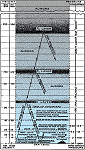 It is always nice to read an article that
encompasses more than one of my hobbies, whether it be amateur radio and amateur
astronomy like this one, amateur radio and model rocketry, or amateur radio and
radio controlled airplanes. I don't recall ever seeing an article that combined
astronomy and model airplanes. In this 1943 QST magazine piece, author
Hollis French expounds on the necessity for Hams to understand the effects that
atmospheric phenomena, caused primarily by our sun's periodic and intermittent
activity, have on radio signal propagation. Properties of the ionospheric layers
had by 1943 been pretty well surmised based on cause and effect relationships through
indirect observation since at the time no sounding rockets had been launched into
the upper atmosphere to obtain in situ measurements of ionization, magnetic fields,
and free electron activity. Today's knowledge of course is much more detailed and
formulated thanks in large part... It is always nice to read an article that
encompasses more than one of my hobbies, whether it be amateur radio and amateur
astronomy like this one, amateur radio and model rocketry, or amateur radio and
radio controlled airplanes. I don't recall ever seeing an article that combined
astronomy and model airplanes. In this 1943 QST magazine piece, author
Hollis French expounds on the necessity for Hams to understand the effects that
atmospheric phenomena, caused primarily by our sun's periodic and intermittent
activity, have on radio signal propagation. Properties of the ionospheric layers
had by 1943 been pretty well surmised based on cause and effect relationships through
indirect observation since at the time no sounding rockets had been launched into
the upper atmosphere to obtain in situ measurements of ionization, magnetic fields,
and free electron activity. Today's knowledge of course is much more detailed and
formulated thanks in large part...
 "The Radio Month" was a regular feature
in Radio-Electronics magazine in the late 1940s and early 1950s. It contained
news items from around the industry and across the world. The entire two pages are
included in the included scan, but a couple items in particular stand out that are
worth mentioning. The first is announcing the soon to be available rectangular cathode
ray tubes (CRT) for television. Until then, the actual CRTs had round faces even
though the displayed image was rectangular. A 4:3 aspect ratio was the standard,
which required the tube diameter to be roughly 25% larger than the horizontal size
of the picture. In fact,
that is how TV display sizes came to be rated by their "diagonal" dimension
rather than the picture width, and the standard stuck even after rectangular tubes
were available. For instance, the 4:3 aspect ratio conveniently produces a diagonal
length of 5 (the 3:4:5 triangle), where the hypotenuse... "The Radio Month" was a regular feature
in Radio-Electronics magazine in the late 1940s and early 1950s. It contained
news items from around the industry and across the world. The entire two pages are
included in the included scan, but a couple items in particular stand out that are
worth mentioning. The first is announcing the soon to be available rectangular cathode
ray tubes (CRT) for television. Until then, the actual CRTs had round faces even
though the displayed image was rectangular. A 4:3 aspect ratio was the standard,
which required the tube diameter to be roughly 25% larger than the horizontal size
of the picture. In fact,
that is how TV display sizes came to be rated by their "diagonal" dimension
rather than the picture width, and the standard stuck even after rectangular tubes
were available. For instance, the 4:3 aspect ratio conveniently produces a diagonal
length of 5 (the 3:4:5 triangle), where the hypotenuse... |