See Page 1 |
2 |
3 |
4 | of the June 2020 homepage archives.
 Many topics of the
electronics-themed comics which appeared in Radio-Craft were suggested
by the magazine's readers. Staff artists like Frank Beaven turned those suggestions
into cartoons. For a while there was a special feature called "Radio Term Illustrated"
where, as the name suggests, terms like "Signal Generator" and "High Potential"
are rendered in farcical form. These four comics, two of each type, appeared in
a May 1947 issue of Radio-Craft. I have to admit that even with my familiarity with
vintage electronics memes I do not get the Television "Organ" comic (yes, I understand
the organ grinder, but not how it applies to TV). Many topics of the
electronics-themed comics which appeared in Radio-Craft were suggested
by the magazine's readers. Staff artists like Frank Beaven turned those suggestions
into cartoons. For a while there was a special feature called "Radio Term Illustrated"
where, as the name suggests, terms like "Signal Generator" and "High Potential"
are rendered in farcical form. These four comics, two of each type, appeared in
a May 1947 issue of Radio-Craft. I have to admit that even with my familiarity with
vintage electronics memes I do not get the Television "Organ" comic (yes, I understand
the organ grinder, but not how it applies to TV).
 "The charge of a single electron, e, is defined
as the basic unit of electric charge. Because electrons - the subatomic particles
that carry electricity - are elementary particles and cannot be split,
fractions of electronic charge are not normally encountered. Despite
this, researchers at the University of Illinois at Urbana-Champaign have recently
observed the signature of fractional charges ranging from e/4 to 2e/3 in exotic
materials known as topological crystalline insulators. The team of researchers,
led by mechanical science and engineering professor Gaurav Bahl and physics professor
Taylor Hughes, has been using ultra high frequency electric circuits to study topological
insulators since 2017..." "The charge of a single electron, e, is defined
as the basic unit of electric charge. Because electrons - the subatomic particles
that carry electricity - are elementary particles and cannot be split,
fractions of electronic charge are not normally encountered. Despite
this, researchers at the University of Illinois at Urbana-Champaign have recently
observed the signature of fractional charges ranging from e/4 to 2e/3 in exotic
materials known as topological crystalline insulators. The team of researchers,
led by mechanical science and engineering professor Gaurav Bahl and physics professor
Taylor Hughes, has been using ultra high frequency electric circuits to study topological
insulators since 2017..."
"ConductRF-Small-Flexible-RF-Test-Cables-6-19-2020.htm" target="_top">
 Component Engineering challenges often require
finding a "commonly available solution," for a specific application that meet broad,
often conflicting requirements, determined by colleagues in electronics. Assuming
knowledge of standards like "ConductRF-Small-Flexible-RF-Test-Cables-6-19-2020.htm"
target="_top"> RG cables and widely available solutions, our expertise can be useful
when those will not work. ConductRF can provide options for higher frequency, lower
loss, greater mechanical integrity and more. When working in tight spaces, try these
new RF cable options available exclusively from ConductRF. Costs & Lead Times
Maintained Because these new cables are derived from older standards, ConductRF
has been able to make minor changes to existing standard connectors. Changing crimp
ferrules or re-purposing designs for other cables has allowed us to make many standard
connectors available for producing assemblies... Component Engineering challenges often require
finding a "commonly available solution," for a specific application that meet broad,
often conflicting requirements, determined by colleagues in electronics. Assuming
knowledge of standards like "ConductRF-Small-Flexible-RF-Test-Cables-6-19-2020.htm"
target="_top"> RG cables and widely available solutions, our expertise can be useful
when those will not work. ConductRF can provide options for higher frequency, lower
loss, greater mechanical integrity and more. When working in tight spaces, try these
new RF cable options available exclusively from ConductRF. Costs & Lead Times
Maintained Because these new cables are derived from older standards, ConductRF
has been able to make minor changes to existing standard connectors. Changing crimp
ferrules or re-purposing designs for other cables has allowed us to make many standard
connectors available for producing assemblies...
 A few years ago, RF Cafe visitor Cornell
Drentea, KW7CD, submitted a short paper entitled, "Who Invented
Radar?" I just updated the page to fix broken hyperlinks and figured it is worth
posting again. I won't spoil his conclusion / assertion by telling you here. Mr. Drentea
begins: "Whenever thinking of Radio, we usually think of one man: Guglielmo Marconi.
Radar, on the other hand resulted from the work of many men. In 1793, the Italian
scientist Lazzaro Spallanzani, a professor at Padua University studied the ability
of blind bats to navigate using ultra sound. He observed that bats flew well in
the dark without the aid of vision. He then designed a unique experiment to demonstrate
the use of the bat's ears and concluded that a bat would become disoriented without
its hearing. He concluded that the bats produced a continuous train of sound pulses
and suggested that the rate of these pulses increased as a bat approached objects.
This was not proven until..." A few years ago, RF Cafe visitor Cornell
Drentea, KW7CD, submitted a short paper entitled, "Who Invented
Radar?" I just updated the page to fix broken hyperlinks and figured it is worth
posting again. I won't spoil his conclusion / assertion by telling you here. Mr. Drentea
begins: "Whenever thinking of Radio, we usually think of one man: Guglielmo Marconi.
Radar, on the other hand resulted from the work of many men. In 1793, the Italian
scientist Lazzaro Spallanzani, a professor at Padua University studied the ability
of blind bats to navigate using ultra sound. He observed that bats flew well in
the dark without the aid of vision. He then designed a unique experiment to demonstrate
the use of the bat's ears and concluded that a bat would become disoriented without
its hearing. He concluded that the bats produced a continuous train of sound pulses
and suggested that the rate of these pulses increased as a bat approached objects.
This was not proven until..."
 Look deeper into those shiny front-page "sheet"
specs - and search out the truly relevant data - to see if the part really is the
best option for your application. Tejaswini Anand "All that Glitters Is Not Gold: Interpreting Datasheet Data When Selecting
Parts" "Application engineers often repeatedly answer the same questions from
different customers, especially queries related to choosing parts in their application.
One mistake we see in part selection happening time and time again is that the customers
become over enamored by what I like to call 'the sheet' in data sheets. I'm talking
about the shiny, glittery, sexy specs. 'Wow! That ADC has a high SNR!' This is the
story of one such customer who was impressed with one analog-to-digital converter's
(ADC) high signal-to-noise (SNR) but who forgot to consider other important datasheet
specs. We will also address common mistakes and how to choose the right parts for
your application." Look deeper into those shiny front-page "sheet"
specs - and search out the truly relevant data - to see if the part really is the
best option for your application. Tejaswini Anand "All that Glitters Is Not Gold: Interpreting Datasheet Data When Selecting
Parts" "Application engineers often repeatedly answer the same questions from
different customers, especially queries related to choosing parts in their application.
One mistake we see in part selection happening time and time again is that the customers
become over enamored by what I like to call 'the sheet' in data sheets. I'm talking
about the shiny, glittery, sexy specs. 'Wow! That ADC has a high SNR!' This is the
story of one such customer who was impressed with one analog-to-digital converter's
(ADC) high signal-to-noise (SNR) but who forgot to consider other important datasheet
specs. We will also address common mistakes and how to choose the right parts for
your application."
 Withwave manufactures an extensive line of
metrology quality coaxial test cable assemblies, connectors (wave-, end-, vertical-launch,
board edge, panel mount), calibration kits (SOLT), a
fully automated 4-port vector
network analyzer (VNA) calibrator, between- and in-series connector adaptors,
attenuators, terminations, DC blocks, torque wrenches, test probes & probe positioner.
Special test fixtures for calibration and multicoax cable assemblies. Frequency
ranges from DC through 110 GHz. Please contact Withwave today to see how they
can help your project succeed. Withwave manufactures an extensive line of
metrology quality coaxial test cable assemblies, connectors (wave-, end-, vertical-launch,
board edge, panel mount), calibration kits (SOLT), a
fully automated 4-port vector
network analyzer (VNA) calibrator, between- and in-series connector adaptors,
attenuators, terminations, DC blocks, torque wrenches, test probes & probe positioner.
Special test fixtures for calibration and multicoax cable assemblies. Frequency
ranges from DC through 110 GHz. Please contact Withwave today to see how they
can help your project succeed.
"MLinkPlanner-Center-Telecommunication-Technologies-6-15-2020.htm" target="_top">
 Center of Telecommunication Technologies is proud
to announce immediate availability of their "MLinkPlanner-Center-Telecommunication-Technologies-6-15-2020.htm"
target="_top"> MLinkPlanner 2.0 wireless network software simulation tool for modeling
microwave point-to-point (PtP) and point-to-multipoint (PtMP) links. The new version
is free for current MLinkPlanner users. MLinkPlanner was created by engineers with
many years of experience in designing microwave links, from single hop access links
to high-power long-haul trunk lines. MLinkPlanner has demonstrated its effectiveness
in designing many links that are operating successfully in various climate zones
and topographical conditions from plains and marshlands to highlands. Special focus
was placed on devising a convenient user interface, the incorporation of adaptable
and easy to use link path profiles in the design process... Center of Telecommunication Technologies is proud
to announce immediate availability of their "MLinkPlanner-Center-Telecommunication-Technologies-6-15-2020.htm"
target="_top"> MLinkPlanner 2.0 wireless network software simulation tool for modeling
microwave point-to-point (PtP) and point-to-multipoint (PtMP) links. The new version
is free for current MLinkPlanner users. MLinkPlanner was created by engineers with
many years of experience in designing microwave links, from single hop access links
to high-power long-haul trunk lines. MLinkPlanner has demonstrated its effectiveness
in designing many links that are operating successfully in various climate zones
and topographical conditions from plains and marshlands to highlands. Special focus
was placed on devising a convenient user interface, the incorporation of adaptable
and easy to use link path profiles in the design process...
 Paul Wade, W1GHZ, has a great article entitled,
"Focusing a Parabolic Disk," in the June 2020 issue of the ARRL's
QST magazine (p54). It discusses how to properly position a feed horn at the focus
of a parabolic antenna dish, and presents plots of how various misalignments affects
the signal quality. The motivation was determining how sensitive feed horn placement
based on a near field test setup affects performance in the far field. Equations
for the plots are not provided; however, Mr. Wade does include the
Rayleigh
distance (DR) formula for antennas of DR = 2D2/λ,
which is the transition distance from
near field
to far field - the Fresnel and Fraunhofer regions, respectively. Unfortunately,
you need an ARRL member login to access the article, but if you don't have one,
find a nearby Ham and ask to borrow his hard copy. BTW, the June 2020 cover has
to be the ugliest thing ever published on QST. Paul Wade, W1GHZ, has a great article entitled,
"Focusing a Parabolic Disk," in the June 2020 issue of the ARRL's
QST magazine (p54). It discusses how to properly position a feed horn at the focus
of a parabolic antenna dish, and presents plots of how various misalignments affects
the signal quality. The motivation was determining how sensitive feed horn placement
based on a near field test setup affects performance in the far field. Equations
for the plots are not provided; however, Mr. Wade does include the
Rayleigh
distance (DR) formula for antennas of DR = 2D2/λ,
which is the transition distance from
near field
to far field - the Fresnel and Fraunhofer regions, respectively. Unfortunately,
you need an ARRL member login to access the article, but if you don't have one,
find a nearby Ham and ask to borrow his hard copy. BTW, the June 2020 cover has
to be the ugliest thing ever published on QST.
 RF Cafe visitor Mike M. sent this very
interesting note after reading this "Frequency Modulation Fundamentals" article: Again, you hit it
out of the ballpark, Kirt! Great article out of QST. Absolutely accurate to credit
"The Old Man" Edwin Armstrong for the invention/development of FM and much more,
plus the work of Dan Noble, who worked with the Connecticut State Police and Motorola
as Director of Research. Also many, many others. Some that have never been properly
credited. Guys like Bob Morris, W2LV and Frank Gunther, W2ALS. They were both interviewed
by Ken Burns for "Empire of the Air". I was fortunate enough to talk to both of
these guys after I got my Tech license in 1970. My immediate supervisor/mentor from
1972 until he retired in ~1990, was George. He was a superb mentor, who espoused
the best engineering methods and as he would say " the price of success is constant
vigilance." George had worked for Armstrong at the pioneering FM station, W2XMN
in the late 40's and early 50's. George had several stories about working for "The
Old Man..." RF Cafe visitor Mike M. sent this very
interesting note after reading this "Frequency Modulation Fundamentals" article: Again, you hit it
out of the ballpark, Kirt! Great article out of QST. Absolutely accurate to credit
"The Old Man" Edwin Armstrong for the invention/development of FM and much more,
plus the work of Dan Noble, who worked with the Connecticut State Police and Motorola
as Director of Research. Also many, many others. Some that have never been properly
credited. Guys like Bob Morris, W2LV and Frank Gunther, W2ALS. They were both interviewed
by Ken Burns for "Empire of the Air". I was fortunate enough to talk to both of
these guys after I got my Tech license in 1970. My immediate supervisor/mentor from
1972 until he retired in ~1990, was George. He was a superb mentor, who espoused
the best engineering methods and as he would say " the price of success is constant
vigilance." George had worked for Armstrong at the pioneering FM station, W2XMN
in the late 40's and early 50's. George had several stories about working for "The
Old Man..."
 Ralph Prigge, of
Alaris USA, wrote to request
that his company be added to the list of companies on the RF Cafe Antenna Vendors
page. Alaris USA is an organization based in Maine to sell products of COJOT, mWAVE
and Alaris Antennas to their customers in the USA. All are sister companies owned
by Alaris Holdings Limited (formerly Poynting Antennas) headquartered in South Africa.
They design, manufacture and distribute antenna products for the global defense,
homeland security and specialized antenna market sectors, including international
electronic warfare (EW) system houses and also include semi- and governmental organizations.
Alaris USA is proud to provide our American customers specialized military and defense
products including EMC, tactical communications, vehicle-mounted, fixed site, switched
beam, direction finding, and mission adaptive antennas. Please check Alaris USA
out today if you have antenna needs. Ralph Prigge, of
Alaris USA, wrote to request
that his company be added to the list of companies on the RF Cafe Antenna Vendors
page. Alaris USA is an organization based in Maine to sell products of COJOT, mWAVE
and Alaris Antennas to their customers in the USA. All are sister companies owned
by Alaris Holdings Limited (formerly Poynting Antennas) headquartered in South Africa.
They design, manufacture and distribute antenna products for the global defense,
homeland security and specialized antenna market sectors, including international
electronic warfare (EW) system houses and also include semi- and governmental organizations.
Alaris USA is proud to provide our American customers specialized military and defense
products including EMC, tactical communications, vehicle-mounted, fixed site, switched
beam, direction finding, and mission adaptive antennas. Please check Alaris USA
out today if you have antenna needs.
 Now that the wonder material graphene and
the wonder wireless communications scheme of 5G has had their respective heydays,
much attention is being given to quantum computing and quantum-tunnel transistors.
"Quantum," which already had its own heyday back in early last century, is in vogue
again - like wide ties, big-framed eyeglasses, and miniskirts. Lee Goldberg has
a piece titled "Are Quantum-Tunnel Transistors Real, and What Do They Mean for Power
Tech?" posted over on the Electronic Design website in case you are
interested in learning about the latest happenings in the field of quantum-tunnel
transistors. They actually have nothing to do with quantum computers, and get their
name due to tunneling effects (a la the familiar tunnel diode) that are exploited
in this new "Bizen" phenomena that is being touted as a replacement for CMOS ICs.
Time will tell how accurate the prediction is, as with the recently mentioned
Wamoscope. Now that the wonder material graphene and
the wonder wireless communications scheme of 5G has had their respective heydays,
much attention is being given to quantum computing and quantum-tunnel transistors.
"Quantum," which already had its own heyday back in early last century, is in vogue
again - like wide ties, big-framed eyeglasses, and miniskirts. Lee Goldberg has
a piece titled "Are Quantum-Tunnel Transistors Real, and What Do They Mean for Power
Tech?" posted over on the Electronic Design website in case you are
interested in learning about the latest happenings in the field of quantum-tunnel
transistors. They actually have nothing to do with quantum computers, and get their
name due to tunneling effects (a la the familiar tunnel diode) that are exploited
in this new "Bizen" phenomena that is being touted as a replacement for CMOS ICs.
Time will tell how accurate the prediction is, as with the recently mentioned
Wamoscope.
TotalTemp Technologies has more than 40 years of combined experience providing
thermal platforms. Thermal Platforms are available to provide temperatures between
-100°C and +200°C for cryogenic cooling, recirculating circulating coolers, temperature
chambers and temperature controllers, thermal range safety controllers, space simulation
chambers, hybrid benchtop chambers, custom systems and platforms. Manual and automated
configurations for laboratory and production environments. Please contact TotalTemp
Technologies today to learn how they can help your project.
 Robert Balin created many quizzes for
Popular Electronics magazine during the 1960s and 1970s. Topics included series
circuits, electrochemistry, electronic analogy, electronic coupling, electronics
analogy, audio, electronic units, capacitor circuits, AC circuit theory, magnetic
phenomena, electronics geography, electronic noise, plugs and jacks, electronic
switching, diodes, and many more. This "Electronics Physics Quiz" is the 59th that I have posted. It challenges
you to name the effects that were first noticed as the result of unexpected actions
during laboratory experiments. Many of the names, as you might expect, eponymously
honor their progenitors. My score was 80%. Robert Balin created many quizzes for
Popular Electronics magazine during the 1960s and 1970s. Topics included series
circuits, electrochemistry, electronic analogy, electronic coupling, electronics
analogy, audio, electronic units, capacitor circuits, AC circuit theory, magnetic
phenomena, electronics geography, electronic noise, plugs and jacks, electronic
switching, diodes, and many more. This "Electronics Physics Quiz" is the 59th that I have posted. It challenges
you to name the effects that were first noticed as the result of unexpected actions
during laboratory experiments. Many of the names, as you might expect, eponymously
honor their progenitors. My score was 80%.
 "Upgrades include a mode for use while wearing
night-vision goggles, and a stealth mode that disables LTE and mutes all RF broadcasting.
The handset has undergone a series of changes to make it a piece of military-grade
tech. In addition to being packed into a case that looks like it could withstand
a nuke, the S20 TE features
DualDAR architecture that secures data with two layers of encryption
and is based on NSA standards. With communications being a vital element of a field
operative's work, Samsung says the S20 TE comes with pre-configured software to
support tactical radios and mission-critical devices through the use of Private
SIM, 5G, Wi-Fi 6 and CBRS (Citizens Broadband Radio Service) -- a band of radio-frequency
spectrum from 3.5 to 3.7 GHz..." "Upgrades include a mode for use while wearing
night-vision goggles, and a stealth mode that disables LTE and mutes all RF broadcasting.
The handset has undergone a series of changes to make it a piece of military-grade
tech. In addition to being packed into a case that looks like it could withstand
a nuke, the S20 TE features
DualDAR architecture that secures data with two layers of encryption
and is based on NSA standards. With communications being a vital element of a field
operative's work, Samsung says the S20 TE comes with pre-configured software to
support tactical radios and mission-critical devices through the use of Private
SIM, 5G, Wi-Fi 6 and CBRS (Citizens Broadband Radio Service) -- a band of radio-frequency
spectrum from 3.5 to 3.7 GHz..."
 Just in time for the birthday of vacuum tube
pioneer Sir William Crookes, Lou Frenzel has an article titled "Tubes: Luckily, They're Still Around" on the Microwaves &
RF website. "As Noah said to his family after dinner, 'Those unicorn steaks
were excellent!'" "So, unicorns are gone for good. But not vacuum tubes. It
doesn't seem that tubes will ever disappear completely - they're still with us and
that's a good thing. I was reminded of that several times over the past weeks. For
example, I was scanning the ads for a high-power ham-radio amplifier. Most of the
popular transceivers top out at about 100 W. For good long-distance (DX) communications
around the world on the high frequency bands (3 to 30 MHz), more power is desired.
A number of companies make accessory power amps to boost power level to the FCC
legal limit of 1500 W. Both transistor and tube models are available to choose from.
The solid-state amps use multiple RF MOSFETs to get to levels of 500 to 1000 W.
These are very expensive..." Just in time for the birthday of vacuum tube
pioneer Sir William Crookes, Lou Frenzel has an article titled "Tubes: Luckily, They're Still Around" on the Microwaves &
RF website. "As Noah said to his family after dinner, 'Those unicorn steaks
were excellent!'" "So, unicorns are gone for good. But not vacuum tubes. It
doesn't seem that tubes will ever disappear completely - they're still with us and
that's a good thing. I was reminded of that several times over the past weeks. For
example, I was scanning the ads for a high-power ham-radio amplifier. Most of the
popular transceivers top out at about 100 W. For good long-distance (DX) communications
around the world on the high frequency bands (3 to 30 MHz), more power is desired.
A number of companies make accessory power amps to boost power level to the FCC
legal limit of 1500 W. Both transistor and tube models are available to choose from.
The solid-state amps use multiple RF MOSFETs to get to levels of 500 to 1000 W.
These are very expensive..."
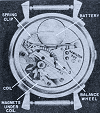 The world's first electric wristwatch went
on sale on January 3, 1957 - the Ventura model, by Hamilton Electric, and it retailed
for $200. I use the event as the theme of the RF Cafe logo for that day in history.
Unlike today's electric watches which use a crystal for timing, the early watches
used a pulsed motor to energize the balance wheel coil, in place of a mainspring
and an escapement mechanism. Some "atomic" wristwatches today like the Casio Waveceptor
(<$40) use the WWV signals from Boulder, Colorado, to synchronize the time with
world standards. The watch shown in this article from the February 1958 edition
of Radio-Electronics magazine is a model 500, which you can find more detail about
on the Unique Watch Guide website... The world's first electric wristwatch went
on sale on January 3, 1957 - the Ventura model, by Hamilton Electric, and it retailed
for $200. I use the event as the theme of the RF Cafe logo for that day in history.
Unlike today's electric watches which use a crystal for timing, the early watches
used a pulsed motor to energize the balance wheel coil, in place of a mainspring
and an escapement mechanism. Some "atomic" wristwatches today like the Casio Waveceptor
(<$40) use the WWV signals from Boulder, Colorado, to synchronize the time with
world standards. The watch shown in this article from the February 1958 edition
of Radio-Electronics magazine is a model 500, which you can find more detail about
on the Unique Watch Guide website...
 Joe Cahak, owner of Sunshine Design Engineering
Services, has submitted another fine article for posting here. Joe has many years
of automated RF testing experience to leverage when writing this paper on making
measurements with scattering parameters (S-parameters) involved. He begins, "In many RF and Microwave measurements
the S-Parameters are typically expressed in dB (decibels) Magnitude units and Degrees
in the polar coordinate system. Network and Vector Network Analyzers and Spectrum
Analyzers all measure with voltage ratio measurements, so to convert to dB in terms
of volts we must use the following equation. The Spectrum Analyzer is a frequency
discriminating detector that detects the voltage for the signal. It will give the
amplitude of signal as a function of frequency. It is scalar in measurement dimension
magnitude vs. frequency. Displayed units are typically expressed in units of power
(dBm). The Vector Network Analyzer measures complex magnitude and angle of RF signals
vs. frequency. By using reference signals to calibrate the test system response
and setting up a reference frame for the measurements, the instrument can measure
the amplitude and phase angle of the AC-RF signal for each frequency it is tuned
to. Displayed units are typically expressed..." Joe Cahak, owner of Sunshine Design Engineering
Services, has submitted another fine article for posting here. Joe has many years
of automated RF testing experience to leverage when writing this paper on making
measurements with scattering parameters (S-parameters) involved. He begins, "In many RF and Microwave measurements
the S-Parameters are typically expressed in dB (decibels) Magnitude units and Degrees
in the polar coordinate system. Network and Vector Network Analyzers and Spectrum
Analyzers all measure with voltage ratio measurements, so to convert to dB in terms
of volts we must use the following equation. The Spectrum Analyzer is a frequency
discriminating detector that detects the voltage for the signal. It will give the
amplitude of signal as a function of frequency. It is scalar in measurement dimension
magnitude vs. frequency. Displayed units are typically expressed in units of power
(dBm). The Vector Network Analyzer measures complex magnitude and angle of RF signals
vs. frequency. By using reference signals to calibrate the test system response
and setting up a reference frame for the measurements, the instrument can measure
the amplitude and phase angle of the AC-RF signal for each frequency it is tuned
to. Displayed units are typically expressed..."
Qorvo / Custom MMIC is a fabless RF and microwave MMIC designer entrusted by government
and defense industry OEMs. Custom and off-the-shelf products include switches, phase
shifters, attenuators, mixers and multipliers, and low noise, low phase noise, and
distributed amplifiers. From next-generation long range military radar systems,
to advanced aerospace and space-qualified satellite communications, microwave signal
chains are being pushed to new limits - and no one understands this more than Custom
MMIC. Please contact Qorvo / Custom MMIC today to see how they use their modern
engineering, testing and packaging facility to help your project.
 According to the Wikipedia entry, Cannon
Electric Company introduced the now-familiar D-Sub (D-subminiature) connector format in 1952. This advertisement in
a 1954 issue of Radio & Television News magazine is the first one I recall seeing.
D-Sub connectors were a really big deal back in the 1980s when personal computers
(PCs) first appeared. CRT monitors used them, printers used them, scanners used
them, network interfaces used them, mice and keyboards used them (those that didn't
use PS/2 connectors, which were an invention of IBM for their Personal System 2
computers). Nowadays the USB (Universal Serial Bus) and HDMI (High-Definition Multimedia
Interface ) connectors have replaced most D-Subs in the computer cable realm. Of
course with everything going wireless, connectors and cables of all sorts are rapidly
disappearing except those used for charging... According to the Wikipedia entry, Cannon
Electric Company introduced the now-familiar D-Sub (D-subminiature) connector format in 1952. This advertisement in
a 1954 issue of Radio & Television News magazine is the first one I recall seeing.
D-Sub connectors were a really big deal back in the 1980s when personal computers
(PCs) first appeared. CRT monitors used them, printers used them, scanners used
them, network interfaces used them, mice and keyboards used them (those that didn't
use PS/2 connectors, which were an invention of IBM for their Personal System 2
computers). Nowadays the USB (Universal Serial Bus) and HDMI (High-Definition Multimedia
Interface ) connectors have replaced most D-Subs in the computer cable realm. Of
course with everything going wireless, connectors and cables of all sorts are rapidly
disappearing except those used for charging...
 "Official talks on construction and operation
of a new TSMC semiconductor
chip manufacturing fab the in U.S. is promising but riddled with
political and technical intrigue. Will the news of a new semiconductor fab on U.S.
soil be a boost to the economy and technological stability or is it merely a fanciful
political scheme? To answer that question, let's start with the news that has created
so much discussion in the electronics space. Recently, the Taiwan Semiconductor
Manufacturing Company (TSMC) announced its intention to build and operate an advanced
5nm semiconductor fab in the U.S. state of Arizona. TSMC, headquartered in Taiwan,
is the largest chip manufacturer in the world. The company currently operates a
fab in Camas, Washington and design centers in both Austin, Texas and San Jose,
California. The Arizona facility would be TSMC's second manufacturing site..." "Official talks on construction and operation
of a new TSMC semiconductor
chip manufacturing fab the in U.S. is promising but riddled with
political and technical intrigue. Will the news of a new semiconductor fab on U.S.
soil be a boost to the economy and technological stability or is it merely a fanciful
political scheme? To answer that question, let's start with the news that has created
so much discussion in the electronics space. Recently, the Taiwan Semiconductor
Manufacturing Company (TSMC) announced its intention to build and operate an advanced
5nm semiconductor fab in the U.S. state of Arizona. TSMC, headquartered in Taiwan,
is the largest chip manufacturer in the world. The company currently operates a
fab in Camas, Washington and design centers in both Austin, Texas and San Jose,
California. The Arizona facility would be TSMC's second manufacturing site..."
 Yeah, I thought the same thing... a "Wamoscope?" Was it produced by the Wham-O toy company that makes
the Hula Hoop, the Frisbee, the Super Ball, and Silly String? Wham-O was founded
in 1948, and this article appeared in a 1956 edition of Radio & Television News
magazine, so why not? Actually, Wamoscope is derived from "WAve-MOdulated oscilloSCOPE."
Developed by Sylvania Electric Products, it combined a traveling-wave tube with
a cathode ray tube in single enclosure. That enabled microwave signals to be fed
directly to the CRT for amplifications and processing. Evidently the idea did not
catch on since the market was never filled with Wamoscope sets. A brochure for Sylvania's
6762 Wamoscope is shown at the bottom of the page... Yeah, I thought the same thing... a "Wamoscope?" Was it produced by the Wham-O toy company that makes
the Hula Hoop, the Frisbee, the Super Ball, and Silly String? Wham-O was founded
in 1948, and this article appeared in a 1956 edition of Radio & Television News
magazine, so why not? Actually, Wamoscope is derived from "WAve-MOdulated oscilloSCOPE."
Developed by Sylvania Electric Products, it combined a traveling-wave tube with
a cathode ray tube in single enclosure. That enabled microwave signals to be fed
directly to the CRT for amplifications and processing. Evidently the idea did not
catch on since the market was never filled with Wamoscope sets. A brochure for Sylvania's
6762 Wamoscope is shown at the bottom of the page...
Berkeley
Nucleonics Corporation (BNC) is a leading manufacturer of precision electronic
instrumentation for test, measurement, and nuclear research. Founded in 1963, BNC
initially developed custom pulse generators. We became known for meeting the most
stringent requirements for high precision and stability, and for producing instruments
of unsurpassed reliability and performance. We continue to maintain a leadership
position as a developer of custom pulse, signal, light, and function generators.
Our designs incorporate the latest innovations in software and hardware engineering,
surface mount production, and automated testing procedures ...
 If 5G began life as and still does to many
people remain a nebulous concept, then the definition of 6G is really up for grabs.
This article on the EDN website by Jessy Cavazos, titled "Aspects of 6G That Will Matter to Wireless Design Engineers,"
is one of the first attempts I've seen to explain it. Here is her summation: "In
addition to the next-level evolution in automated driving and smart manufacturing,
6G will enable innovative applications by combining sensing, imaging, and precise
timing with mobility and truly leveraging artificial intelligence (AI) and intelligent
networks. Further integrating communications technologies into society, 6G technology
will bring mixed reality experiences and telepresence to life, while playing a pivotal
role in achieving global sustainability, improving society, and increasing productivity
across industries." If 5G began life as and still does to many
people remain a nebulous concept, then the definition of 6G is really up for grabs.
This article on the EDN website by Jessy Cavazos, titled "Aspects of 6G That Will Matter to Wireless Design Engineers,"
is one of the first attempts I've seen to explain it. Here is her summation: "In
addition to the next-level evolution in automated driving and smart manufacturing,
6G will enable innovative applications by combining sensing, imaging, and precise
timing with mobility and truly leveraging artificial intelligence (AI) and intelligent
networks. Further integrating communications technologies into society, 6G technology
will bring mixed reality experiences and telepresence to life, while playing a pivotal
role in achieving global sustainability, improving society, and increasing productivity
across industries."
Nova Microwave is a leader in technically differentiated electronic and radio
frequency Ferrite Circulators and Isolators that connect, protect and control critical
commercial and military wireless telecommunications systems. Our staff is dedicated
to research and development of standard and custom design quality Ferrite Circulators
and Isolators from 380 MHz to 26.5 GHz. Available in single or multi-junction
topographies, the Nova Microwave product line of is specifically designed for use
in varied environmental and temperature extremes.
 This is another example of one of those
advertisements you likely would not see in a modern electronics magazine.
There is nothing fundamentally problematic about its content or message, but politically
correct standards would condemn any depiction of a woman expressing such excessive
appreciation for a man's efforts. It might, after all, convey the idea that all
television antenna servicemen should expect such treatment from all women. It also
implies that only men can be TV antenna servicemen / servicepersons. If that sounds
nutty, well, what can I say. It's the world we live in as evidenced by news items
of late. Keep firmly in mind that what is accepted as a social norm today might
be considered to be a crime in a few decades, so exercise caution in all you do
in the presence of witnesses be it written, videoed, spoken, or acted out... This is another example of one of those
advertisements you likely would not see in a modern electronics magazine.
There is nothing fundamentally problematic about its content or message, but politically
correct standards would condemn any depiction of a woman expressing such excessive
appreciation for a man's efforts. It might, after all, convey the idea that all
television antenna servicemen should expect such treatment from all women. It also
implies that only men can be TV antenna servicemen / servicepersons. If that sounds
nutty, well, what can I say. It's the world we live in as evidenced by news items
of late. Keep firmly in mind that what is accepted as a social norm today might
be considered to be a crime in a few decades, so exercise caution in all you do
in the presence of witnesses be it written, videoed, spoken, or acted out...
 "Silicon
solar cells folded into spheres hint at solar power's flexibility
in even small devices. Flat solar panels still face big limitations when it comes
to making the most of the available sunlight each day. A new spherical solar cell
design aims to boost solar power harvesting potential from nearly every angle without
requiring expensive moving parts to keep tracking the sun's apparent movement across
the sky. The spherical solar cell prototype designed by Saudi researchers is a tiny
blue sphere that a person can easily hold in one hand like a ping pong ball. Indoor
experiments with a solar simulator lamp have already shown that it can achieve between
15% and 100% more power output compared with a flat solar cell..." "Silicon
solar cells folded into spheres hint at solar power's flexibility
in even small devices. Flat solar panels still face big limitations when it comes
to making the most of the available sunlight each day. A new spherical solar cell
design aims to boost solar power harvesting potential from nearly every angle without
requiring expensive moving parts to keep tracking the sun's apparent movement across
the sky. The spherical solar cell prototype designed by Saudi researchers is a tiny
blue sphere that a person can easily hold in one hand like a ping pong ball. Indoor
experiments with a solar simulator lamp have already shown that it can achieve between
15% and 100% more power output compared with a flat solar cell..."
 RF Cafe visitor Dave H. wrote to offer the
following additional information about the
history of mobile radio communications. It is fairly extensive,
so it is posted at the bottom of the page. "I liked the article about Don Wallace
and his car to home radio. I knew that in Detroit, the police had attempted to have
car to car transmissions. They were not overly successful however. They did implement
a station to car, 1 way transmission. I discovered the facts about the Detroit police
radios while researching a paper that I wrote entitled: 'SAW Filters : The Unsung
Heroes of the Cell Phone Revolution.' Did you know that that the phone developed
by Martin Cooper while at Motorola, circa 1973, had a filter board that measured
10 inches by about 1 inch? That would be a tad hard to find..." RF Cafe visitor Dave H. wrote to offer the
following additional information about the
history of mobile radio communications. It is fairly extensive,
so it is posted at the bottom of the page. "I liked the article about Don Wallace
and his car to home radio. I knew that in Detroit, the police had attempted to have
car to car transmissions. They were not overly successful however. They did implement
a station to car, 1 way transmission. I discovered the facts about the Detroit police
radios while researching a paper that I wrote entitled: 'SAW Filters : The Unsung
Heroes of the Cell Phone Revolution.' Did you know that that the phone developed
by Martin Cooper while at Motorola, circa 1973, had a filter board that measured
10 inches by about 1 inch? That would be a tad hard to find..."
 This is the first of a two-part series on
the move of the
WWV transmitter stations operated by the National Bureau of Standards
(now called National Institute of Standards and Technology) from Greenbelt, Maryland,
to Boulder, Colorado. WWV Part II appeared in the February 1967 edition of the ARRL's
QST magazine. WWV began transmitting time / frequency standards in 1920
in order to provide a means for remote stations and laboratories to calibrate local
standards that would prevent transmitting stations from interfering with each other.
Although most people don't realize it, the 60 kHz signal that their 'atomic'
clocks and watches use to self-adjust time emanates from the WWVB antenna in Boulder.
This first installment of the article discusses the history and rationale for relocating
the WWV facility to a new location. The second part gets into the technical aspects... This is the first of a two-part series on
the move of the
WWV transmitter stations operated by the National Bureau of Standards
(now called National Institute of Standards and Technology) from Greenbelt, Maryland,
to Boulder, Colorado. WWV Part II appeared in the February 1967 edition of the ARRL's
QST magazine. WWV began transmitting time / frequency standards in 1920
in order to provide a means for remote stations and laboratories to calibrate local
standards that would prevent transmitting stations from interfering with each other.
Although most people don't realize it, the 60 kHz signal that their 'atomic'
clocks and watches use to self-adjust time emanates from the WWVB antenna in Boulder.
This first installment of the article discusses the history and rationale for relocating
the WWV facility to a new location. The second part gets into the technical aspects...
"triad-rf-systems-high-altitude-platform-stratospheric-flight-test-6-11-2020.htm"
target="_top">
 When an industry-leading provider of stratospheric
communications platforms first called on "triad-rf-systems-high-altitude-platform-stratospheric-flight-test-6-11-2020.htm"
target="_top"> TRIAD RF Systems, they were initially looking to gain an incremental
wireless communications range boost. What they achieved instead was a mission that
went from an underwhelming link performance test to an incredible long-range success
in under 5 minutes. The Challenge: Filling the capability gap between aircraft,
drones and satellites, this industry-leading platform designer and manufacturer
delivers solutions for communications, data relay, and intelligence, surveillance,
and recognizance (ISR) applications to space agencies, the military, communications
providers, and many other commercial applications. The customer simulated that the
link distance without a TRIAD power amplifier would be approximately 100 miles.
However, at a distance of 75 miles away from the base station, the link started
to cut out, and all communication was lost... When an industry-leading provider of stratospheric
communications platforms first called on "triad-rf-systems-high-altitude-platform-stratospheric-flight-test-6-11-2020.htm"
target="_top"> TRIAD RF Systems, they were initially looking to gain an incremental
wireless communications range boost. What they achieved instead was a mission that
went from an underwhelming link performance test to an incredible long-range success
in under 5 minutes. The Challenge: Filling the capability gap between aircraft,
drones and satellites, this industry-leading platform designer and manufacturer
delivers solutions for communications, data relay, and intelligence, surveillance,
and recognizance (ISR) applications to space agencies, the military, communications
providers, and many other commercial applications. The customer simulated that the
link distance without a TRIAD power amplifier would be approximately 100 miles.
However, at a distance of 75 miles away from the base station, the link started
to cut out, and all communication was lost...
 PCB Directory is the largest directory of
Printed Circuit Board (PCB)
Manufacturers, Assembly houses, and Design Services on the Internet. We have listed
the leading printed circuit board manufacturers around the world and made them searchable
by their capabilities - Number of laminates used, Board thicknesses supported, Number
of layers supported, Types of substrates (FR-4, Rogers, flexible, rigid), Geographical
location (U.S., China), kinds of services (manufacturing, fabrication, assembly,
prototype), and more. Fast turn-around on quotations for PCB fabrication and assembly. PCB Directory is the largest directory of
Printed Circuit Board (PCB)
Manufacturers, Assembly houses, and Design Services on the Internet. We have listed
the leading printed circuit board manufacturers around the world and made them searchable
by their capabilities - Number of laminates used, Board thicknesses supported, Number
of layers supported, Types of substrates (FR-4, Rogers, flexible, rigid), Geographical
location (U.S., China), kinds of services (manufacturing, fabrication, assembly,
prototype), and more. Fast turn-around on quotations for PCB fabrication and assembly.
 Each week, for the sake of all avid cruciverbalists
amongst us, I create a new
technology-themed crossword puzzle using only words from my custom-created
lexicon related to engineering, science, mathematics, chemistry, physics, astronomy,
etc. In this crossword for June 14th you will never find among the words names of
politicians, mountain ranges, exotic foods or plants, movie stars, or anything of
the sort. You might, however, see someone or something in the exclusion list who
or that is directly related to this puzzle's theme, such as Hedy Lamarr or the Bikini
Atoll, respectively. Enjoy! Each week, for the sake of all avid cruciverbalists
amongst us, I create a new
technology-themed crossword puzzle using only words from my custom-created
lexicon related to engineering, science, mathematics, chemistry, physics, astronomy,
etc. In this crossword for June 14th you will never find among the words names of
politicians, mountain ranges, exotic foods or plants, movie stars, or anything of
the sort. You might, however, see someone or something in the exclusion list who
or that is directly related to this puzzle's theme, such as Hedy Lamarr or the Bikini
Atoll, respectively. Enjoy!
These archive pages are provided in order to make it easier for you to find items
that you remember seeing on the RF Cafe homepage. Of course probably the easiest
way to find anything on the website is to use the "Search
RF Cafe" box at the top of every page. Some quoted items have been shortened
to save space. About RF Cafe.
Homepage Archive Pages
2026:
Jan |
Feb |
Mar |
Apr |
May | Jun | Jul | Aug
| Sep | Oct | Nov | Dec
2025:
Jan |
Feb |
Mar |
Apr |
May |
Jun |
Jul |
Aug |
Sep |
Oct |
Nov |
Dec
2024:
Jan |
Feb |
Mar |
Apr |
May |
Jun |
Jul |
Aug |
Sep |
Oct |
Nov |
Dec
2023:
Jan |
Feb |
Mar |
Apr |
May |
Jun |
Jul |
Aug |
Sep |
Oct |
Nov |
Dec
2022:
Jan |
Feb |
Mar |
Apr |
May |
Jun |
Jul |
Aug |
Sep |
Oct |
Nov |
Dec
2021:
Jan |
Feb |
Mar |
Apr |
May |
Jun |
Jul |
Aug |
Sep |
Oct |
Nov |
Dec
2020:
Jan |
Feb |
Mar |
Apr |
May |
Jun |
Jul |
Aug |
Sep |
Oct |
Nov |
Dec
2019:
Jan |
Feb |
Mar |
Apr |
May |
Jun |
Jul |
Aug |
Sep |
Oct |
Nov |
Dec
2018:
Jan |
Feb |
Mar |
Apr |
May |
Jun |
Jul |
Aug |
Sep |
Oct |
Nov |
Dec
2017:
Jan | Feb |
Mar |
Apr |
May |
Jun |
Jul |
Aug |
Sep |
Oct |
Nov |
Dec
2016:
Jan | Feb |
Mar |
Apr |
May |
Jun |
Jul |
Aug |
Sep |
Oct |
Nov |
Dec
2015:
Jan | Feb |
Mar |
Apr |
May |
Jun |
Jul |
Aug | Sep |
Oct |
Nov |
Dec
2014:
Jan | Feb |
Mar |
Apr |
May |
Jun |
Jul |
Aug |
Sep |
Oct |
Nov |
Dec
2013:
Jan | Feb |
Mar |
Apr |
May |
Jun |
Jul |
Aug |
Sep |
Oct |
Nov |
Dec
2012: 1 |
2 | 3
| 4 | 5
| 6 | 7
| 8 | 9
| 10 | 11
| 12 | 13
(no archives before 2012)
- Christmas-themed
items
|