See Page 1 |
2 |
3 |
4 |
5 | of the July 2020 homepage archives.
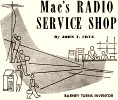 It has been a long time since I heard this
saying: "Well, they always say that if you want to find out the best and easiest
way of doing something, just put a lazy man at the job." Mac McGregor offered that
line to his service shop technician Barney - in jest of course - when Barney explains
his million dollar invention idea for a
fool-proof vacuum tube tester that can be used by just about anyone.
Mac's Radio Service Shop creator John Frye often used the monthly techno-drama to
introduce some good ideas for new inventions and/or new methods for troubleshooting
problems. Somewhere along the line I think I have seen an advertisement for a tube
tester that used the automation concept dreamed up by Barney... It has been a long time since I heard this
saying: "Well, they always say that if you want to find out the best and easiest
way of doing something, just put a lazy man at the job." Mac McGregor offered that
line to his service shop technician Barney - in jest of course - when Barney explains
his million dollar invention idea for a
fool-proof vacuum tube tester that can be used by just about anyone.
Mac's Radio Service Shop creator John Frye often used the monthly techno-drama to
introduce some good ideas for new inventions and/or new methods for troubleshooting
problems. Somewhere along the line I think I have seen an advertisement for a tube
tester that used the automation concept dreamed up by Barney...
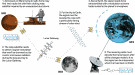 "How
radios can use neural networks to adapt to alien environments.
Space seems empty and therefore the perfect environment for radio communications.
Don't let that fool you: There's still plenty that can disrupt radio communications.
Earth's fluctuating ionosphere can impair a link between a satellite and a ground
station. The materials of the antenna can be distorted as it heats and cools. And
the near-vacuum of space is filled with low-level ambient radio emanations, known
as cosmic noise, which come from distant quasars, the sun, and the center of our
Milky Way galaxy. This noise also includes the cosmic microwave background radiation,
a ghost of the big bang. Although faint, these cosmic sources can overwhelm a wireless
signal over interplanetary distances..." "How
radios can use neural networks to adapt to alien environments.
Space seems empty and therefore the perfect environment for radio communications.
Don't let that fool you: There's still plenty that can disrupt radio communications.
Earth's fluctuating ionosphere can impair a link between a satellite and a ground
station. The materials of the antenna can be distorted as it heats and cools. And
the near-vacuum of space is filled with low-level ambient radio emanations, known
as cosmic noise, which come from distant quasars, the sun, and the center of our
Milky Way galaxy. This noise also includes the cosmic microwave background radiation,
a ghost of the big bang. Although faint, these cosmic sources can overwhelm a wireless
signal over interplanetary distances..."
 This is a different type of
electronics-related quiz from Quizmaster Robert P. Balin.
Mr. Balin created many monthly quizzes for Popular Electronics magazine.
Here you are provided a series of images and a list of men's first names, and you
need to match the image to the name. There are nine in all. Sure, it's kind of hokey
(especially B and I), but it is a good Friday afternoon challenge to help pass the
time until the weekend begins. Enjoy. This is a different type of
electronics-related quiz from Quizmaster Robert P. Balin.
Mr. Balin created many monthly quizzes for Popular Electronics magazine.
Here you are provided a series of images and a list of men's first names, and you
need to match the image to the name. There are nine in all. Sure, it's kind of hokey
(especially B and I), but it is a good Friday afternoon challenge to help pass the
time until the weekend begins. Enjoy.
"Anatech-Electronics-Filters-7-28-2020.htm" target="_top">
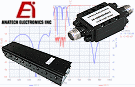 Anatech Electronics offers the industry's largest
portfolio of high-performance standard and customized "Anatech-Electronics-Filters-7-28-2020.htm"
target="_top">RF and microwave filters and filter-related products for military,
commercial, aerospace and defense, and industrial applications up to 40 GHz.
Our 902 MHz ISM cavity notch filter part number AE902N2246 is a high performance
ISM band notch filter exhibiting a very sharp roll off and low insertion loss in
the passbands below and above the notch portion. Notch frequency range is 892-912 MHz,
notch rejection is ≥40 dB, passband low side of notch is DC-882 MHz, passband
high side of notch: 922-2700 MHz. Part number AE18000SSH6615 has a cutoff frequency
of 18 GHz and a passband frequency of 18~40 GHz. The passband insertion
loss: ≤2.0 dB @18~19.5 GHz and ≤1.0 dB @19.5~40 GHz. Custom
RF power directional coupler designs... Anatech Electronics offers the industry's largest
portfolio of high-performance standard and customized "Anatech-Electronics-Filters-7-28-2020.htm"
target="_top">RF and microwave filters and filter-related products for military,
commercial, aerospace and defense, and industrial applications up to 40 GHz.
Our 902 MHz ISM cavity notch filter part number AE902N2246 is a high performance
ISM band notch filter exhibiting a very sharp roll off and low insertion loss in
the passbands below and above the notch portion. Notch frequency range is 892-912 MHz,
notch rejection is ≥40 dB, passband low side of notch is DC-882 MHz, passband
high side of notch: 922-2700 MHz. Part number AE18000SSH6615 has a cutoff frequency
of 18 GHz and a passband frequency of 18~40 GHz. The passband insertion
loss: ≤2.0 dB @18~19.5 GHz and ≤1.0 dB @19.5~40 GHz. Custom
RF power directional coupler designs...
Tutorial: Half Band Filters
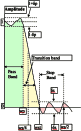 I have to admit to not being familiar with
half-band filters, so this article titled "Tutorial: Half Band Filters" posted by Ain Rehman on the High
Frequency Electronics website was a good introduction.
Wikipedia
defines the half-band filter thusly: "In digital signal processing, half-band filters
are widely used for their efficiency in multi-rate applications. A half-band filter
is a low-pass filter that reduces the maximum bandwidth of sampled data by a factor
of 2 (one octave). When multiple octaves of reduction are needed, a cascade of half-band
filters is common. And when the goal is downsampling, each half-band filter needs
to compute only half as many output samples as input samples. It follows from the
filter's definition that its transition region..." I have to admit to not being familiar with
half-band filters, so this article titled "Tutorial: Half Band Filters" posted by Ain Rehman on the High
Frequency Electronics website was a good introduction.
Wikipedia
defines the half-band filter thusly: "In digital signal processing, half-band filters
are widely used for their efficiency in multi-rate applications. A half-band filter
is a low-pass filter that reduces the maximum bandwidth of sampled data by a factor
of 2 (one octave). When multiple octaves of reduction are needed, a cascade of half-band
filters is common. And when the goal is downsampling, each half-band filter needs
to compute only half as many output samples as input samples. It follows from the
filter's definition that its transition region..."
 Withwave manufactures an extensive line of
metrology quality coaxial test cable assemblies, connectors (wave-, end-, vertical-launch,
board edge, panel mount), calibration kits (SOLT), a
fully automated 4-port vector
network analyzer (VNA) calibrator, between- and in-series connector adaptors,
attenuators, terminations, DC blocks, torque wrenches, test probes & probe positioner.
Special test fixtures for calibration and multicoax cable assemblies. Frequency
ranges from DC through 110 GHz. Please contact Withwave today to see how they
can help your project succeed. Withwave manufactures an extensive line of
metrology quality coaxial test cable assemblies, connectors (wave-, end-, vertical-launch,
board edge, panel mount), calibration kits (SOLT), a
fully automated 4-port vector
network analyzer (VNA) calibrator, between- and in-series connector adaptors,
attenuators, terminations, DC blocks, torque wrenches, test probes & probe positioner.
Special test fixtures for calibration and multicoax cable assemblies. Frequency
ranges from DC through 110 GHz. Please contact Withwave today to see how they
can help your project succeed.
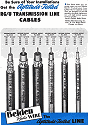 During World War II, the government
created a specification for military-grade cable and assigned the designation RG-#/U, where "RG" stands for Radio Guide and the "U" stands
for Utility. The "dash number" was sequentially issued and has no bearing on the
characteristics of the cable. Founded in 1902 in St. Louis, Missouri, by Joseph
Belden, the eponymously named company has been and continues today designing and
manufacturing coaxial cable. Most of the RG-x/U coaxial cable types displayed in
this 1951 Radio & Television News magazine advertisement are still being used
today, in particular the very familiar RG-58/U (50 Ω), RG-59/U (75 Ω),
RG-8/U (50 Ω), and RG-11/U (75 Ω)... During World War II, the government
created a specification for military-grade cable and assigned the designation RG-#/U, where "RG" stands for Radio Guide and the "U" stands
for Utility. The "dash number" was sequentially issued and has no bearing on the
characteristics of the cable. Founded in 1902 in St. Louis, Missouri, by Joseph
Belden, the eponymously named company has been and continues today designing and
manufacturing coaxial cable. Most of the RG-x/U coaxial cable types displayed in
this 1951 Radio & Television News magazine advertisement are still being used
today, in particular the very familiar RG-58/U (50 Ω), RG-59/U (75 Ω),
RG-8/U (50 Ω), and RG-11/U (75 Ω)...
 Platinum sponsor Cadence® is involved
in a host of activities designed to enrich attendees' knowledge with the latest
RF/microwave design techniques at the International Microwave Symposium (IMS), being
held as a virtual event online August 4-6. The Cadence virtual booth will be showcasing
the latest
V15 release of Cadence AWR Design Environment® software and the
technical program will feature AWR software in a technical lecture, three microwave
applications (MicroApps) and three industry workshops: Best Practices for Efficient
EM Simulation, 5G System-Level Evaluation, Design Tutorial for a High-Efficiency
GaN Doherty PA. Platinum sponsor Cadence® is involved
in a host of activities designed to enrich attendees' knowledge with the latest
RF/microwave design techniques at the International Microwave Symposium (IMS), being
held as a virtual event online August 4-6. The Cadence virtual booth will be showcasing
the latest
V15 release of Cadence AWR Design Environment® software and the
technical program will feature AWR software in a technical lecture, three microwave
applications (MicroApps) and three industry workshops: Best Practices for Efficient
EM Simulation, 5G System-Level Evaluation, Design Tutorial for a High-Efficiency
GaN Doherty PA.
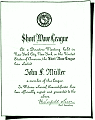 I tend to be a traditionalist for most things,
but do not go out of my way to make trouble for other people who don't appreciate
the way things are and have been... as long as, per Thomas Jefferson, "It neither
picks my pocket nor breaks my leg." In other words, if your actions cause me no
financial or physical harm, I'm not likely to oppose your actions - unless they're
illegal. Many older Hams are greatly offended at the FCC for having removed the
Morse code requirement in 2005 for obtaining an amateur radio
operator's license. They see it as a way to separate the wheat from the chaff, so
to speak; that is to say, to maintain a barrier that keeps non-serious aspirants
from gaining entry into the ranks of the elite group... I tend to be a traditionalist for most things,
but do not go out of my way to make trouble for other people who don't appreciate
the way things are and have been... as long as, per Thomas Jefferson, "It neither
picks my pocket nor breaks my leg." In other words, if your actions cause me no
financial or physical harm, I'm not likely to oppose your actions - unless they're
illegal. Many older Hams are greatly offended at the FCC for having removed the
Morse code requirement in 2005 for obtaining an amateur radio
operator's license. They see it as a way to separate the wheat from the chaff, so
to speak; that is to say, to maintain a barrier that keeps non-serious aspirants
from gaining entry into the ranks of the elite group...
"Triad-RF-Systems-Airborne-Taxi-Prototypes-7-29-2020.htm" target="_top">
 Imagine being able to catch a sky taxi to avoid
traffic congestion on the ground. That's what one UK-based autonomous vehicle company
is aiming to do and they reached out to Triad RF to help solve their critical communication
challenges. Developing a highly reliable link system is required in order to make
safe air taxi service a reality. Triad delivered several "Triad-RF-Systems-Airborne-Taxi-Prototypes-7-29-2020.htm"
target="_top"> dual MIMO integrated radio systems to help meet the long-distance
and data throughput requirements for their prototypes. "The challenge for our engineering
team was to maintain a link budget with very good margins and to support the need
for high data rates over an extended distance," said Steve Barthelmes, Co-Founder
of Triad. "While amplification of the transmit and receive signal of the COTS radio
was achievable, the client wanted to avoid the complexity of bolting on external
amplifiers, power supplies... Imagine being able to catch a sky taxi to avoid
traffic congestion on the ground. That's what one UK-based autonomous vehicle company
is aiming to do and they reached out to Triad RF to help solve their critical communication
challenges. Developing a highly reliable link system is required in order to make
safe air taxi service a reality. Triad delivered several "Triad-RF-Systems-Airborne-Taxi-Prototypes-7-29-2020.htm"
target="_top"> dual MIMO integrated radio systems to help meet the long-distance
and data throughput requirements for their prototypes. "The challenge for our engineering
team was to maintain a link budget with very good margins and to support the need
for high data rates over an extended distance," said Steve Barthelmes, Co-Founder
of Triad. "While amplification of the transmit and receive signal of the COTS radio
was achievable, the client wanted to avoid the complexity of bolting on external
amplifiers, power supplies...
 As a great appreciator of equipment teardown
reports, I always like reading through articles like Paul Rako's "The Tektronix Function Generator Teardown" on the Design News
website. This is a Tektronix FG503 function generator of a 1970s vintage, contained
in a TM503 mainframe chassis along with a PG502 pulse generator, an RG501 ramp generator.
The entire assembly is very well p[reserved. One of the nice things about photos
of the older equipment it the presence of leaded discrete and IC components, so
it is easier to visualize what a circuit is doing, aided by a schematic. Circuits
from the pre-IC era are even easier to follow because every item in the schematic
is right in front of you - except the occasional use of a "gimmick" capacitor or inductor. Here is my
HP5212A Electronic Counter teardown if you're interested. As a great appreciator of equipment teardown
reports, I always like reading through articles like Paul Rako's "The Tektronix Function Generator Teardown" on the Design News
website. This is a Tektronix FG503 function generator of a 1970s vintage, contained
in a TM503 mainframe chassis along with a PG502 pulse generator, an RG501 ramp generator.
The entire assembly is very well p[reserved. One of the nice things about photos
of the older equipment it the presence of leaded discrete and IC components, so
it is easier to visualize what a circuit is doing, aided by a schematic. Circuits
from the pre-IC era are even easier to follow because every item in the schematic
is right in front of you - except the occasional use of a "gimmick" capacitor or inductor. Here is my
HP5212A Electronic Counter teardown if you're interested.
 At the request of a
RF & Electronics Symbols for Visio user, a set of
digital attenuator symbols has been added to the Attenuators page. If you would
like these symbols, please send me an e-mail along with proof of purchase (PayPal
record works) and I will send them to you. Please note these are not part of
RF Stencils for Visio. At the request of a
RF & Electronics Symbols for Visio user, a set of
digital attenuator symbols has been added to the Attenuators page. If you would
like these symbols, please send me an e-mail along with proof of purchase (PayPal
record works) and I will send them to you. Please note these are not part of
RF Stencils for Visio.
TotalTemp Technologies has more than 40 years of combined experience providing
thermal platforms. Thermal Platforms are available to provide temperatures between
-100°C and +200°C for cryogenic cooling, recirculating circulating coolers, temperature
chambers and temperature controllers, thermal range safety controllers, space simulation
chambers, hybrid benchtop chambers, custom systems and platforms. Manual and automated
configurations for laboratory and production environments. Please contact TotalTemp
Technologies today to learn how they can help your project.
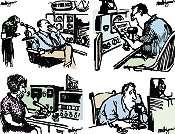 Found in what is the first issue of
Electronics Illustrated magazine that I have bought are these Amateur radio
related comics entitled, "Over and Out." The cartoonist's signature is simply "Rodrigues,"
which according to a Google search might be Charles Rodrigues (who also contributed
to other tech magazines as well as to National Lampoon). I have to admit
to needing to look up the "Yanqui aggressors" thing on the one comic, and then it
made sense: Yanqui= Yankee. The last comic with the parrot is pretty funny; it's
sort of the Ham radio equivalent to an auto-repeat telephone dialer like what you
would use to call into a radio show during a listener contest... Found in what is the first issue of
Electronics Illustrated magazine that I have bought are these Amateur radio
related comics entitled, "Over and Out." The cartoonist's signature is simply "Rodrigues,"
which according to a Google search might be Charles Rodrigues (who also contributed
to other tech magazines as well as to National Lampoon). I have to admit
to needing to look up the "Yanqui aggressors" thing on the one comic, and then it
made sense: Yanqui= Yankee. The last comic with the parrot is pretty funny; it's
sort of the Ham radio equivalent to an auto-repeat telephone dialer like what you
would use to call into a radio show during a listener contest...
 "Japan is mining deep sea mud and the U.S.
is developing biotech to extract REEs in an environmentally responsible way. You
may not have realized it, but praseodymium, terbium, and gadolinium are as important
to your work as the soldering iron, multimeter, and oscilloscope. Respectively,
these
rare earth elements (REEs) help make possible lasers and certain
magnets, fluorescent lamps and sonar systems, computer memories and X-ray tubes.
There are seventeen REEs, and most of them play a special role in 21st Century living
- several pounds of these compounds, for instance, are used in batteries for electric
and hybrid vehicles. But the industry producing them is overshadowed by the fact
it has become a monopoly of China..." "Japan is mining deep sea mud and the U.S.
is developing biotech to extract REEs in an environmentally responsible way. You
may not have realized it, but praseodymium, terbium, and gadolinium are as important
to your work as the soldering iron, multimeter, and oscilloscope. Respectively,
these
rare earth elements (REEs) help make possible lasers and certain
magnets, fluorescent lamps and sonar systems, computer memories and X-ray tubes.
There are seventeen REEs, and most of them play a special role in 21st Century living
- several pounds of these compounds, for instance, are used in batteries for electric
and hybrid vehicles. But the industry producing them is overshadowed by the fact
it has become a monopoly of China..."
 Over on the EDN website, Mssrs. L. Rizzatti,
R. Squiers, and M. Castren have a good article entitled, "Design
and Verify 5G Systems." It begins with recalling some of the features of previous
generations, then, as the title implies, focuses on current 5G system definitions,
expectations, and requirements. "Starting in the 1980s, the mobile industry has
been upgrading the wireless technology at the rate of one new standard every decade.
The first-generation (1G) cell phones launched in the '80s, although they were not
referred to as 1G at the time, were based on an analog technology that supported
only voice communication with poor quality. The second generation (2G) mobile phones
introduced in the '90s upgraded analog voice transmission to digital voice communication,
added support for short message service / multimedia messaging service (SMS/SMM)..." Over on the EDN website, Mssrs. L. Rizzatti,
R. Squiers, and M. Castren have a good article entitled, "Design
and Verify 5G Systems." It begins with recalling some of the features of previous
generations, then, as the title implies, focuses on current 5G system definitions,
expectations, and requirements. "Starting in the 1980s, the mobile industry has
been upgrading the wireless technology at the rate of one new standard every decade.
The first-generation (1G) cell phones launched in the '80s, although they were not
referred to as 1G at the time, were based on an analog technology that supported
only voice communication with poor quality. The second generation (2G) mobile phones
introduced in the '90s upgraded analog voice transmission to digital voice communication,
added support for short message service / multimedia messaging service (SMS/SMM)..."
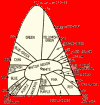 Like so many things in life that
we take for granted - aspirin, automatic clothes washers, drill
motors and bits, eyeglasses, rifles, bicycles, transistors, to name a few - we rarely
think about the effort that went behind the end product that is now enjoyed. Even
relatively simple devices like scissors are the result of someone saying to himself
or herself, "Self, I need something to make cutting fabric and paper and hair simpler
and neater, so what might that thing look like?" Then, after making a working prototype,
improvements are made based on empirical testing from usage, improvements are made
in the form factor, materials, size, etc., until evolution results in what can be
purchased today. If you have ever been in a product design cycle, either privately
or corporately, then you know the process well... Like so many things in life that
we take for granted - aspirin, automatic clothes washers, drill
motors and bits, eyeglasses, rifles, bicycles, transistors, to name a few - we rarely
think about the effort that went behind the end product that is now enjoyed. Even
relatively simple devices like scissors are the result of someone saying to himself
or herself, "Self, I need something to make cutting fabric and paper and hair simpler
and neater, so what might that thing look like?" Then, after making a working prototype,
improvements are made based on empirical testing from usage, improvements are made
in the form factor, materials, size, etc., until evolution results in what can be
purchased today. If you have ever been in a product design cycle, either privately
or corporately, then you know the process well...
"Copper-Mountain-Technologies-SMD-Test-Solution-7-27-2020.htm" target="_top">
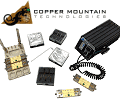 Copper Mountain Technologies is releasing "Copper-Mountain-Technologies-SMD-Test-Solution-7-27-2020.htm"
target="_top"> SMD Test Solution and an Automatic Fixture Removal (AFR) software
plug-in. These two component testing solutions facilitate characterization of RF
devices and discrete components with metrological accuracy. The AFR plug-in and
SMD Test Solution may be used in combination, or individually, depending on user
applications. SMD Test Solution is a comprehensive product utilizing a vector network
analyzer, fixtures, software, and tools—for manual, non-destructive characterization
of 0402 components. It allows for measurement of SMD components over a wide frequency
range from 100 kHz to 20 GHz – an industry first. SMD Test Solution uses serial
and shunt fixtures with known topology to make metrologically accurate measurements
for discreet resistors, capacitors, or inductors under real-life installation conditions... Copper Mountain Technologies is releasing "Copper-Mountain-Technologies-SMD-Test-Solution-7-27-2020.htm"
target="_top"> SMD Test Solution and an Automatic Fixture Removal (AFR) software
plug-in. These two component testing solutions facilitate characterization of RF
devices and discrete components with metrological accuracy. The AFR plug-in and
SMD Test Solution may be used in combination, or individually, depending on user
applications. SMD Test Solution is a comprehensive product utilizing a vector network
analyzer, fixtures, software, and tools—for manual, non-destructive characterization
of 0402 components. It allows for measurement of SMD components over a wide frequency
range from 100 kHz to 20 GHz – an industry first. SMD Test Solution uses serial
and shunt fixtures with known topology to make metrologically accurate measurements
for discreet resistors, capacitors, or inductors under real-life installation conditions...
Qorvo / Custom MMIC is a fabless RF and microwave MMIC designer entrusted by government
and defense industry OEMs. Custom and off-the-shelf products include switches, phase
shifters, attenuators, mixers and multipliers, and low noise, low phase noise, and
distributed amplifiers. From next-generation long range military radar systems,
to advanced aerospace and space-qualified satellite communications, microwave signal
chains are being pushed to new limits - and no one understands this more than Custom
MMIC. Please contact Qorvo / Custom MMIC today to see how they use their modern
engineering, testing and packaging facility to help your project.
These archive pages are provided in order to make it easier for you to find items
that you remember seeing on the RF Cafe homepage. Of course probably the easiest
way to find anything on the website is to use the "Search
RF Cafe" box at the top of every page. Some quoted items have been shortened
to save space. About RF Cafe.
Homepage Archive Pages
2026:
Jan |
Feb |
Mar |
Apr |
May | Jun | Jul | Aug
| Sep | Oct | Nov | Dec
2025:
Jan |
Feb |
Mar |
Apr |
May |
Jun |
Jul |
Aug |
Sep |
Oct |
Nov |
Dec
2024:
Jan |
Feb |
Mar |
Apr |
May |
Jun |
Jul |
Aug |
Sep |
Oct |
Nov |
Dec
2023:
Jan |
Feb |
Mar |
Apr |
May |
Jun |
Jul |
Aug |
Sep |
Oct |
Nov |
Dec
2022:
Jan |
Feb |
Mar |
Apr |
May |
Jun |
Jul |
Aug |
Sep |
Oct |
Nov |
Dec
2021:
Jan |
Feb |
Mar |
Apr |
May |
Jun |
Jul |
Aug |
Sep |
Oct |
Nov |
Dec
2020:
Jan |
Feb |
Mar |
Apr |
May |
Jun |
Jul |
Aug |
Sep |
Oct |
Nov |
Dec
2019:
Jan |
Feb |
Mar |
Apr |
May |
Jun |
Jul |
Aug |
Sep |
Oct |
Nov |
Dec
2018:
Jan |
Feb |
Mar |
Apr |
May |
Jun |
Jul |
Aug |
Sep |
Oct |
Nov |
Dec
2017:
Jan | Feb |
Mar |
Apr |
May |
Jun |
Jul |
Aug |
Sep |
Oct |
Nov |
Dec
2016:
Jan | Feb |
Mar |
Apr |
May |
Jun |
Jul |
Aug |
Sep |
Oct |
Nov |
Dec
2015:
Jan | Feb |
Mar |
Apr |
May |
Jun |
Jul |
Aug | Sep |
Oct |
Nov |
Dec
2014:
Jan | Feb |
Mar |
Apr |
May |
Jun |
Jul |
Aug |
Sep |
Oct |
Nov |
Dec
2013:
Jan | Feb |
Mar |
Apr |
May |
Jun |
Jul |
Aug |
Sep |
Oct |
Nov |
Dec
2012: 1 |
2 | 3
| 4 | 5
| 6 | 7
| 8 | 9
| 10 | 11
| 12 | 13
(no archives before 2012)
- Christmas-themed
items
|