|
 Welcome to the
RF
Cafe Antenna Theory Quiz, a specialized assessment designed to test your
knowledge of the radiating structures that define the success of any RF
communications system. From fundamental dipole operation and feedpoint impedance
to the critical nuances of gain, polarization, and pattern formation, a deep
understanding of antenna physics is essential for any serious radio enthusiast
or professional engineer. This quiz challenges you on key concepts, including
the characteristics of Yagi-Uda arrays, the significance of front-to-back
ratios, the dynamics of ground planes, and the practical challenges of matching
networks. By evaluating your grasp of these essential antenna principles... Welcome to the
RF
Cafe Antenna Theory Quiz, a specialized assessment designed to test your
knowledge of the radiating structures that define the success of any RF
communications system. From fundamental dipole operation and feedpoint impedance
to the critical nuances of gain, polarization, and pattern formation, a deep
understanding of antenna physics is essential for any serious radio enthusiast
or professional engineer. This quiz challenges you on key concepts, including
the characteristics of Yagi-Uda arrays, the significance of front-to-back
ratios, the dynamics of ground planes, and the practical challenges of matching
networks. By evaluating your grasp of these essential antenna principles...
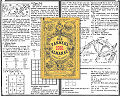 Each autumn I used to anxiously await the
appearance of the newest edition of
The Old Farmer's Almanac on the store shelf, and such was the case with
this 1981 issue. It is not that I was/am an avid farmer, just that I enjoy reading
the anecdotes, tales, and interesting historical tidbits included amongst the pages
along with tables of high and low tides, moon and sun rising and setting times,
astronomical events, and weather patterns expected for the year that lay ahead.
Most of all, I liked working the puzzles and riddles. Over the years the difficulty
levels gradually got lower and lower (aka dumbed down), to the point where for the
last decade or so I have not even bothered buying the OFA. Now it is full of numbnut
stuff... Each autumn I used to anxiously await the
appearance of the newest edition of
The Old Farmer's Almanac on the store shelf, and such was the case with
this 1981 issue. It is not that I was/am an avid farmer, just that I enjoy reading
the anecdotes, tales, and interesting historical tidbits included amongst the pages
along with tables of high and low tides, moon and sun rising and setting times,
astronomical events, and weather patterns expected for the year that lay ahead.
Most of all, I liked working the puzzles and riddles. Over the years the difficulty
levels gradually got lower and lower (aka dumbed down), to the point where for the
last decade or so I have not even bothered buying the OFA. Now it is full of numbnut
stuff...
 This is a great
electronics-themed comic from a February 1972 issue of Popular
Electronics. It encompasses the essence of the stereotypical salesman ruse,
especially in that era when people were sure that electronics repair services were
out to rip them off by selling unneeded services and replacement parts. Aspiring
TV technicians who couldn't grasp the technology moved on to working as mechanics
in a garage, poking tiny holes in brake lines to scare owners into paying for complete
braking system rebuilds. I usually like to post multiple comics on each page, but
at the moment only this one is available... This is a great
electronics-themed comic from a February 1972 issue of Popular
Electronics. It encompasses the essence of the stereotypical salesman ruse,
especially in that era when people were sure that electronics repair services were
out to rip them off by selling unneeded services and replacement parts. Aspiring
TV technicians who couldn't grasp the technology moved on to working as mechanics
in a garage, poking tiny holes in brake lines to scare owners into paying for complete
braking system rebuilds. I usually like to post multiple comics on each page, but
at the moment only this one is available...
 As with your school and college days where
once there was no longer any reason to memorize physical constants, conversion formulas,
and names of people, places, and things, much of the noggin's gray matter was
repurposed to remember topics of more immediate need. You can always look up what
you have forgotten. While studying for your Ham radio or FCC license, being able
to be able to quickly convert between wavelength and frequency is essential. Recalling
on demand
frequency-wavelength pairs is a real time saver on a timed exam.
Even being able to perform the conversion on a calculator during the test takes
up valuable time that could be better used on other tasks. This handy-dandy chart
for converting... As with your school and college days where
once there was no longer any reason to memorize physical constants, conversion formulas,
and names of people, places, and things, much of the noggin's gray matter was
repurposed to remember topics of more immediate need. You can always look up what
you have forgotten. While studying for your Ham radio or FCC license, being able
to be able to quickly convert between wavelength and frequency is essential. Recalling
on demand
frequency-wavelength pairs is a real time saver on a timed exam.
Even being able to perform the conversion on a calculator during the test takes
up valuable time that could be better used on other tasks. This handy-dandy chart
for converting...
 IMS 2026 (IEEE MTT-S International
Microwave Symposium) is the world's premier RF and microwave conference,
bringing together thousands of industry professionals from around the globe to
explore the latest technologies, tools, and technical developments. IMS2026 will
feature the RFIC Symposium, the new RFSA and RFTT Symposia, and conclude with
the ARFTG Microwave Measurement Conference.
everything RF website's medai team
is providing full coverage of the event. Stop by Booth 24048 to meet the crew. IMS 2026 (IEEE MTT-S International
Microwave Symposium) is the world's premier RF and microwave conference,
bringing together thousands of industry professionals from around the globe to
explore the latest technologies, tools, and technical developments. IMS2026 will
feature the RFIC Symposium, the new RFSA and RFTT Symposia, and conclude with
the ARFTG Microwave Measurement Conference.
everything RF website's medai team
is providing full coverage of the event. Stop by Booth 24048 to meet the crew.
 In
1961, the United States Navy commemorated the fiftieth anniversary of the A-1 Triad,
the service's first aircraft. This milestone honored
Glenn Hammond Curtiss, the father of naval aviation, who designed the versatile
machine capable of operating on land, water, and air. Born in Hammondsport, New
York, in 1878, Curtiss possessed an innate obsession with speed and mechanical ingenuity.
Before revolutionizing aviation, he dominated motorcycle racing, famously earning
the title of the fastest man on Earth. His transition to flight led to landmark
achievements, including winning the Gordon Bennett trophy in France and executing
the first successful U.S. intercity flight... In
1961, the United States Navy commemorated the fiftieth anniversary of the A-1 Triad,
the service's first aircraft. This milestone honored
Glenn Hammond Curtiss, the father of naval aviation, who designed the versatile
machine capable of operating on land, water, and air. Born in Hammondsport, New
York, in 1878, Curtiss possessed an innate obsession with speed and mechanical ingenuity.
Before revolutionizing aviation, he dominated motorcycle racing, famously earning
the title of the fastest man on Earth. His transition to flight led to landmark
achievements, including winning the Gordon Bennett trophy in France and executing
the first successful U.S. intercity flight...
 A 720-line HDTV display is made up of 1,280
vertical lines and 720 horizontal lines of pixels, which gives a total of 921,600
pixels. A 1080-line HDTV has 1,920 vertical lines and 1,080 horizontal lines, for
a total of 2,073,600 pixels. In 1969, a 230 vertical line by 230 horizontal line
electroluminescent (EL) flat-screen television display with 52,900
pseudo-pixels was considered a big deal - and it was since it was the starting point
for digital flat-screens of today. Interestingly, while the "pixel" distribution
was square, the actual display retained the standard 4:3 aspect ratio, meaning horizontal
element width was 33% greater than the vertical element. Since each EL element was
addressed individually, there was no ability of a picture element to be shared by
adjacent "pixels," so displaying a circle would result in a very pixelated picture... A 720-line HDTV display is made up of 1,280
vertical lines and 720 horizontal lines of pixels, which gives a total of 921,600
pixels. A 1080-line HDTV has 1,920 vertical lines and 1,080 horizontal lines, for
a total of 2,073,600 pixels. In 1969, a 230 vertical line by 230 horizontal line
electroluminescent (EL) flat-screen television display with 52,900
pseudo-pixels was considered a big deal - and it was since it was the starting point
for digital flat-screens of today. Interestingly, while the "pixel" distribution
was square, the actual display retained the standard 4:3 aspect ratio, meaning horizontal
element width was 33% greater than the vertical element. Since each EL element was
addressed individually, there was no ability of a picture element to be shared by
adjacent "pixels," so displaying a circle would result in a very pixelated picture...
 Dr. Linder's patented AC and DC
generators exploited alpha (proton) and beta (electron) particle emissions from
radioisotopes contained within. The device is basically a metallic sphere concentric
to an enclosed mounting platform for polonium (α
particle emitter), phosphorous (β particle emitter), or similar elements. With
just a gram of radioactive material, the charge which accumulates on the outer sphere
generates a very high voltage (~1 MV) driving a low current (~1 mA). Georg
Ohm's work tells us that is equivalent to 1 kW of power - quite a lot for
a fairly compact device. Dr. Linder envisioned multiple
atomic generators combined in series and/or parallel to obtain
the required power. No mention was made of the effective internal resistance, which
would ultimately determine the terminal voltage when connected to a load... Dr. Linder's patented AC and DC
generators exploited alpha (proton) and beta (electron) particle emissions from
radioisotopes contained within. The device is basically a metallic sphere concentric
to an enclosed mounting platform for polonium (α
particle emitter), phosphorous (β particle emitter), or similar elements. With
just a gram of radioactive material, the charge which accumulates on the outer sphere
generates a very high voltage (~1 MV) driving a low current (~1 mA). Georg
Ohm's work tells us that is equivalent to 1 kW of power - quite a lot for
a fairly compact device. Dr. Linder envisioned multiple
atomic generators combined in series and/or parallel to obtain
the required power. No mention was made of the effective internal resistance, which
would ultimately determine the terminal voltage when connected to a load...
 Television broadcast stations were quickly
growing in number in the post-Korean War era and the FCC needed to devise a scheme
for
accommodating more channels. There were only 13 channels (only
2-13 used) allocated in the VHF spectrum with 6 MHz-wide bands. Even though
VHF propagates primarily in a line-of-sight mode, reflections and earth-bounce can
extend the range fairly significantly, limiting density in closely spaced cities.
The military refused to yield any spectrum so a decision was made to add new channels
(14-83, also 6 MHz wide) in the UHF band. UHF presented its own problems with
more difficult equipment manufacturing issues and higher atmospheric attenuation.
It never really caught on because cable TV was being widely installed in metro areas... Television broadcast stations were quickly
growing in number in the post-Korean War era and the FCC needed to devise a scheme
for
accommodating more channels. There were only 13 channels (only
2-13 used) allocated in the VHF spectrum with 6 MHz-wide bands. Even though
VHF propagates primarily in a line-of-sight mode, reflections and earth-bounce can
extend the range fairly significantly, limiting density in closely spaced cities.
The military refused to yield any spectrum so a decision was made to add new channels
(14-83, also 6 MHz wide) in the UHF band. UHF presented its own problems with
more difficult equipment manufacturing issues and higher atmospheric attenuation.
It never really caught on because cable TV was being widely installed in metro areas...
 Anatech Electronics is pleased to announce
that we will be exhibiting at the 2026 IEEE International MTT Symposia (IMS), taking
place June 9-11, 2026 at the Thomas M. Menino Convention & Exhibition Center
in Boston, MA. We invite you to visit our booth #12091 to discuss your current and
upcoming RF and microwave requirements. Our team will be available to review specifications,
provide technical guidance, and explore custom solutions tailored to your application... Anatech Electronics is pleased to announce
that we will be exhibiting at the 2026 IEEE International MTT Symposia (IMS), taking
place June 9-11, 2026 at the Thomas M. Menino Convention & Exhibition Center
in Boston, MA. We invite you to visit our booth #12091 to discuss your current and
upcoming RF and microwave requirements. Our team will be available to review specifications,
provide technical guidance, and explore custom solutions tailored to your application...
 You probably need to be a
Ham radio operator to fully appreciate the humor in some of these
comics. The first one, for instance, is a poke at a guy proudly pointing out his
QSL cards from distant (DX) stations "right near the city limits," "on the other
side of town," etc., basically what you can pull in with a home Citizens Band (CB)
radio base station and a rooftop antenna. In another, the "73" signoff code is from
the Western Union telegraph standard meaning "Best regards." "88" means "Love and
kisses," hence the guy's unnerved response. The others don't really require
an insider viewpoint. Let me know if you need any more help ;-)... You probably need to be a
Ham radio operator to fully appreciate the humor in some of these
comics. The first one, for instance, is a poke at a guy proudly pointing out his
QSL cards from distant (DX) stations "right near the city limits," "on the other
side of town," etc., basically what you can pull in with a home Citizens Band (CB)
radio base station and a rooftop antenna. In another, the "73" signoff code is from
the Western Union telegraph standard meaning "Best regards." "88" means "Love and
kisses," hence the guy's unnerved response. The others don't really require
an insider viewpoint. Let me know if you need any more help ;-)...
Exodus AMP20188, 4-8
GHz, 200 W SSPA
 Exodus Advanced Communications'
AMP20188 is a broadband solid state power amplifier operating from 4.0 to 8.0 GHz,
delivering 200 W minimum output power with 53 dB minimum gain. Designed
for EMI/RFI, CW and pulsed, laboratory, and communications applications, it provides
high power density with excellent reliability. The amplifier features extensive
monitoring and built in protection, along with local LCD and remote-control interfaces,
all integrated into a compact, rugged 4U rack mount chassis for demanding RF environments.
Features Include Designed for high power EMI/RFI... Exodus Advanced Communications'
AMP20188 is a broadband solid state power amplifier operating from 4.0 to 8.0 GHz,
delivering 200 W minimum output power with 53 dB minimum gain. Designed
for EMI/RFI, CW and pulsed, laboratory, and communications applications, it provides
high power density with excellent reliability. The amplifier features extensive
monitoring and built in protection, along with local LCD and remote-control interfaces,
all integrated into a compact, rugged 4U rack mount chassis for demanding RF environments.
Features Include Designed for high power EMI/RFI...
 At least 10 clues with an asterisk (*)
in this
technology-themed crossword puzzle are pulled from this past week's
(7/16 - 7/20) "Tech Industry Headlines" column on the RF Cafe homepage. For the
sake of all the avid cruciverbalists amongst us, each week I create a new technology-themed
crossword puzzle using only words from my custom-created list related to engineering,
science, mathematics, chemistry, physics, astronomy, etc. You will never find among
the words names of politicians, mountain ranges, exotic foods or plants, movie stars,
or anything of the sort. You might, however, see someone or something in the exclusion
list who or that is directly related to this puzzle's theme, such as Hedy Lamar
or the Bikini Atoll... At least 10 clues with an asterisk (*)
in this
technology-themed crossword puzzle are pulled from this past week's
(7/16 - 7/20) "Tech Industry Headlines" column on the RF Cafe homepage. For the
sake of all the avid cruciverbalists amongst us, each week I create a new technology-themed
crossword puzzle using only words from my custom-created list related to engineering,
science, mathematics, chemistry, physics, astronomy, etc. You will never find among
the words names of politicians, mountain ranges, exotic foods or plants, movie stars,
or anything of the sort. You might, however, see someone or something in the exclusion
list who or that is directly related to this puzzle's theme, such as Hedy Lamar
or the Bikini Atoll...
 IMS 2026 Giveaway Alert
Booth 16076! Stop by our booth at IMS 2026 in Boston (June 7-12) and
enter to win prizes!
IMS 2026 Giveaway Alert
Booth 16076! Stop by our booth at IMS 2026 in Boston (June 7-12) and
enter to win prizes!
Prizes Include:
- Apple AirPods, Premium audio with
ANC, perfect for calls, music, and blocking noise at the show.
- JBL Flip 7
Portable Speaker
- LEGO NASA Artemis Space Launch System Set
- Vanilla Visa
Gift Card
How to Enter: 1 Entry: Drop your business card
in the raffle box at Booth 16076. +1 Bonus Entry: Repost this post (tag us
so we see it!).
Winners will be announced at the end of the show.
Multiple
entries = better odds! Come say hi, talk RF/microwave tech, and grab some swag while
you're there. See you in Boston!
 Any time I see an article that references
causing limb movements by poking the brain with electrical signals, I think of the
old The Far Side comic. Artist Gary Larson drew quite a few hilarious operating
room scenarios.
Electrocution is of course not a laughing matter - unless it happens
to someone else and it is not serious and no harm is done. Then - and only then
- can it be funny. I've laughed at myself many times after receiving a good
jolt due to stupidity. Sometimes after such an experience I wonder how I never killed
myself from getting zapped as the result of being too lazy to turn off a circuit
breaker before servicing a light switch or receptacle. The sad thing is that I'll
probably do it again some day... Any time I see an article that references
causing limb movements by poking the brain with electrical signals, I think of the
old The Far Side comic. Artist Gary Larson drew quite a few hilarious operating
room scenarios.
Electrocution is of course not a laughing matter - unless it happens
to someone else and it is not serious and no harm is done. Then - and only then
- can it be funny. I've laughed at myself many times after receiving a good
jolt due to stupidity. Sometimes after such an experience I wonder how I never killed
myself from getting zapped as the result of being too lazy to turn off a circuit
breaker before servicing a light switch or receptacle. The sad thing is that I'll
probably do it again some day...
 Empower RF Systems is the technological
leader in RF & microwave power amplifier solutions for EW, Radar, Satcom, Threat
Simulation, Communications, and Product Testing. Our air and liquid cooled amplifiers
incorporate the latest semiconductor and power combining technologies and with a
patented architecture we build the most sophisticated and flexible COTS system amplifiers
in the world. Solutions range from tens of watts to hundreds of kilowatts and includes
basic PA modules to scalable rack systems. Empower RF Systems is the technological
leader in RF & microwave power amplifier solutions for EW, Radar, Satcom, Threat
Simulation, Communications, and Product Testing. Our air and liquid cooled amplifiers
incorporate the latest semiconductor and power combining technologies and with a
patented architecture we build the most sophisticated and flexible COTS system amplifiers
in the world. Solutions range from tens of watts to hundreds of kilowatts and includes
basic PA modules to scalable rack systems.
 Popular Electronics magazine printed
in April 1966 its first notice of
new frequency units to be used beginning with the June edition.
The May issue included this piece titled, "Comes the Revolution - or - '40 Million
Frenchmen Can't Be Wrong'." Predictably, not everyone liked it. With the
June issue came the promised change and along with it the first in a series of reader
responses. I also found a reader's opinion from the August issue as well. Evidently,
not everyone wanted to honor Heinrich Hertz by naming the base unit of frequency
in his honor... Popular Electronics magazine printed
in April 1966 its first notice of
new frequency units to be used beginning with the June edition.
The May issue included this piece titled, "Comes the Revolution - or - '40 Million
Frenchmen Can't Be Wrong'." Predictably, not everyone liked it. With the
June issue came the promised change and along with it the first in a series of reader
responses. I also found a reader's opinion from the August issue as well. Evidently,
not everyone wanted to honor Heinrich Hertz by naming the base unit of frequency
in his honor...
 "Eventually," Dr. Herwald said, "we believe
it will even be possible to automatically and continuously produce actual electronic
equipment, such as radio receivers and amplifiers, starting from a pool of molten
semiconductor materials." That was in early 1960 in an Electronics World
article titled, "Molecular Electronics." The term "molecular" references what eventually
became integrated circuits (IC), the first of which was realized in 1958 by Texas
Instruments engineer Jack Kilby. Kilby's IC incorporated one transistor, one
capacitor, and three resistors on a germanium substrate. Building on that success,
researchers envisioned single-chip semiconductors which contained hundreds, thousands,
and even millions of transistors, diodes... "Eventually," Dr. Herwald said, "we believe
it will even be possible to automatically and continuously produce actual electronic
equipment, such as radio receivers and amplifiers, starting from a pool of molten
semiconductor materials." That was in early 1960 in an Electronics World
article titled, "Molecular Electronics." The term "molecular" references what eventually
became integrated circuits (IC), the first of which was realized in 1958 by Texas
Instruments engineer Jack Kilby. Kilby's IC incorporated one transistor, one
capacitor, and three resistors on a germanium substrate. Building on that success,
researchers envisioned single-chip semiconductors which contained hundreds, thousands,
and even millions of transistors, diodes...
 Anatech Electronics offers the industry's
largest portfolio of high-performance
standard and customized RF and microwave filters and filter-related products
for military, commercial, aerospace and defense, and industrial applications up
to 40 GHz. Three new models have been added to the product line in June, including
a 9660 MHz (COM1 - COM3) cavity bandpass filter, a 2442 MHz waveguide
band stop filter, and a 2072.5 MHz / 2250 MHz / 1800 MHz triplexer
filter. Custom RF power filter and directional couplers designs can be designed
and produced with required connector... Anatech Electronics offers the industry's
largest portfolio of high-performance
standard and customized RF and microwave filters and filter-related products
for military, commercial, aerospace and defense, and industrial applications up
to 40 GHz. Three new models have been added to the product line in June, including
a 9660 MHz (COM1 - COM3) cavity bandpass filter, a 2442 MHz waveguide
band stop filter, and a 2072.5 MHz / 2250 MHz / 1800 MHz triplexer
filter. Custom RF power filter and directional couplers designs can be designed
and produced with required connector...
 I suppose a more appropriate title for this
chart would be "Foreign Valve Substitution Data," considering that most (if not
all) of Europeans refer(red) to vacuum tubes as "valves." As with having posted
scores of Radio Service Data Sheet pages for the benefit of hobbyists who restore
and service vintage radio equipment, I also post other hard-to-find reference resources
when I find them. Sure, the number of people looking for this information is extremely
small, but they are extremely grateful for this when in the throes of finding replacement
tubes (valves). Posting a hyperlink to this page on the RF Cafe homepage will assure
that... I suppose a more appropriate title for this
chart would be "Foreign Valve Substitution Data," considering that most (if not
all) of Europeans refer(red) to vacuum tubes as "valves." As with having posted
scores of Radio Service Data Sheet pages for the benefit of hobbyists who restore
and service vintage radio equipment, I also post other hard-to-find reference resources
when I find them. Sure, the number of people looking for this information is extremely
small, but they are extremely grateful for this when in the throes of finding replacement
tubes (valves). Posting a hyperlink to this page on the RF Cafe homepage will assure
that...
 My father used to refer to the "sweet-voiced
lady predicting the weather over and over again" as my girlfriend because I would
call the "WEather 6-1212" phone number (936-1212) so often. It really wasn't
because I was infatuated with her voice, it's that I was obsessed with weather forecasting.
Most of my free time as a kid and teenager was spent building and flying model airplanes
and rockets, and at eighteen years of age I began taking full-size aeroplane flying
lessons, so my world revolved around a zone extending from terra firma up to about
5,000 feet AGL. This collection of communications news... My father used to refer to the "sweet-voiced
lady predicting the weather over and over again" as my girlfriend because I would
call the "WEather 6-1212" phone number (936-1212) so often. It really wasn't
because I was infatuated with her voice, it's that I was obsessed with weather forecasting.
Most of my free time as a kid and teenager was spent building and flying model airplanes
and rockets, and at eighteen years of age I began taking full-size aeroplane flying
lessons, so my world revolved around a zone extending from terra firma up to about
5,000 feet AGL. This collection of communications news...
 Innovative Power Products has been designing
and manufacturing RF and Microwave passive components since 2005. We use the latest
design tools available to build our baluns, 90-degree couplers, directional couplers,
combiners/dividers, single-ended transformers, resistors, terminations, and custom
products. Applications in military, medical, industrial, and commercial markets
are serviced around the world. Products listed on the website link to detailed mechanical
drawings, electrical specifications, and performance data. If you cannot find a
product that meets your requirements on our website, contact us to speak with one
of our experienced design engineers about your project. Innovative Power Products has been designing
and manufacturing RF and Microwave passive components since 2005. We use the latest
design tools available to build our baluns, 90-degree couplers, directional couplers,
combiners/dividers, single-ended transformers, resistors, terminations, and custom
products. Applications in military, medical, industrial, and commercial markets
are serviced around the world. Products listed on the website link to detailed mechanical
drawings, electrical specifications, and performance data. If you cannot find a
product that meets your requirements on our website, contact us to speak with one
of our experienced design engineers about your project.
 Welcome to the
RF Cafe
Isolators & Circulators Quiz, an essential assessment for engineers focused
on the reliable sampling and monitoring of signal flow. Directional couplers are
the cornerstone of power metering, reflected power detection, and signal injection
in high-frequency transmission systems. Whether you are calibrating a forward-power
monitor, auditing VSWR in a feedline, or balancing a complex signal distribution
network, a rigorous understanding of coupling factor, directivity, and insertion
loss is vital. This quiz challenges your knowledge of these passive structures,
covering the mechanics of coupled transmission lines, the significance of isolation
and directivity, and the critical trade-offs in power splitters and tap networks.
By evaluating your grasp of these core principles Welcome to the
RF Cafe
Isolators & Circulators Quiz, an essential assessment for engineers focused
on the reliable sampling and monitoring of signal flow. Directional couplers are
the cornerstone of power metering, reflected power detection, and signal injection
in high-frequency transmission systems. Whether you are calibrating a forward-power
monitor, auditing VSWR in a feedline, or balancing a complex signal distribution
network, a rigorous understanding of coupling factor, directivity, and insertion
loss is vital. This quiz challenges your knowledge of these passive structures,
covering the mechanics of coupled transmission lines, the significance of isolation
and directivity, and the critical trade-offs in power splitters and tap networks.
By evaluating your grasp of these core principles
 Werbel Microwave's
WMADC-0.38-3-40DB-SERIES is a high-power 40 dB directional coupler covering
380 to 3000 MHz, supporting a wide range of VHF, UHF, cellular, LTE, and wireless
infrastructure bands. Built on an air dielectric coaxial structure, this design
delivers low insertion loss, excellent power handling, and exceptional directivity
for accurate forward and reverse power discrimination. Unlike many broadband couplers
that prioritize ultra-flat coupling, this model is engineered to maximize directivity
across the band, ensuring cleaner separation between forward and reflected signals.
In most real-world systems, coupling variation is easily calibrated out... Werbel Microwave's
WMADC-0.38-3-40DB-SERIES is a high-power 40 dB directional coupler covering
380 to 3000 MHz, supporting a wide range of VHF, UHF, cellular, LTE, and wireless
infrastructure bands. Built on an air dielectric coaxial structure, this design
delivers low insertion loss, excellent power handling, and exceptional directivity
for accurate forward and reverse power discrimination. Unlike many broadband couplers
that prioritize ultra-flat coupling, this model is engineered to maximize directivity
across the band, ensuring cleaner separation between forward and reflected signals.
In most real-world systems, coupling variation is easily calibrated out...
 The
medical x-ray machine shown here reminds me of the "Illudium Q-36 Explosive
Space Modulator" contraption Marvin the Martian wanted to use in "Hare-Way to the
Stars" to disintegrate the Earth (because it blocks his view of Venus). Of course
our hero Bugs Bunny thwarts his plan, whereupon Marvin asks, "Where's the kaboom?"
Can you imagine being fraught with cancer and getting strapped into a chair with
that huge hypodermic-needle-looking thingy pointed at you, as shown in this 1959
issue of Popular Electronics magazine? The Caduceus sword in the pic doesn't
help matters, either. The trauma of such an experience might have been worse than
the treatment for some people. As usual the pioneers took the arrows so that we
can benefit from the treatments enjoyed today, and the equipment does not look nearly
as intimidating. See also "After Class: X-Rays" for more info... The
medical x-ray machine shown here reminds me of the "Illudium Q-36 Explosive
Space Modulator" contraption Marvin the Martian wanted to use in "Hare-Way to the
Stars" to disintegrate the Earth (because it blocks his view of Venus). Of course
our hero Bugs Bunny thwarts his plan, whereupon Marvin asks, "Where's the kaboom?"
Can you imagine being fraught with cancer and getting strapped into a chair with
that huge hypodermic-needle-looking thingy pointed at you, as shown in this 1959
issue of Popular Electronics magazine? The Caduceus sword in the pic doesn't
help matters, either. The trauma of such an experience might have been worse than
the treatment for some people. As usual the pioneers took the arrows so that we
can benefit from the treatments enjoyed today, and the equipment does not look nearly
as intimidating. See also "After Class: X-Rays" for more info...
|

The RF Cafe Homepage
Archive is a comprehensive collection of every item appearing daily on this
website since 2008 - and many from earlier years. Many thousands of pages of unique
content have been added since then.
 Do a WWW search for
filter equations and you will find thousands of pages, including
a few here on RF Cafe. However, if you want an example of how to implement the transfer
functions in a spreadsheet or software, examples of actual code are elusive (other
than maybe a Matlab or MathCAD worksheet). As one who has incorporated equations
for Butterworth, Chebyshev Type 1, Chebyshev Type 2, and other filter
functions in many spreadsheets and software over the past few decades, I figured
it might be useful to post snippets of my code so that someone else can copy and
paste it directly into other work. BTW, I do not consider myself to be a filter
expert by any means and there is no ground-breaking knowledge here; it's just
hopefully easier to find. Writing a macro to use in a spreadsheet is the preferred... Do a WWW search for
filter equations and you will find thousands of pages, including
a few here on RF Cafe. However, if you want an example of how to implement the transfer
functions in a spreadsheet or software, examples of actual code are elusive (other
than maybe a Matlab or MathCAD worksheet). As one who has incorporated equations
for Butterworth, Chebyshev Type 1, Chebyshev Type 2, and other filter
functions in many spreadsheets and software over the past few decades, I figured
it might be useful to post snippets of my code so that someone else can copy and
paste it directly into other work. BTW, I do not consider myself to be a filter
expert by any means and there is no ground-breaking knowledge here; it's just
hopefully easier to find. Writing a macro to use in a spreadsheet is the preferred...
 According to this 1964 article in Electronics
magazine, the U.S. Air Force's decision to build radar systems that would enable
low altitude,
terrain-following flight paths for strategic and tactical aircraft
was in response to the shooting down of Gary Powers' U-2 spy craft in 1960.
The event made clear that simply flying high over enemy territory and dropping bombs
would not be a reliable strategy since surface-to-air missiles could reach and destroy
aircraft before they got to their targets. Terrain-following capability on the part
of bombers and fighters would add a major element of surprise since approach paths
could be masked until it was too late to take offensive action. That approach was
not without its risks and faults, as made apparent by the Dr. Strangelove movie
satire that poked fun at the very concept... According to this 1964 article in Electronics
magazine, the U.S. Air Force's decision to build radar systems that would enable
low altitude,
terrain-following flight paths for strategic and tactical aircraft
was in response to the shooting down of Gary Powers' U-2 spy craft in 1960.
The event made clear that simply flying high over enemy territory and dropping bombs
would not be a reliable strategy since surface-to-air missiles could reach and destroy
aircraft before they got to their targets. Terrain-following capability on the part
of bombers and fighters would add a major element of surprise since approach paths
could be masked until it was too late to take offensive action. That approach was
not without its risks and faults, as made apparent by the Dr. Strangelove movie
satire that poked fun at the very concept...
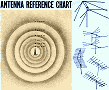 Selecting the proper antenna for a particular
application can mean the difference between success and failure when any combination
of signal strength and/or signal interference is involved. Modern spread spectrum
technologies has eased the job a bit, but there are still instances when high gain
and/or directivity is necessary. You might be tempted to say that gain and directivity
are essentially the same thing, and to some extent that is true. However, in the
case of needing to minimize signal interference from surrounding sources, a
directional antenna might be utilized not due to a need for increased
desired signal strength but to reduce the power of undesired emitters. Such was
often the requirement for television and FM radio reception. After years of needing
to reorient the folded dipole antenna for my FM radio because... Selecting the proper antenna for a particular
application can mean the difference between success and failure when any combination
of signal strength and/or signal interference is involved. Modern spread spectrum
technologies has eased the job a bit, but there are still instances when high gain
and/or directivity is necessary. You might be tempted to say that gain and directivity
are essentially the same thing, and to some extent that is true. However, in the
case of needing to minimize signal interference from surrounding sources, a
directional antenna might be utilized not due to a need for increased
desired signal strength but to reduce the power of undesired emitters. Such was
often the requirement for television and FM radio reception. After years of needing
to reorient the folded dipole antenna for my FM radio because...
 America's first successful orbiting of
a satellite launch happened on February 1, 1958 with the launch of Explorer 1
atop a Juno 1 rocket. Our first attempted satellite launch was the Vanguard TV3,
on December 6, 1957, but it unfortunately succumbed to a failed booster rocket (it
rose only 4 feet off the launch pad). Russia had already launched its Sputnik 1
satellite on October 4, 1957, making it the very first manmade satellite to orbit
the earth - to the forever chagrin of U.S. scientists. Fortunately, advances occurred
rapidly for the U.S. space program after Explorer 1. In its first full decade
of existence, the
Goddard Space Flight Center, located in Greenbelt, Maryland, was
responsible for launching more than 100 different spacecraft... America's first successful orbiting of
a satellite launch happened on February 1, 1958 with the launch of Explorer 1
atop a Juno 1 rocket. Our first attempted satellite launch was the Vanguard TV3,
on December 6, 1957, but it unfortunately succumbed to a failed booster rocket (it
rose only 4 feet off the launch pad). Russia had already launched its Sputnik 1
satellite on October 4, 1957, making it the very first manmade satellite to orbit
the earth - to the forever chagrin of U.S. scientists. Fortunately, advances occurred
rapidly for the U.S. space program after Explorer 1. In its first full decade
of existence, the
Goddard Space Flight Center, located in Greenbelt, Maryland, was
responsible for launching more than 100 different spacecraft...
 This 1934 edition of Tower Radio
magazine was thrown in with a batch of vintage radio magazines I bought on eBay.
Most of the content pertains to entertainers of the day rather than with technical
issues. Reportedly, it was only sold at Woolworth's stores. Ironically, the
number of households with over-the-air (OTA) radio listeners today, at least as
a percentage of the population if not in absolute numbers, is probably about the
same as in 1934 when commercial radio broadcasting was just getting a foothold.
These days, many - if not most - people listen to radio and podcasts via cellphone
and/or Internet streaming media than from over-the-air broadcasts, even while in
their cars. Organizations like the National Association of Broadcasters (NAB) are
trying to change that, but it's an uphill battle. I tune in to OTA when possible,
but with my radio sitting close to the computer with all the EMI it spews... This 1934 edition of Tower Radio
magazine was thrown in with a batch of vintage radio magazines I bought on eBay.
Most of the content pertains to entertainers of the day rather than with technical
issues. Reportedly, it was only sold at Woolworth's stores. Ironically, the
number of households with over-the-air (OTA) radio listeners today, at least as
a percentage of the population if not in absolute numbers, is probably about the
same as in 1934 when commercial radio broadcasting was just getting a foothold.
These days, many - if not most - people listen to radio and podcasts via cellphone
and/or Internet streaming media than from over-the-air broadcasts, even while in
their cars. Organizations like the National Association of Broadcasters (NAB) are
trying to change that, but it's an uphill battle. I tune in to OTA when possible,
but with my radio sitting close to the computer with all the EMI it spews...
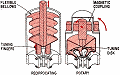 Frequency hopping spread spectrum, first
proposed and patented by Hollywood actress Hedy Lamarr, relies on both transmitters
and receivers to precisely tune in a pseudorandom manner to a band of discrete frequencies
in a time-synchronized manner with each other. The faster an encoded signal hops
between frequencies, the more difficult it is for an unintended listener to decode
the message. Same goes for the number of discrete frequencies used in the spread
spectrum scheme. Modern computer programs and fast-tuning receiver systems can gather
huge amounts of information spread across a broad bandwidth and re-assemble it into
intelligible data, and if an unlimited amount of time was available to do so, just
about any message can be decoded... Frequency hopping spread spectrum, first
proposed and patented by Hollywood actress Hedy Lamarr, relies on both transmitters
and receivers to precisely tune in a pseudorandom manner to a band of discrete frequencies
in a time-synchronized manner with each other. The faster an encoded signal hops
between frequencies, the more difficult it is for an unintended listener to decode
the message. Same goes for the number of discrete frequencies used in the spread
spectrum scheme. Modern computer programs and fast-tuning receiver systems can gather
huge amounts of information spread across a broad bandwidth and re-assemble it into
intelligible data, and if an unlimited amount of time was available to do so, just
about any message can be decoded...
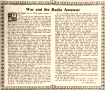 Amateur radio station operators seemed to
always be amongst the first to lose their rights in time of war. Governmental power
brokers - from unelected local bureaucrats on up to presidents - love to demonstrate
their influence over citizens when the opportunity arises. The
Radio Act of 1912 revoked the rights of amateur radio stations
to operate, and in some cases authorized the confiscation of radio equipment for
use by the government. Permission was not restored until 1919, after World War I.
Amateurs took it on the chin again in World War II with revocation of licenses.
In this 1917 article in The Electrical Experimenter publisher Hugo Gernsback
makes the case for permitting "our red-blooded boys be trusted to assist our officials
in running down spies." "...we realize how absurd it is to close all privately owned
radio stations during the war..." Amateur radio station operators seemed to
always be amongst the first to lose their rights in time of war. Governmental power
brokers - from unelected local bureaucrats on up to presidents - love to demonstrate
their influence over citizens when the opportunity arises. The
Radio Act of 1912 revoked the rights of amateur radio stations
to operate, and in some cases authorized the confiscation of radio equipment for
use by the government. Permission was not restored until 1919, after World War I.
Amateurs took it on the chin again in World War II with revocation of licenses.
In this 1917 article in The Electrical Experimenter publisher Hugo Gernsback
makes the case for permitting "our red-blooded boys be trusted to assist our officials
in running down spies." "...we realize how absurd it is to close all privately owned
radio stations during the war..."
 An ancient legend tells us that nearly 5,000
years ago an Emperor of China had a small statue of a man mounted on his chariot.
This statue was pivoted at the base and one outstretched arm always pointed to the
south. In those ancient times, this action must have seemed truly miraculous - probably
the Emperor used his statue more to impress his subjects than he did to find his
way. This legend is the first report of man's use of a black or lead-colored
stone called
magnetite. About the time of Christ, magnetite was rediscovered
by a Grecian shepherd. He noticed that the iron of his staff was attracted to certain
stones. But for nearly another 1,000 years, no particular use was made of this discovery... An ancient legend tells us that nearly 5,000
years ago an Emperor of China had a small statue of a man mounted on his chariot.
This statue was pivoted at the base and one outstretched arm always pointed to the
south. In those ancient times, this action must have seemed truly miraculous - probably
the Emperor used his statue more to impress his subjects than he did to find his
way. This legend is the first report of man's use of a black or lead-colored
stone called
magnetite. About the time of Christ, magnetite was rediscovered
by a Grecian shepherd. He noticed that the iron of his staff was attracted to certain
stones. But for nearly another 1,000 years, no particular use was made of this discovery...
 Although "Citizens Band" (CB) is the common reference to these unlicensed
two-way radio service transceivers, the official name for the spectrum allocated
by the FCC to their operation is "Citizens Band Radio Service" (CBRS). It was originally
called just "Citizens Radio Service," but the popular use of "Band" caused the FCC
to incorporate the additional term later on. Early Part 95 Class D citizens band
radios offered up to 23 channels in the 11-meter band from 26.965 MHz through
27.255 MHz. CB radio channels increased to 40 in 1977 due to the immense popularity
at the time (long before cellphones) - recall the "Convoy" song. The 11-meter band
was re-allocated from the amateur radio spectrum in 1958 (to the great dismay of
Hams). CB radios are still used heavily by truckers who don't like the idea
of "Big Brother" listening to and recording conversations... Although "Citizens Band" (CB) is the common reference to these unlicensed
two-way radio service transceivers, the official name for the spectrum allocated
by the FCC to their operation is "Citizens Band Radio Service" (CBRS). It was originally
called just "Citizens Radio Service," but the popular use of "Band" caused the FCC
to incorporate the additional term later on. Early Part 95 Class D citizens band
radios offered up to 23 channels in the 11-meter band from 26.965 MHz through
27.255 MHz. CB radio channels increased to 40 in 1977 due to the immense popularity
at the time (long before cellphones) - recall the "Convoy" song. The 11-meter band
was re-allocated from the amateur radio spectrum in 1958 (to the great dismay of
Hams). CB radios are still used heavily by truckers who don't like the idea
of "Big Brother" listening to and recording conversations...
 A few years ago I posted a note about a technical
faux pas on an episode of Star Trek titled "Court Martial," where Captain Kirk makes
a comment ordering the ship's auditory sensors to be boosted "on the order of
1 to the 4th power," (14) in order to pick up heart
beats. RF Cafe visitor Sam M. just sent me a note offering a possible - and
plausible - explanation for the gaff. If you are a devoted Trekkie looking for a
response to your apostate friends when confronted over the scene, read on... A few years ago I posted a note about a technical
faux pas on an episode of Star Trek titled "Court Martial," where Captain Kirk makes
a comment ordering the ship's auditory sensors to be boosted "on the order of
1 to the 4th power," (14) in order to pick up heart
beats. RF Cafe visitor Sam M. just sent me a note offering a possible - and
plausible - explanation for the gaff. If you are a devoted Trekkie looking for a
response to your apostate friends when confronted over the scene, read on...
 Beginning in 2000, I have created hundreds
of custom
technology-themed crossword puzzles for the brain-exercising benefit
and pleasure of RF Cafe visitors who are fellow cruciverbalists. The jury is out
on whether or not this type of mental challenge helps keep your gray matter from
atrophying in old age, but it certainly helps maintain your vocabulary and cognitive
skills at all ages. A database of thousands of words has been built up over the
years and contains only clues and terms associated with engineering, science, physical,
astronomy, mathematics, chemistry, etc. You will never find a word taxing your knowledge
of a numbnut soap opera star or the name of some obscure village in the Andes mountains.
You might, however, encounter the name of a movie start like Hedy Lamarr or a geographical
location like Tunguska, Russia, for reasons which, if you don't already know,
might surprise you... Beginning in 2000, I have created hundreds
of custom
technology-themed crossword puzzles for the brain-exercising benefit
and pleasure of RF Cafe visitors who are fellow cruciverbalists. The jury is out
on whether or not this type of mental challenge helps keep your gray matter from
atrophying in old age, but it certainly helps maintain your vocabulary and cognitive
skills at all ages. A database of thousands of words has been built up over the
years and contains only clues and terms associated with engineering, science, physical,
astronomy, mathematics, chemistry, etc. You will never find a word taxing your knowledge
of a numbnut soap opera star or the name of some obscure village in the Andes mountains.
You might, however, encounter the name of a movie start like Hedy Lamarr or a geographical
location like Tunguska, Russia, for reasons which, if you don't already know,
might surprise you...
 When I first read the title for this article,
"A Look at the PC Market," I was thinking personal computers, not
printed circuits. It being from a 1972 issue of Popular Electronics, my assumption
was that the photos of circuit boards were from early kit format computers, but
then it finally dawned on me that there were no personal computers in 1972 - not
even in kit form. Actually, that is not entirely true since there were advertisements
for hokey contraptions called "computers" that combined some switches, logic gates,
and LEDs for implementing simple multiple choice true/false testing boxes or rudimentary
(with emphasis on "rud[e]") calculators. Getting to the real story, though, the
1970s was the decade where printed circuit boards (PCBs) were replacing point-to-point
wiring wherever possible. If you opened a radio or television... When I first read the title for this article,
"A Look at the PC Market," I was thinking personal computers, not
printed circuits. It being from a 1972 issue of Popular Electronics, my assumption
was that the photos of circuit boards were from early kit format computers, but
then it finally dawned on me that there were no personal computers in 1972 - not
even in kit form. Actually, that is not entirely true since there were advertisements
for hokey contraptions called "computers" that combined some switches, logic gates,
and LEDs for implementing simple multiple choice true/false testing boxes or rudimentary
(with emphasis on "rud[e]") calculators. Getting to the real story, though, the
1970s was the decade where printed circuit boards (PCBs) were replacing point-to-point
wiring wherever possible. If you opened a radio or television...
 Chapter 12 of the U.S. Navy's basic electronics
training course discusses
electromagnetism. It follows on the heels of the sections introducing
magnetism and electrical currents. The Navy (and the Air Force, I must add) is renowned
for its high quality training and for turning out graduates that perform highly
in both their service duties and in private industry after separation. It describes
the electromagnet as being like a natural or artificial magnet in its attractive
force, is tremendous and can hold tons of iron. Because this magnet is powered by
an electric current, the magnetism can be turned on and off with the flick of a
switch. Electrically-powered magnets are called electromagnets. Electromagnets come
in all sizes and shapes... Chapter 12 of the U.S. Navy's basic electronics
training course discusses
electromagnetism. It follows on the heels of the sections introducing
magnetism and electrical currents. The Navy (and the Air Force, I must add) is renowned
for its high quality training and for turning out graduates that perform highly
in both their service duties and in private industry after separation. It describes
the electromagnet as being like a natural or artificial magnet in its attractive
force, is tremendous and can hold tons of iron. Because this magnet is powered by
an electric current, the magnetism can be turned on and off with the flick of a
switch. Electrically-powered magnets are called electromagnets. Electromagnets come
in all sizes and shapes...
 Have you ever used any of these
voltage-variable capacitor (VVC) types: varicaps, epicaps, minicaps,
voltacaps, capistors and varactrons? If you answered "no, but I have used varactor
diodes," then the more correct answer would have "yes, I have, but by a different
name." Construction was similar for all variations. This article from a 1969 issue
of Radio-Electronics magazine reports on some of the earliest forms of
diodes specifically designed to use a reverse bias on the PN junction to control
the effective capacitance of the device for use in frequency tuning circuits. The
first uses were for electronically tuning local oscillators in mixing stages, and
then for making tunable filters. Capacitance ratios greater than 10:1 with some
VVCs allowed tuning over a very wide range. At the time the article was written,
there was not universally agreed upon schematic symbol for the VVC, as illustrated
in Figure 2. Varactor-tuned television channel selectors... Have you ever used any of these
voltage-variable capacitor (VVC) types: varicaps, epicaps, minicaps,
voltacaps, capistors and varactrons? If you answered "no, but I have used varactor
diodes," then the more correct answer would have "yes, I have, but by a different
name." Construction was similar for all variations. This article from a 1969 issue
of Radio-Electronics magazine reports on some of the earliest forms of
diodes specifically designed to use a reverse bias on the PN junction to control
the effective capacitance of the device for use in frequency tuning circuits. The
first uses were for electronically tuning local oscillators in mixing stages, and
then for making tunable filters. Capacitance ratios greater than 10:1 with some
VVCs allowed tuning over a very wide range. At the time the article was written,
there was not universally agreed upon schematic symbol for the VVC, as illustrated
in Figure 2. Varactor-tuned television channel selectors...
 There is no such thing as too many introductory
articles on
operational amplifiers (opamps). Of course, when this story was
written for Electronics World back in 1967, opamps were relatively new to the scene.
Prior to the advent of opamps, circuit design for controllers, filter, comparators,
isolators, and just plain old amplification was much more involved. Opamps suddenly
allowed designers to not worry as much about biasing, variations in power supply
voltages, and other annoyances, and instead focus on function. Even from the very
beginning with the μa741 operational amplifier, the parameters came close to those
of an ideal device: infinite input impedance, zero output impedance, perfect isolation
between ports, and infinite bandwidth. OK, the bandwidth spec was more constrained
compared to the other three, but still, with frequencies... There is no such thing as too many introductory
articles on
operational amplifiers (opamps). Of course, when this story was
written for Electronics World back in 1967, opamps were relatively new to the scene.
Prior to the advent of opamps, circuit design for controllers, filter, comparators,
isolators, and just plain old amplification was much more involved. Opamps suddenly
allowed designers to not worry as much about biasing, variations in power supply
voltages, and other annoyances, and instead focus on function. Even from the very
beginning with the μa741 operational amplifier, the parameters came close to those
of an ideal device: infinite input impedance, zero output impedance, perfect isolation
between ports, and infinite bandwidth. OK, the bandwidth spec was more constrained
compared to the other three, but still, with frequencies...
|