|
|||||||||||||
 |
|||||||||||||
Mac's Radio Service Shop: Something Borrowed
|
|||||||||||||
Mac's Radio Service Shop: Something Borrowed
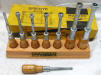
What a day!" Barney exclaimed as he stamped into the service shop brushing the snowflakes from his wool jacket. "If it keeps on snowing like this all day, a man is going to have to have a dog-team to get home tonight -s-a-a-a-y," he broke off as he stepped into the service department, "what have you been up to over the weekend? I can't tell if I'm in a radio store or a barber shop! Where did you get all that mirror behind the bench ?" "Like it?" Mac, Barney's employer, asked with a self-satisfied grin. "A little barber shop over on Seventeenth Street just closed up, and I bought the big mirror very cheap because of a couple of small flaws in it. After I had these cut out, I still had left two mirrors six feet long and two-and-a-half feet wide. That is just right to give us a continuous mirror behind the whole length of the service bench." "I'll say I like it," Barney exclaimed as he leaned forward for a closer admiring inspection of his reflection. "It will be a real pleasure to do servicing with a handsome devil like that working opposite me all day long." "All right, Narcissus; but that was not quite the idea," Mac drawled. "I simply grew tired of squinting into a small mirror and trying to get a good view of a TV screen while I was making adjustments on the set. No matter how hard I tried, I never seemed to be able to tilt the mirror so that I could see the exact corner of the tube I wanted to see. Now we've really got that whipped." "Yeah, and that mirror will be the old mustard for working on record-changers," Barney pointed out. "When the changer is sitting on a stand on the bench, a guy will be able to see what is going on on both sides of the mechanism at the same time; and believe me with a lot of changers these days, you almost have to be able to do just that." "There's still another good feature I've found out," Mac added. "You know how tools and screws and parts dearly love to hide by snuggling up against the far side of a chassis on which you are working, don't you? Well, they won't be able to do that on .this bench. With that mirror to let you see the surface of the bench from dozens of angles, not even a knob set-screw can hide. It is almost as good as having an extra eye on the end of a stick that you can poke around behind the chassis." "That's a gruesome way of putting it," Barney commented. "That's not the only haul I made at the defunct barber shop," Mac said over his shoulder as he disappeared into the storeroom. "Take a look at this," he said as he reappeared pushing what looked like the granddaddy of all flower stands. "The guy had a dilapidated old barber chair that he said I could have if I wanted it; so I brought it along, discarded the chair part of it, mounted this thirty-inch-square platform solidly on the old chair-supporting bracket, and then put those four heavy-duty casters underneath the base." "Fine, but what's it for?" "For holding a TV chassis while you're working on it," Max explained. "That weighted base makes it almost impossible to push over; the platform can be pumped up or let down through a range of several inches so that it will be just the right height for comfortable working; and the set can be easily twirled around to any position. Instead of having to drag a heavy chassis all over the workbench, we simply roll this dolly up to whatever instrument we want to use. When we need to make adjustments both above and below the chassis in rapid sequence, the set is placed on its side on the platform and then any part of it is easily and comfortably accessible simply by turning the platform." "Let me try it," Barney begged as he sat down on the platform and whirled himself around. "I always did want to do this with a barber chair but never got the chance. Wh-e-e-e! This is fun! Did you steal any other ideas from the barber shop?" "No, but I've been snooping around some other 'service' concerns in search of tools or ideas that I could borrow for doing radio and TV service, and I've come up with several that are well worth adopting. Take this jeweler's loupe, for example," Mac said as he screwed the black magnifying eyepiece into his eye-socket and peered owlishly through it at his assistant. "It really is the thing for finding a broken coil end, for discovering a tiny chipped place on a jeweled pickup needle, or for examining a TV tuner mechanism for dirt and corrosion. This one focuses at a distance of about five inches from the eye, which my jeweler told me would be the best for all around work; but they come in various powers. I think that we shall need an eye-aid of this sort more and more in the future. The Signal Corps admits that much of its present effort is directed toward miniaturization of equipment. Judging from the few samples of this effort we have seen in magazines, the eye is going to need all the help it can get to see trouble in the midget components and printed circuits that will go into civilian sets in the not-too-distant future. "And here is another little sight-aid I picked up from the doctors and dentists," he went on as he self-consciously slipped on a head-reflector and carefully adjusted the mirror so that it shined directly into Barney's blinking eyes. "One thing a technician never has enough of is hands, and when all ten of your fingers are busy in a dark corner of the chassis this handy little gadget will light up that corner just as well as you could do with a third hand holding a flashlight." "Yes, Doctor," Barney mockingly agreed. Mac slipped off the reflector and picked up three shiny little steel rods. "You probably have seen something like these before," he said to Barney. "They are the instruments the dentist uses to break loose the calcium deposits from teeth, and they are surprisingly strong." "I'll say they are," Barney agreed with feeling. "I've had a dentist lift me right out of the chair with one of those nasty little cusses." "Their toughness and small size makes them ideal for working over loose tube socket contacts, bending switch contacts back in place, and performing other jobs of mechanical manipulation in very restricted quarters. When working on live receivers, it is a good idea to slip a length of spaghetti over the shanks so that you will not short out anything." "And don't forget to mumble 'This may hurt a little' before you start using them on a set," Barney advised. "But how about the automobile mechanics? Did they watch you too closely for you to steal any of their stuff ?" "'Borrow' is the word," Mac corrected with a pained expression; "and I did get some tools and ideas at the garage. Notice these three additions to our pliers department; that big, loose-jawed pair is known as water-pump pliers, and they are just the stuff for grabbing hold of a can-type electrolytic and holding it solidly while you unscrew the big mounting nut. For that matter, they are also fine for starting those nuts or for acting as a wrench on any outsize nuts for which we do not ordinarily have an end-wrench. The pliers with the short powerful jaws are called battery pliers, and they are fine for any job where you need some extra leverage. The tiny little pliers are ignition pliers, and they have a dozen uses around the shop. For example, they can be used for loosening or tightening the nuts that hold speaker spiders; for loosening speaker mounting nuts when the bolts are so long that our Spintite wrenches will not reach them, or for doing any job where you need to grip something firmly in a space where there is no room for ordinary pliers." Before continuing, Mac opened a box sitting beneath the bench and revealed a brightly-painted little bench-grinder. "I was shamed into buying this," he said with a grin. "The other night Homer Frank, my favorite garage mechanic, was loafing here while I turned out a few sets. He got to prowling around in the tools and nearly had a fit when he saw our collection of drills, punches, chisels, and screwdrivers, which he insisted was the sorriest lot he had ever seen outside of a toy tool chest! Then he did have a fit when he wanted to sharpen them and I told him we had no electric grinder. "Homer declared that tools ought not be sold to a man who was too tight to buy equipment to maintain them. He said the emery wheel in his garage got more of a workout than any other power tool in the shop. He pointed out that if we had a grinder here we could keep our chisels sharp, our punches punching, our screwdriver bits square, and our bits so they would cut. He kept insisting that he could punch a hole quicker using a nail for a drill than I could using some of the bits we have in our collection. After listening to about twenty minutes of that kind of talk I promised to buy a grinder just to shut him up; but I've got a sneaking suspicion he was right to a certain extent." "Well, it certainly does me a lot of good to know that you were on the receiving end of a currying for once," Barney commented. "My only regret is that I was not here to listen to him pour it on." "Never mind that," Mac told him. "The point I want you to keep in mind is that we can speed up our own work a lot if we will keep our eyes open for tools and techniques employed in other lines of service work that can be used to advantage in our shop." "Hm-m-m-m," Barney said, thoughtfully stroking his chin, "you have something there; and I'm going to look into another form of repair and maintenance shop this very noon-hour." "And where would that be?" Mac asked suspiciously. "At that beauty shop on the next corner," Barney explained. "There's the cutest little redhead working in there who has been giving me the eye every day when I go to lunch; so today I'll just drop in and casually ask-" Before he could finish the sentence Mac grabbed up the cardboard box in which the grinder had been and crushed it down over the boy's ears. Mac's Radio Service Shop Episodes on RF Cafe This series of instructive technodrama™ stories was the brainchild of none other than John T. Frye, creator of the Carl and Jerry series that ran in Popular Electronics for many years. "Mac's Radio Service Shop" began life in April 1948 in Radio News magazine (which later became Radio & Television News, then Electronics World), and changed its name to simply "Mac's Service Shop" until the final episode was published in a 1977 Popular Electronics magazine. "Mac" is electronics repair shop owner Mac McGregor, and Barney Jameson his his eager, if not somewhat naive, technician assistant. "Lessons" are taught in story format with dialogs between Mac and Barney. There are 131 stories as of January 2026.
|
|||||||||||||
 |
|||||||||||||
|
|||||||||||||



|
||||||||||||||||||||||||||||||||||||