Electronics & High Technology Components
- See Full List of AI Topics -
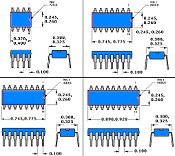 A Dual Inline Package (DIP) is
a type of electronic component packaging used for integrated circuits (ICs) and
other electronic devices. DIPs were widely used in the electronics industry for
several decades, but they have largely been replaced by surface-mount technology
(SMT) packages in recent years. Here's a brief history of the DIP: A Dual Inline Package (DIP) is
a type of electronic component packaging used for integrated circuits (ICs) and
other electronic devices. DIPs were widely used in the electronics industry for
several decades, but they have largely been replaced by surface-mount technology
(SMT) packages in recent years. Here's a brief history of the DIP:
- Invention and Early Adoption: The DIP was first introduced in the 1960s. It
consisted of a rectangular plastic or ceramic package with two parallel rows of
pins along its sides. This design allowed for easy insertion and soldering of the
package onto a printed circuit board (PCB).
- Proliferation in the 1970s and 1980s: DIP packages became the standard for many
types of ICs during the 1970s and 1980s. This era saw the rise of microprocessors,
memory chips, and various other digital and analog ICs packaged in DIPs.
- Variants and Sizes: DIPs came in various sizes, with the most common being the
14-pin, 16-pin, 18-pin, 20-pin, and 40-pin varieties. Smaller DIPs, like the 8-pin
and 10-pin versions, were also used for simpler devices.
- Decline in Popularity: As electronic devices became smaller, lighter, and more
compact, there was a growing need for smaller and more densely packed components.
This led to the decline in popularity of DIP packages. Surface-mount devices (SMDs)
became the new standard due to their smaller footprint and ability to be densely
packed on PCBs.
- Legacy Use: While DIPs are no longer the primary choice for new electronic designs,
they are still used in some legacy systems and for hobbyist projects. Additionally,
DIP sockets (which allow for the easy replacement of DIP ICs) are sometimes used
in prototyping and testing.
- DIP vs. SMT: The transition from DIP to SMT packaging brought advantages like
reduced size, improved manufacturing efficiency, and better electrical performance
due to shorter lead lengths. However, SMT components can be more challenging to
hand solder and repair compared to DIPs.
- Obsolete for Modern Applications: In modern electronics, especially for portable
devices and miniaturized products, you'll rarely find DIP packages. SMT and other
advanced packaging technologies have largely replaced DIPs in these applications.
 This content was generated primarily with
the assistance of ChatGPT (OpenAI), and/or
Gemini (Google), and/or
Arya (GabAI), and/or Grok
(x.AI), and/or DeepSeek artificial intelligence
(AI) engines. Review was performed to help detect and correct any inaccuracies;
however, you are encouraged to verify the information yourself if it will be used
for critical applications. In all cases, multiple solicitations to the AI engine(s)
was(were) used to assimilate final content. Images and external hyperlinks have
also been added occasionally - especially on extensive treatises. Courts have ruled
that AI-generated content is not subject to copyright restrictions, but since I
modify them, everything here is protected by RF Cafe copyright. Many of the images
are likewise generated and modified. Your use of this data implies an agreement
to hold totally harmless Kirt Blattenberger, RF Cafe, and any and all of its assigns.
Thank you. Here is Gab AI in an iFrame. This content was generated primarily with
the assistance of ChatGPT (OpenAI), and/or
Gemini (Google), and/or
Arya (GabAI), and/or Grok
(x.AI), and/or DeepSeek artificial intelligence
(AI) engines. Review was performed to help detect and correct any inaccuracies;
however, you are encouraged to verify the information yourself if it will be used
for critical applications. In all cases, multiple solicitations to the AI engine(s)
was(were) used to assimilate final content. Images and external hyperlinks have
also been added occasionally - especially on extensive treatises. Courts have ruled
that AI-generated content is not subject to copyright restrictions, but since I
modify them, everything here is protected by RF Cafe copyright. Many of the images
are likewise generated and modified. Your use of this data implies an agreement
to hold totally harmless Kirt Blattenberger, RF Cafe, and any and all of its assigns.
Thank you. Here is Gab AI in an iFrame.
Electronics & High Tech
Companies | Electronics &
Tech Publications | Electronics &
Tech Pioneers | Electronics &
Tech Principles |
Tech Standards Groups &
Industry Associations | Societal
Influences on Technology
|