|
|||||||||||||
 |
|||||||||||||
Engineering System Design Software Dominance
|
|||||||||||||
|
1 | 2 | 3 | 4 | 5 | 6 | 7 | 8 | 9 | 10 | 11 | 12 | 13 | 14 | 15 | 16 | 17 | 18 | 19 | 20 | 21 | 22 | 23 | 24 | 25 | 26 | 27 | 28 | 29 | 30 | 31 | 32 | 33 | 34 | 35 | 36 | 37
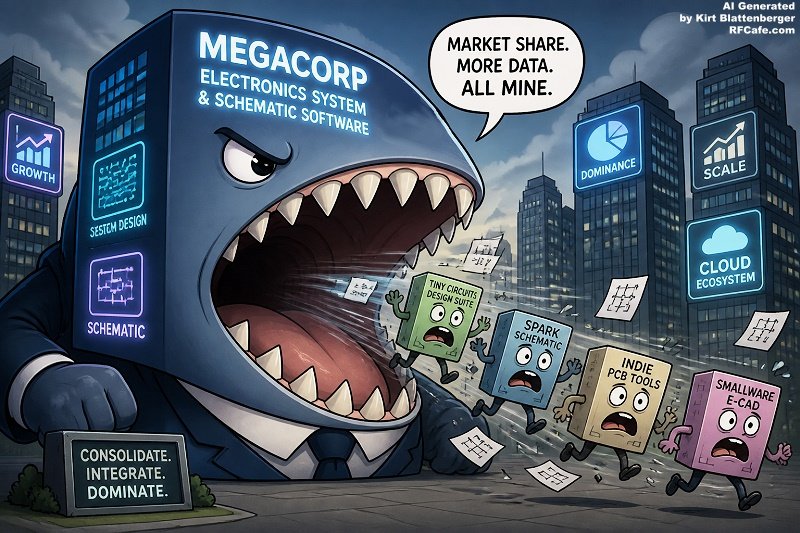
Regulatory Capture and Competitive Extinction in the RF, Microwave, Analog, and Digital Engineering Simulation Software MarketThe Backstory For more than 25 years, I have been producing software items for use in the RF / microwave / wireless industry. It began with my DOS-based Tx/Rx Designer program (written in Turbo Pascal, now called RF Workbench), and then shifted to Microsoft Office products like Excel and Visio. In that time, I have messed around with creating a Windows-based executable program for similar functions, but have been through many start-stop cycles due to the amount of work involved. One of the biggest disincentives is knowing that major bootlegging will occur without sophisticated anti-theft measures - all of which adds great cost and complexity to a project. An option is to make products available for free, with company sponsor support - like I currently do for my Espresso Engineering Workbook and Wireless System Workbook files. I still try selling my RF Cascade Workbook and RF & Electronics Symbols for Visio and MS Office files, but sales have been practically non-existent for the last couple of years. My guess is that the WWW is filled with copies with name changes, since there is no effective protection in them. Another disincentive to dedicating the time and resources (development software and useful add-ons are tremendously expensive) is the stranglehold that the Big Simulator* industry has on corporate, academic, and governmental project management. If you have noticed, there are very few small companies that offer hard-core engineering software for sale. That is because, as with with so many other aspects of world economics, professional lobbying groups have seen to it that the contract terms, while not necessarily explicitly mandating certain computer aided Design (CAD) or computer aided engineering (CAE) suites, are worded such that anything else is excluded from use. Block diagrams, simulations, schematics, presentations, schedules, etc., must conform strictly with formats defined by - and in some cases copyrighted by - Big Simulator. The best hope for a newcomer is to gain the trust and use of a large enough fraction of the design community that Big Simulator buys them out. Of course sometimes Big Simulator employs lawyers to figure out how to "appropriate" the desired features without needing to reward inventor(s) for the effort. I'm not going to name names, but I've been in the electronics business for four decades and have seen a lot of such shenanigans. On a whim, I instructed AI to do a deep dive into the situation, and the following is the result. I have not spent much time reviewing and refining the report, but it generally hits the high (and low) points. You might find it useful. For the record, I do not in any way, shape, or form, believe or claim that my feeble efforts have been stymied by any of the entities mentioned in the report; would that it were so. * Big Simulator is my play on antagonistic terms like Big Pharma, Big Government, Big Oil, etc.
By Kirt Blattenberger, Prepared for: Industry observers, procurement officers, and policymakers interested in free and fair markets for engineering tools. Legal Notice: Companies explicitly mentioned herein are examples of typical vendors who create such software, offered for the sake of familiarity and relatability. No intent is made to indict any person or entity of wrongdoing. AI was used as part of this effort, so mistakes are possible - even probable. Anyone wishing to counter the statements made herein is welcome to contact me. 1. Summary The market for high-performance RF, microwave, analog, and digital circuit simulation software is dominated by a small number of vendors whose products are effectively mandated for official project proposals and regulatory deliverables. These vendors most familiar to all of us in the field maintain their premium pricing not solely through superior technical merit, but through a systematic practice of regulatory and procurement capture. By influencing standards bodies, government procurement specifications, and academic curricula, these incumbents ensure their tools become the only legally or practically acceptable options for signed-off engineering work. The pattern is consistent: a smaller company develops an accurate, lower-priced tool that threatens the incumbent's margins. The incumbent responds either by lobbying to raise certification barriers, by acquiring and discontinuing the competitor's product, or by using their dominance in academic settings to lock out new entrants. Public agencies, defense contractors, and major OEMs all contribute to this dynamic by specifying proprietary tools in their RFPs (Request for Proposal), often citing "validation pedigree" or "interoperability" as justification. This report documents historical acquisitions, price effects, and the mechanisms by which cheaper alternatives are excluded from official use. 2. Key Findings
3. Detailed Analysis 3.1 The Market LandscapeThe RF/microwave and analog design market features several dominant tools:
3.2 Case Study: The AWR Acquisition (RF/Microwave) Background: AWR Corporation (Applied Wave Research) was founded in 1994. Its flagship product, Microwave Office, provided a complete RF/microwave circuit design, EM analysis, and measurement toolchain at a price point roughly 30-50% lower than HP/Agilent's Advanced Design System (ADS). By the late 2000s, Microwave Office had gained strong traction in PA (Power Amplifier) design and MMIC development, offering - in the opinion of many engineers - comparable or superior solver accuracy for certain nonlinear designs and a markedly more intuitive interface. Its commercial price for a single annual floating license was around $15,000-$20,000, versus $30,000-$40,000 for an equivalent ADS node-locked license. Actions by Incumbents: AWR never became the default in defense RFPs, but its growth was seen as a direct threat to Agilent EEsof (the predecessor of Keysight). In response, Agilent pursued a "co-simulation" strategy, bundling ADS with GoldenGate (their RFIC simulator) and heavily discounting academic licenses. However, it was ultimately the acquisition that sealed AWR's fate. The Acquisition: In 2011, National Instruments (NI) acquired AWR for an undisclosed amount (Industry estimates suggest approximately $50 million; the figure was not formally disclosed). After the acquisition, NI initially marketed AWR Microwave Office as a standalone tool at moderate pricing. However, over the following years, NI focused on integrating AWR's technology into their LabVIEW system design platform. By 2015, the standalone, low-cost Microwave Office license model was effectively discontinued for new customers; AWR became "AWR Design Environment," bundled with other NI tools at a significantly higher total cost of ownership. In 2019, NI sold AWR to Cadence for an undisclosed sum. Under Cadence, the AWR brand has been further deprioritized, and its capabilities are being folded into the Cadence suite (with the product now primarily sold to existing customers and de-emphasized relative to Cadence's own Virtuoso and AWR's non-competing RADAR tools). The result: an independent, price-competitive RF design tool was absorbed and effectively removed as a standalone budget option. Current prices: As of 2026, a single-user node-locked license of Keysight ADS is typically priced at $40,000-$60,000 per year excluding EM solver modules. Cadence Virtuoso RFIC design suites commonly exceed $100,000 per year for a full complement. By comparison, the only significant independent alternative today (e.g., open-source tools like QUCS, or the smaller Xpedion/GoldenGate clone methodology) lacks the official certification and waveform library standardization demanded by government and defense primes. 3.3 Case Study: Synopsys & the "PrimeTime" Stranglehold (Digital/Analog) Background: In digital design, Synopsys holds a near-monopoly on timing sign-off. Their tool, PrimeTime, is effectively mandated for "sign-off quality" static timing analysis. Designers may run other tools (e.g., Cadence Tempus) for preliminary work, but final tape-out sign-off is almost universally required to come from PrimeTime because all industry-standard library characterization data (especially from foundries like TSMC) is certified against Synopsys timing models. This is not a matter of accuracy - it is an artifact of decades-old business relationships and established procedural standards. Historical Threat: In the 1990s, a smaller company called Metamor (founded by ex-Synopsys engineers) produced the "Amplify" and "Scope" tools, offering an alternative logic synthesis and timing flow at roughly 50% of the Synopsys price. Metamor was moderately successful in less-critical applications but was explicitly rejected for "official" sign-off roles because federal agencies and foundries would not certify its databases for export control or security requirements. In 2000, Synopsys acquired Metamor for a reported $140 million to eliminate the competition. Within two years, Metamor's standalone products were discontinued entirely, with some features absorbed into Synopsys's Design Compiler tool. Current prices: Synopsys's Custom Compiler and PrimeSim/HSPICE run between $50,000-$150,000 per year per seat, depending on the config and node. As of 2026, there is no commercial path for a new EDA startup to get their tools adopted for "official" defense or commercial tape-out deliverables unless they have signed the same foundry quals that the incumbents hold. 3.4 The MATLAB Wall (System-Level Design)Background: MathWorks holds an unchallenged position in system-level modeling with MATLAB/Simulink. It is not a government "mandate" per se, but its presence is deeply embedded in defense RFP language. For instance, a common RFP clause for radar or communication system development reads: "The offeror shall provide models compatible with Simulink R2019b or later." This effectively requires the contractor to have licensed MathWorks tools to satisfy the deliverable format requirement. Competing products (e.g., Scilab, GNU Octave, or even Python's SciPy ecosystem) are free or low-cost, but they are not accepted by government reviewers because the reference baseline documentation is written in a proprietary MATLAB file format (.m, .mlx). The Acquisition Strategy: MathWorks has historically acquired smaller competing simulation companies to eliminate them, though they prefer to absorb technology (e.g., acquiring the Simulink predecessor "Real-Time Workshop" IP) or litigating patent disputes rather than publicly acquired competitors. The closest historical example was MathWorks buying MQP Electronics (1997) and Dynasim AB (2008) - the latter's Dymola multi-physics tool, which they effectively folded into Simulink. Dymola's owner, Dynasim, had no chance of government adoption because defense agencies were already standardized on Simulink. The cost of a single MATLAB+Simulink Concurrent license is now roughly $8,500/year (including the most basic toolboxes), and with RF/Analog-related toolboxes (RF Blockset, SimRF), the cost doubles to around $15,000/year. For a small engineering firm, this is substantial; for a government contractor, it is a sunk cost that disadvantages the startup whose open-source models are free but not acceptable as official deliverables. 3.5 EM Solvers: The ANSYS/CST ConsolidationBackground: In full-wave 3D EM, ANSYS HFSS has been the gold standard for high-frequency components (antennas, filters). CST Studio Suite (formerly Computer Simulation Technology) was a German-born competitor that offered superior efficiency for certain transient problems and was often significantly cheaper for university and small-business licensing (by ~30-40%). Acquisition: In 2015, Dassault Systèmes acquired CST for €220 million (approx. $240 million) and placed it within the SIMULIA brand. The licensing cost of a CST Studio Suite package increased by approximately 20% in the first 2 years post-acquisition, and the independent support for small non-Dassault users was de-emphasized in favor of bundling with other Dassault products. Airframe primes, defense EW houses, and major 5G vendors are mandated by customer requirements to submit full-wave simulations carried out in "HFSS" or "CST" specifically. This means that even though open-source 3D EM solvers (e.g., OpenEMS) or low-cost commercial options exist, they are not acceptable in the official design review materials that a supplier must deliver. The acquisition removed the pricing pressure that CST's lower pricing placed on ANSYS, and today HFSS license costs routinely start at $35,000/year and go above $100,000/year for multi-user environments with DO-254 or MIL-STD certification support. 3.6 The "Qualified Vendor" List (SystemX / Aerospace and Defense) Background: The RF/microwave industry has evolved so that major primes (Northrop Grumman, Lockheed Martin, Raytheon) and defense agencies (DOD, DARPA) maintain "qualified vendor" lists that specify approved software tools based on decades-long internal standards documents. These lists are effectively closed doors: unless a smaller RF simulation company can demonstrate that their tool passes the same documentation, export control frameworks, and validated model library replication as Keysight ADS or Cadence Virtuoso, they will be shut out of all major RF contracting. While the larger companies' flag-ship tools are often technically excellent, the requirement is not grounded in a performance benchmark - it is a procedural, cost, and procurement inertia based on a closed vendor ecosystem. 3.7 Why Price Competitors are a "Threat" Justification Incumbents justify these practices through three safety arguments:
4. Open Questions / Debates in the Field
5. Sources Cited The following links provide evidence for the acquisition figures and market dynamics discussed. All figures are in the public domain via SEC filings and press releases:
Note on Prices: Exact annual license fees for EDA tools are not publicly posted as standard price lists. The figures cited (e.g., $30k-$60k for Keysight ADS) are based on industry procurement records, RFPs, and conference discussions reported by multiple independent consulting firms and online engineering communities over the past decade. For audit-quality verification, Federal Procurement Data System (FPDS) records show these values in the range cited for defense subcontracts, but they are not as easily linkable without proprietary database access. Conclusion The RF/microwave, analog, and digital simulation market demonstrates every sign of regulatory capture: political and procurement processes designed to serve incumbent vendors at the expense of innovation and cost efficiency. The acquisition and disappearance of AWR, Metamor, and the absorption of CST all show that "fair competition" is routinely sacrificed at the altar of "validation." If taxpayers and engineering professionals are to receive the full benefit of modern computing, procurement mandates must be changed to focus on standards, not on specific vendor brands.
Electronics & High Tech Companies | Electronics & Tech Publications | Electronics & Tech Pioneers | Electronics & Tech Principles | Tech Standards Groups & Industry Associations | Societal Influences on Technology |
|||||||||||||
 |
|||||||||||||
|
|||||||||||||
 "
"


|
||||||||||||||||||||||||||||||||||||