|
||||||||||||||||||
 |
||||||||||||||||||
Nuclear Power Generation in 2026
|
||||||||||||||||||
|
1 | 2 | 3 | 4 | 5 | 6 | 7 | 8 | 9 | 10 | 11 | 12 | 13 | 14 | 15 | 16 | 17 | 18 | 19 | 20 | 21 | 22 | 23 | 24 | 25 | 26 | 27 | 28 | 29 | 30 | 31 | 32 | 33 | 34 | 35 | 36 | 37 <Previous Next>
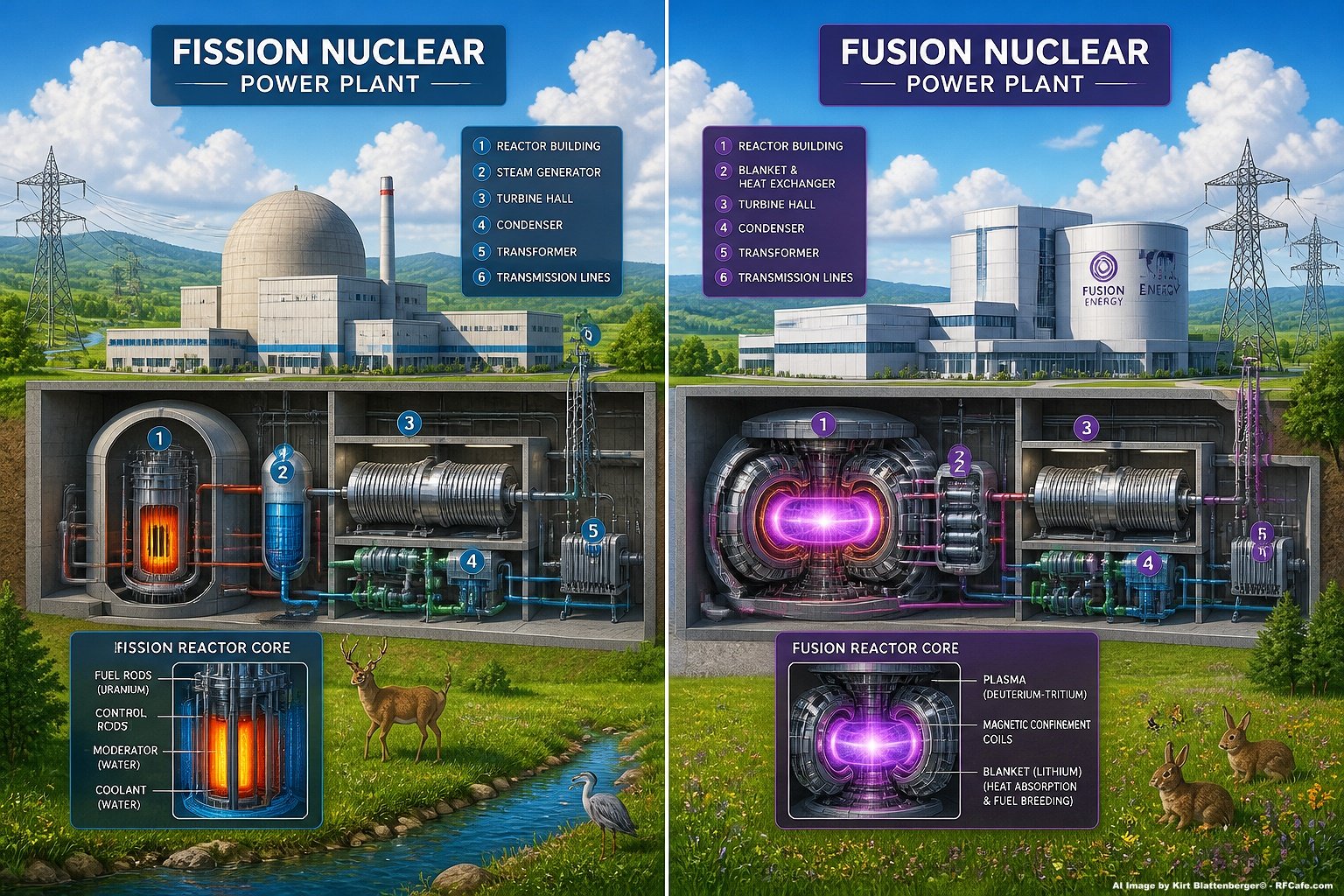
As of mid-2026, the global nuclear sector is experiencing a genuine renaissance, driven less by traditional energy politics and more by the insatiable baseload power demands of artificial intelligence data centers. Fission technology has matured significantly - Generation III+ reactors (AP1000, EPR) have entered commercial service with passive safety features, while Small Modular Reactors (SMRs) are now at the cusp of commercial deployment. Fusion, long a science fiction dream, has achieved laboratory net energy gain (NIF) and is attracting enormous private capital (Commonwealth Fusion Systems, Helion), though grid-scale fusion remains at least 15-20 years away. Regulatory Momentum Has Shifted The U.S. Nuclear Regulatory Commission (NRC) has finalized its first-ever "Part 53" risk-informed licensing framework, explicitly designed for advanced reactors and SMRs. The Department of Energy (DOE) Loan Programs Office has committed billions to keep existing reactors online and fund new builds. Most notably, the restart of Three Mile Island Unit 1 - under a 20-year power purchase agreement with Microsoft - signals a sea change in how utilities and corporate buyers view nuclear energy. Formerly-strident anti-nuclear organizations, including major environmental NGOs (NRDC, Sierra Club, Greenpeace), have largely gone silent or shifted focus. While formal policy positions remain technically opposed, their activism has diminished dramatically because AI data centers require emissions-free baseload power that only nuclear can provide at the required scale. This is widely perceived as hypocrisy, though some groups (e.g., the Environmental Defense Fund and the Breakthrough Institute) have openly reversed course to endorse advanced fission. Water supply remains a significant constraint for traditional large light-water reactors, but emerging SMR designs can use air-cooled condensers, eliminating the need for large rivers or coastal locations. Fuel supply is a strategic vulnerability: the U.S. is heavily dependent on Russian enrichment for HALEU (high-assay low-enriched uranium), though Centrus in Ohio is ramping up domestic production. The historical record - from Three Mile Island (1979), Chernobyl (1986), and Fukushima (2011) - provides valuable lessons in both human error and engineering resilience. Modern passive safety systems, accident-tolerant fuels, and defense-in-depth make new designs demonstrably safer, downgrading the risk profile to below that of fossil fuels, hydropower, and even some renewable sources per TWh generated. The perception of nuclear danger has been markedly exaggerated for decades by ideological opposition groups, but the scientific consensus holds that nuclear energy is among the safest forms of electricity generation ever devised. Key Findings
Detailed AnalysisThe Fission Renaissance: Generation III+ and SMRsThe current state of fission construction is a tale of two technologies. Large-scale Generation III+ reactors - most notably the Westinghouse AP1000 and EPR - have had torturous cost overruns (Vogtle Units 3 & 4 in Georgia exceeded $30 billion, roughly double the original budget, and were completed in 2023-2024). Yet they are now operating efficiently and providing reliable baseload power. In the U.K., Hinkley Point C (two EPRs) continues with delays and cost increases, with commissioning now slated for 2030-2031. The industry's hope rests on SMRs. NuScale's VOYGR design lost its first U.S. customer (UAMPS canceled the Idaho project in 2023 due to cost escalations), but the design certification set a precedent. TerraPower's Natrium (a 345-MWe sodium-cooled fast reactor) is under construction in Kemmerer, Wyoming, with a completion target of 2029-2030; it relies on HALEU fuel, which is currently the limiting constraint. X-energy's Xe-100 (a 80-MWe high-temperature gas-cooled reactor) received DOE funding and is slated for installation at a Dow chemical site in Texas. Fusion: From Lab to GridFusion progress accelerated dramatically after the National Ignition Facility (NIF) achieved net energy gain (Q>1) in December 2022, and repeated the feat multiple times since. However, NIF is laser-based, not viable for commercial generation. The world's largest tokamak, ITER in France, has suffered repeated delays and cost overruns; the current schedule pushes full magnetic fusion operation (deuterium-tritium) to 2039 - a decade later than original 2020s goals. Private fusion is moving faster than government programs. Commonwealth Fusion Systems (CFS) is building SPARC in Massachusetts, using high-temperature superconducting magnets. SPARC is designed to achieve Q>1 by late 2026 or 2027. Helion Energy has a PPA with Microsoft to deliver fusion power by 2028, though that timeline is widely seen as extremely optimistic (the company uses a separate "pulsed magnetic" technology with far less external validation). TAE Technologies and General Atomics are also pursuing research. The consensus is that fusion is 20-30 years away from commercially dispatchable power, but the capital investment (over $6 billion in private fusion venture funding since 2021) demonstrates genuine technical breakthrough potential. Safety, Dangers, and the Historical ContextTo understand the current safety regime, one must revisit the three historic failures:
Modern safety enhancements include: Passive cooling (AP1000 relies on gravity and natural convection, with a 72-hour grace period without any operator action or external power). Accident-tolerant fuel (ATF) made with silicon carbide claddings and enhanced uranium compounds that resist hydrogen generation and high-temperature oxidation. Defense-in-depth - multi-layered physical barriers, human redundancy, and probabilistic risk assessment (PRA) that quantifies core damage frequencies below 1-in-10 million per reactor-year. SMRs like NuScale's design automatically shut down and cool via thermal conduction without pumps or electricity, making a Fukushima-style station blackout physically impossible in the same manner. Is the danger exaggerated? Yes, sharply, particularly when measured in deaths per TWh. Coal causes roughly 100-200 times more deaths per unit energy than nuclear (including mining accidents, air pollution mortality). The anti-nuclear movement of the 1970s-90s - driven by fear of weapons proliferation, environmental concerns, and often Soviet-funded disinformation - created a societal panic that persists today. The Linear No-Threshold (LNT) model for radiation effects is now widely challenged as overly conservative; the actual health impact of low-dose radiation (below 100 mSv) may be negligible or even hormetic (a toxicological form of "what does'nt kill you makes you stronger"). That said, nuclear waste, weapons proliferation (even if fission reactors are tightly safeguarded), and catastrophic meltdown risk (though reduced to near-zero with modern passive systems) remain legitimate, if overstated, concerns. Regulatory Trends: Permitting and DenialThe major trend is unmistakable: deregulation and streamlining. The NRC, historically criticized for being slow (4-6 years for rulemaking, >10 years for new licenses), has changed course under pressure from Congress, the DOE, and industry. Key examples:
The Data Center Paradox: Former Opponents Silence and HypocrisyArtificial intelligence is the game-changer. Data centers - the physical infrastructure for AI compute - now consume ~15% of U.S. electricity and are projected to triple by 2030. They need 24/7 baseload power, not intermittent wind or solar. So corporate giants have turned to nuclear:
This has placed formerly anti-nuclear groups in an awkward position. The Sierra Club, Greenpeace, and Friends of the Earth still formally maintain anti-nuclear stance. However, their public activism and lobbying against nuclear has diminished dramatically - specifically, they do not campaign against these data center PPAs because the tech industry is a major donor to these environmental NGOs. The NRDC, which waged aggressive legal opposition to new reactors in the 1980s-2000s, has not launched a single lawsuit against an AI data center nuclear deal. This quietness is widely labeled hypocrisy by climate realists and pro-nuclear advocates. In contrast, newer entities like the Environmental Defense Fund and majority of climate scientists (e.g., James Hansen) openly advocate nuclear expansion as the only clean, bulky baseload resource viable at the required scale. The "hypocrisy" is thus a matter of governance: large environmental groups rely on tech donations for operational funds, and will not bite the hand that feeds their climate budget. Leading Institutional Efforts
Future Locations and the Water QuestionWhere will future plants be built? The growth areas are (1) existing nuclear sites for recommissioning or adjacent expansion (Palisades, TMI, potentially Clinton and Quad Cities in Illinois); (2) brownfield industrial sites like Dow Chemical's Texas plant for X-energy, and Microsoft's planned deployments near its data center campuses in Virginia and Ohio; and (3) countries with aggressive build programs: China, India, Russia, South Korea, and the UAE (which has operationalized its Barakah plant). Water Remains a Crucial but Surmountable Constraint Traditional large PWRs/BWRs require massive cooling water - typically 400-800 gallons per MWh (evaporation losses of ~500 gal/MWh), equivalent to draining a local river or consuming a municipal water treatment plant's capacity. That's why most U.S. plants sit on coastlines, large rivers, or use cooling towers. However, modern SMRs have addressed this. NuScale's design can use dry cooling towers, reducing water consumption to near zero (0-10 gal/MWh) at a cost of ~2-3% thermal efficiency. The Natrium reactor and X-energy's HTGR also use inert gas or molten salt intermediate loops, allowing air-cooled heat rejection. Thus, for the first time, nuclear plants can be sited in arid regions (Wyoming, Nevada, Arizona) without despoiling local water supplies. For any new large EPR/AP1000, a river or coastal location will still be a siting constraint. Environmental Regulations: Eased or Not?Yes, environmental regulations are being eased specifically to favor permitting. The NEPA categorical exclusions mentioned above directly shorten environmental reviews for small reactors. The U.S. EPA has also issued guidance that existing nuclear plants may extend their licenses to 80 years (safety evaluation by NRC shows no fundamental material degradation at 80 years), avoiding new environmental compliance beyond the Thermal Pollution Control Act waivers. The EPA's "Section 316(b)" rules for cooling water intake structures were revised in 2022-2024 to grandfather existing nuclear intakes, and SMRs with dry cooling avoid further issues. The DOE's loan guarantees (e.g., $1.52B for Palisades) come with tightened federal environmental review timelines. Internationally, the trend is similar: the EU's Green Taxonomy officially classified nuclear as a "sustainable investment" in 2022 (with some legacy opposition from Germany/Austria), and the U.K. is fast-tracking a new large-scale nuclear program through its Nuclear Nation initiative. Through Technologies with New Safety or Danger ProfilesSeveral technological breakthroughs are altering the risk equation - in both directions. On the safety side, the transition from analog to digital instrumentation and control systems has enabled automated fault-tree analyses and real-time risk monitoring, improving alarm handling over the manual workflows of the 1970s. Accident-tolerant fuels (ATFs) are perhaps the single most consequential near-term safety innovation: triple-layer silicon-carbide-coated uranium nitride and chromium-coated zirconium claddings delay hydrogen generation and fuel failure to far higher temperatures and for far longer periods (hours rather than minutes) during a loss-of-coolant accident. This transforms the safety case from reliance on active emergency core cooling to fundamental material resilience. Another major safety enabler is molten salt coolants. Both Kairos Power's fluoride salt reactor and TerraPower's sodium-cooled Natrium operate at near-ambient pressure, eliminating the large high-pressure containment vessel required by light-water reactors. In the event of a leak, the coolant simply freezes into a solid salt or sodium pool, unlike water flashing to steam at 150 times atmospheric pressure. This has allowed the NRC Part 53 rulemaking to reduce the required exclusion zone radius for SMRs from 10 miles to about 0.5 miles, which makes siting next to data centers feasible. On the more dangerous side, the shift to HALEU fuel (enriched to 19.75% U-235) introduces proliferation and radiological release considerations that differ from conventional 4.95% enriched low-enriched uranium. HALEU requires more robust physical security and is a direct weapons-usable precursor material, though far below weapons-grade (90%). Advanced "breeder" fast reactors (like Natrium) operating on a fertile blanket can transmute long-lived actinides, potentially reducing waste radiotoxicity, but they also have a larger inventory of fissile material in the core - requiring fast-spectrum safety analysis and sodium coolant engineering, which brings a violent chemical fire risk if exposed to oxygen. The NRC's safety evaluation for Natrium has required additional fire suppression and dedicated vessel catch pans as a result. A second dangerous trend involves load-following operation and cybersecurity. Data centers require variable power to match AI training workloads, so nuclear plants are being asked to perform rapid power changes (like a hydraulic transient every 1-3 hours). This increases thermal cycling fatigue in fuel cladding and turbine components, potentially accelerating degradation - though modern ATF materials are designed to handle this. Cybersecurity has also emerged as a top safety threat: a deliberate cyberattack on the digital instrumentation and control of a reactor (via a Trojan horse in supply chain software) could induce conditions beyond design basis. The NRC now requires enhanced security for remote-controlled utility grid load schedules, a risk category that did not exist in the previous generation. Fuel Sources and Long-Term Waste DisposalThe source of nuclear fuel is uranium-bearing geological ore. The current annual global consumption is about 60,000 tonnes of natural uranium, primarily mined in Kazakhstan (~40%), Canada (~15%), Australia (~10%), and Namibia (~5%). However, uranium enrichment is the strategic bottleneck. Conventional light-water reactors require ~5% enriched U-235, which is supplied by three global players - Urenco (Europe/U.S.), Rosatom (Russia), and China - with Russian supply accounting for ~23% of the U.S. market as of 2025. For HALEU (19.75%), the U.S. has almost no commercial capacity; the DOE has invested $700 million in Centrus to restart that capability at its Piketon, Ohio plant, but current production capacity (about 1 tonne per year) is far short of what TerraPower or X-energy will need (several tonnes per reactor). If U.S. builds accelerate without a domestic HALEU production scale-up, the fuels will have to be sourced via high-enriched uranium blend-down - a politically fragile route. Regarding spent fuel disposal, the problem is less technical than political. Commercial reactor spent fuel is roughly 95% unburned uranium-238, ~1% plutonium, ~4% fission products, and <1% minor actinides. It's thermally hot and radiotoxic for a few centuries due to fission products, and for 10,000+ years due to minor actinides. The industry consensus (IAEA, U.S. National Academies, and Finnish counterpart) is deep geological disposal - burial at 400-500 meters in stable granite or tuff, behind multiple barriers (copper-iron canisters, bentonite clay, and low permeability host rock). Finland's Onkalo repository began initial disposal operations in 2024; Sweden is close behind. The U.S., however, has no operational repository, and Yucca Mountain (Nevada) remains legislatively stuck. In practice, American spent fuel sits in licensed dry cask storage - highly safe, passively cooled, and monitored, but requiring indefinite surface stewardship. Some advanced reactor designs (e.g., select molten salt systems) can actually consume transuranic waste in a "fast burnout" cycle, which could reduce the needed repository footprint by two orders of magnitude. Still, even the optimists concede that geological disposal is necessary for the long-term radioactive residue. Recommissioning: TMI and BeyondThree Mile Island Unit 1 (a Babcock & Wilcox PWR, 855 MWe, not the melted-down Unit 2) is the highest-profile recommissioning candidate. Constellation Energy closed the plant in 2019 for economic reasons, but in early 2025 announced a 20-year PPA with Microsoft to supply power to its AI data centers in Pennsylvania and Virginia. The NRC has a licensing process for "license renewal," here an original operating license reinstatement plus a subsequent license renewal from a status of "possession-only." Technical reviews indicate the plant's steam generators, reactor vessel, and containment are in good condition after being shut down with proper preservation, but the restart demands full NRC inspection of non-safety auxiliary systems, and likely $1-2 billion for refurbishment (control rod drive mechanisms, feedwater pumps, main transformers). The target COD is early 2028. If successful, it will set a milestone for a generation of "reactivation," as opposed to "new build." Worldwide, several other recommissioning efforts are active. In the U.S., Palisades (Michigan), a 805 MWe PWR closed in 2022, is being acquired by Holtec for restart using a DOE loan, aiming for 49-year extension; its spent fuel pool has already been cooled to low burn-up, and a new management team is in place. In Japan, the government has pushed hard to restart reactors closed after Fukushima: as of mid-2026, 17 units have restarted, with another 7 under active safety review, all with new regulatory requirements (tsunami-resistant seawalls, backup emergency control centers, air filtration systems). However, no Japanese plant has yet applied for recommissioning after a full fuel-loading shutdown, so the Japanese restarts are technically "reactivation" of originally operating plants, not new recommissionings. In Italy, a law passed in 2024 repealed the 1987 post-Chernobyl prohibition, and the utility Enel has publicly stated it is converting its two shut-down BWR sites (Cerno, Trino Vercellese) into advanced SMR deployments. South Africa's Koeberg plant is undergoing a massive life-extension, but no other major Western reactor is being formally recommissioned beyond TMI and Palisades. The U.K.'s Sizewell B and Hunterston B are being evaluated for life extension beyond 60 years, which is a related category. Who Benefits Financially, Politically, and SociallyThe renewed interest in nuclear power is creating a set of clear winners. Financially, the largest beneficiaries are the nuclear plant operators - Constellation, Holtec, Dominion, and Vistra - which see shutdown plants become stranded assets turned into revenue sources without the capital cost of a new reactor. The reactor vendors (Westinghouse, GE Hitachi, NuScale, TerraPower, X-energy) benefit from new and refurbishment orders, as does the engineering, procurement, and construction sector (Fluor, Bechtel) and the fuel supply chain (Centrus, Cameco, Uranium One). Microsoft, Amazon, and Google also benefit indirectly by securing zero-carbon baseload power for AI infrastructure at a lower total cost than installing battery storage paired with renewables; they also capture a public relations "green" advantage while avoiding the intermittency penalties of renewables. Politically, nuclear energy now enjoys a rare bipartisan alliance. Republicans see it as a matter of national security and grid baseload, while Democrats with strong fossil fuel opposition see it as the only credible carbon-neutral path to replace coal without intermittent defaults. The U.S. federal government benefits through tax revenues and through the strategic imperative of reducing reliance on Russian enrichment services. Regional politicians in Virginia, Ohio, Pennsylvania, and Wyoming directly benefit from job creation and union construction employment, and the nuclear transition has become a signature issue for several gubernatorial candidates. Socially, local communities near former plant sites stand to gain high-paying permanent jobs and tax base recovery. For example, Palisades township in Michigan had lost ~500 jobs after the plant closure; the restart promises 400 permanent and 1,000 construction jobs. At the national level, the climate movement's focus on net-zero gives nuclear an acceptance it lacked a decade ago, which shifts the social license for the industry. Conversely, the anti-nuclear social organizations lose financial and influence in the policy sphere because their main source of funding - foundations tied to renewable energy interests - now tacitly acknowledges that nuclear will be necessary for data centers versus a purely solar/wind/storage future. This is the crux of the hypocrisy charge: major environmental NGOs (Sierra Club, NRDC, Friends of the Earth) maintain their formal anti-nuclear resolutions but have stopped dedicating resources to block these specific restart projects. They are silent because their major corporate donors (large tech companies) are directly funding or buying output from those exact plants. What Is the Total Amount of Heat Added to the Environment Due to AI Datacenters? Because of the fundamental laws of thermodynamics, all energy consumed by data centers - whether performing computational logic or driving cooling fans - is ultimately converted into heat and rejected to the environment. There is no useful work that escapes this fate; even the energy stored in transient electrical states is dissipated as phonon vibrations in silicon semiconductors. Therefore, the total heat added to the global environment by data centers in 2030 is effectively equal to their total grid electricity consumption. Using the mid-range projection of approximately 1,250 terawatt-hours (TWh) of annual data center electricity use by 2030, this translates to 4.5 exajoules (EJ) of pure heat energy released into the Earth's atmosphere and hydrosphere each year. At the upper bound of estimates (1,500 TWh), this rises to 5.4 EJ. To put this in perspective, this single sector will inject roughly 0.75% of the entire global anthropogenic energy budget (currently ~600 EJ) into the environmental thermal load - an amount comparable to the annual heat release of 450 to 540 modern 1,000 MWe coal-fired power plants running at full capacity. This heat does not simply vanish; it must be absorbed by the atmosphere or local water sources, contributing to regional urban heat islands and elevating coolant water temperatures. While this total remains small relative to total global industrial heat rejection, the absolute quantity - on the order of 4.5 to 5.4 EJ per year - represents a physical, unavoidable addition to the planet's thermal budget that scales linearly with AI infrastructure growth. Open Questions and Debates
Sources Cited Inline
Note: Where costs, dates, and capacities are uncertain, they are marked with "approximately"/"targeted" per latest 2025-2026 public disclosures. Regulatory processes are ongoing, and final decisions are subject to change.
Electronics & High Tech Companies | Electronics & Tech Publications | Electronics & Tech Pioneers | Electronics & Tech Principles | Tech Standards Groups & Industry Associations | Societal Influences on Technology |
||||||||||||||||||
 |
||||||||||||||||||
|
||||||||||||||||||
 "
"


|
||||||||||||||||||||||||||||||||||||