|
|
|||||||||
| Software: RF Cascade Workbook | RF Symbols for Office | RF Symbols & Stencils for Visio | Espresso Workbook | ||||||||||
|
|||||||||||||||||||||||||||||||
  |
   |
||||||||||||||||||||||||||||||
|
Please Support RF Cafe by purchasing my ridiculously low-priced products, all of which I created. RF & Electronics Symbols for Visio RF & Electronics Symbols for Office RF & Electronics Stencils for Visio T-Shirts, Mugs, Cups, Ball Caps, Mouse Pads These Are Available for Free |
|||||||||||||||||||||||||||||||


Module 9 - Introduction to Wave-Generation and Wave-Shaping
Navy Electricity and Electronics Training
Series (NEETS)
Chapter 1: Pages 1-41 through 1-52

NEETS Module 9 - Introduction to Wave- Generation and Wave-Shaping
Pages i, 1-1, 1-11, 1-21, 1-31, 1-41, 2-1, 2-11, 2-21, 2-31, 3-1, 3-11, 3-21, 3-31, 3-41, 3-51, 4-1, 4-11, 4-21, 4-31, 4-41, 4-51, Index
| NEETS Modules | |
| - | Matter, Energy, and Direct Current |
| - | Alternating Current and Transformers |
| - | Circuit Protection, Control, and Measurement |
| - | Electrical Conductors, Wiring Techniques, and Schematic Reading |
| - | Generators and Motors |
| - | Electronic Emission, Tubes, and Power Supplies |
| - | Solid-State Devices and Power Supplies |
| - | Amplifiers |
| - | Wave-Generation and Wave-Shaping Circuits |
| - | Wave Propagation, Transmission Lines, and Antennas |
| - | Microwave Principles |
| - | Modulation Principles |
| - | Introduction to Number Systems and Logic Circuits |
| - | - Introduction to Microelectronics |
| - | Principles of Synchros, Servos, and Gyros |
| - | Introduction to Test Equipment |
| - | Radio-Frequency Communications Principles |
| - | Radar Principles |
| - | The Technician's Handbook, Master Glossary |
| - | Test Methods and Practices |
| - | Introduction to Digital Computers |
| - | Magnetic Recording |
| - | Introduction to Fiber Optics |
| Note: Navy Electricity and Electronics Training Series (NEETS) content is U.S. Navy property in the public domain. | |
Q-16. What is the filter called in which the low frequencies do not produce a useful voltage?
Q-17. What is the filter called that passes low frequencies but rejects or attenuates high frequencies? Q-18. How does a capacitor and an inductor react to (a) low frequency and (b) high frequency?
Q-19. What term is used to describe the frequency at which the filter circuit changes from the point of rejecting the unwanted frequencies to the point of passing the desired frequencies?
Q-20. What type filter is used to allow a narrow band of frequencies to pass through a circuit and attenuate all other frequencies above or below the desired band?
Q-21. What type filter is used to block the passage of current for a narrow band of frequencies, while allowing current to flow at all frequencies above or below this band?
MULTIsECTION FILTERS
All of the various types of filters we have discussed so far have had only one section. In many cases, the use of such simple filter circuits does not provide sufficiently sharp cutoff points. But by adding a capacitor, an inductor, or a resonant circuit in series or in parallel (depending upon the type of filter action required), the ideal effect is more nearly approached. When such additional units are added to a filter circuit, the form of the resulting circuit will resemble the letter T, or the Greek letter p (pi). They are, therefore, called T- or p-type filters, depending upon which symbol they resemble. Two or more T- or p-type filters may be connected together to produce a still sharper cutoff point.
Figure 1-23, (view A) (view B) and (view C), and figure 1-24, (view A) (view B) and (view C) depict some of the common configurations of the T- and p-type filters. Further discussion about the theory of operation of these circuits is beyond the intended scope of this module. If you are interested in learning more about filters, a good source of information to study is the Electronics Installation and Maintenance Handbook (EIMB), section 4 (Electronics Circuits), NAVSEA 0967-LP-000-0120.

Figure 1-23A. - Formation of a T-type filter.
1-41

Figure 1-23B. - Formation of a T-type filter.

Figure 1-23C. - Formation of a T-type filter.

Figure 1-24A. - Formation of a p-type filter.

Figure 1-24B. - Formation of a p-type filter.
1-42

Figure 1-24C. - Formation of a p-type filter.
Safety PRECautionS
When working with resonant circuits, or electrical circuits, you must be aware of the potentially high voltages. Look at figure 1-25. With the series circuit at resonance, the total impedance of the circuit is 5 ohms.

Figure 1-25. - Series RLC circuit at resonance.
Remember, the impedance of a series-RLC circuit at resonance depends on the resistive element. At resonance, the impedance (Z) equals the resistance (R). Resistance is minimum and current is maximum. Therefore, the current at resonance is:

The voltage drops around the circuit with 2 amperes of current flow are:
EC = IT x XC
EC = 2 x 20
EC = 40 volts AC
EL = IT x XL
1-43
EL = 2 x 20
EL = 40 volts AC
ER = IT x R
ER = 2 x 5
ER = 10 volts AC
You can see that there is a voltage gain across the reactive components at resonance.
If the frequency was such that XL and XC were equal to 1000 ohms at the resonant frequency, the reactance voltage across the inductor or capacitor would increase to 2000 volts AC with 10 volts AC applied. Be aware that potentially high voltage can exist in series-resonant circuits.
Summary
This chapter introduced you to the principles of tuned circuits. The following is a summary of the major subjects of this chapter.
The EFFECT of Frequency on an INDUCTOR is such that an increase in frequency will cause an increase in inductive reactance. Remember that XL = 2πfL; therefore, XL varies directly with frequency.

The EFFECT of Frequency on a Capacitor is such that an increase in frequency will cause a decrease in capacitive reactance. Remember that

therefore, the relationship between XC and frequency is that XC varies inversely with frequency.
1-44

RESULTANT REACTANCE X = (XL - XC) or X = (XC - XL). XL is usually plotted above the reference line and XC below the reference line. Inductance and capacitance have opposite effects on the current in respect to the voltage in AC circuits. Below resonance, XC is larger than XL, and the series circuit appears capacitive. Above resonance, XL is larger than XC, and the series circuit appears inductive. At resonance, XL = XC, and the total impedance of the circuit is resistive.
A RESONANT Circuit is often called a TANK Circuit. It has the ability to take energy fed from a power source, store the energy alternately in the inductor and capacitor, and produce an output which is a continuous AC wave. The number of times this set of events occurs per second is called the resonant frequency of the circuit. The actual frequency at which a tank circuit will oscillate is determined by the formula:

IN a Series-LC Circuit impedance is minimum and current is maximum. Voltage is the variable, and voltage across the inductor and capacitor will be equal but of opposite phases at resonance. Above resonance it acts inductively, and below resonance it acts capacitively.
1-45
IN a PARALLEL-LC Circuit impedance is maximum and current is minimum. Current is the variable and at resonance the two currents are 180 degrees out of phase with each other. Above resonance the current acts capacitively, and below resonance the current acts inductively.
1-46

The "Q" OR FIGURE of MERIT of a circuit is the ratio of XL to R. Since the capacitor has negligible losses, the circuit Q becomes equivalent to the Q of the coil.

The Bandwidth of a circuit is the range of frequencies between the half-power points. The limiting frequencies are those at either side of resonance at which the curve falls to .707 of the maximum value. If circuit Q is low, you will have a wide bandpass. If circuit Q is high, you will have a narrow bandpass.
1-47


A FILTER Circuit consists of a combination of capacitors, inductors, and resistors connected so that the filter will either permit or prevent passage of a certain band of frequencies.
a Low-PASS FILTER passes low frequencies and attenuates high frequencies.
1-48
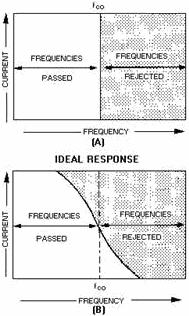
A High-PASS FILTER passes high frequencies and attenuates low frequencies.

A Bandpass FILTER will permit a certain band of frequencies to be passed.
1-49

A Band-REJECT FILTER will reject a certain band of frequencies and pass all others.

A Safety PRECaution concerning series resonance: Very high reactive voltage can appear across L and C. Care must be taken against possible shock hazard.
1-50
Answers to Questions Q1. Through Q21.
A-1.
a. XL varies directly with frequency.
XL = 2πfL
b. XC varies inversely with frequency.

c. Frequency has no affect on resistance.
A-2. Resultant reactance.
A-3.

A-4. Decreases.
A-5. Impedance low Current high.
A-6. Nonresonant (circuit is either above or below resonance).
A-7. Inductor magnetic field.
A-8. Capacitor.
A-9. Natural frequency or resonant frequency (fr).
A-10. Maximum impedance, minimum current.
A-11. At the resonant frequency.
A-12.

A-13. Bandwidth of the circuit.
A-14. a filter.
1-51
A-15.
a. Low-pass.
b. High-pass
c. Bandpass.
d. Band-reject.
A-16. High-pass filter, low-frequency discriminator, or low-frequency attenuator.
A-17. Low-pass filter, high-frequency discriminator or high-frequency attenuator.
A-18. At low-frequency, a capacitor acts as an open and an inductor acts as a short. At high-frequency, a capacitor acts as a short and an inductor acts as an open.
A-19. Frequency cutoff (fco).
A-20. Bandpass.
A-21. Band-reject.
1-52

Copyright: 1996 - 2026 |
About RF Cafe RF Cafe began life in 1996 as "RF Tools" in an AOL screen name web space totaling 2 MB. Its primary purpose was to provide me with ready access to commonly needed formulas and reference material while performing my work as an RF system and circuit design engineer. The World Wide Web (Internet) was largely an unknown entity at the time and bandwidth was a scarce commodity. Dial-up modems blazed along at 14.4 kbps while tying up your telephone line, and a lady's voice announced "You've Got Mail" when a new message arrived... |
Copyright 1996 - 2026 All trademarks, copyrights, patents, and other rights of ownership to images
and text used on the RF Cafe website are hereby acknowledge My Hobby Website: My Daughter's Website: |
