|
|||||||||||||
 |
|||||||||||||
Cascaded 2-Tone, 2nd-Order Intercept Point (IP2) |
|||||||||||||
|
When two or more tones are present in a nonlinear device, intermodulation products are created as a result. A power series describes all of the possible combinations of generated frequencies. 2nd-order products lie far in frequency to the two input tones and are therefore not very likely to fall inband at the output in a narrow band system. As a device is driven farther into its nonlinear region, the amplitudes of the 2nd-order products increase while the powers of the input tones decrease. If the device was not limited in output power, then the powers of the intermodulation products would increase in power until they were eventually equal in power with the input tones at the output.
Graph of P1dB, IP2, IP3, and Saturation See cascade calculations for NF, IP2, IP3, and P1dB.
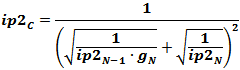
The power of the 2nd-order products can be predicted when the IP2 is known, or the IP2 can be predicted when the relative amplitudes of the 2nd-order tones and the input tones are known. P2nd-order products = 2 · Pinput tones@output - IP2 {dBm} IP2 =2 · Pinput tones@output - P2nd-order products {dBm} Cascading IP2 Values in a Chain of Components Calculating the cascaded values for 2nd-order intercept point (IP2) for the system budget requires use of ratios for gain and power levels for IP2 (do not use dB and dBm values, respectively). The standard format for indicating decibel values is to use upper case letters; i.e., IP2 for units of dBm. The standard format for indicating power values is to use lower case letters; i.e., ip2 for units of mW. Conversions: ip2 = 10IP2/10 ↔ IP2 = 10 * log10 (ip2) where ip2 has units of mW and IP2 has units of dBm
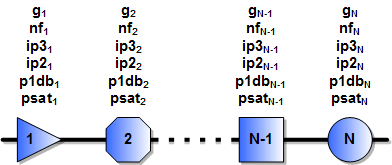
A Typical Chain of Cascaded Components
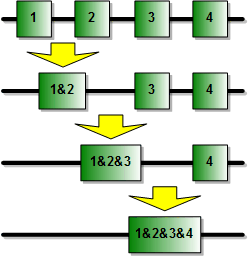
Combining 2 Stages at a Time for Calculations This equation gives the method for calculating cascaded output ip2 (oip2) values based on the oip2 and gain of each stage. When using the formula in a software program or in a spreadsheet, it is more convenient and efficient to calculate each successive cascaded stage with the one preceding it using the following format, per the drawing (above-right). Note that the ip2N-1 term in the denominator is the same as the cumulative ip2 up through the previous (N-1) stage.
These formulas are used to convert back and forth between input- and output-referenced IP2 values: IP2Output = (IP2Input + Gain) {dBm} IP2Input = (IP2Output - Gain) {dBm} |
|||||||||||||
 |
|||||||||||||
|
|||||||||||||




|
||||||||||||||||||||||||||||||||||||