|
|||||||||||||||||||||||||||||||||||
 |
|||||||||||||||||||||||||||||||||||
Electronic Warfare and Radar Systems Engineering Handbook |
|||||||||||||||||||||||||||||||||||
|
MIXERS AND FREQUENCY DISCRIMINATORS Mixers are used to convert a signal from one frequency to another. This is done by combining the original RF signal with a local oscillator (LO) signal in a non-linear device such as a Schottky-barrier diode. The output spectrum includes:
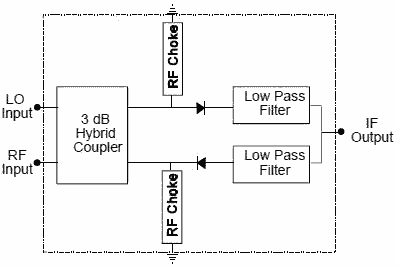
The desired output frequency, commonly called the intermediate frequency (IF), can be either the lower (LO-RF) or upper (LO+RF) sideband. When a mixer is used as a down converter, the lower sideband is the sideband of interest. A microwave balanced mixer makes use of the 3 dB hybrid to divide and recombine the RF and LO inputs to two mixing diodes. The 3 dB hybrid can be either the 90° or 180° type. Each has certain advantages which will be covered later. The critical requirement is that the LO and RF signals be distributed uniformly (balanced) to each mixer diode. Figure 1 is a typical balanced mixer block diagram. The mixer diodes are reversed relative to each other; the desired frequency (IF) components of each diode are then in-phase while the DC outputs are positive and negative respectively. The two diode outputs are summed in a tee where the DC terms cancel and only the desired IF component exists at the IF port.
Figure 1. Mixer Block Diagram Other types of mixers exist, including the double-balanced mixer, and the Ortho-Quad® (quadrature fed dual) mixer. The relative advantages and disadvantages of each of the four types are summarized in Table 1. Table 1. Mixer Comparison
NOTES: (1) Poor = 2.5:1 typical ; Good = 1.3:1 typical (2) Conversion loss: lowest: 5-7 dB typical; Low
7-9 dB typical (3) Poor: 10 dB typical ; Good: 20 dB typical ; Very Good: 25-30 dB typical ; Excellent: 35-40 dB typical (4) Poor: partial
rejection of LO/RF even harmonics Fair: slightly better Good: can reject all LO even
harmonics Very Good: can reject all LO and RF even harmonics Used in various circuits, mixers can act as modulators, phase detectors, and frequency discriminators. The phase discriminators can serve as a signal processing network for systems designed to monitor bearing, polarization, and frequency of AM or FM radiated signals.
When the two output signals are fed to the horizontal and vertical input of an oscilloscope, the resultant display angle will be a direct function of frequency.
Table of Contents for Electronics Warfare and Radar Engineering Handbook Introduction | Abbreviations | Decibel | Duty Cycle | Doppler Shift | Radar Horizon / Line of Sight | Propagation Time / Resolution | Modulation | Transforms / Wavelets | Antenna Introduction / Basics | Polarization | Radiation Patterns | Frequency / Phase Effects of Antennas | Antenna Near Field | Radiation Hazards | Power Density | One-Way Radar Equation / RF Propagation | Two-Way Radar Equation (Monostatic) | Alternate Two-Way Radar Equation | Two-Way Radar Equation (Bistatic) | Jamming to Signal (J/S) Ratio - Constant Power [Saturated] Jamming | Support Jamming | Radar Cross Section (RCS) | Emission Control (EMCON) | RF Atmospheric Absorption / Ducting | Receiver Sensitivity / Noise | Receiver Types and Characteristics | General Radar Display Types | IFF - Identification - Friend or Foe | Receiver Tests | Signal Sorting Methods and Direction Finding | Voltage Standing Wave Ratio (VSWR) / Reflection Coefficient / Return Loss / Mismatch Loss | Microwave Coaxial Connectors | Power Dividers/Combiner and Directional Couplers | Attenuators / Filters / DC Blocks | Terminations / Dummy Loads | Circulators and Diplexers | Mixers and Frequency Discriminators | Detectors | Microwave Measurements | Microwave Waveguides and Coaxial Cable | Electro-Optics | Laser Safety | Mach Number and Airspeed vs. Altitude Mach Number | EMP/ Aircraft Dimensions | Data Busses | RS-232 Interface | RS-422 Balanced Voltage Interface | RS-485 Interface | IEEE-488 Interface Bus (HP-IB/GP-IB) | MIL-STD-1553 & 1773 Data Bus | This HTML version may be printed but not reproduced on websites. [miscellany/homepage-archive/2026/vendors/components/z-frequency-conversion-common.htm] |
|||||||||||||||||||||||||||||||||||
 |
|||||||||||||||||||||||||||||||||||
|
|||||||||||||||||||||||||||||||||||
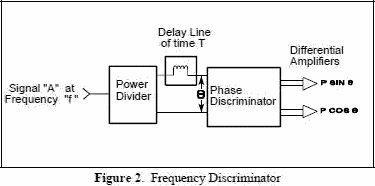 A frequency discriminator
uses a phase discriminator and adds a power divider and delay line at the RF input as shown in Figure 2. The unknown RF signal "A" is divided
between a reference and delay path. The differential delay (T) creates a phase difference (θ) between the two signals which is a linear function
of frequency (f) and is given by θ = 2
A frequency discriminator
uses a phase discriminator and adds a power divider and delay line at the RF input as shown in Figure 2. The unknown RF signal "A" is divided
between a reference and delay path. The differential delay (T) creates a phase difference (θ) between the two signals which is a linear function
of frequency (f) and is given by θ = 2
|
||||||||||||||||||||||||||||||||||||