|
|
|||||||||
| Software: RF Cascade Workbook | RF Symbols for Office | RF Symbols & Stencils for Visio | Espresso Workbook | ||||||||||
|
|||||||||||||||||||||||||||||||
   |
  |
||||||||||||||||||||||||||||||
|
Please Support RF Cafe by purchasing my ridiculously low-priced products, all of which I created. RF & Electronics Symbols for Visio RF & Electronics Symbols for Office RF & Electronics Stencils for Visio T-Shirts, Mugs, Cups, Ball Caps, Mouse Pads These Are Available for Free |
|||||||||||||||||||||||||||||||



News Briefs
December 1959 Radio-Electronics

|
December 1959 Radio-Electronics  [Table of Contents] [Table of Contents]
Wax nostalgic about and learn from the history of early electronics. See articles from Radio-Electronics, published 1930-1988. All copyrights hereby acknowledged. |
The electronics and communications worlds were on fast-forward in 1959 when this "News Briefs" column was published in Radio-Electronics magazine. Space exploration featured Explorer VII's launch to study radiation belts with advanced instrumentation. A pioneering "Stratovision" project planned airborne educational TV broadcasts across six Midwestern states using DC-7 aircraft. Communications developments included the world's most powerful naval transmitter in Maine for submarine communication and Bell Labs' experiments with passive satellite balloons for intercontinental microwave transmission. The Supreme Court ruled on FM multiplex usage, potentially paving the way for stereo broadcasting. Other notable items covered Soviet microwave tube development, RCA's anti-static record coating breakthrough, rapid growth of international television, and strong starting salaries for electrical engineering graduates.
News Briefs: 11/57 | 8/58 | 9/59 | 11/59 | 12/59 | 2/60 | 4/60 | 8/60 | 9/60 | 10/60 | 12/60 | 1/61 | 3/61 | 5/61 | 6/61 | 7/61 | 8/61 | 9/61 | 10/61 | 11/61 | 12/61 | 1/62 | 2/62 | 3/62 | 4/62 | 5/62 | 6/62 | 7/62 | 8/62 | 9/62 | 10/62 | 11/62 | 2/63 | 3/63 | 4/63 | 6/63 | 8/63 | 9/63 | 11/63 | 2/64 | 3/64 | 4/64 | 7/64 | 8/64 | 12/64 | 8/64 | 9/64 | 1/66 | 3/66 | 8/66 | 9/66 | 1/67 | 3/67 | 4/67 | 5/67 | 6/67 | 7/67 | 9/67 | 3/68 | 4/68 | 5/68 | 8/68 | 9/68 | 4/69 | 1/69 | 5/69 | 6/69 | 10/69 | 11/69 | 12/69
News Briefs
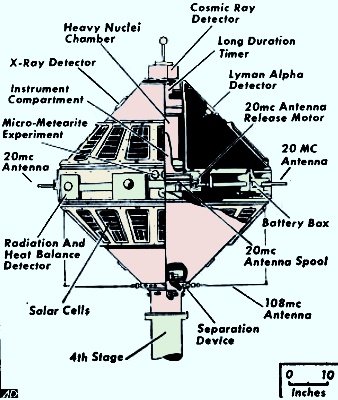 Explorer VII satellite will supply
valuable data on the radiation belts around the earth. It has antennas for 108-
and 20-mc communications, in addition to devices for measuring cosmic rays, micrometeoric
density, sun-produced ultra-violet radiation and the heat balance between the sun
and the earth.
Explorer VII satellite will supply
valuable data on the radiation belts around the earth. It has antennas for 108-
and 20-mc communications, in addition to devices for measuring cosmic rays, micrometeoric
density, sun-produced ultra-violet radiation and the heat balance between the sun
and the earth.
Explorer VII weighs 911/2 pounds and is orbiting between 664 and 346 miles 6 from us, whizzing around earth at 4 miles a second (15,000 mph) . Its larger predecessor, Explorer VI, carried more instrumentation, weighed 142 pounds and orbits up to 25,000 miles away. (Radio-Electronics, October, 1959, page 10.)
Stratovision is planned for late 1960 in six Midwestern states, using an airplane circling Fort Wayne, Ind., to transmit educational TV courses. Flying 5 miles up, a DC-7 will pick up programs from Purdue University, rebroadcasting them on uhf channels to Michigan, Ohio, Indiana and part of Illinois, Wisconsin and Kentucky, a 200-mile radius around Fort Wayne.
The Midwest Council on Airborne Television Instruction has been formed at Purdue, and the Ford Foundation has promised over $4,000,000 initially. General Dynamics Corp. will provide two DC-7's. The technical adviser to the Council is C. E. Nobles, who originated the idea in the early 1940's. (Radio-Electronics described this proposed system in considerable detail in October, 1945.)
Westinghouse, at the time Nobles' employer, ran tests with a B -29 which covered 225 miles, compared with the usual 50 -mile range of that day. The project will serve about 13,000 schools, and up to 5,000,000 students.
World-Wide Radio Net shared live symphonic music originating in Moscow, Geneva and New York with 20 countries on UN day, Oct. 24. UN radio in New York fed the program to Canada, Mexico and South America, contacting Europe via the Atlantic telephone cable. Listeners in New York report music from Geneva sounded better than many programs fed from other cities here over regular network lines. The program was flat to 8 kc, according to UN radio operations manager Joseph Nichols. Next year it's hoped to do the exchange program in stereo.
World's Biggest Transmitter will go into action at a Navy base in Maine near the end of 1961. Beaming signals to submerged Polaris submarines, it will operate at 30 kc or lower because long waves penetrate salt water better than do high frequencies. Four conventional 500-kilowatt push-pull rf amplifiers will be used, allowing any one to be shut down for maintenance while 1,500,000 watts keep pounding out.
Two separate antenna arrays, each with one tower almost 1,000 feet high, and 12 more reaching above 800 feet, will spread over 2 square miles of ground. Either antenna can be turned off while 60-cycle de-icing power is applied to melt ice up to 3 inches thick.
The transmitter will also be useful in detecting hostile missiles as they leave launching sites overseas.
The most powerful known station at present is also a Navy installation, at Jim Creek, Ore., rated at 350,0Ò0 watts. The USSR is believed to have a station called Goliath whose output is comparable. It was taken from the Germans after WWII.
FM Multiplex need not be used for storecasting background music, the Supreme Court ruled recently, backing up the Court of Appeals, which voided an FCC order putting background music onto multiplex from previous simplex. In simplex operation everybody gets the same program with subscribers to the storecast service getting the commercials silenced by an ultrasonically triggered tone. This could be a positive step toward FM- multiplexed stereo, allowing broadcasters to eat their cake (stereo) while keeping it (storecast).
Electronics Magazine - The Braille Technical Press, is now available on records for the blind ham, hi -fi enthusiast and electronics technician. It is published monthly on 162/3-rpm ("Talking Book" speed) discs. Each issue has 2 hours of technical information. Yearly subscription is $10 from the Braille Technical Press, Inc., 984 Waring Ave., New York 69, N. Y. This price is for the purchase, not rental, of the records.
The magazine has been used as a textbook in many schools and libraries and has been the electronics Bible for Braille readers all over the world. The new "Talking Book" edition makes it available to all interested, regardless of their ability to read Braille.
Passive Satellites - 100-foot balloons with aluminized surface - will be orbited about 1,000 miles up as relay stations for microwave communications and intercontinental TV transmission in tests by Bell Labs. Facilities are being built at Holmdel, N. J., and Goldstone, Calif., for experiments next year.
Transmitters using 85-foot parabolic dishes will beam 10-kw signals at the satellites at about 1,000 mc. It is hoped reflection from a satellite will give a usable signal receivable with a parabola 2,300 miles away. The signal will he funneled into a maser amplifier, in this case a ruby crystal bathed in liquid helium. Bell engineers expect extremely low noise figures with this maser and a special horn collector used with the receiving dish - signal-to-noise ratios up to a hundred times better than presently obtainable. In this sort of work, much interference often comes from the heat of the earth.
Where the new transoceanic cables carry up to 160 phone conversations at a time, a single microwave channel of this kind would carry 900 phone circuits, or a full-width TV channel.
About 20 satellites would provide communication across the US 95% of the time. This many would be required because such light, large, passive satellites would drift, failing to stay in the regular orbits of heavy, small, active satellites presently orbiting, or the doughnut-shaped satellite envisioned by others (see What's New, page 54). However, as many microwave channels as desired could be focused on one satellite at one time, providing a virtual infinity of communications lines.
Shorter-Tube Trend continues with a new type of 23-inch picture tube which has a 114° deflection angle (uses standard 110° yoke and coils) and is minus the twin-panel bonded-on safety glass which present 23- inchers carry. The 23-114 will thus be shorter than present tubes, and also somewhat cheaper, at least for the set maker. G-E has indicated it'll use the new 23; Zenith and Westinghouse are also said to be interested in this new design. Already using 23-inch picture tubes in current production are Admiral, Hoffman, RCA, Westinghouse, Sylvania and others.
Meanwhile, two new low-power picture tubes with - hold your hat -160° and 170° deflection were said to have been demonstrated, using 110° components. If the 170° tube were to work out practically with 170° neck components, it would be only about 5 inches deep!
Russian Microwave development is seen threatening to catch up with that of the US, according to D. W. Atchley, Microwave Associates, Inc., who recently returned from a visit with the head of microwave research of the Institute of Radio Engineering and Electronics, Moscow. Dr. Zarem Chernov showed Mr. Atchley a traveling-wave tube which promises amplification of millimeter waves. In this "most unusual" tube, the electron beam interacts with a sheath of charged gas particles instead of with a wire helix. Another important tube he saw is called the Spiratron. This traveling-wave tube is a lightweight, efficient, broad-band amplifier which Mr. Atchley felt could be used in a communications satellite.
Radio Pocket is predicted for men's clothes by a prominent Chicago appliance dealer. Based on his store's sales of transistor radios during the last World Series, Sol Polk of Polk Brothers believes even women's clothes may have special little pockets designed for tiny personal radios.
Sputnik Signal allocations are being discussed at the current Geneva meeting of the International Telecommunications Union (ITU). The United States has asked that seven bands be set aside for space communications. The Russians are expected to oppose this request, saying that frequencies for space communication are available in bands now allocated to fixed and mobile aeronautical services.
Meanwhile, leading astronomers who had earlier expressed concern over the anticipated US request for only one frequency allocation for the new science of radio astronomy were praising the proposal finally made by the American delegation to the ITU. This new position includes a request that 17 bands be set aside for probing interstellar space with huge radio telescopes. Frequencies are requested from 2.5 all the way up to 30,000 mc.
The ITU, meeting for several months once every 10 years, has over 5,000 proposals to deal with.
1,000-Foot Radar astronomy dish in Puerto Rico will be a fixed aluminum-mesh basin sending pulses on 400 mc to explore the solar system and help develop defenses against ballistic missiles. Because it can pick up objects only a cubic yard in size at distances of 20,000 miles or more, the huge antenna will be useful in mapping the moon and sun.
Anti-Static devices for keeping dust off discs, or for cleaning them may soon be a thing of the past. RCA-Victor is putting a new "magic ingredient" 317-X, in their stereo discs, producing a staticless record with "Miracle Surface." It really works, costs no more and, RCA says, it'll last permanently.
Unconfirmed but persistent talk is that RCA will license or perhaps even give the secret process to the rest of the record industry. Congratulations to RCA-Victor for solving a longstanding problem!
Electrical Engineers graduating from Lehigh University this year get an average starting salary of $515 a month, exceeded only by beginning engineering physicists, who are averaging $525. Interest is increasing on the part of industry in young EE's as shown in the number of interviews conducted on the Lehigh campus. This year there were 618 interviews for the 40 graduates; last year's 44 had only 317.
Graduate chemical engineers started at an average of $460. The average for all students graduating was up 4% from the previous year, but the EE's were up 6; and the physics graduates got 12% more to start than in 1958.
Foreign TV is growing fast, much the way TV in this country did a few years ago. Over 1,000 transmitting stations and more than 30 million sets are in use outside this country, compared with 554 stations and over 50 million receivers in the US.
In the past 12 months, overseas sets jumped almost half; stations increased by over 60 %. Biggest increases were in Italy, West Germany, Japan, Russia and France, but England and Canada still led the other countries in total sets and stations.

Copyright: 1996 - 2026 |
About RF Cafe RF Cafe began life in 1996 as "RF Tools" in an AOL screen name web space totaling 2 MB. Its primary purpose was to provide me with ready access to commonly needed formulas and reference material while performing my work as an RF system and circuit design engineer. The World Wide Web (Internet) was largely an unknown entity at the time and bandwidth was a scarce commodity. Dial-up modems blazed along at 14.4 kbps while tying up your telephone line, and a lady's voice announced "You've Got Mail" when a new message arrived... |
Copyright 1996 - 2026 All trademarks, copyrights, patents, and other rights of ownership to images
and text used on the RF Cafe website are hereby acknowledge My Hobby Website: My Daughter's Website: |
