Search RFC: |                                     
Please support my efforts by ADVERTISING!
About | Sitemap | Homepage Archive
Serving a Pleasant Blend of Yesterday, Today, and Tomorrow™
Vintage Magazines
Electronics World
Popular Electronics
Radio & TV News
QST | Pop Science
Popular Mechanics
Radio-Craft
Radio-Electronics
Short Wave Craft
Electronics | OFA
Saturday Eve Post
Alliance Test | Isotec
Please Support My Advertisers!
RF Cafe Sponsors
Aegis Power | Centric RF | RFCT
Empwr RF | Reactel | SF Circuits

Formulas & Data

Electronics | RF
Mathematics
Mechanics | Physics


Calvin & Phineas

kmblatt83@aol.com

Resources

Articles, Forums, Radar
Magazines, Museum
Radio Service Data
Software, Videos


Artificial Intelligence

Entertainment

Crosswords, Humor Cogitations, Podcast
Quotes, Quizzes

Parts & Services

1000s of Listings

        Software:

Please Donate
RF Cascade Workbook | RF Symbols for Office
RF Symbols for Visio | RF Stencils for Visio
Espresso Engineering Workbook
Werbel Microwave power dividers, couplers - RF Cafe
Electricity - Basic Navy Training Courses
NAVPERS 10622

Here is the "Electricity - Basic Navy Training Courses" (NAVPERS 10622) in its entirety. It should provide one of the Internet's best resources for people seeking a basic electricity course - complete with examples worked out. See copyright. See Table of Contents.   • U.S. Government Printing Office; 1945 - 618779

Chapter 4 QUIZ

the ELECTRICAL CIRCUIT


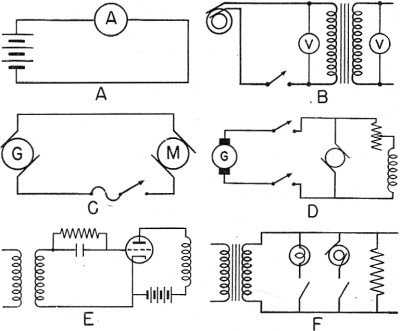
1. Identify each symbol in the circuit diagram below. Refer to the table in figure 15 for your answers.

Chapter 4 quiz - Q1

2. Why are dirty or loose connections classified as "opens"?

3. In making any type of connection, what is the most important thing to remember?

4. Why are fuses made of metals which melt at a low temperature?
5. What are some common causes of short circuits?
6. Why are no intentional grounds used on regular Navy ships?

Chapter 4 ANSWERS

the ELECTRICAL CIRCUIT


1. Refer to the table in figure 15.
2. Because they reduce current flow.
3. do not increase the circuit resistance by a dirty or loose connection.
4. So that the fuse will melt and open the circuit before other parts of the circuit overheat.
5. Salt water, heat, wear, and vibration.

6. Because of the danger of a hot wire being grounded to the hull. This would produce a
    short circuit.


Return to Chapter 4

Werbel Microwave power dividers, couplers - RF Cafe