|
|||||||||||||
 |
|||||||||||||
Anatech Electronics May 2026 Newsletter |
|||||||||||||

Press Release Archives: Content is copyright of company represented. Page format, custom text and images are RF Cafe copyright - do not distribute. Note: Posting of press releases costs $100 each for non-advertisers.
Sam Benzacar, of Anatech Electronics, an RF and microwave filter company, has published his May 2026 Newsletter that, along with timely news items, features his short op-ed titled "The Math of LEO No Longer Adds Up." Sam runs the numbers on Low-Earth-Orbit satellites, and assesses future plans. "SpaceX now operates more than 10,000 Starlink satellites, roughly two-thirds of everything in orbit. The next-largest operator, OneWeb, has fewer than 700." They roam the nighttime sky, with small dots of light tracking across our already light-polluted skies. The ITU coordination process now confronts filings for more than a million LEO spacecraft, with half a million projected to be in orbit by 2040. Now that Internet coverage and even Direct-to-Device (D2D) networks are in the deployment stages, the next big thing is orbiting data centers - which may reduce the massive terra firma installations that consume huge amounts of natural landscape, energy, water, and quietness. At some point the amount of space debris available for collisions (look up the Kessler syndrome) and the consequential de-orbiting and burning up in the atmosphere may someday create a new astronomy term: "shooting starlink" (my phrase). A Word from Sam Benzacar - The Math of LEO No Longer Adds Up
The ITU coordination process was built for a manageable number of operators negotiating over geostationary slots. It is now confronting filings for more than a million LEO spacecraft, with the projected 2040 population approaching half a million. The shift from GEO to LEO is the structural cause. A geostationary spacecraft at 35,786 km covers roughly a third of the Earth from a single platform, which is why operators stayed with the orbit for five decades. A LEO satellite at 500 km sees only a few hundred kilometers of useful footprint before geometry and link budget pushes the user out of the beam, so continuous global coverage requires thousands of spacecraft, with low latency as the offsetting benefit. SpaceX now operates more than 10,000 Starlink satellites, roughly two-thirds of everything in orbit. The next-largest operator, OneWeb, has fewer than 700. The filing volume is the most striking number. Between 2017 and 2022, national regulators submitted ITU notifications covering more than a million satellites across 300-plus constellation systems, with Rwanda alone filing for 337,320. In January, SpaceX filed for roughly a million orbital data-center spacecraft intended to host AI workloads in orbit, and Blue Origin followed with a 50,000-satellite data-center notification. The cumulative effect is a projected satellite population that exceeds the historical total by two orders of magnitude, in a coordination regime that was never built for it.
Counter-space activity has compounded the debris problem: Russia's 2021 Kosmos-1408 ASAT test produced more than 1,500 trackable fragments, and China's 2007 Fengyun-1C test produced more than 3,000 tracked pieces and an estimated 150,000 smaller fragments at 865 km that will persist for decades. Atmospheric drag eventually scrubs smaller fragments from 500 km orbits within five to eight years, but debris at higher altitudes is effectively permanent. History suggests that filed numbers overstate eventual deployments by a wide margin. Even so, the trajectory points toward a crowded LEO and a coordination problem that has outgrown the institutional machinery designed to handle it.
The FCC has expanded its ban on foreign-manufactured consumer-grade network routers to include portable Wi-Fi hotspot devices and cellular-based home routers. This essentially solves an apparent oversight in the original prohibition. It now specifies that "consumer-grade portable or mobile MiFi Wi-Fi or hotspot devices for residential use" and "LTE/5G consumer premises equipment devices for residential use" are subject to the ban. The expansion captures both the portable hotspots that provide internet access on the go and the home routers that rely on a cellular connection instead of a wired landline. Mobile phones with hotspot functionality remain outside the scope of the ban, as do industrial, enterprise, and military equipment, at least for the moment. The FCC has cited national security as the rationale.
Amazon has agreed to pay more than $11.5 billion for Globalstar, a deal that adds roughly two dozen satellites to Amazon Leo (formerly Project Kuiper) and aims to acquire the mobile satellite services operator's spectrum and direct-to-device technology. The 24 operational Globalstar satellites do little to close the gap with SpaceX's Starlink, which has roughly 10,000 satellites in orbit. Amazon Leo had 241 satellites aloft as of earlier this month. The strategic value of the acquisition lies in Globalstar's exclusive license to Band 53, a midband block running from 2483.5 to 2495 MHz that the company describes as optimized for high-performance, low-latency, interference-free connectivity. That spectrum is well-suited for direct-to-device communication, extending service beyond cell-tower coverage wherever a compatible satellite is overhead.
The 11th Airborne Division has completed its Operation Arctic Tech in Alaska, integrating unmanned aircraft systems, counter-UAS tools, and electronic warfare into reconnaissance missions under Arctic conditions. After an air assault phase supported by UH-60 Black Hawk helicopters, teams advanced on snowshoes through terrain that placed a premium on early detection and stand-off observation, combining visual surveillance, real-time video, and electromagnetic spectrum analysis to identify concealed targets through their emissions. Embedding UAS operators and EW specialists at the team level consolidates sensing, analysis, and action within a single small unit. The exercise reflects intensifying competition in the Arctic, where Russia maintains forward bases, long-range radars, and S-400 air defense systems, and China is expanding its presence through scientific and economic initiatives along polar routes.
The University of Oulu's 6G Flagship received the Joint Best Demo Paper Award at the IEEE 6th International Symposium on Joint Communications & Sensing for an integrated sensing and communication (ISAC) system operating in the D-band (110-170 GHz). The demonstration combined data transmission with radio tomography imaging over a single continuous sub-THz link, performing environmental sensing without the active electrical or mechanical scanning typically required at these frequencies. The work reflects growing research interest in the joint use of D-band and sub-THz spectrum for high-rate 6G communication and high-resolution sensing. Anatech Electronics Introduces a New Line of Suspended Stripline and Waveguide Type RF Filters
Check out Our Filter Products
Cavity Band Pass Filters LC Band Pass Filters Cavity Bandstop/Notch Filter About Anatech Electronics Anatech Electronics, Inc. (AEI) specializes in the design and manufacture of standard and custom RF and microwave filters and other passive components and subsystems employed in commercial, industrial, and aerospace and applications. Products are available from an operating frequency range of 10 kHz to 30 GHz and include cavity, ceramic, crystal, LC, and surface acoustic wave (SAW), as well as power combiners/dividers, duplexers and diplexers, directional couplers, terminations, attenuators, circulators, EMI filters, and lightning arrestors. The company's custom products and capabilities are available at www.anatechelectronics.com. Contact: Anatech Electronics, Inc. |
|||||||||||||
 |
|||||||||||||
|
|||||||||||||

 By Sam Benzacar
 Spectrum, debris, and atmospheric chemistry
are all under pressure. Active LEO broadband satellites consume Ku-, Ka-, and increasingly
V-band downlink resources alongside feeder allocations that must coexist with terrestrial
fixed-service and radio-astronomy users, and out-of-band emissions are already compromising
observations across portions of the 10.7 to 12.7 GHz band.
Spectrum, debris, and atmospheric chemistry
are all under pressure. Active LEO broadband satellites consume Ku-, Ka-, and increasingly
V-band downlink resources alongside feeder allocations that must coexist with terrestrial
fixed-service and radio-astronomy users, and out-of-band emissions are already compromising
observations across portions of the 10.7 to 12.7 GHz band.  Router Ban Finds a Wireless
Loophole
Router Ban Finds a Wireless
Loophole  Amazon Buys Globalstar for
$11.5 Billion
Amazon Buys Globalstar for
$11.5 Billion  Army Pushes EW and UAS in
Alaska
Army Pushes EW and UAS in
Alaska 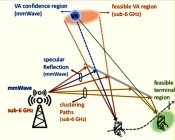 Sub-THz Link Handles Data
and Imaging
Sub-THz Link Handles Data
and Imaging 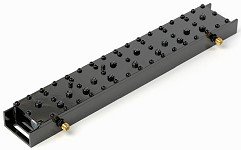




|
||||||||||||||||||||||||||||||||||||