|
|||||||||||||
 |
|||||||||||||
Engineering the Sky:
|
|||||||||||||
|
1 | 2 | 3 | 4 | 5 | 6 | 7 | 8 | 9 | 10 | 11 | 12 | 13 | 14 | 15 | 16 | 17 | 18 | 19 | 20 | 21 | 22 | 23 | 24 | 25 | 26 | 27 | 28 | 29 | 30 | 31 | 32 | 33 | 34 | 35 | 36 | 37
IntroductionFor decades, the engineering community has viewed space as the ultimate frontier (Captain Kirk declared it: ultimate = final) - a clean, vacuum-sealed environment that offered a solution to the terrestrial limitations of bandwidth, range, and latency. Nations and industries have long championed the democratization of global communications, seeing Direct-to-Device (D2D) connectivity as the next logical step in our technological evolution. But as we move from the era of rare satellite backhaul to the age of the "mega-constellation," the engineering paradigm has shifted. We are no longer just looking at the sky; we are beginning to occupy it with such density that we risk creating a perpetual "noise floor" for the rest of humanity. This article examines the thermodynamics, the mechanics of orbital mesh nodes, and the sheer volume of material required to shift our compute infrastructure into the heavens for, among other applications, datacenters, cryptocurrency mining, artificial intelligence (AI) computing, high-frequency trading (HFT) arbitrage, and entertainment (videos). It is a necessary look past the marketing gloss to confront the hard physics: the launch debt, the spectral congestion, and the geopolitical fallout of turning the night sky into industrialized, high-speed real estate. Summing up the motivation: If you are not on their network, you are not participating in the economy, and you become "invisible" to the massive arbitrage and predictive algorithms that run the modern world. This is not a market responding to demand; this is a market creating a technical dependency - a captive user base that must pay the "orbital tax" to exist within the modern global digital environment. Thesis Outline
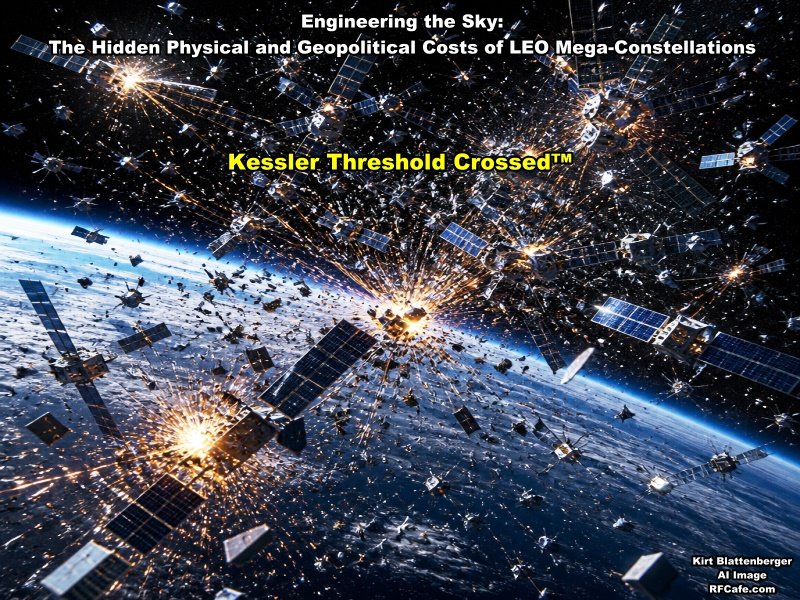
Part I: The Terrestrial Burden – Why the Modern Compute Model Is BreakingTo understand why capital is aggressively pouring into space-based infrastructure, one must first understand the catastrophic limitations of terrestrial data storage and processing. For the last two decades, the "Cloud" has been erroneously marketed as an ethereal, weightless space. In physical reality, the cloud is a collection of massive, power-hungry, and land-intensive factories. These facilities have reached an inflection point where they can no longer expand without triggering local social, political, and ecological resistance. The first limiting factor is power density. A modern hyperscale data center can consume between 100 to 500 megawatts of electricity - enough to power a medium-sized city. As these facilities congregate in industrial hubs like Northern Virginia or Northern Europe, they put an unbearable strain on electrical grids. This leads to tiered service, where data companies are forced to lobby for priority access to renewable energy or, increasingly, to build their own dedicated fossil-fuel or modular nuclear plants. This creates a "resource island" effect, where the presence of a data center degrades the quality of life and utility reliability for the surrounding local population. Second is the water requirement. Semiconductors release massive amounts of waste heat as they perform calculations. Cooling systems, specifically evaporative cooling towers, require millions of gallons of water per day. In drought-prone regions of the United States, such as the American Southwest, the optics of massive data centers consuming municipal water supplies to "cool" information has become a potent source of grassroots protest. The "Human Factor" here is clear: communities are no longer willing to sacrifice their local water table for regional latency improvements. The recent news story of a massive data center in Fayette, Georgia, wreaking terror on local residents with noise, dust, and low water pressure exemplifies the problem. Taxpayers are unwillingly funding the destruction of their quality of life. Third is the spatial footprint. A hyperscale data center requires substantial square footage for the servers themselves, but also for security perimeters, external substations, and fiber-optic backhaul infrastructure. In high-value real estate markets, this land is increasingly categorized as "misused." When developers could be building housing, logistics centers, or agricultural hubs, the allocation of hundreds of acres for passive data storage creates an economic opportunity cost that is becoming impossible to ignore. The "Terrestrial Burnout" is not just a trend; it is the fundamental driver behind the space-based thesis. If the Earth is becoming too "expensive" for hyperscale compute, it is only logical that capital seeks a vacuum (figuratively and literally). However, the move to space is not merely a transfer of burden; it is a transformation of the cost structure. Moving a server rack into orbit removes the cost of water-based cooling but introduces the prohibitively high cost of thermal management in a vacuum, where heat cannot be rejected via convection. It trades the cost of real estate for the cost of orbital velocity (the Delta-V requirements). The core question we must resolve is whether the energy efficiency gained by the vacuum of space is eventually negated by the logistical energy required to sustain that infrastructure. As we move on to the following sections, we must evaluate the "physics of the throughput." Is it truly possible to replicate a 500 MW terrestrial facility in orbit? Current launch and manifest capacities suggest no. We are likely looking at a distributed architecture - a "thin" mesh of orbital compute nodes - rather than a direct one-to-one replacement of the terrestrial facility. This fundamental change in topology will have massive implications for latency, the necessity of machine-to-machine autonomy, and the ultimate environmental load on the near-Earth atmosphere. Part II: The Orbital Physics of ComputeIn the terrestrial data center, thermodynamics is a problem of convection. We pump cool air or chilled water through rows of racks, transfer the CPU and GPU heat into the medium, and exhaust it into the atmosphere. The upper limit of this system is defined by local energy prices and ambient temperature. If the local grid is strained, or if local water supplies fluctuate under drought conditions, the data center faces a bottleneck. Moving this compute burden to Low-Earth-Orbit (LEO) changes the fundamental thermodynamic equation. A server in the vacuum of space operates under two extremes. First, it is exposed to incident solar radiation that can push surface temperatures well above 120°C in direct light. Second, when the satellite passes into the Earth's shadow, it faces the extreme cold of deep space, dropping significantly below -100°C. Maintaining a constant operating temperature for sensitive silicon requires massive, heavy heat-sink radiators that must be oriented relative to the sun to avoid overheating. The "energy efficiency" of space is therefore a fallacy based on the assumption that solar energy is "free." While solar flux in orbit is consistent and not blocked by clouds, the conversion efficiency of current photovoltaic technology is limited - typically 30% to 40% for the high-end multi-junction cells used in space. To match a 100 MW terrestrial data center, an orbital platform would require square miles of solar arrays. If this power generation is centralized on the satellite platform, the structural mass required to support these arrays becomes the limiting factor for the launch. If power is beamed from the ground, the atmospheric loss and the sheer complexity of laser or microwave energy transmission introduce massive inefficiencies and signal safety concerns. From a financial and physics perspective, the "Launch Debt" is the hidden cost. We are effectively choosing to spend vast quantities of energy fighting gravity to place compute nodes in an environment where we must then spend even more energy shielding them from the harsh environment of space. We are replacing the "grid cost" on Earth with a "launch/maintenance cost" in orbit. If the lifespan of an orbital node is, as currently seen with Starlink, approximately 5 to 7 years, we are effectively committing to a permanent industrial cycle of manufacturing, launching, and de-orbiting thousands of machines just to keep a constant amount of data processing capacity aloft. This is the definition of a high-entropy industrial process, and the math suggests that the carbon and resource footprint is significantly higher than maintaining a static, localized server facility on the ground. One partial solution is to place the heaviest burden of data crunching in higher orbit platforms with significantly higher lifetimes, but cost of deployment multiplies significantly with higher orbits. The reliability and servicing of a widely distributed network of LEO platforms exceeds a network depending on relatively few central processing centers. Part III: The Math of Mega-ConstellationsTo replace the workload of a typical 100-megawatt terrestrial data center, one must first define the bottleneck: throughput or latency. If the objective is raw processing capacity, the "space-based" model fails immediately. You cannot pack the same number of transistors into an orbital node as you can in a stationary terrestrial facility. Therefore, the "orbital data center" model is actually a distributed model. It moves the edge-compute closer to the user to minimize latency, rather than housing the core logic in orbit. A typical mega-constellation requires a precise number of nodes to ensure that at least one, and preferably two, satellites are within the "look angle" of any given user on the ground at all times. This is a geometry problem. To provide continuous, high-speed, 24/7 global coverage, current models suggest a minimum density of 1,500 to 3,000 satellites per shell. However, as link demand increases and the number of users grows, the "data density" required per satellite requires the constellation to grow into the tens of thousands. The math of throughput vs. constellation density follows an inverse law: as you add more users to a "beam" (the satellite's footprint), the available bandwidth per user drops. To maintain constant high-speed data (as promised by current D2D and satellite-internet marketing), you must decrease the beam size by increasing the number of satellites. This "spot-beam density" creates the visual of our night sky as a permanent grid of active transponders. Each satellite must maintain multiple high-speed laser optical cross-links (OISLs) to its neighbors to form a mesh backhaul. For the RF engineer, this represents a significant challenge in cross-talk and coordinate-frequency management. If a constellation operates with half a million spacecraft, the coordination of frequency reuse becomes a statistical nightmare. The ITU (International Telecommunication Union) filing process, which once managed thousands of nodes, now oversees lists containing millions of identifiers. This is not just a filing exercise; it is an act of "spectral hoarding." Companies file for millions of satellites to prevent competitors from acquiring the rights to those orbital bands, even if they have no intention or capacity to launch the full constellation. This raises the question of efficiency: What is the "data cost" per node? Because each satellite is constantly moving at 17,000+ mph relative to the ground, the handoff between nodes - the "soft handover" - must be handled with millisecond precision to avoid packet loss. In a terrestrial server, a packet travels over a fixed copper or fiber path. In an orbital network, the path is dynamic and changing several times per second. The energy consumption of the switching fabric required to maintain these thousands of simultaneous handovers is a tax on every bit of data moved. We are moving toward a reality where the overhead of the network (the "signaling junk") consumes as much power as the data itself. If we apply these constraints to the "Data Center" concept, we see that the orbital infrastructure is less of a "storage and processing" hub and more of a "high-speed routing" skeleton. The storage remains on the ground, but the ability to route that data is becoming physically tied to the sky. This creates a dependency: if your orbital mesh fails, your terrestrial data storage becomes "dark." Part IV: The Human-Machine-Machine NexusThe transition toward space-based compute is driven by an irreversible shift in the global economy known as the Machine-to-Machine (M2M) or "Internet of Things" paradigm. We are moving well beyond the era where the internet was a tool for human interpersonal communication. Today, the vast majority of data traffic is generated by autonomous systems - sensors, vehicles, industrial controllers, and predictive AI models - that require continuous, low-latency connectivity to function. The "human-to-human" (H2H) use case is arguably the least demanding in terms of raw throughput (discounting the angry cellphone user whose full-length, UHD movie stream is not seamless), but the "human-to-machine" (H2M) and "machine-to-machine" (M2M) use cases are the primary engines of the current orbital gold rush. For instance, the deployment of global autonomous fleets - whether they be Tesla, Waymo, or autonomous shipping vessels - requires a constant link-state verification. These machines must sync with remote central logic to navigate in real-time, effectively requiring a "digital tether" that spans the entire globe. Terrestrial 5G or fiber networks cannot provide this link in the middle of the Pacific Ocean or deep in the Siberian tundra. The motivation for this massive processing requirement stems from the drive to remove the "human latency" from critical systems. In the current M2M architecture, the goal is to create a digital twin of global industrial processes. Every motor being monitored, every power grid being balanced, and every logistics chain being optimized relies on a feed of telemetry that must be processed in real-time. This creates an exponential demand for bandwidth: we are not just asking, "what is this machine doing?" but "what will this machine do in the next five milliseconds?" The predictive capacity of artificial intelligence requires massive datasets harvested in real-time from the physical world, leading to a feedback loop where the need for compute power is fueled by the very machines it seeks to coordinate. The danger inherent in this nexus is the loss of local autonomy. As critical infrastructure becomes tethered to orbital mesh networks, the "local" node - the factory, the city power plant, or the local community grid - loses its ability to operate independently. If the connection to the orbital constellation is severed due to solar flares, hardware failure, or geopolitical dispute, the machine network risks cascading failure. We are effectively creating a global "central nervous system" that is highly efficient but lacks the resilience of a decentralized, disconnected system. We are sacrificing the safety of the individual node for the efficiency of the total network. Furthermore, the motivation for "always-on" connectivity is deeply rooted in financial logic. Financial high-frequency trading (HFT) and global capital management demand that latency between major financial centers be reduced to the absolute minimum. Orbital paths - specifically those using laser cross-links - can theoretically transmit light faster through the vacuum of space than through fiber-optic cables buried in the ground (where light is slowed by the refractive index of glass). This tiny fractions-of-a-second advantage represents billions of dollars in arbitrage, powering the massive capital investment behind these mega-constellations. The "Internet of Things" is therefore bankrolled by the "Internet of Finance," meaning the deployment of this technology is not driven by human need, but by the relentless pursuit of speed in global capital markets. Part V: Weaponizing the High Ground - Scorched Sky PotentialThe geopolitical dimension of orbital mega-constellations reveals that space is no longer a "global commons" for scientific exploration; it has become the most contested strategic theater on the planet. By concentrating orbital infrastructure, nations and private entities are essentially engaging in a "land grab" in the sky. If an operator owns the satellites that facilitate global positioning, secure communications for military drone swarms, and the backbone of international retail banking, they effectively hold a veto over the sovereignty of other nations. The ITU (International Telecommunication Union) coordination process, once a neutral forum, has effectively collapsed under the weight of "filing spam." Large conglomerates now file for rights to millions of spectral slots, ensuring that any nascent space program from a developing nation is crowded out by legacy filings. This creates a state of "orbital exclusion," where the barrier to entry is not just the cost of a rocket, but the legal and spectral blockade erected by established incumbents. For nations without the ability to deploy their own mega-constellations, the alternative is to become a "digital vassal" to whichever superpower controls the connectivity in their region. This has unavoidable consequences for security. Because these networks are now dual-use - serving both civilian D2D traffic and high-security military command links - they become primary strategic targets. We are moving toward a reality where an armed conflict on Earth could be kinetically resolved in orbit. The "Kessler risk" is actually exacerbated by the incentive to target constellations. If one nation were to successfully employ anti-satellite (ASAT) technology to blind an adversary's mesh network, they would essentially be detonating a shrapnel cloud that would render that orbital shell unusable for everyone, including themselves. This is the "scorched earth" (or, rather, "scorched sky") of the new century: "If I cannot have the sky, no one will." Part VI: The Financial PanopticonThe financial backing of this infrastructure creates what has been accurately be described as a "financial panopticon." The current orbital model requires massive capital expenditure (CapEx) that can only be recouped through the continuous and exhaustive collection of metadata. Because each satellite in a mega-constellation acts as a node in a global tracking grid, the system is designed to know not just "what" is being communicated, but "where" that communication is occurring with sub-meter precision via signal triangulation. This capability fundamentally alters the relationship between the governing entity and the individual. In the traditional terrestrial model, a user could move off the grid by choosing not to use a cellular tower or fiber line. In the orbital model, the coverage is pervasive and unavoidable. Because the infrastructure is "ubiquitous," the ability to "unplug" is effectively retired. The financial motivation for this is simple: the value of the network lies in the total integration of human activity. If you are not on the network, you are not participating in the economy, and you become "invisible" to the massive arbitrage and predictive algorithms that run the modern world. This has led to a precarious feedback loop. To support the multi-billion dollar valuations of these platforms, data throughput must grow at a rate that exceeds the natural human requirement for communication. Thus, the industry is forcing machine-to-machine (M2M) communication as a necessity. By making autonomous systems dependent on constant orbital synchronization, the companies owning the satellites ensure a permanent, locked-in client base. This is not a market responding to demand; this is a market creating a technical dependency - a captive user base that must pay the "orbital tax" to exist within the modern global digital environment. Part VII: The Human CostThe human cost of this transition is often framed as the "price of progress," yet it represents a fundamental shift in the nature of human autonomy. Historically, humanity has always possessed the ability to exist beyond the reach of centralized systems. Whether it was the ability to traverse the wilderness without a GPS trace or the ability to converse without a digital signature, this "anonymity of presence" has served as a critical pressure valve for human psychology. The advent of universal, satellite-based connectivity effectively closes this valve. When the sky itself becomes a tracking grid, the "right to be forgotten" - or more simply, the right to exist without data generation - vanishes. For the average individual, this manifests as a constant, low-grade erosion of privacy. Every movement, from the cellular "ping" of a phone to the telemetry of a smart vehicle, is potentially aggregated into a global profile. We are moving toward a reality where the "offline" state is treated as a defect or a potential security risk by the algorithms managing the infrastructure. This creates a psychological burden: the requirement to remain "connected" for the sake of professional, financial, and societal credibility. Furthermore, there is the loss of the "nighttime sanctuary." The human psychological development is inextricably linked to the natural cycles of light and dark. By saturating the stratosphere with artificial light-reflecting constellations, we have fundamentally altered the celestial backdrop that has served as the anchor for human culture and mythology for millennia. The psychological impact of losing the "pristine" night sky is profound. It is a form of environmental claustrophobia - an awareness that when we look up, we are not looking into the infinite, but into an industrialized, managed, and artificial ceiling. I live in the southeast corner of Greensboro, North Carolina, outside of the I-85 loop. It is classified as having a Bortle Class 5 level of light pollution. Polaris, the North Star, is barely visible by the naked eye. It is a magnitude 2 star (a Cepheid variable double star, actually). On a clear night, I can barely make out the Milky Way. Even with a 6" reflector telescope, the Orion nebula appears in low contrast, the Andromeda galaxy is a mere blotch, and star clusters appear thinly populated. Unlike back in the 1980s, when spotting a satellite transiting the eyepiece view was a thrill (or curse if taking a time-exposure photograph), nowadays looking anywhere virtually assures a satellite view within minutes of concentrating on a particular location. Finally, the dependency on these systems contributes to the atrophy of human practical skills. As predictive AI and automated routing become the backbone of our logistics and decision-making, the average person loses the ability to navigate, plan, or solve problems without the network (how did we navigate with paper maps?). We are creating a civilization where an outage of the orbital mesh is equivalent to a sudden and total loss of memory for the global organism. This fragility creates a latent, deep-seated anxiety: a collective realization that our modern lives are precariously perched atop a hardware stack that sits miles above our heads, entirely outside of our physical reach or control. Part VIII: The Kessler ThresholdThe "Kessler Threshold" - the point at which the density of objects in LEO makes collisions inevitable - is no longer a theoretical debate; it is a mathematical probability shadow looming over the industry. With current industry projections aiming for hundreds of thousands of satellites, we are intentionally driving the orbital density towards the tipping point. The fundamental issue is that every satellite launched creates a "debris signature" not just during its operation, but through its inevitable end-of-life disposal. The catastrophic risk here is the creation of a "chain reaction." A single collision between two large satellites, or even a collision between a satellite and a dense cluster of existing debris, produces thousands of new, high-velocity fragments. Each fragment then becomes a bullet, capable of striking other satellites and creating more fragments. This exponential growth can render specific, useful orbital shells completely unusable, effectively "caging" the Earth in a sphere of shrapnel. It is worth noting that current de-orbiting strategies, such as "controlled re-entry," rely on the satellite maintaining its propulsion capability at the end of its life. However, if a collision occurs - or if a satellite suffers a major power or guidance failure - it becomes a "zombie" object. These non-maneuverable satellites are the primary precursors to Kessler events. As we populate the skies with these "quick-turnaround" electronic nodes, the sheer volume of "zombie" hardware is statistically destined to rise. We are, in effect, creating a long-term liability for the sake of short-term throughput. If the Kessler Threshold is crossed, the ability to launch anything - not just communications hardware, but scientific instruments, climate monitors, or exploration probes - will be paralyzed for centuries. Part IX: Conclusion and the Path to Orbital StewardshipThe transition to a space-based digital architecture is a fundamental turning point in human history, comparable to the electrification of the globe or the rise of the industrial city. However, unlike the industrialization of the land, the industrialization of orbit is currently proceeding with an alarming lack of ecological constraint or long-term vision. We are trading the finite sovereignty of our skies for the short-term expedience of global, latency-free data. The Worst-Case ScenarioThe "worst case" is not merely a single catastrophic event, but a dual-collapse: the transition of our near-space environment into a hostile "shell of shrapnel" via a Kessler-syndrome event, coupled with the permanent, forced assimilation of the human experience into a global, "always-on" surveillance-heavy data grid. In this reality, the sky is no longer a window to the universe but a dark, automated ceiling that generates a perpetual noise floor for astronomy - in both the visible and the RF spectrums - effectively blinding us to the stars (optical and radio telescopes) while tethering us to a fragile, hyper-centralized network that we have lost the ability to live without. Pathways to MitigationTo avoid this enclosure, the international community must pivot from "orbital expansionism" to "orbital stewardship." This requires moving beyond voluntary guidelines and toward enforceable, high-stakes international law:
Ultimately, we must recognize that "more connectivity" is not a synonymous equivalent to "progress." True progress requires the wisdom to understand that some frontiers are meant to be observed, not occupied or industrialized. We are currently treating the atmosphere as a bottomless resource, failing to recognize that the damage we inflict upon our celestial commons is uniquely irreversible. If we risk the ultimate tragedy: attaining total digital connectivity at the cost of our physical freedom and our vision of the heavens. Part X: Case Study ResultsThe rapid expansion of hyperscale data centers in 2026 presents a significant geopolitical and local infrastructure challenge. Driven by the explosive demand for AI compute cycles and large language model training, these facilities are straining electrical grids, water supplies, and land use regulations. This report examines the tension between the push for digital hegemony and the degradation of local quality of life, noting that while industry proponents cite tax revenue and technological advancement, local communities face tangible externalities, including noise pollution, grid instability, and the displacement of residential growth. Key Findings
Impact on Local Residents Negative impacts primarily manifest as "noise pollution" from industrial-scale HVAC and cooling fans, which often runs 24/7. Land value disputes are common, as the visual blight of windowless bunkers impacts property aesthetics. More critically, residents in states like Texas and Virginia have reported flickering power and higher utility rates as utilities prioritize data center load. Positive Aspects?: Industry proponents argue that data centers serve as backbones for the modern economy, enabling remote work and digital services. They contribute intermittent construction jobs and, occasionally, investments in local fiber-optic infrastructure that may trickle down to residential access. However, most jobs are temporary during the construction phase - often from outside contractors - and permanent staffing is minimal. Tax Breaks and Financial Incentives: States aggressively court data centers through tax abatements (sales tax exemptions on equipment and property tax discounts). These are often justified by the "Multiplier Effect," though academic analysis suggests that because data centers are highly automated, the actual per-job tax benefit is often lower than the public subsidies provided. Geographic Hotspots
Ownership and Control: The landscape is concentrated among major cloud service providers (CSPs). These companies own the infrastructure directly or via massive real estate investment trusts (REITs) like Equinix or Digital Realty. Citizen Action and Intervention: Citizen action has shifted from absolute prevention to "load control." While preventing a data center entirely is rare once zoning is approved, successful grassroots movements in various counties have forced:
Open Questions and Debates 1. AI Efficiency vs. Expansion: There is a heated debate regarding whether "Green AI" optimization will reduce electricity demands per MFLOP, or if the "Jevons Paradox" will simply ensure that efficiency gains lead to even more massive deployments. 2. Sovereignty: Should data centers be classified as utility infrastructure rather than private commercial use, thereby forcing greater public oversight? 3. Grid Resilience: How much weight should be given to data center needs when they conflict with the survival and affordability of the local residential energy grid? |
|||||||||||||
 |
|||||||||||||
|
|||||||||||||
 "
"

|
||||||||||||||||||||||||||||||||||||