|
|
|||||||||
| Software: RF Cascade Workbook | RF Symbols for Office | RF Symbols & Stencils for Visio | Espresso Workbook | ||||||||||
|
|||||||||||||||||||||||||||||||
   |
   |
||||||||||||||||||||||||||||||
|
Please Support RF Cafe by purchasing my ridiculously low-priced products, all of which I created. RF & Electronics Symbols for Visio RF & Electronics Symbols for Office RF & Electronics Stencils for Visio T-Shirts, Mugs, Cups, Ball Caps, Mouse Pads These Are Available for Free |
|||||||||||||||||||||||||||||||



Anatech Electronics August 2024 Newsletter


Press Release Archives:
2026 | 2025 |
2024 |
2023
|
2022 |
2021
Content is copyright of company represented. Page format, custom text and images are RF Cafe copyright - do not distribute. Note: Posting of press releases costs $100 each for non-advertisers.

Sam Benzacar, of Anatech Electronics, an RF and microwave filter company, has published his August 2024 newsletter that, along with timely news items, features his short op-ed titled "Fixed-Wireless Access Is Finally Available, and People Love It." His description perfectly describes the experience I have had with Verizon 5G FWA Internet service since February of this year. My cost is $45/month, with a fixed price guarantee of four years. Download speeds are in the 50-60 Mbps realm, and upload is 6-7 Mbps. That fulfills my needs since I don't watch videos, TV, or use other bandwidth-hogging services. If there have been any outages, I haven't noticed, even when electric service is down during a storm. The asymmetrical data rates Sam mentions have always been a mystery to me - why is that necessary? For a while living in Pennsylvania, I had optical Internet and the download/upload speeds were the same: around 600 Mbps. That was way more than I needed, but providers no longer offer lower bandwidth options at a lower price. The fact is I could live with 10 Mbps since my highest demand need is publishing my RF Cafe and Airplanes and Rockets websites.
A Word from Sam Benzacar - Fixed-Wireless Access Is Finally Available, and People Love It
 By Sam Benzacar
As fiber continues to be rolled throughout the country and cable faces a slow death, another solution, fixed-wireless access (FWA), which relies on 5G, is making significant inroads in bringing broadband to the masses. In fact, FWA accounted for 90% of the broadband additions in 2022, even though it delivers speeds far lower than fiber or cable and is only slightly less expensive. So, why would consumers choose this option?
From my perspective, the adoption of FWA is that it eliminates wiring, whether coax or fiber, both outside and inside the home. Carriers, primarily T-Mobile and Verizon, make installing simple without carriers sending out a technician for every new installation, costing them billions of dollars annually. So, they can offer FWA with monthly costs ranging from $50 to $70. The provider mails a package to the home that includes a router-modem combo and sometimes an external antenna. All that's required is to put this "box" near a window, download an app, and create a Wi-Fi SSID.
 FWA is basically a point-to-point (or multipoint)
microwave by another name. It has been tried several times since the 1990s as a
solution for delivering TV, voice, and data, which ultimately failed for various
reasons. However, the technologies within 5G and its widespread deployment have
finally made it a viable alternative even in rural and underserved communities.
FWA is basically a point-to-point (or multipoint)
microwave by another name. It has been tried several times since the 1990s as a
solution for delivering TV, voice, and data, which ultimately failed for various
reasons. However, the technologies within 5G and its widespread deployment have
finally made it a viable alternative even in rural and underserved communities.
What's the catch? First, speeds are lower than even the least expensive cable plans and an order of magnitude slower than those of fiber. That's fine for most people but not households with "heavy users," who could exceed what the limited bandwidth offers. In some locations, optimum placement of "the box" (with its integrated antenna) might not be possible, which would require an external (and its accompanying cable).
In addition, in its current form, FWA has the same asymmetric service as cable - much higher download than upload speeds. Finally, FWA shares 5G bandwidth with mobile subscribers, so speeds might decrease when traffic on the network is heavy. Nevertheless, according to recent reports, people with FWA are happier with this solution than with what they had before. However, when the wireless industry eventually widely deploys millimeter-wave frequencies, performance should increase dramatically, perhaps rivaling fiber, the high-speed champion.
Deployment of millimeter-wave 5G has been a slow process, but it should eventually be widely available, as mandated in the 5G standards. In short, FWS seems destined to be the go-to choice for broadband delivery, replacing cable and competing only with fiber where it's available.
 Replacement for Patriot
System Coming
Replacement for Patriot
System Coming
The U.S. Army has awarded RTX Corp. a $2.09 billion contract for low-rate initial production of the Lower Tier Air and Missile Defense System (LTAMDS), also known as GhostEye. This next-generation radar will replace the current Patriot system, offering 360-degree coverage and more than double the performance. Key features include gallium nitride components, one primary and two secondary antenna arrays, and the ability to detect and engage multiple threats simultaneously.
 FAA To Rule on Beyond Visual
Line of Sight
FAA To Rule on Beyond Visual
Line of Sight
The Federal Aviation Administration (FAA) has committed to meeting deadlines for rulemaking beyond visual line of sight (BVLOS). BVLOS operations involve flying aircraft or drones beyond the pilot's or operator's visual range, enabling more extensive and sophisticated drone missions. These operations rely on GPS, telemetry, and potentially artificial intelligence for navigation and control. Due to the complexity and potential risks involved, special certifications are typically required to conduct BVLOS flights. The FAA has outlined a timeline for implementing new BVLOS regulations and intends to publish a Notice of Proposed Rulemaking (NPRM) by the end of the year, with a final rule by January 2026.
 Antenna Paves the Way for
OneWeb Satcom Access
Antenna Paves the Way for
OneWeb Satcom Access
Gogo Business Aviation has successfully connected its HDX antenna to the Eutelsat OneWeb LEO satellite network, marking a major step towards the launch of its Gogo Galileo broadband service later this year. The HDX antenna, designed for ground-based testing, will soon undergo flight tests. Two antenna sizes will be offered: the compact HDX for smaller aircraft and the larger FDX for heavier jets. Hughes Network Systems manufactures both antennas in collaboration with Gogo. With power outputs ranging from 110 to 330 watts, these antennas promise to deliver high-speed connectivity to business aviation.
 New System Provides Drone
Detection
New System Provides Drone
Detection
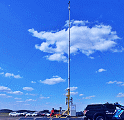
Altitude Angel and NATS Services have launched Arrow, a system that detects and tracks drones and other aircraft in lower-level airspace. This addresses a challenge for traditional radar systems. Arrow was developed to improve safety by monitoring all traffic, authorized or not. Its capabilities were demonstrated at Farnborough Airport, where road-towable sensors provided a comprehensive view of the airspace. Arrow is self-sufficient and uses solar power and a private network. This technology represents a significant step in airspace management, enhancing safety and enabling drone integration in busy areas.
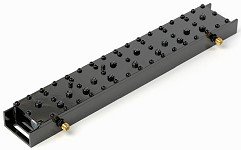
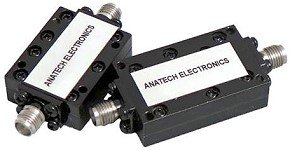
Anatech Electronics Introduces a New Line of Suspended Stripline and Waveguide Type RF Filters
|
LINKS: Waveguide Bandstop & Waveguide Bandpass |
LINKS: Suspended Stripline Highpass & Suspended Stripline Lowpass |
Check out Our Filter Products


Cavity Band Pass Filters LC Band Pass Filters Cavity Bandstop/Notch Filter
About Anatech Electronics
Anatech Electronics, Inc. (AEI) specializes in the design and manufacture of standard and custom RF and microwave filters and other passive components and subsystems employed in commercial, industrial, and aerospace and applications. Products are available from an operating frequency range of 10 kHz to 30 GHz and include cavity, ceramic, crystal, LC, and surface acoustic wave (SAW), as well as power combiners/dividers, duplexers and diplexers, directional couplers, terminations, attenuators, circulators, EMI filters, and lightning arrestors. The company's custom products and capabilities are available at www.anatechelectronics.com.
Contact:
Anatech Electronics, Inc.
70 Outwater Lane
Garfield, NJ 07026
(973)
772-4242
Posted July 31, 2024

Copyright: 1996 - 2026 |
About RF Cafe RF Cafe began life in 1996 as "RF Tools" in an AOL screen name web space totaling 2 MB. Its primary purpose was to provide me with ready access to commonly needed formulas and reference material while performing my work as an RF system and circuit design engineer. The World Wide Web (Internet) was largely an unknown entity at the time and bandwidth was a scarce commodity. Dial-up modems blazed along at 14.4 kbps while tying up your telephone line, and a lady's voice announced "You've Got Mail" when a new message arrived... |
Copyright 1996 - 2026 All trademarks, copyrights, patents, and other rights of ownership to images
and text used on the RF Cafe website are hereby acknowledge My Hobby Website: My Daughter's Website: |
