|
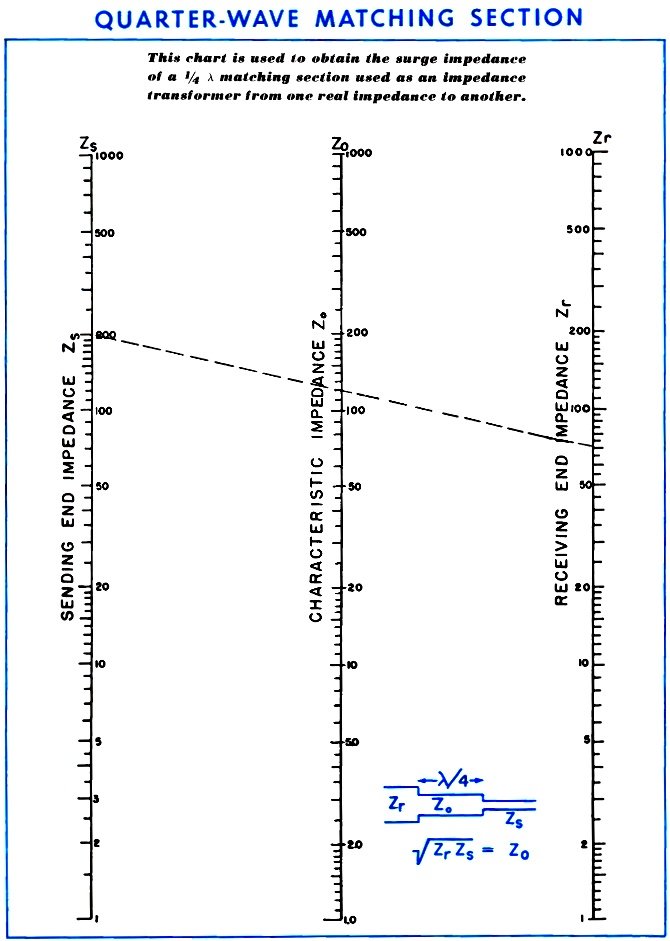
This nomograph from a 1959 issue
of Radio & TV News magazine simplifies matching a source (sending -
s) impedance (Zs) and a load (receiving - r) impedance (Zr)
using a quarter-wave transmission line. To use it, locate your Zs value
on the left vertical scale and your Zr value on the right scale. Lay
a straightedge across these points; the intersection with the center vertical scale
reveals the required surge impedance† - also called characteristic impedance - (Z0).
Surge impedance is the ratio of voltage to current for a wave traveling along an
infinite transmission line, dictated by the physical geometry and dielectric properties
of the cable, defined as Z0 = sqrt (L/C), where L is inductance
per unit length and C is capacitance per unit length. The quarter-wave transformer
relies on the relationship Z0 = sqrt (Zs * Zr).
By using a line with this specific surge impedance cut to one-quarter wavelength,
you achieve perfect impedance matching, effectively eliminating signal reflections
and maximizing power transfer between your source and load systems.
Mac's Service Shop: Customer Cues
This chart is used to obtain the surge impedance of a ¼-wave matching section
used as an impedance transformer from one real impedance to another.
† The term "surge impedance" originates from the study of transient phenomena and
traveling waves on power transmission lines. In electrical engineering, a "surge"
refers to a high-voltage, short-duration transient caused by lightning strikes,
switching operations, or sudden faults on a line. When such a surge wave propagates
down a conductor, it does not see the entire line as a single lumped element of
resistance. Instead, it encounters the line's distributed inductance and capacitance.
The wave behaves as if it is charging the line's capacitance through its inductance
as it travels. The ratio of the voltage of this surge to the resulting current is
constant, determined solely by the geometry of the physical conductors and the insulating
medium. Because this ratio represents the "opposition" the surge wave encounters
as it travels - before the wave reaches the end of the line or "sees" the terminal
load - it was historically termed the "surge impedance." Today, it is more commonly
called characteristic impedance, but the legacy term remains common in
power systems.
|