|
|||||||||||||
 |
|||||||||||||
Talent Hunt Unearths Junior Scientists
|
|||||||||||||
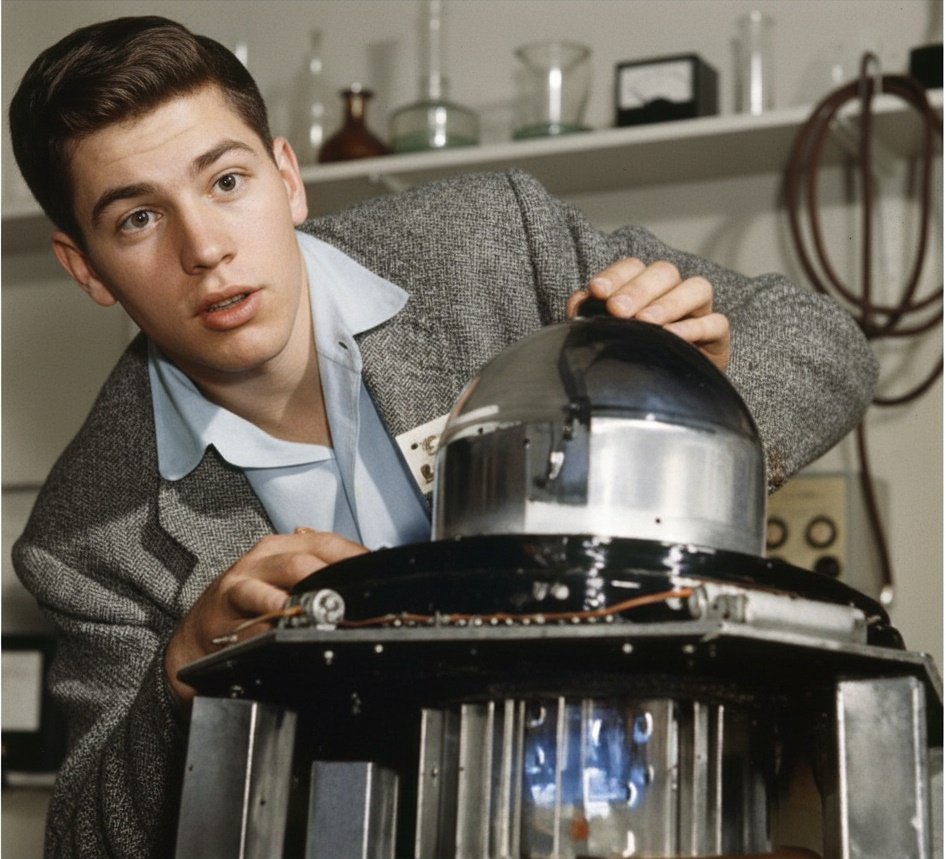
You have been warned not to believe anything you see, hear, or read anymore, because of the ability of AI (artificial intelligence) to alter and/or create just about anything. I offer in support of that thesis the two photos shown below. The top black and white image was scanned from a 1958 issue of Popular Electronics magazine. I fed it exactly as shown to Gemini 2.5 Flash, along with these simple instructions: "Please clean up the 1958 magazine photo to remove noise, sharpen, and colorize it." You see the result. The AI beast not only perfected the picture, but interpreted its content (an amateur cyclotron, per the article) as a science laboratory scenario and added the appropriate background. Yikes! Talent Hunt Unearths Junior Scientists
This is the original black-and white photo scanned from the magazine.
This is what Gemini 2.5 Flash did with it. Amazing, non? It has become increasingly popular these days to weigh the youth of America on the scale of achievement and find it wanting. In many cases, the balance has been upset by glaring headlines and lurid newspaper tales of "juvenile delinquency." But there are other ways to measure the teenager in the United States. Shown at left is a cyclotron and its young builder, Reinier Beeuwkes III, who took the top award in the annual Westinghouse Science Talent Search held for the 17th time this year. He designed and built this cyclotron for accelerating electrons to high speeds. It cost less than $150, and is only as complex "as a radio," he says, but it netted the 17-year-old Newton, Mass., lad a $7500 science scholarship. Reinier's scholarship was one of five such scholarships; the others ranged, from $6000 to $3000. In addition, there were 35 cash awards. In all, a total of almost $35,000 was presented to eight girls and 32 boys who were the winners-chosen from a field of 25,039 entries. Begun in 1942, the science talent search was launched in the belief that the ability of America to maintain its scientific leadership depended upon the discovery and development of scientific ability among high-school youth. It is conducted by the Science Clubs of America through Science Service. The Westinghouse Educational Foundation, supported by Westinghouse Electric Corp., provides the financial backing. The search is open to any high-school senior, who must face a science aptitude exam, submit a 1000-word report on his project, and allow his school to furnish a transcript of his scholarship record. This takes place in December of each year. All data are sifted and the field is reduced to about 600, then 300, and finally to about 40. This group is invited to Washington, D. C., where the boys and girls face a three-man board of judges which makes the final selections. |
|||||||||||||
 |
|||||||||||||
|
|||||||||||||



|
||||||||||||||||||||||||||||||||||||