|
|||||||||||||
 |
|||||||||||||
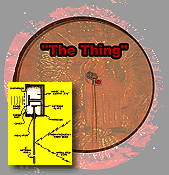
Russian Spy Radio in U.S. Embassy - "The Thing"
|
|||||||||||||
Reveals for the first time the exact design of famed bug that Reds planted in our embassy.
May 26, 1960: In United Nations, U.S. Ambassador Henry Cabot Lodge shows secret listening device the Russians planted in Great Seal they gave our Moscow embassy. EI now discloses haw the clever bug operated. By S. David Pursglove During our long cold war with the Communists we've heard a lot about secret listening devices planted (and discovered) by our side or theirs to eavesdrop on conversation between high government officials. But we seldom are shown any of these little electronic spies, and even less often do we find out how they operate. On May 26, 1960, U. S. Ambassador Henry Cabot Lodge astounded the United Nations by displaying a tiny bug which had been discovered in our embassy in Moscow. It was secreted in the Great Seal hanging over the Ambassador's desk. And the Seal was a gift from the Russians! As the story came out, the bug actually had been unearthed in 1952 but the fact was not revealed for eight years. After the UN incident, the gadget dropped from sight and its operation was never explained. Now, for the first time, EI reveals the device's design and workings. Actually, the Great Seal bug is only one of an army of Red eavesdroppers we've unfrocked. In the last ten years 128 others have turned up in embassies, missions and consulates. We still don't know design details of most of the others, but we hazard the guess that the Great Seal's little pal is the most fiendishly clever of the lot.
N.Y. Times item indicates worry about bugging during President Kennedy's '61 trip to Europe. The bug shown by Lodge consists of a cylinder about as big around as a quarter and measuring 11/16-inch from front to back. A nine-inch rod protrudes from one side and on the front of the cylinder is a perforated cover holding a diaphragm (see diagram). In operation, the device was secreted in a cavity be tween the front and back section of the Great Seal (made of maple). Just below the eagle's beak several tiny holes opened on the bug's diaphragm. Sound waves passed through the holes and struck the diaphragm. The idea of this bug - and all others - is to convert acoustical energy to electrical energy so the information (speech) it contains can be sent by wire or radio waves to a listening post. The Great Seal apparatus used radio waves in a way so diabolically simple as to astound even people sophisticated in electronics. It had no circuit as such and was devoid of any local power supply. Let's look at our captured spy in detail. Its cylinder, made of copper and silver plated, is hollowed out inside to such close tolerances as to create a high-Q (sharply tuned) cavity. Our State Department experts estimate the Q factor to be as high as 1,000. Mounted on the back of the cavity is a tuning post (or electrode) holding a quarter-inch-wide flat plate parallel to the three-mil diaphragm. The tuning post's plate and the diaphragm are capacitively coupled.
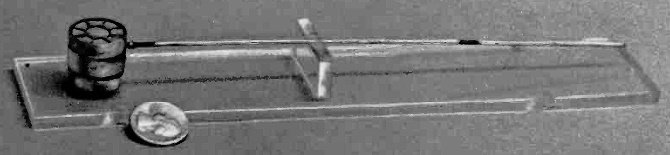
Listening gadget that Reds put in Great Seal lies on plastic stand; quarter is for size comparison.
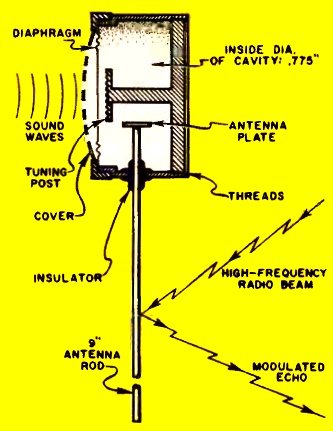
Diagram of bug shows how capacitive changes in cavity alters charge on antenna, which in turn modulates radio beam (see copy for details).
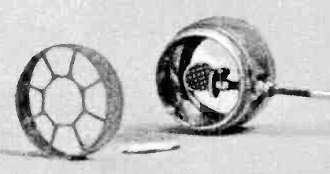
Visible in close-up of cavity are tuning post in center and the antenna plate. The threaded cover holds diaphragm. Quarter lies on table. Next, we find that the nine-inch antenna (a silver-plated copper rod) passes through one wall of the cylinder and terminates in a small plate which it holds near the tuning post. The post and antenna plate, then, also are capacitively coupled. The back cover of the cavity is threaded for precise adjustment of cavity size. In operation, the Russians placed a high-frequency transmitter with directional antenna at some nearby spot. Out of the antenna came a signal at around 1600 megacycles. The antenna must have looked something like a small radar dish and the signal also was radar-like, except not pulsed. The RF beam struck the bug's tiny antenna and a minuscule signal echoed back. As long as the antenna kept the same electrical length the echo remained at a set frequency. Now the fiendish bit developed. Anyone who spoke near the Great Seal generated sound waves which struck the bug's diaphragm, causing it a. to vibrate. This altered the cavity's size ever so slightly and varied the capacitive values described above. The changes in capacitances altered the charge on the antenna rod (radiated to it from the transmitter) and caused its echoed signal to vary accordingly. In effect, the bug modulated a little piece of the beamed signal before sending it back as an echo. The echo was picked up by a receiver and demodulated to reproduce the original speech. State Department security officers say this bug was particularly hard to spot since its power was controlled by the eavesdropper. They liken the device to echo boxes that once were placed in front of radar units to tune them. The entire bug weighs only 1.1 ounces and its cavity has an inductance of 1/100 microhenry. In the years since 1952 our experts have put the Great Seal's little friend to many tests. They say it works well in free space but is extremely sensitive to environment. It must have given its creators fits now and then because its operation is so critical as to go haywire when any small piece of metal (a watch, the nails in shoes, etc.) is brought near. Electronic eavesdropping has become a major headache to our government because the bugs are getting smaller, more efficient and easier to hide. Our foreign buildings are vulnerable because they are put up by local workmen who, if they dislike us, can salt the whole premises with bugs that may take years to find. A bug in the wall, it is said, is worth two in the bush, or almost anyplace else. Meanwhile, one wonders what the Commies have produced as a successor to the Great Seal bug. |
|||||||||||||
 |
|||||||||||||
|
|||||||||||||




|
||||||||||||||||||||||||||||||||||||