Search RFC: |                                  
Please support my efforts by ADVERTISING!
Serving a Pleasant Blend of Yesterday,
Today, and Tomorrow™

Vintage Magazines

Electronics World
Popular Electronics
Radio & TV News
QST | Pop Science
Popular Mechanics
Radio-Craft
Radio-Electronics
Short Wave Craft
Electronics | OFA
Saturday Eve Post
Electronics Illustrated

Formulas | Data

Electronics | RF
Mathematics
Mechanics
Physics


Calvin & Phineas

kmblatt83@aol.com

Archive | Sitemap

Resources

Radar | AI
Cogitations
RF Museum
Videos | Pics |
Things | Logos
Radio Datashts
Tech Notes

Entertainment

Crosswords
Humor | Podcasts
Quotes | Quizzes
Tech Comics

Parts | Services

1000s of Listings


About RF Cafe

Software: RF Cascade Workbook | RF Symbols for Office | RF Symbols & Stencils for Visio | Espresso Workbook
Please Support My Advertisers!
Transcat | Axiom Test Equipment - RF Cafe
Aegis Power | Centric RF | RFCT
Empower RF | Reactel | SF Circuits

Alliance Test | Isotec
KR Electronics (RF Filters) - RF Cafe

Exodus Advanced Communications Best in Class RF Amplifier SSPAs

Innovative Power Products (IPP) Directional Couplers - RF Cafe
Anatech Electronics RF & Microwave Filters - RF Cafe

Maury Microwave / Boonton SGX1000 Signal Generator - RF Cafe

dB Control dB-9006 Magnum Opus Synthesizer - RF Cafe

Please Support RF Cafe by purchasing my ridiculously low-priced products, all of which I created.

RF Cascade Workbook for Excel

RF & Electronics Symbols for Visio

RF & Electronics Symbols for Office

RF & Electronics Stencils for Visio

RF Workbench

T-Shirts, Mugs, Cups, Ball Caps, Mouse Pads

These Are Available for Free

Espresso Engineering Workbook™

Smith Chart™ for Excel

Temwell RF Microwave Components - RF Cafe

Exploding Wire Spacecraft Propulsion
January 1962 Electronics Illustrated

minimum height spacer

January 1962 Electronics Illustrated

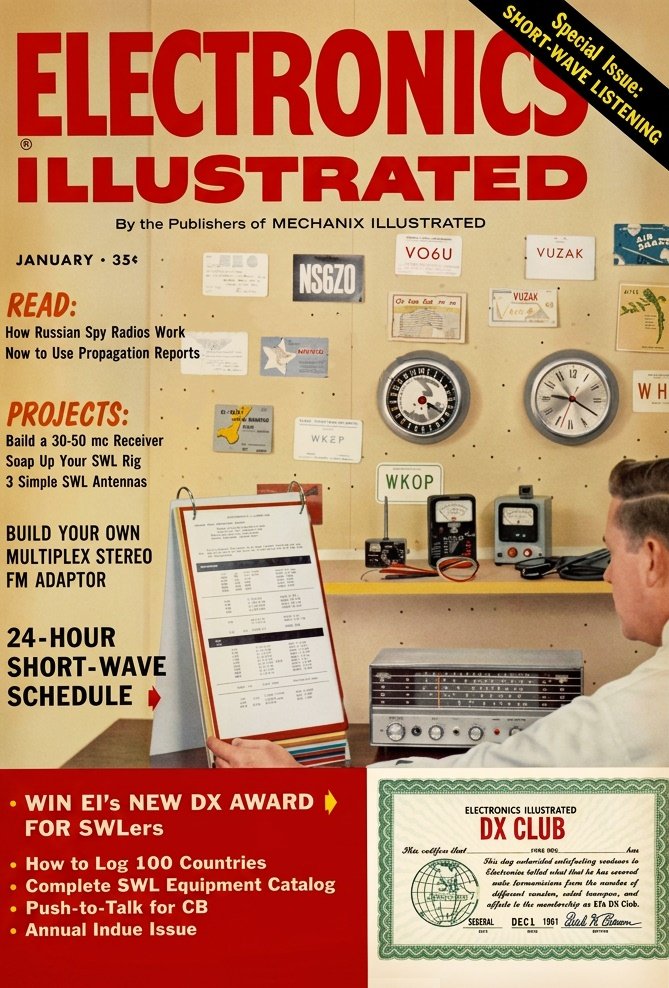
January 1962 Electronics Illustrated Cover - RF CafeTable of Contents

Wax nostalgic about and learn from the history of early electronics. See articles from Electronics Illustrated, published May 1958 - November 1972. All copyrights hereby acknowledged.

The concept of exploding wire propulsion is a fascinating relic of the early Space Age concepts, reflecting an era of high-energy-density experimentation that prioritized power density over long-term system efficiency. While this 1962 Electronics Illustrated magazine report captured a valid physical phenomenon - the rapid plasma expansion of a metallic conductor - the practical implementation for spacecraft encountered insurmountable engineering hurdles relative to the chemical and electrical propulsion benchmarks that followed. When you dump several thousand amperes into a 1-mil wire in nanosecond timescales, you bypass traditional heating and cause a phase explosion where the wire skips the liquid state and transitions into a dense, high-temperature plasma. The resulting megabar pressures are indeed "powerful stuff," but in the context of propulsion, the efficiency is governed by the ability to direct that expansion. The Exploding Wire Phenomenon (E.W.P.) was studied extensively in the 1958-1963 timeframe.

Electronic Brain

Exploding Wire Spacecraft Propulsion, January 1962 Electronics Illustrated - RF Cafe

Here, in series of ultra-highspeed photos, aluminum wire explodes after switching of current.

What happens when you switch several thousand amperes into a 1 mil wire about 1/4-inch long in a time period no longer than a few millimicroseconds? Simple: it explodes - with vaporization energy many times normal, temperatures above 100,000 degrees centigrade and pressures in the megabar range. This is powerful stuff. An Army sponsored study by ElectroOptical Systems, Inc., Pasadena, California, claims that exploding wire impulses could provide a space vehicle with 2 to 10 times the thrust now obtainable by chemical means. The technique, developed as a result of detonator research, may also be used for space communications via light, as well as terrestial searchlight operations. A 0.002 to 0.02 mfd capacitor is charged to 10,000 to 20,000 volts and suddenly discharged into the wire. Current is switched by a hydrogen thyratron and triggered air spark gap.


Why It Did Not Become a Standard

  1. Mass and Duty Cycle Limitations: The primary issue is the logistics of the fuel. Unlike chemical rockets that utilize continuous combustion or ion drives that use propellant gas (xenon/argon), an exploding wire system requires a physical wire for every "pulse." Feeding microscopic wires into an ignition chamber at the high repetition rates required for meaningful delta-v is a mechanical nightmare. The mass of the wire-feed mechanism and the associated high-voltage storage banks quickly offsets the thrust-to-weight advantages.
  2. Electromagnetic Interference and Reliability: Switching 20 kV via hydrogen thyratrons and spark gaps at high frequencies creates extreme electromagnetic noise, which compromises the delicate avionics of a spacecraft. Furthermore, the erosion of the ignition chamber (the "gun" or "barrel") due to repetitive plasma shockwaves necessitates frequent maintenance that current mission profiles do not allow.
  3. CCompetition from Advanced Tech: During the late 1960s and 70s, the development of pulsed plasma thrusters (PPTs) and vacuum arc thrusters (VATs) essentially solved the problem of "solid-state" propellant propulsion without the need for mechanical wire feeds. These systems use solid blocks of Teflon or metal that are ablated by arcs; they are much more reliable than feeding 1-mil wire.

Where the Research Went

The "exploding wire" physics didn’t die; it migrated into other niche fields:

  • Z-Pinch Research: The high-energy physics of exploding wires became the foundation for Z-pinch experiments. Labs like Sandia National Laboratories use massive current pulses to compress plasmas for inertial confinement fusion and X-ray source development.
  • Nanoparticle Synthesis: The destructive vaporization of wires is now a standard, industrial way to produce high-purity metallic nanopowders. Instead of using it for space propulsion, we use the energy to "bottom-up" manufacture materials.
  • High-Speed Imaging/Diagnostics: The technique persists in laboratory settings where researchers need to create repeatable, high-temperature, high-pressure events for studying shockwave interactions.

In short, the Army-sponsored studies hit a wall of mechanical complexity. We learned to achieve the same plasma states without the physical chore of spooling wire. While it remains a brilliant example of the "can-do" electrical engineering spirit of the 1960s, it lacked the scalability required for the vacuum of space.

dB Control dB-9006 Magnum Opus Synthesizer - RF Cafe