|
|||||||||||||
 |
|||||||||||||
Navy Electricity and Electronics Training Series (NEETS)
|
|||||||||||||
|
Chapter 2
Radio WAVE PROPAGATION
Learning Objectives
Upon completion of this unit, you should be able to:
1. State what the electromagnetic field is and what components make up the electromagnetic field.
2. State the difference between the induction field and the radiation field.
3. State what radio waves are.
4. List the components of a radio wave and define the terms cycle, frequency, harmonics, period, wavelength, and velocity as applied to radio wave propagation.
5. Compute the wavelength of radio waves.
6. State how radio waves are polarized, vertically and horizontally.
7. State what reflection, refraction, and diffraction are as applied to radio waves.
8. State what influence the Earth's atmosphere has on radio waves and list the different layers of the Earth's atmosphere.
9. Identify a ground wave, a sky wave, and state the effects of the ionosphere on the sky wave.
10. Identify the structure of the ionosphere.
11. Define density of layer, frequency, angle of incidence, skip distance, and skip zone.
12. Describe propagation paths.
13. Describe fading, multipath fading, and selective fading. Describe propagation paths.
14. State how transmission losses affect radio wave propagation.
15. State how electromagnetic interference, man-made/natural interference, and ionospheric disturbances affect radio wave propagation. State how transmission losses affect radio wave propagation.
16. Identify variations in the ionosphere.
17. Identify the maximum, optimum, and lowest usable frequencies of radio waves.
18. State what temperature inversion is, how frequency predictions are made, and how weather affects frequency.
19. State what tropospheric scatter is and how it affects radio wave propagation.
2-1
ELECTROMagnetic FIELDS
The way energy is propagated into free space is a source of great dispute among people concerned with it. Although many theories have been proposed, the following theory adequately explains the phenomena and has been widely accepted. There are two basic fields associated with every antenna; an INDUCTION FIELD and a Radiation FIELD. The field associated with the energy stored in the antenna is the induction field. This field is said to provide no part in the transmission of electromagnetic energy through free space. However, without the presence of the induction field, there would be no energy radiated.
INDUCTION FIELD
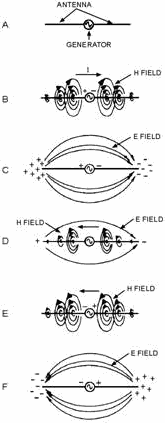
Figure 2-1, a low-frequency generator connected to an antenna, will help you understand how the induction field is produced. Let's follow the generator through one cycle of operation.
Figure 2-1. - Induction field about an antenna.
2-2 Initially, you can consider that the generator output is zero and that no fields exist about the antenna, as shown in view A. Now assume that the generator produces a slight potential and has the instantaneous polarity shown in view B. Because of this slight potential, the antenna capacitance acts as a short, allowing a large flow of current (I) through the antenna in the direction shown. This current flow, in turn, produces a large magnetic field about the antenna. Since the flow of current at each end of the antenna is minimum, the corresponding magnetic fields at each end of the antenna are also minimum. As time passes, charges, which oppose antenna current and produce an electrostatic field (E field), collect at each end of the antenna. Eventually, the antenna capacitance becomes fully charged and stops current flow through the antenna. Under this condition, the electrostatic field is maximum, and the magnetic field (H field) is fully collapsed, as shown in view C.
As the generator potential decreases back to zero, the potential of the antenna begins to discharge. During the discharging process, the electrostatic field collapses and the direction of current flow reverses, as shown in view D. When the current again begins to flow, an associated magnetic field is generated. Eventually, the electrostatic field completely collapses, the generator potential reverses, and current is maximum, as shown in view E. As charges collect at each end of the antenna, an electrostatic field is produced and current flow decreases. This causes the magnetic field to begin collapsing. The collapsing magnetic field produces more current flow, a greater accumulation of charge, and a greater electrostatic field. The antenna gradually reaches the condition shown in view F, where current is zero and the collected charges are maximum.
As the generator potential again decreases toward zero, the antenna begins to discharge and the electrostatic field begins to collapse. When the generator potential reaches zero, discharge current is maximum and the associated magnetic field is maximum. a brief time later, generator potential reverses, and the condition shown in view B recurs.
Note: The electric field (E field) and the electrostatic field (E field) are the same. They will be used interchangeably throughout this text.
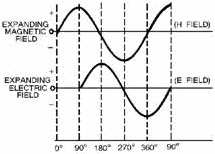
The graph shown in figure 2-2 shows the relationship between the magnetic (H) field and the electric (E) field plotted against time. Note that the two fields are 90 degrees out of phase with each other. If you compare the graph in figure 2-2 with figure 2-1, you will notice that the two fields around the antenna are displaced 90 degrees from each other in space. (The H field exists in a plane perpendicular to the antenna. The E field exists in a plane parallel with the antenna, as shown in figure 2-1.)
Figure 2-2. - Phase relationship of induction field components.
2-3 All the energy supplied to the induction field is returned to the antenna by the collapsing E and H fields. No energy from the induction field is radiated from the antenna. Therefore, the induction field is considered a local field and plays no part in the transmission of electromagnetic energy. The induction field represents only the stored energy in the antenna and is responsible only for the resonant effects that the antenna reflects to the generator.
Radiation FIELDS
The E and H fields that are set up in the transfer of energy through space are known collectively as the radiation field. This radiation field is responsible for electromagnetic radiation from the antenna. The radiation field decreases as the distance from the antenna is increased. Because the decrease is linear, the radiation field reaches great distances from the antenna.
Let's look at a half-wave antenna to illustrate how this radiation actually takes place. Simply stated, a half-wave antenna is one that has an electrical length equal to half the wavelength of the signal being transmitted. Assume, for example, that a transmitter is operating at 30 megahertz. If a half-wave antenna is used with the transmitter, the antenna's electrical length would have to be at least 16 feet long. (The formula used to compute the electrical length of an antenna will be explained in chapter 4.) When power is delivered to the half-wave antenna, both an induction field and a radiation field are set up by the fluctuating energy. At the antenna, the intensities of these fields are proportional to the amount of power delivered to the antenna from a source such as a transmitter. At a short distance from the antenna and beyond, only the radiation field exists. This radiation field is made up of an electric component and a magnetic component at right angles to each other in space and varying together in intensity.
With a high-frequency generator (a transmitter) connected to the antenna, the induction field is produced as described in the previous section. However, the generator potential reverses before the electrostatic field has had time to collapse completely. The reversed generator potential neutralizes the remaining antenna charges, leaving a resultant E field in space.
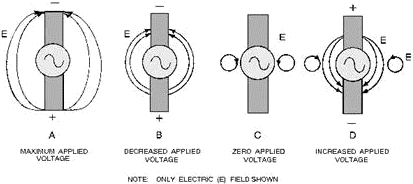
Figure 2-3 is a simple picture of an E field detaching itself from an antenna. (The H field will not be considered, although it is present.) In view a the voltage is maximum and the electric field has maximum intensity. The lines of force begin at the end of the antenna that is positively charged and extend to the end of the antenna that is negatively charged. Note that the outer E lines are stretched away from the inner lines. This is because of the repelling force that takes place between lines of force in the same direction. As the voltage drops (view B), the separated charges come together, and the ends of the lines move toward the center of the antenna. But, since lines of force in the same direction repel each other, the centers of the lines are still being held out.
2-4
Figure 2-3. - Radiation from an antenna.
As the voltage approaches zero (view B), some of the lines collapse back into the antenna. At the same time, the ends of other lines begin to come together to form a complete loop. Notice the direction of these lines of force next to the antenna in view C. At this point the voltage on the antenna is zero. As the charge starts to build up in the opposite direction (view D), electric lines of force again begin at the positive end of the antenna and stretch to the negative end of the antenna. These lines of force, being in the same direction as the sides of the closed loops next to the antenna, repel the closed loops and force them out into space at the speed of light. As these loops travel through space, they generate a magnetic field in phase with them.
Since each successive E field is generated with a polarity that is opposite the preceding E field (that is, the lines of force are opposite), an oscillating electric field is produced along the path of travel. When an electric field oscillates, a magnetic field having an intensity that varies directly with that of the E field is produced. The variations in magnetic field intensity, in turn, produce another E field. Thus, the two varying fields sustain each other, resulting in electromagnetic wave propagation.
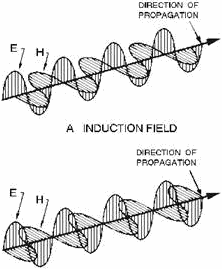
During this radiation process, the E and H fields are in phase in time but physically displaced 90 degrees in space. Thus, the varying magnetic field produces a varying electric field; and the varying electric field, in turn, sustains the varying magnetic field. Each field supports the other, and neither can be propagated by itself. Figure 2-4 shows a comparison between the induction field and the radiation field.
2-5
Figure 2-4. - E and H components of induction and radiation fields.
Q1. Which two composite fields (composed of E and H fields) are associated with every antenna?
Q2. What composite field (composed of E and H fields) is found stored in the antenna?
Q3. What composite field (composed of E and H fields) is propagated into free space?
Radio WAVES
An energy wave generated by a transmitter is called a Radio WAVE. The radio wave radiated into space by the transmitting antenna is a very complex form of energy containing both electric and magnetic fields. Because of this combination of fields, radio waves are also referred to as ELECTROMagnetic Radiation.
This discussion will explain the Earth's atmosphere and its effect on radio waves. All the principles of wave motion that were discussed in chapter 1 also apply to radio waves.
Note: The term radio wave is not limited to communications equipment alone. The term applies to all equipment that generate signals in the form of electromagnetic energy.
COMPONENTS of Radio WAVES
The basic shape of the wave generated by a transmitter is that of a sine wave. The wave radiated out into space, however, may or may not retain the characteristics of the sine wave.
2-6 A sine wave can be one cycle or many cycles. Recall from chapter 1 that the number of cycles of a sine wave that are completed in 1 second is known as the frequency of the sine wave. For example, 60 cycles of ordinary house current occur each second, so house current is said to have a frequency of 60 cycles per second or 60 hertz.
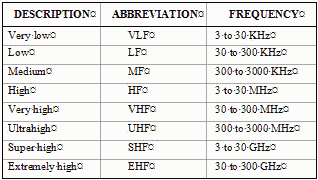
The frequencies falling between 3000 hertz (3 kHz) and 300,000,000,000 hertz (300 GHz) are called Radio FREQUENCIES (abbreviated RF) since they are commonly used in radio communications. This part of the radio frequency spectrum is divided into bands, each band being 10 times higher in frequency than the one immediately below it. This arrangement serves as a convenient way to remember the range of each band. The RF bands are shown in table 2-1. The usable radio-frequency range is roughly 10 kilohertz to 100 gigahertz.
Table 2-1. - Radio Frequency Bands
Any frequency that is a whole number multiple of a smaller basic frequency is known as a Harmonic of that basic frequency. The basic frequency itself is called the first harmonic or, more commonly, the FUNDAMENTAL Frequency. a frequency that is twice as great as the fundamental frequency is called the second harmonic; a frequency three times as great is the third harmonic; and so on. For example:
.................. First harmonic (Fundamental frequency) 3000 kHz Second Second harmonic.................................... 6000 kHz Third Third harmonic.................................... 9000 kHz
The PERIOD of a radio wave is simply the amount of time required for the completion of one full cycle. If a sine wave has a frequency of 2 hertz, each cycle has a duration, or period, of one-half second. If the frequency is 10 hertz, the period of each cycle is one-tenth of a second. Since the frequency of a radio wave is the number of cycles that are completed in one second, you should be able to see that as the frequency of a radio wave increases, its period decreases.
A wavelength is the space occupied by one full cycle of a radio wave at any given instant. Wavelengths are expressed in meters (1 meter is equal to 3.28 feet). You need to have a good understanding of frequency and wavelength to be able to select the proper antenna(s) for use in successful
2-7 communications. The relationship between frequency, wavelength, and antennas will be discussed in chapter 4 of this module.
The velocity (or speed) of a radio wave radiated into free space by a transmitting antenna is equal to the speed of light - 186,000 miles per second or 300,000,000 meters per second. Because of various factors, such as barometric pressure, humidity, molecular content, etc., radio waves travel inside the Earth's atmosphere at a speed slightly less than the speed of light. Normally, in discussions of the velocity of radio waves, the velocity referred to is the speed at which radio waves travel in free space.
The frequency of a radio wave has nothing to do with its velocity. a 5-megahertz wave travels through space at the same velocity as a 10-megahertz wave. However, the velocity of radio waves is an important factor in making wavelength-to-frequency conversions, the subject of our next discussion.
Q4. What is the term used to describe the basic frequency of a radio wave?
Q5. What is the term used to describe a whole number multiple of the basic frequency of a radio wave?
WAVELENGTH-to-Frequency CONVERSIONS
Radio waves are often referred to by their wavelength in meters rather than by frequency. For example, most people have heard commercial radio stations make announcements similar to the following: "Station WXYZ operating on 240 meters..." To tune receiving equipment that is calibrated by frequency to such a station, you must first convert the designated wavelength to its equivalent frequency.
As discussed earlier, a radio wave travels 300,000,000 meters a second (speed of light); therefore, a radio wave of 1 hertz would have traveled a distance (or wavelength) of 300,000,000 meters. Obviously then, if the frequency of the wave is increased to 2 hertz, the wavelength will be cut in half to 150,000,000 meters. This illustrates the principle that the HighER The Frequency, the ShortER The WAVELENGTH.
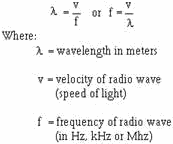
Wavelength-to-frequency conversions of radio waves are really quite simple because wavelength and frequency are reciprocals: Either one divided into the velocity of a radio wave yields the other. Remember, the formula for wavelength is:
The wavelength in meters divided into 300,000,000 yields the frequency of a radio wave in hertz. Likewise, the wavelength divided into 300,000 yields the frequency of a radio wave in kilohertz, and the wavelength divided into 300 yields the frequency in megahertz.
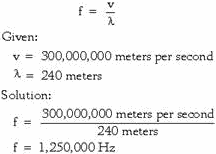
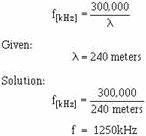
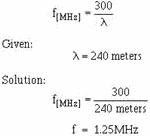
2-8 Now, let us apply the formula to determine the frequency to which the receiving equipment must be tuned to receive station WXYZ operating on 240 meters. Radio wave frequencies are normally expressed in kilohertz or megahertz.
To find the frequency in hertz, use the formula:
To find the frequency in kilohertz, use the formula:
To find the frequency in megahertz, use the formula:
2-9 Q6. It is known that WWV operates on a frequency of 10 megahertz. What is the wavelength of WWV? Q7. a station is known to operate at 60-meters. What is the frequency of the unknown station? POLARIZATION
For maximum absorption of energy from the electromagnetic fields, the receiving antenna must be located in the plane of polarization. This places the conductor of the antenna at right angles to the magnetic lines of force moving through the antenna and parallel to the electric lines, causing maximum induction.
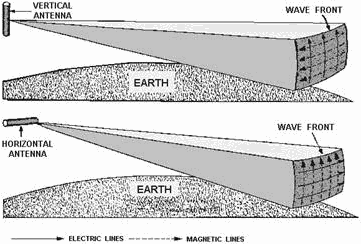
Normally, the plane of polarization of a radio wave is the plane in which the E field propagates with respect to the Earth. If the E field component of the radiated wave travels in a plane perpendicular to the Earth's surface (vertical), the radiation is said to be VERTICALLY POLARIZED, as shown in figure 2-5, view A. If the E field propagates in a plane parallel to the Earth's surface (horizontal), the radiation is said to be HORIZONTALLY POLARIZED, as shown in view B.
Figure 2-5. - Vertical and horizontal polarization.
The position of the antenna in space is important because it affects the polarization of the electromagnetic wave. When the transmitting antenna is close to the ground, vertically polarized waves cause a greater signal strength along the Earth's surface. On the other hand, antennas high above the ground should be horizontally polarized to get the greatest possible signal strength to the Earth's surface. Vertically and horizontally polarized antennas will be discussed in more detail in chapter 4.
The radiated energy from an antenna is in the form of an expanding sphere. Any small section of this sphere is perpendicular to the direction the energy travels and is called a WAVEFRONT. All energy on a wavefront is in phase. Usually all points on the wavefront are at equal distances from the antenna. The farther the wavefront is from the antenna, the less spherical the wave appears. At a considerable distance the wavefront can be considered as a plane surface at a right angle to the direction of propagation.
2-10 |
|||||||||||||
 |
|||||||||||||
|
|||||||||||||

|
||||||||||||||||||||||||||||||||||||