|
|
|||||||||
| Software: RF Cascade Workbook | RF Symbols for Office | RF Symbols & Stencils for Visio | Espresso Workbook | ||||||||||
|
|||||||||||||||||||||||||||||||
  |
  |
||||||||||||||||||||||||||||||
|
Please Support RF Cafe by purchasing my ridiculously low-priced products, all of which I created. RF & Electronics Symbols for Visio RF & Electronics Symbols for Office RF & Electronics Stencils for Visio T-Shirts, Mugs, Cups, Ball Caps, Mouse Pads These Are Available for Free |
|||||||||||||||||||||||||||||||



Anatech Electronics August 2022 Newsletter


Press Release Archives:
2026 | 2025 |
2024 |
2023
|
2022 |
2021
Content is copyright of company represented. Page format, custom text and images are RF Cafe copyright - do not distribute. Note: Posting of press releases costs $100 each for non-advertisers.

Sam Benzacar of Anatech Electronics, an RF and microwave filter company, has published his August 2022 newsletter that features his short op-ed titled "The Millimeter-Wave Debacle Revisited," where he discusses some of the realities that have impacted the mm-wave portion of 5G systems - the two biggest of which are cost and lagging technology (e.g., semiconductors) to support the scheme. Nascent 6G plans which envision spectrum operation in realms above 100 GHz are saddled with the same limitation (at least currently) as 5G. As always, Sam demonstrates a keen awareness of the industry for which his company, Anatech Electronics, services.
A Word from Sam Benzacar
The Millimeter-Wave Debacle Revisited
 By Sam Benzacar
One of the big reveals when the 5G standards were released was that it would expand the frequencies used by wireless carriers well into the millimeter-wave spectrum, a region previously used only by satellite communications, defense systems, point-to-point microwave links, and some scientific applications. As I've noted previously in this column, there are good reasons why few have dared to tread there, not the least of which are extremely challenging propagation characteristics, very short range, and the need to rely on complex technologies to make communications possible. I found it interesting that, except for a few bold journalists, hardly anyone has asked whether, with all these challenges, it will be economically feasible, at least initially, to use these frequencies. But some researchers and financial organizations have begun to ask this question, finally.
For proof of how expensive millimeter-wave deployment will actually be, consider that back in 2019 Google conducted a study for the Defense Innovation Board to determine how many millimeter-wave base stations will be needed. The researchers used 425 MHz of spectrum at 28 GHz and compared it with 250 MHz of spectrum at 3.4 GHz. They deployed millimeter-wave infrastructure on 72,325 macro cell towers and rooftops, and deduced that coverage would be available to just 11.6% of the U.S. population at speeds at 100 Mb/s and 3.9% coverage at 1 Gb/s.
In comparison, at frequencies below 6 GHz, the same tower sites covered 57.4% of the population at 100 Mb/s and 21.2% of the population at 1 Gb/s. Using a database of utility poles in the U.S., they determined that using 28 GHz as the study frequency about 13 million and $400 billion in capital expenditures will be required to deliver 100 Mb's to 72% of the U.S. population and 1 Gb/s to 55% of the population. Even with the deep pockets of wireless carriers, this is an astronomical amount of money.
What's more disturbing is that the U.S. is an outlier as it concerns the use of millimeter-wave frequencies, being almost the only country that is so heavily invested in this region of the spectrum. This being said, the FCC has been feverishly finding ways to squeeze more out of the frequencies below about 7 GHz as it is becoming more clear than ever that relying on very high frequencies as a fundamental element of 5G might be a great idea in the long run, but for the near future it's a Sisyphean challenge.
Infrastructure Market Is Accelerating
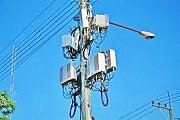 By any yardstick, deployment of 5G wireless
infrastructure is booming. The CTIA reports that the industry spent $30 billion
in networks last year, a 5-year high and the third year of increased capital expenditures.
And in the past five years, wireless carriers have spent nearly $140 billion for
a total investment of more than $600 billion, not including spectrum acquired at
auction. In the last two years, more cell sites have been added than the previous
7 years combined. The research group IDTechEx predicts that by 2031 45 million cells
will have been deployed, primarily for millimeter-wave frequencies.
By any yardstick, deployment of 5G wireless
infrastructure is booming. The CTIA reports that the industry spent $30 billion
in networks last year, a 5-year high and the third year of increased capital expenditures.
And in the past five years, wireless carriers have spent nearly $140 billion for
a total investment of more than $600 billion, not including spectrum acquired at
auction. In the last two years, more cell sites have been added than the previous
7 years combined. The research group IDTechEx predicts that by 2031 45 million cells
will have been deployed, primarily for millimeter-wave frequencies.
Energy Harvesting Tag Start-up Gets Cash
 Wiliot, an IoT startup that has developed
low-cost Bluetooth sensors to manage inventory and reduce waste across grocery,
medicine, apparel and myriad other industries, has raised $200 million from SoftBank
Vision Fund 2. The company's battery-free sensor is the size of a postage stamp
and attaches to food packaging, vaccine vials, clothes, pill bottles, and thousands
of other products. The tags harvest power from Wi-Fi, cellular, and Bluetooth signals
and the stickers can sense temperature, fill level, motion, location changes, humidity
and proximity in real-time. Data is fed into a private Wiliot cloud server for analysis.
Wiliot, an IoT startup that has developed
low-cost Bluetooth sensors to manage inventory and reduce waste across grocery,
medicine, apparel and myriad other industries, has raised $200 million from SoftBank
Vision Fund 2. The company's battery-free sensor is the size of a postage stamp
and attaches to food packaging, vaccine vials, clothes, pill bottles, and thousands
of other products. The tags harvest power from Wi-Fi, cellular, and Bluetooth signals
and the stickers can sense temperature, fill level, motion, location changes, humidity
and proximity in real-time. Data is fed into a private Wiliot cloud server for analysis.
Part of Arlington, VA Is Getting "Smart"
 AT&T and JBG Smith, a developer of upscale,
mixed-use properties in the Washington, DC market, plan to create the first 5G smart
city at scale in National Landing1 in Arlington, VA, with first network infrastructure
deployments planned for the first half of next year. JBG Smith's National Landing
portfolio spans 6.8 million square feet of existing office space, 2,856 residential
units, and 7.2 million square feet of commercial, multi-family and retail development.
The company is also the development partner for Amazon's second headquarters and
master developer for Virginia Tech's forthcoming $1 billion Innovation Campus.
AT&T and JBG Smith, a developer of upscale,
mixed-use properties in the Washington, DC market, plan to create the first 5G smart
city at scale in National Landing1 in Arlington, VA, with first network infrastructure
deployments planned for the first half of next year. JBG Smith's National Landing
portfolio spans 6.8 million square feet of existing office space, 2,856 residential
units, and 7.2 million square feet of commercial, multi-family and retail development.
The company is also the development partner for Amazon's second headquarters and
master developer for Virginia Tech's forthcoming $1 billion Innovation Campus.
Vertical (X-Axis) Location Technology
 Vertical (Z-axis) location technology from NextNav
is coming to the nation's FirstNet nationwide public safety broadband networks soon,
according to the company. The solution is one of very few that have solved this
long-standing gap in positioning required so first responders can accelerate their
responses. Currently, cell site triangulation for 911 callers using mobile phones
from multi-story buildings is extremely difficult because the Z-axis accuracy is
wholly inadequate. Wireless carriers have agreed with the FCC to implement Z-axis
solutions from companies like NextNav and Polaris Wireless by April of next year.
Vertical (Z-axis) location technology from NextNav
is coming to the nation's FirstNet nationwide public safety broadband networks soon,
according to the company. The solution is one of very few that have solved this
long-standing gap in positioning required so first responders can accelerate their
responses. Currently, cell site triangulation for 911 callers using mobile phones
from multi-story buildings is extremely difficult because the Z-axis accuracy is
wholly inadequate. Wireless carriers have agreed with the FCC to implement Z-axis
solutions from companies like NextNav and Polaris Wireless by April of next year.
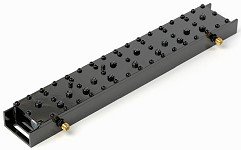
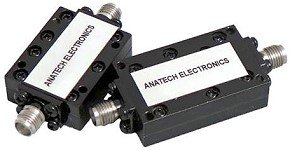
Anatech Electronics Introduces a New Line of Suspended Stripline and Waveguide Type RF Filters
|
LINKS: Waveguide Bandstop & Waveguide Bandpass |
LINKS: Suspended Stripline Highpass & Suspended Stripline Lowpass |
Check out Our Filter Products


Cavity Band Pass Filters LC Band Pass Filters Cavity Bandstop/Notch Filter
About Anatech Electronics
Anatech Electronics, Inc. (AEI) specializes in the design and manufacture of standard and custom RF and microwave filters and other passive components and subsystems employed in commercial, industrial, and aerospace and applications. Products are available from an operating frequency range of 10 kHz to 30 GHz and include cavity, ceramic, crystal, LC, and surface acoustic wave (SAW), as well as power combiners/dividers, duplexers and diplexers, directional couplers, terminations, attenuators, circulators, EMI filters, and lightning arrestors. The company's custom products and capabilities are available at www.anatechelectronics.com.
Contact:
Anatech Electronics, Inc.
70 Outwater Lane
Garfield, NJ 07026
(973) 772-4242
Posted August 18, 2022

Copyright: 1996 - 2026 |
About RF Cafe RF Cafe began life in 1996 as "RF Tools" in an AOL screen name web space totaling 2 MB. Its primary purpose was to provide me with ready access to commonly needed formulas and reference material while performing my work as an RF system and circuit design engineer. The World Wide Web (Internet) was largely an unknown entity at the time and bandwidth was a scarce commodity. Dial-up modems blazed along at 14.4 kbps while tying up your telephone line, and a lady's voice announced "You've Got Mail" when a new message arrived... |
Copyright 1996 - 2026 All trademarks, copyrights, patents, and other rights of ownership to images
and text used on the RF Cafe website are hereby acknowledge My Hobby Website: My Daughter's Website: |
