|
|
|||||||||
| Software: RF Cascade Workbook | RF Symbols for Office | RF Symbols & Stencils for Visio | Espresso Workbook | ||||||||||
|
|||||||||||||||||||||||||||||||
   |
  |
||||||||||||||||||||||||||||||
|
Please Support RF Cafe by purchasing my ridiculously low-priced products, all of which I created. RF & Electronics Symbols for Visio RF & Electronics Symbols for Office RF & Electronics Stencils for Visio T-Shirts, Mugs, Cups, Ball Caps, Mouse Pads These Are Available for Free |
|||||||||||||||||||||||||||||||



Anatech Electronics December 2021 Newsletter


Press Release Archives:
2026 | 2025 |
2024 |
2023
|
2022 |
2021
Content is copyright of company represented. Page format, custom text and images are RF Cafe copyright - do not distribute. Note: Posting of press releases costs $100 each for non-advertisers.

Sam Benzacar of Anatech Electronics, an RF and microwave filter company, has published his December 2021 newsletter that features his short op-ed titled "My Prediction for 2022," where he prognosticates in some specificity that the major problems with millimeter technology will be solved for 5G, the defense market will grow for RF and microwave manufacturers, the gap in the digital divide will further close and the commercial satellite market will provide significant revenue to the industry. An admission to getting one last year's major predictions wrong is also included.
A Word from Sam Benzacar
My Prediction for 2022
 By Sam Benzacar
At this time every year, I make my best attempt to predict what the coming year will bring for the RF and microwave industry. A sad commentary on last year's prediction is that while 2020 was a year like "no other in memory," 2021 would be different. Now, 12 months later, it turns out I was wrong as the pandemic continues its destructive path across the world. Being an optimist, I'm going to make the same prediction for 2022 in the hope that in the coming year, the scourge will be gone or at least diminished. So here are my technology and market predictions for 2022.
The Major Problems with Millimeter Technology Will Be Solved for 5G
As everyone reading this column obviously knows, propagation conditions that millimeter-wave frequencies are problematic at best, and some naysayers last year predicted it would be "dead." The reason, they say, is that the astronomical cost of deploying small cells everywhere would be financially catastrophic for wireless carriers and other providers. I beg to differ. An innovative approach promises to dramatically reduce the number of small cells through the use of repeaters, AI, cloud-based processing resources, and mesh-based topology.
Simply stated, a central hub with access to optical fiber connects to a wireless base station operating at one of the allocated millimeter-wave frequencies. The base station sends its signal to repeaters that combine higher RF output power than small cells that can send narrow beams to multiple destinations that can be reconfigured on the fly to address changing traffic conditions using phased-array antennas and intelligent algorithms (and the cloud).
This way, every residence or business acts as a node in the mesh network, passing the signal on to others, effectively eliminating at least half of the small cells needed to serve the geographical area. Thanks to beamforming, AI and cloud-based processing, the network can also serve mobile users, the most challenging operational scenario of all. A year ago, there were few companies with the technology to deliver such a solution, but the list is growing.
The Gap in the Digital Divide will Further Close
As the pandemic illustrated, everyone needs access to the Internet, and people in rural and even urban areas either cannot afford broadband or have no access to it., There is no excuse for this in a nation with massive resources and it has been a problem for far too long. The President's infrastructure plan should help solve this problem, but the most dramatic results will be delivered by millimeter-wave systems like the ones described above. In addition, AT&T's FirstNet is also a contributor because it has a mandate to deploy a first responder network throughout the country. This has required the company to provide infrastructure in places Internet providers ignored before. In addition, Starlink and other satellite communications constellations will continue to expand, eliminate their early technical problems, and reduce costs to the user.
The Defense Market Will Grow for RF and Microwave Manufacturers
The Department of Defense has always been a major force driving our industry and the rivalry between America, China, and Russia is accelerating the need for RF, microwave, and millimeter-wave components and systems. I believe this marks a long-term trend for manufacturers of nearly all types of components and subsystems for radar, EW, SIGINT, and other applications.
The Commercial Satellite Market Will Provide Significant Revenue to the Industry
The commercial satellite industry is booming, from spacecraft the size of a tissue box to larger ones, primarily operating in low Earth orbit, and they all require significant RF and microwave content. This industry didn't even exist five years ago, but over the next decade, it will provide big benefits for many manufacturers. So, that's my take on some key markets I believe will play a huge role in the fortunes of RF and microwave manufacturers in 2022.
We Can Always Find a Solution!
Anatech Electronics has been providing standard and custom RF and microwave filters and other filter-based components to solve interference problems for utilities, oil and gas companies, and organization with similar requirements for more than 30 years, and we can solve yours as well. So, reach out to us with your most challenging problems at (973) 442-7272 or visit our website at anatechelectronics.com.
 FCC Reaps a Bonanza from Latest Spectrum Auction
The FCC's Auction 110 for licenses between 3.45 and 3.55 GHz resulted in bidders winning 4,041 of the 4,060 available blocks and gross proceeds over $21.8 billion, among the highest-grossing auctions in FCC history. Auction 110 makes available 100 MHz of mid-band spectrum for commercial use across the contiguous United States. License winners will operate within a cooperative sharing framework that will enable commercial use by an array of service providers while also ensuring coexistence with federal incumbents where and when they require continued access to the band.
Radar May Help Keep Kids Safe in Hot Cars
 Radar is the latest technology being considered for determining when the temperature
in a parked car rises enough to cause harm. The FCC has given approval for automakers
to install them to detect the presence of a child in a vehicle and alert their operators
before dangerous levels have been reached. The upcoming Genesis GV70 SUV will be
the first vehicle to use them for rear seat occupants, and the company claims they
are much more sophisticated than ultrasonic sensors and sensitive enough to detect
a baby's breathing.
Radar is the latest technology being considered for determining when the temperature
in a parked car rises enough to cause harm. The FCC has given approval for automakers
to install them to detect the presence of a child in a vehicle and alert their operators
before dangerous levels have been reached. The upcoming Genesis GV70 SUV will be
the first vehicle to use them for rear seat occupants, and the company claims they
are much more sophisticated than ultrasonic sensors and sensitive enough to detect
a baby's breathing.
Interference to Vehicle Collision-Avoidance Radars
 The High Traffic Safety Administration and others have found that vehicle radars
can interfere with each other, cause among other things, false positives. HTSA conducted
a "radar congestion study" to model and simulate radar interference to determine
how much power a given radar can receive from others and how this affects the performance
of a collision warning system. The results of the study show that levels of interference
in the 76-81 GHz band when operated in congested environments can be significant
because the other radars can exceed the received signal strength required for optimum
performance by several orders of magnitude.
The High Traffic Safety Administration and others have found that vehicle radars
can interfere with each other, cause among other things, false positives. HTSA conducted
a "radar congestion study" to model and simulate radar interference to determine
how much power a given radar can receive from others and how this affects the performance
of a collision warning system. The results of the study show that levels of interference
in the 76-81 GHz band when operated in congested environments can be significant
because the other radars can exceed the received signal strength required for optimum
performance by several orders of magnitude.
Diabetic Woman Claims Ham's Transmitter Causes Insulin Pump to Fail
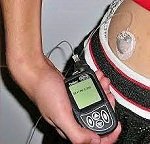 Michelle Smith, a Type 1 Diabetic in the Orlando area, has been fighting for
more than a year with her community association because she believes that her neighbor's
amateur radio transmitter is interfering with her insulin pump. She switched pumps
to no avail. The association hired a consultant who noted that the transmitter's
emissions "could have" exceeded levels the insulin pump could handle, and the neighbor
was told to shut down his station. The ham noted, however, that the station has
been sitting unplugged in his office. At the moment, the situation remains contentious,
and the community's board of directors changed the wording in its rules from defining
antennas from "a device used to receive" to one that could also "transmit."
Michelle Smith, a Type 1 Diabetic in the Orlando area, has been fighting for
more than a year with her community association because she believes that her neighbor's
amateur radio transmitter is interfering with her insulin pump. She switched pumps
to no avail. The association hired a consultant who noted that the transmitter's
emissions "could have" exceeded levels the insulin pump could handle, and the neighbor
was told to shut down his station. The ham noted, however, that the station has
been sitting unplugged in his office. At the moment, the situation remains contentious,
and the community's board of directors changed the wording in its rules from defining
antennas from "a device used to receive" to one that could also "transmit."
Getting Ready for 5G:
Anatech Electronics introduce New Ka band 30.5 GHz Waveguide Band Pass Filter. Featuring a center frequency of 30.5 GHz, a bandwidth of 1000 MHz, an Insertion Loss 1 dB Max, and a Power Handling is 20 watts.

Anatech Electronics Introduces a New Line of Suspended Stripline and Waveguide Type RF Filters
|
LINKS: Waveguide Bandstop & Waveguide Bandpass |
LINKS: Suspended Stripline Highpass & Suspended Stripline Lowpass |


Check out Our Filter Products
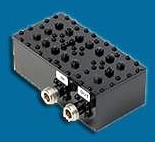
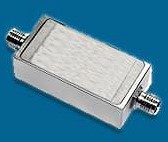
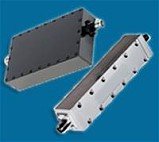
Cavity Band Pass Filters LC Band Pass Filters Cavity Bandstop/Notch Filter
About Anatech Electronics
Anatech Electronics, Inc. (AEI) specializes in the design and manufacture of standard and custom RF and microwave filters and other passive components and subsystems employed in commercial, industrial, and aerospace and applications. Products are available from an operating frequency range of 10 kHz to 30 GHz and include cavity, ceramic, crystal, LC, and surface acoustic wave (SAW), as well as power combiners/dividers, duplexers and diplexers, directional couplers, terminations, attenuators, circulators, EMI filters, and lightning arrestors. The company's custom products and capabilities are available at www.anatechelectronics.com.
Contact:
Anatech Electronics, Inc.
70 Outwater Lane
Garfield, NJ 07026
(973) 772-4242
Posted September 29, 2021

Copyright: 1996 - 2026 |
About RF Cafe RF Cafe began life in 1996 as "RF Tools" in an AOL screen name web space totaling 2 MB. Its primary purpose was to provide me with ready access to commonly needed formulas and reference material while performing my work as an RF system and circuit design engineer. The World Wide Web (Internet) was largely an unknown entity at the time and bandwidth was a scarce commodity. Dial-up modems blazed along at 14.4 kbps while tying up your telephone line, and a lady's voice announced "You've Got Mail" when a new message arrived... |
Copyright 1996 - 2026 All trademarks, copyrights, patents, and other rights of ownership to images
and text used on the RF Cafe website are hereby acknowledge My Hobby Website: My Daughter's Website: |