|
|
|||||||||
| Software: RF Cascade Workbook | RF Symbols for Office | RF Symbols & Stencils for Visio | Espresso Workbook | ||||||||||
|
|||||||||||||||||||||||||||||||
   |
   |
||||||||||||||||||||||||||||||
|
Please Support RF Cafe by purchasing my ridiculously low-priced products, all of which I created. RF & Electronics Symbols for Visio RF & Electronics Symbols for Office RF & Electronics Stencils for Visio T-Shirts, Mugs, Cups, Ball Caps, Mouse Pads These Are Available for Free |
|||||||||||||||||||||||||||||||



Constant K Type High-Pass Filter Design
August 1952 Radio News

| August 1952 Radio & Television News |
 [Table
of Contents] [Table
of Contents]
Wax nostalgic about and learn from the history of early electronics. See articles from Radio & Television News, published 1919-1959. All copyrights hereby acknowledged. |
Constant K filters are not seen much in modern designs, but were some of the earliest types of controlled impedance frequency selective networks. George Campbell is credited with inventing constant K filters in the early days of the last century. He referred to the circuits as "electric wave filters." Campbell's filters consisted of identical cascaded sections of "T" and "pi" inductor and capacitor combinations, yielding arbitrarily high (theoretically) out-of-band cutoff and band edge steepness. Less than ideal quality factor of the components causes realizable filters to exhibit increasing insertion loss and reduction in band edge corner sharpness as sections are added. Within a couple decades as improved filters became necessary, other transfer functions like the Butterworth, Chebyshev, Bessel, Gaussian, elliptical, and others were replacing the constant K for their superior in-band and out-of-band amplitude, phase, and group delay characteristics, depending on system requirements. This nomograph from a 1952 issue of Radio & Television News magazine made constant K filter design a cinch.
Constant K Type High-Pass Filter Design
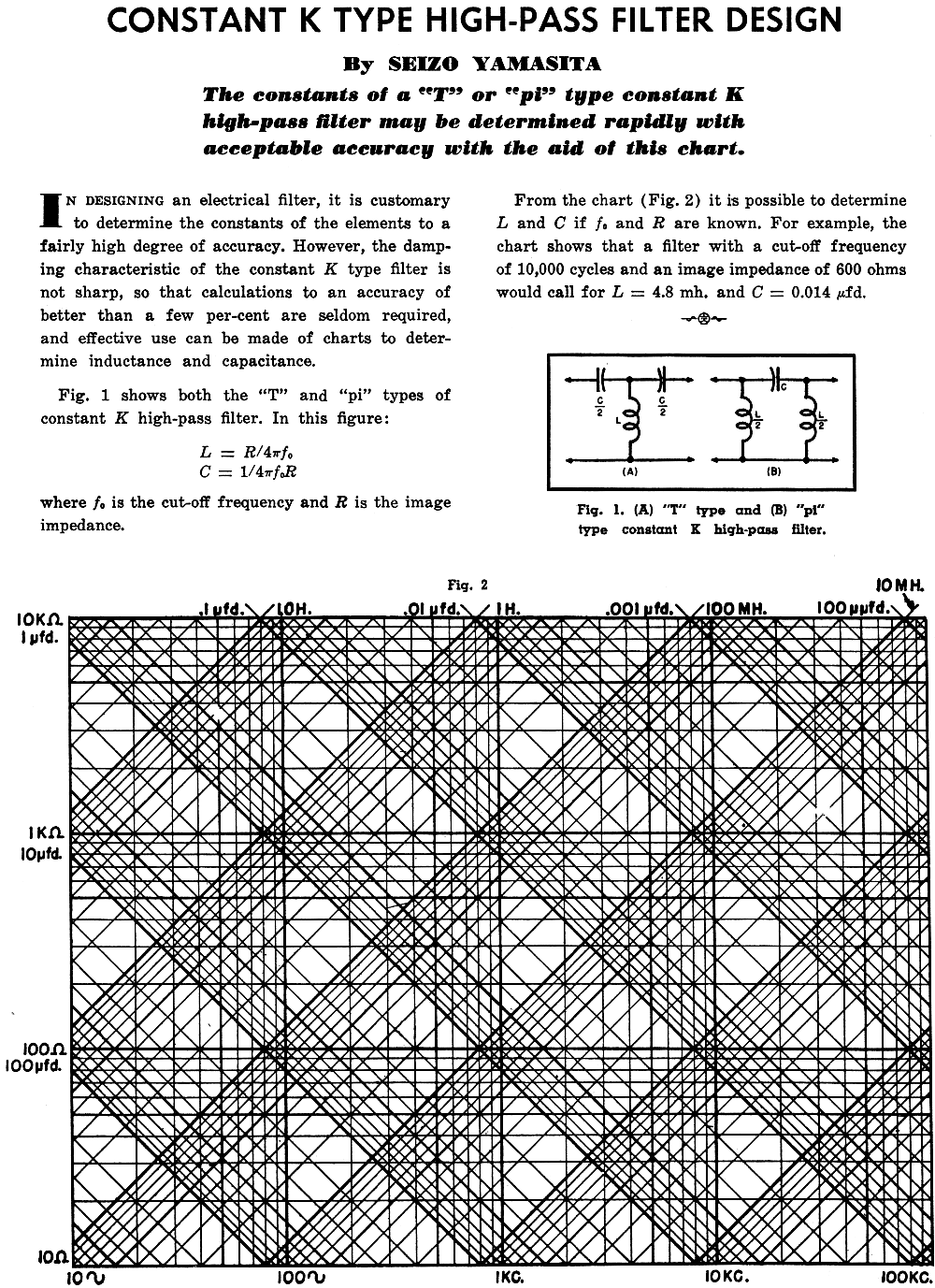
Fig. 1 - (A) "T" type and (B) "pi" type constant K high-pass filter.
By Seizo Yamasita
The constants of "T" or "pi" type constant K high-pass filter may be determined rapidly with acceptable accuracy with the aid of this chart.
In designing an electrical filter, it is customary to determine the constants of the elements to a fairly high degree of accuracy. However, the damping characteristic of the constant K type filter is not sharp, so that calculations to an accuracy of better than a few per-cent are seldom required, and effective use can be made of charts to determine inductance and capacitance.
Fig. 1 shows both the "T" and "pi" types of constant K high-pass filter. In this figure:
L = R/(4πf0)
C = 1/(4πf0R)
where f0 is the cut-off frequency and R is the image impedance.
From the chart (Fig. 2) it is possible to determine L and C if f0 and R are known. For example, the chart shows that a filter with a cut-off frequency of 10,000 cycles and an image impedance of 600 ohms would call for L = 4.8 mH. and C = 0.014 μfd.

Copyright: 1996 - 2026 |
About RF Cafe RF Cafe began life in 1996 as "RF Tools" in an AOL screen name web space totaling 2 MB. Its primary purpose was to provide me with ready access to commonly needed formulas and reference material while performing my work as an RF system and circuit design engineer. The World Wide Web (Internet) was largely an unknown entity at the time and bandwidth was a scarce commodity. Dial-up modems blazed along at 14.4 kbps while tying up your telephone line, and a lady's voice announced "You've Got Mail" when a new message arrived... |
Copyright 1996 - 2026 All trademarks, copyrights, patents, and other rights of ownership to images
and text used on the RF Cafe website are hereby acknowledge My Hobby Website: My Daughter's Website: |