|
|||||||||||||
 |
|||||||||||||
Pedro and the Swami
|
|||||||||||||
Technodrama stories were a popular means of teaching valuable lessons back in the mid-twentieth century. Carl and Jerry, Mac's Radio Service Shop, Sally the Service Maid - even Hobnobbing with Harbaugh - et al, were very popular features. Popular Science magazine's Gus Wilson's Model Garage was a gearhead equivalent. An occasional non-regular feature appeared, as with this "Pedro and the Swami" troubleshooting adventure in a 1959 issue of Radio-Electronics magazine. You will like the ending. As a long-time troubleshooter of electrical, mechanical, and hydraulic systems, I always read these kinds of things. Pull up a chair and take a read through it; you will appreciate the combination of reductio ad simplicitatem, reductio ad absurdum, divide et impera, reductio ad primum principium, and Occam's razor approaches. Don't ya love those Latin phrases that make you look smart? Pedro and the Swami
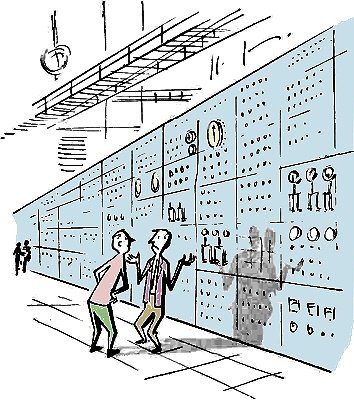
The industrial service technician runs into a tough one. By Guy Slaughter "Pedro," I said into the handset. "This is nuts. I don't even know what I'm looking for." "You're looking for the relay that drops out first," the familiar voice came back. "It should be a cinch to find." "Sure it should," I replied, with my best sarcasm. "There aren't more than a million or so here. It should be a real breeze." I was standing in the control basement of one of the local steel mills, staring suspiciously at a relay panel which extended maybe 50 feet each way from me. It was covered with relays, contactors and knife switches. I had been watching this particular section of the panel for nearly an hour now, which served me right for letting Pedro talk me into helping him troubleshoot industrial gear I didn't know anything about. "Here we go again, Herk," Pedro's voice called. "The line's going to start up. Pay attention, now." I sighed in resignation and fixed my eyes on the panel in front of me. At once there was the snapping clack of a multitude of contacts closing in rapid sequence as armatures all up and down the control board picked up and seated solidly against their coils. Off to my right the arm of the motor-operated rheostat began its rotation, described its arc and came to a stop two-thirds of the way around. "The line's up to speed," Pedro's voice came through the handset, "750 a minute. Keep your eyes open." "Yeah, yeah I'm looking." Fifteen minutes later I was still looking, while the sense of urgency I'd been feeling grew stronger. The motor-operated rheostat was holding at its two-thirds position. Most of the relays on the board were sealed in. The hum of the motors and generators upstairs carried down to me as a sleep-inducing drone. My eyes began to burn from the strain of staring. I blinked them to ease the strain. And at that precise instant relays began dropping out with the staccato clatter of machine-gun fire, first one and then all the rest on the panel in rapid sequence. The motor-operated rheostat buzzed back to zero, clicked its limit switch. "That was it, Herk," Pedro yelled excitedly in my ear. "The line is down again. Which relay dropped out first?" "I don't have the faintest notion," I said solemnly. "What's more . . ."
"You're standing right there. How could you miss it?" "It was easy. But I'm not standing here another minute. I'm coming upstairs right now. Of all the darn fool ways you've figured out to waste my time, this one is the worst!" "Don't get teed off, Herk," the voice said pleadingly. "Just once more, please. We've got to find it." I debated for a moment, gave in. "Okay," I sighed resignedly. "Once more. But make it fast. That doggone coffee . . ." "Here we go," Pedro's voice cut in. "Keep your eyes open, now." Relays picked up all over the board. The line can't run until we find out which piece of electronic gear is tripping out its line-stop relay. We've been hired to do a job here, and we can't run out. . ." "We?" I cut him off. "We can't leave, and we've been hired?" Pedro's face assumed the color of an overloaded rectifier. "We," he echoed, flatly. "They called me in, and I called you in. That makes it we. And anyway, I need your help. For the honor of all radiomen everywhere, we've got to find the trouble." "Oh, great," I groaned. "Here we go with that 'get-in-there-and-fight' stuff again." "Sure," Pedro continued. His grin was back now, and he winked at me. "The future of industrial electronics is in our hands." "Go-go-go," I murmured. "Old buddy, how do you know the trouble's in the electronic gear? Maybe one of the drive motors is kicking out on overload or something." "The mill electricians have already checked their own gear," Pedro replied. "They've even shorted out all the oil-pressure switches and stuff with jumper wires, but still the line kicks out. So all that's left is the electronic equipment." "But why pick on me? I don't know anything about this gear, and I'm not sure you do either."
"Thanks, but I don't want to. So you do it." I turned to leave him, but he grabbed my elbow. "Wait," he almost wailed. "I need your help. The thing is, the trouble's not in the gear itself. It's in one of the line circuits associated with it. Every piece of equipment in the place is interlocked into the line-stop circuit, so that failure will stop everything dead. And one of the interlocks is dropping out. We've just got to find out which one." "Okay," I agreed, surrendering for the dozenth time that day. "But there must be a better approach than for me to stare at a million relays for hours on end, hoping to catch the culprit in the act." "Any suggestions?" Pedro wanted to know. "Not a one. You think about it, and I'll be right back. I've got an errand." I headed for the washroom on the far side of the building, and went in. When I came out, the line was just starting up; it had been running a moment before. I stood there, while the line came up to full speed, thinking about that. Then I went back into the washroom. The line was down again when I came out a moment later. I grinned to myself, happily. Enter the Swami
"Having consulted my crystal ball," I chuckled gaily, "I am in a position to solve your problem." "You and your jokes," the glum Pedro responded, not looking up from the chart. "I'm convulsed." "Swami does not joke," I intoned smugly. "Swami is all-seeing." "You got a clue?" he demanded, letting the chart roll up on its spring-loaded mandrel. "Water," I said. "What pieces of electronic gear are tied in with water?" Pedro pondered a moment. "Just two. The seam-welder ignitrons are water-cooled, and so is the X-ray gauge." "Check 'em over. There's your trouble" Pedro didn't hear me. "But the welder doesn't run continuously," he was saying, evidently to himself. "Only when a coil of steel runs out and the operator welds in a new one. Yet the line stops any time, during the weld or not. So that leaves the X-ray gauge." He looked up at me, grinning. "Hope you're right, Herk. Come on." I came. He led the way to a big, steel-cabineted device parked alongside the line about halfway down. The cabinet bore a painted-on legend: Danger - XRay equipment - 80,000 volts. Connected to the cabinet by a shielded cable an inch in diameter was another piece of equipment, a 3-foot long, unshaped affair, through the open ends of which the steel strip ran on its way from the tin-plating tanks, past the melter and oiler towers, and on toward the hole-detecting equipment and the flying shear. "That's the X -ray head," Pedro explained, pointing at the U-shaped device. "The X-ray tube is in the part on top of the strip, and there's an electron-multiplier photocell in the part under the strip. The gadget gauges the thickness of the strip continuously." He jerked a thumb at the cabinet alongside us. "The power supplies, dc amplifiers and comparator circuitry are in there."
"Cooling the X-ray tube, stupid," Pedro grinned. "What else?" "Yeah," I said. "What else? But what's the connection between it and the line-stop circuits?" Pedro shrugged. "Beats me. Unless there's a pressure switch in the water line. We'll have to check." He crawled around on the floor, under the strip, which ran horizontally here about 3 feet above the floor. After a minute, he beckoned me to join him. I ducked under the moving strip reluctantly, looked where he was pointing. There was a water line there, sure enough, of ½-inch galvanized pipe. And strapped to the water pipe was a foot-square steel box, maybe 6 inches deep, its top a flat sheet of steel held on by four screws. Pedro was already working on them with a screwdriver. He removed the top, peered inside. I crept closer for a better look. Inside the box was a transformer whose primary leads disappeared into the cement floor through a piece of conduit, and whose secondary leads were clamped securely to the water pipe, about 6 inches apart. In the center of the 6-inch pipe section between the clamps, a small, black object resembling a microswitch was strapped to the water line. A pair of leads from it also disappeared into the same piece of conduit. "Interesting," I said. "Most interesting. What is it?" Pedro grinned at me happily. "Can't you guess, Herk? I can. Instead of a pressure switch in the water line, the X-ray gauge manufacturer used a thermal protector. That transformer must be a current affair which feeds a few amperes through that short section of water pipe. A normal flow of water prevents this current flow from heating the pipe significantly, while a water failure kills the cooling action and makes the pipe-and-transformer into a regular solder gun. The gizmo that looks like a microswitch must be a bimetal thermal cutout interlocked into the line-stop circuit through one of the relays on the board downstairs. If the water fails, the pipe gets hot, the thermal cutout opens and the relay drops out. Simple and easy, huh?" A Fluid Situation It proved to be just that simple. I watched while Pedro hunted up one of the electricians, got him to bring us a handful of blueprints, and finally found one that showed an interlock relay in the line-stop circuit whose coil was fed through a thermal cutout. "There it is," Pedro told the electrician, pointing out the relay in question. "Block that one in, and you're back in production. Then you better have a pipefitter check out the water line to the X-ray gauge and see what's lousing up the flow. Maybe that particular run of pipe is corroded almost shut, or maybe the trouble is in the pressure line to this whole end of the mill. Anyway, I've shut down the X-ray gauge until he gets the water fixed, and told the production operator he'll have to check the strip with a mechanical gauge meanwhile." The electrician grinned and trotted off. Pedro turned to me. "Okay, Herk, give. What's this crystal-ball stuff?" "I don't know how I do it," I said. "Sometimes it frightens me. It must be a gift. Like telepathy, or clairvoyance, or..." "Hold it, Swami," Pedro said testily. "When I turn in our bill, they'll ask me how we found the trouble. Shall I tell them it came to you in a vision?" "No, I guess not." I grinned at him. "Just tell them I noticed that the line stopped whenever I flushed the toilet, and..." "That's enough," Pedro said. "I'll take it from there." And he did . . . |
|||||||||||||
 |
|||||||||||||
|
|||||||||||||


 "Yes, I do," Pedro said calmly. "And so do you.
I've worked this stuff over before, and it's routine electronic circuitry, most
of it. There isn't a piece of stuff in the place you couldn't bug out if you wanted
to."
"Yes, I do," Pedro said calmly. "And so do you.
I've worked this stuff over before, and it's routine electronic circuitry, most
of it. There isn't a piece of stuff in the place you couldn't bug out if you wanted
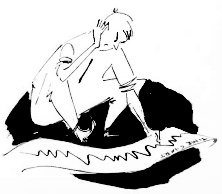
to." 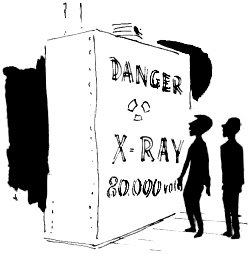 Pedro was wearing his most harried look when
I found him. He was examining the continuous-running time chart which showed, with
an inked path along a paper strip, the speed of the line during every minute of
every day. The section of chart he was staring at was a mess of inky zig-zags, like
an oscillograph of a noise pulse, showing how the line had started and stopped dozens
of times in a few hours.
Pedro was wearing his most harried look when
I found him. He was examining the continuous-running time chart which showed, with
an inked path along a paper strip, the speed of the line during every minute of
every day. The section of chart he was staring at was a mess of inky zig-zags, like
an oscillograph of a noise pulse, showing how the line had started and stopped dozens
of times in a few hours.  "What's water used for ?" I asked, bewildered.

|
||||||||||||||||||||||||||||||||||||