|
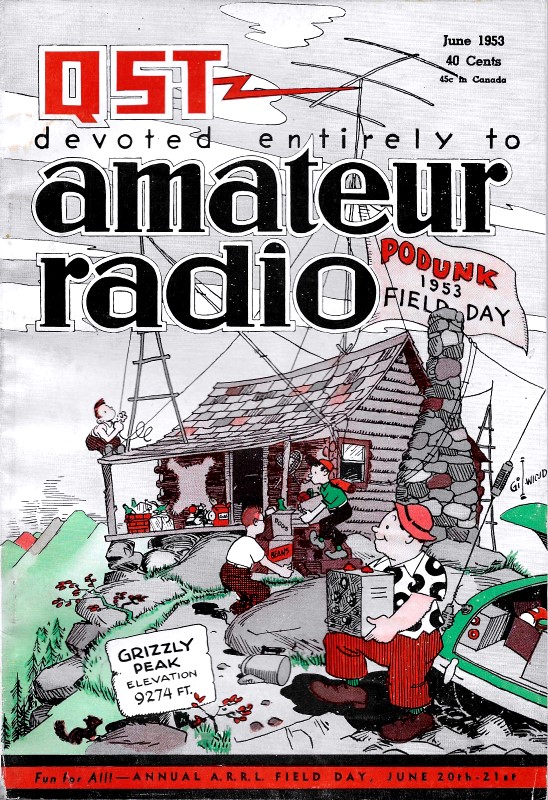
June 1953 QST
 Table of Contents Table of Contents
Wax nostalgic about and learn from the history of early electronics. See articles
from
QST, published December 1915 - present (visit ARRL
for info). All copyrights hereby acknowledged.
|
Arthur (Art) Collins, who began his radio
career as a Ham, founded Collins Radio in 1933, in Cedar Rapids, Iowa. Just as civil
aviation enthusiasts long ago began associating
Wichita, Kansas, with Cessna, Lear, Beechcraft, et al, and its
airplanes, radio people associate Cedar Rapids with
Collins
Radio Company. In
fact - and this is a fact - electronics companies like RF Micro Devices, now Qorvo
(see
origin of the name) and Skyworks Solutions
set up RFIC design centers there back in the early 1990s in order to exploit the
availability of highly talented engineers who worked for Collins. It was a time
when defense industry contracts were winding down and cellphones were winding up.
He Makes What We Hams Use
Art Collins, W0CXX Collins Radio Company
 Although s.s.b. has been getting a big play
at W0CXX lately, Art operates c.w. and f.s.k., too. He's likely to be on any band
from 3.5 Mc. through 28 Mc. where you can work him almost any night or weekend.
The call W0CXX was 9CXX when it was assigned in 1923 and 9CXX immediately became
a well-known call. Early QSOs that gave Art the biggest kick were on 20 meters with
1QP and 6TS. Just the day before, on January 22, 1925, these stations had established
on that band the first daylight coast-to-coast contact. Art was also one of the
pioneers on 5 and 10 meters and worked both 21-Mc. c.w. and 7-Mc. s.s.b. on their
recent opening days. Ham-shack wallpaper includes an A-1 Operator Award; W0CXX can
qualify for both WAS and DXCC. Art likes to recall how he was helped by friendly
amateurs when building his first transmitters. That he returned the help is known
to all of us, since talks by Art Collins at conventions and articles written by
him for QST - like the pi-network story in the February, 1934, issue - have inspired
many a ham to build a better rig. Although s.s.b. has been getting a big play
at W0CXX lately, Art operates c.w. and f.s.k., too. He's likely to be on any band
from 3.5 Mc. through 28 Mc. where you can work him almost any night or weekend.
The call W0CXX was 9CXX when it was assigned in 1923 and 9CXX immediately became
a well-known call. Early QSOs that gave Art the biggest kick were on 20 meters with
1QP and 6TS. Just the day before, on January 22, 1925, these stations had established
on that band the first daylight coast-to-coast contact. Art was also one of the
pioneers on 5 and 10 meters and worked both 21-Mc. c.w. and 7-Mc. s.s.b. on their
recent opening days. Ham-shack wallpaper includes an A-1 Operator Award; W0CXX can
qualify for both WAS and DXCC. Art likes to recall how he was helped by friendly
amateurs when building his first transmitters. That he returned the help is known
to all of us, since talks by Art Collins at conventions and articles written by
him for QST - like the pi-network story in the February, 1934, issue - have inspired
many a ham to build a better rig.
Posted September 16, 2020
(updated from original post on 7/21/2016)
|