|
|
|||||||||
| Software: RF Cascade Workbook | RF Symbols for Office | RF Symbols & Stencils for Visio | Espresso Workbook | ||||||||||
|
|||||||||||||||||||||||||||||||
   |
   |
||||||||||||||||||||||||||||||
|
Please Support RF Cafe by purchasing my ridiculously low-priced products, all of which I created. RF & Electronics Symbols for Visio RF & Electronics Symbols for Office RF & Electronics Stencils for Visio T-Shirts, Mugs, Cups, Ball Caps, Mouse Pads These Are Available for Free |
|||||||||||||||||||||||||||||||


Teach Kids Electricity
June 1958 Popular Electronics

|
June 1958 Popular Electronics  Table of Contents Table of Contents
Wax nostalgic about and learn from the history of early electronics. See articles from Popular Electronics, published October 1954 - April 1985. All copyrights are hereby acknowledged. |
Some things never change - at least at the fundamentals level. Electric circuits is one of those things. I don't remember when I first became interested in electrical apperati, but it must have been due to a natural affinity to the science because nobody in my family or my circle of friends expressed any interest. I was the odd man (or boy) out on my street, because while all the other kids were playing baseball, basketball, and football, I was sticking forks in electric sockets and disassembling flashlights, battery-powered toys, and building Erector Set contraptions using the included electric motor. That's not to say I ever got really good at it, but significantly better than I ever got at playing sports. This 1958 Popular Electronics magazine article promotes the introduction of electrical concepts to young kids in hopes of instilling a lifelong interest in the subject. BTW, the glasses on that nice lady may just have been the inspiration for the kind drawn by "The Far Side" comic artist Gary Larson.
Teach Kids Electricity
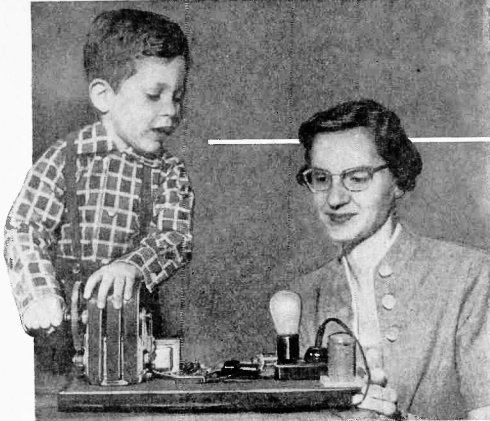
Easily assembled "power plant" shows electrical facts of life.
By John Hoke
"Daddy," what makes the light bulb light? ..."
Thus begins an era for many a young father, for this sentence is but the first trickle of what will later become a waterfall of questions, as a small boy learns that there is more involved than just flicking on the switch. When dealing with an elusive entity such as electricity, the most effective means of describing what it is consists of a simple way of showing what it does.
Seeing Is Believing
Here, on a short length of planking, are the ingredients of a small power plant capable of doing amazing things. It will make electricity - at the turn of the crank. It will provide high or low voltages, at the flip of a switch. It will store electricity. It will light a 117-volt, 10-watt light bulb or run a small, 6-volt motor. It will operate a transistor radio or an electric clock. And it will yield current in small enough doses to permit feeling it - without discomfort.
For a small boy, next to putting a coin in a gum machine, there is no greater urge than to turn a crank. It won't take long to get the idea across that he is making the bulb light - or the motor run - when he turns the crank. And when he first feels the current generated, he will realize that his crank - turning makes "something," and that this "something" in turn flows through the circuit to the motor and makes it run. From here on, step by step, his understanding of this invisible force will increase.
A useful by-product of the child's self-education is a healthy respect for the power of electricity. He soon becomes aware of the shocking potential of wall outlets when a few turns on his little generator make its current uncomfortable to touch.
On the Board
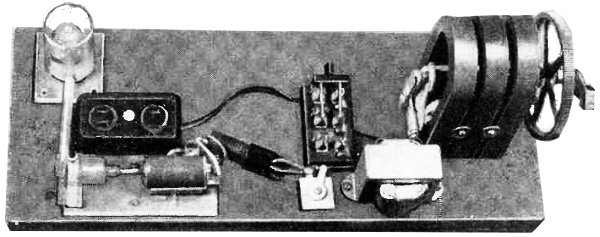
Hand generator mounted on plank with one of the gadgets that can be powered by it.
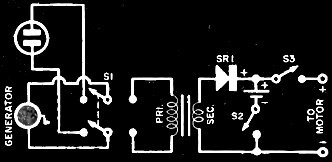
Schematic shows one possible hookup described in text.
Assembly is not overly complicated. Most of the components which are mounted on the plank should be locally available and only the generator need be obtained by mail.
The generator is actually the same type of bell-ringing mechanism used in rural telephone systems years ago. Having a maximum output of about 100 volts, a.c., such generators are currently available from firms like Johnson Smith Co., Detroit 7, Mich., for approximately four dollars. No modifications are necessary; they are ready to operate as is.
The output of the generator is fed to the center posts of a double-pole, double-throw knife switch (S1). One side of the switch is connected to a conventional socket. This will permit connecting a number of devices, including a 10-watt light bulb.
You'll need a step-down transformer line voltage to about 6 volts is the proper size. A bell transformer will do fine.
Primary leads of the transformer go to the remaining terminals of the knife switch, and hence to the output of the generator, when switched in. The secondary feeds through the rectifier and then to the binding posts that will serve as an outlet for devices. The rectifier can be any low -voltage type with adequate current rating, such as International Rectifier M1H.
Current on Tap
To store current, you will need a small storage cell. The Willard 2-volt types are useful in this application.
When hooking up a circuit to utilize one of these cells, it is a good idea to incorporate an s.p.s.t. knife switch (S2), so that the cell can be switched in and out of the circuit whenever circumstances dictate. You can then run the motor directly from the output, or you can switch in the battery with the motor to charge the cell and run the motor simultaneously. The motor's continued running when the generator is stopped will illustrate the fact that power was stored in the battery - and is yielded when the supply from the generator and transformer ceases.
If you wish, you can charge the battery alone, with the generator, and run the motor on the stored current by opening and then closing another s.p.s.t. switch (SS). Other variations are also possible.
As an example, the small motor shown mounted on the board is hooked up to a miniature water fountain. Motors such as the Mighty Midget (Lafayette F253) can be used in innumerable mechanical hookups.
With the complete setup, you have an impressive transference of power. The chain goes from initial mechanical origin to generation, transformation, rectification, storage and consumption by motor ... all at the turn of a crank, with a one boy - power source of energy! This is the foundation for a course in electricity and its applications, tailor - made and contained on a short pine board.

Copyright: 1996 - 2026 |
About RF Cafe RF Cafe began life in 1996 as "RF Tools" in an AOL screen name web space totaling 2 MB. Its primary purpose was to provide me with ready access to commonly needed formulas and reference material while performing my work as an RF system and circuit design engineer. The World Wide Web (Internet) was largely an unknown entity at the time and bandwidth was a scarce commodity. Dial-up modems blazed along at 14.4 kbps while tying up your telephone line, and a lady's voice announced "You've Got Mail" when a new message arrived... |
Copyright 1996 - 2026 All trademarks, copyrights, patents, and other rights of ownership to images
and text used on the RF Cafe website are hereby acknowledge My Hobby Website: My Daughter's Website: |
