|
|||||||||||||
 |
|||||||||||||
Saga of the Edison Award
|
|||||||||||||
This 1957 Popular Electronics article describes the "Edison Radio Amateur Award," established by General Electric in 1951. The prestigious honor, judged by a committee of national figures, recognized the ham radio operator who performed the most exceptional public service each year, awarding him or her a trophy and $500. The piece chronicles the winners from 1952-1956, including Don Mullican for tornado relief and Stan Surber for Arctic communications. The 1956 winner was Mae Burke, W3CUL, who handled an immense volume of messages for servicemen and their families. The committee also issued special citations to others, like a teenager who relayed traffic from Antarctica and operators who provided lifesaving communications during emergencies and natural disasters. The article underscores that nominees came from all backgrounds, with some even being bedridden, proving the profound morale-building and altruistic power of amateur radio. "Edison Award" articles include Saga of the Edison Award, 1953 Edison Radio Amateur Award, Mary Burke, W3CUL Wins 1956 Edison Award Saga of the Edison Award
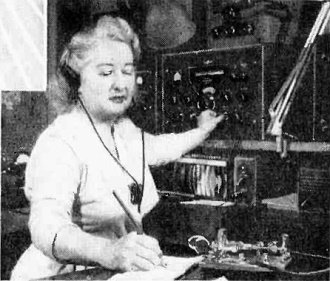
Mary "Mae" Burke, 50 W3CUL, 1956 Edison Award winner.
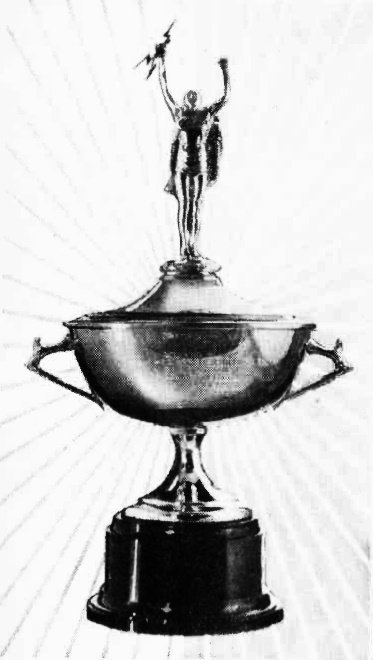
Fifth Annual G.E. Award recognizes value of ham radio to general public. Edison Radio Amateur Award Radio Amateurs have performed innumerable acts on behalf of their fellow citizens. Many of these are called "acts of public service." They are not in any way duties which the radio ham is obligated to perform; they are, rather, proof of his concern for the welfare and safety of his country. The General Electric Company realized in 1951 that many such acts were far beyond the call of a private citizen. To honor the one ham whose public service stood out above all others, they established the annual Edison Radio Amateur Award. With it went national recognition, a handsome trophy, and a check for $500. The judges of the Award include national figures such as: E. Roland Harrison, President of the Red Cross; Under Secretary of State Herbert Hoover, Jr., (a ham himself) ; Rosel H. Hyde, Chairman of the Federal Communications Commission; and Goodwin L. Dosland, President of the American Radio Relay League (ARRL). In 1952, the Edison Award was given to Don L. Mullican, W5PHP, for providing emergency communications to an area devastated by a tornado. The 1953 award went to Stan Surber, W9NZZ, who handled hundreds of free messages from isolated Arctic outposts. Benjamin Hamilton, W6VFT, won the 1954 award for activities related to civil defense; and in 1955 it was awarded to Bob Gunderson, W2J10, a blind radio ham. The 1956 award has gone to Mae Burke, W3CUL, Morton, Pa. More than any other radio ham in the United States, she exemplifies the almost unbelievable ability of ham operators to "pass traffic." Message-handling, or "traffic" as it is known to hams, means providing a line of communication between servicemen and their families (Mae handles as many as 3000 messages a month), or for anyone else who doesn't have the money to use a commercial circuit. At W3CUL, as many as 10,- 000 messages may be handled each month; the total since 1949 is over 300,000. Working as a radio relay station, Mae must meet schedules (at 6:30 a.m., 7:00 a.m., 11 :00 a.m., 2:00 p.m., 6:00 p.m., and finally at 8:00 p.m., daily), type or copy the many messages, and tune her receiver and transmitters ... certainly a "man-size" job for anyone. While declaring W3CUL the 1956 Edison Award winner, the judging committee also issued eight other special citations. One of these went to Julius M. J. Madey, K2KGJ, a 16-year-old high-school honor student who rearranged his living habits (to bed at 4:30 p.m., up at 9:30 p.m., to bed again at 5:00 a.m., and finally off to school at 8:30 a.m.) so that he might be able to relay traffic from the Navy personnel working in Antarctica with "Operation Deepfreeze." A citation went to Harry Fendt, W2PFL, who was instrumental in saving two lives in 1956 through quick message -handling to doctors. One of these events concerned a special drug needed in the Belgian Congo and was dramatized on Dave Garroway's morning show. Natural disasters played a big part in two other citation awards. One of them was issued to Sam Baker, W3FIQ, for setting up and maintaining an emergency communications link with Erie, Pa., during the heavy Thanksgiving snowstorm. Another woman, Martha Shirley, WOZWL, Black Hawk, S. D., twice operated her ham station from totally isolated and snow- bound communities; in doing so, she provided the only means of communication available over periods of up to four days. People from all walks of life are nominated for the Edison Award - students, housewives, police officers and craftsmen as well as those working in radio factories or broadcasting stations. If there is an outstanding characteristic, it can only be that four of this year's nominees are bedridden! Unbelievable as it may sound, these people perform public services of such magnitude that friends and neighbors believe they merit Edison Award consideration. Need more be said in behalf of the morale- building and deeply rewarding aspects of ham radio?
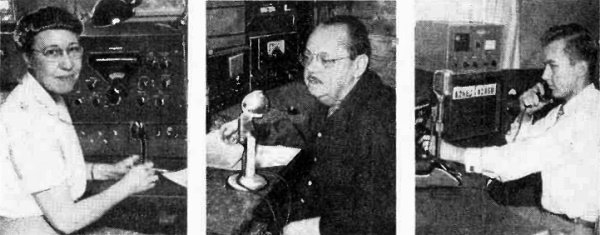
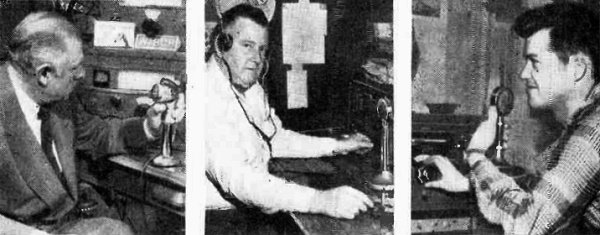
Citation winners discussed in text; Martha Shirley, WOZWL (above, left); Harry Fendt, W2PFL (above, center) ; Julius Madey, K2KGJ (above, right). Additional citations were awarded to: Newton Kraus, WIBCR (below, left) for message handling from "Operation Deepfreeze;" James Born, W4ZD (below, center) for his numerous civic and ham radio activities; and Sam Baker, W3FIQ (below, right) for emergency communications during a severe Erie, Pa., snowstorm.
|
|||||||||||||
 |
|||||||||||||
|
|||||||||||||


|
||||||||||||||||||||||||||||||||||||