|
October 1961 Popular Electronics
 Table of Contents Table of Contents
Wax nostalgic about and learn from the history of early electronics. See articles
from
Popular Electronics,
published October 1954 - April 1985. All copyrights are hereby acknowledged.
|
"Blackmailing a Blonde"
is yet another of John Frye's technodramas featuring the now-in-college pals, Carl
and Jerry. In 1954, when the series began in Popular Electronics magazine, the boys
were in high school. They shared a common interest in electronics, mechanics, amateur
radio, sleuthing, high adventure, and, of course, girls. As in Mr. Frye's other
stories (e.g.,
Mac's Radio Service Shop), a useful lesson in electronic equipment, components,
circuitry, troubleshooting, customer relations, etc., was woven into the article's
fabric. In this case, we are treated to a brief primer on directional microphones
(analogous to radio antennas) and the plot of a cardioid response. Jerry even offers
the simple mathematics behind the curve. He also discusses the construction of a
type of audio "antenna" that has a broadband, directional response (think of a half-wave
dipole antenna with sections made resonant at more than one wavelength). It occurs
to me that there might be an ethical question about what this cadre of frat brothers
pulled off, as it is not unlike taking pictures or recording a video using a concealed
camera with a telephoto lens.
A comprehensive list of all the Carl & Jerry episodes posted on
RF Cafe is at the bottom of the page.
Carl & Jerry: Blackmailing a Blonde
 By John T. Frye W9EGV By John T. Frye W9EGV
It was a warm Friday evening in Indian summer, and the balmy air outside Residence
Hall H-3 at Parvoo University carried the exciting scent of burning leaves; but
Carl and Jerry were seated at their respective desks in their room, doggedly grinding
away at conic sections.
"On your feet, frosh, and follow me!" a voice suddenly ordered. The boys turned
around to see Pete Lacey, a junior from across the hall, standing in the open doorway.
The boys had already learned one lesson well: it was best to humor upper classmen.
So they got to their feet and followed Pete to his darkened room. Inside, Carl and
Jerry could dimly make out at least half a dozen other fellows sitting around on
the floor all staring glumly at a brightly lighted window across the street.
"A sophomore from your home town tells us you two are pretty clever at solving
problems," Pete announced. "Well, we have one. See that dizzy blonde holding court
in her room in the sorority house across the way? She's a thorn in the flesh of
H-3. That's one of our trophies resting on her table, and this is the fourth time
she has stolen it.
 "The other three times H-3 has gone along with
tradition and recovered the trophy by serenading the sorority, but this is becoming
ridiculous. She doesn't know when to quit. "The other three times H-3 has gone along with
tradition and recovered the trophy by serenading the sorority, but this is becoming
ridiculous. She doesn't know when to quit.
"All you two have to do is dream up a way for us to get our trophy back without
having to sing for it and, at the same time, discourage that bird-brain from making
any more raids."
"Is that all ?" Carl muttered sarcastically. "You know an ed who is found skulking
around co-ed grounds, no matter what his reason, is almost certain to be expelled
..."
"What do you suppose those girls are talking about?" Jerry interrupted musingly,
as he stared across at the third - floor window some fifty yards away. "Some of
that conversation, if recorded, might make good blackmail material," he suggested.
"Yeah, it might at that! You have a fine criminal mind," Pete said respectfully.
"But how can we do it? We can't put a mike into that room, and we certainly can't
hear a word from here."
"I have an idea," Jerry said; "but it requires some special equipment. Carl and
I are going home tomorrow, and we can pick up the stuff and bring it back with us
Sunday afternoon. With luck, we may be able to do something Sunday night. Think
you can wait?"
"We haven't much choice unless we want to knuckle under and do some more singing,"
Pete said. "I really don't expect much out of green freshmen, but we'll give it
a try."
The two boys didn't see much of each other Saturday night and Sunday morning,
for each of them tried to spend as much time with his family as he could; but when
Mr. Bishop drove them down to the bus station Sunday afternoon, Carl was carrying
his tape recorder and Jerry was carrying a long, mysterious-looking object wrapped
in canvas.
"What on earth is that thing, a folding movie screen?" Carl asked.
"Nope, it's E-V's very directional gun-type microphone I fast-talked the radio
station manager into letting me borrow for a couple of days," Jerry explained. "I
remembered our using it when I was helping him cover basketball games last winter.
It was fine for picking up cheerleaders, announcements from the floor, and that
sort of thing.
"This mike is very similar to the one you see used at President Kennedy's news
conferences ... it sits on a tripod to the left of the President, and the guy operating
it aims it like a machine gun at the newsman who is asking a question.
It picks up that man's voice almost as well as if he were using a hand mike,
and it accepts very little else."
"I've always been interested in directional mikes," Carl said as the boys settled
down for their hour-long bus ride, "but I'm pretty hazy on how they operate."
"You know how a parabolic reflector works with a mike - we've used the combination
to record bird calls," Jerry pointed out. "Waves arriving from a sound source along
the axis of the reflector are uniformly reflected from the curved surface so as
to pass through the focal point of the parabolic dish. That means the dish will
intercept a large amount of sound energy and concentrate it on a mike mounted at
this point.
"On the other hand," he continued, "sound waves arriving from a point not on
the axis are not uniformly reflected to the focal point. Only a small amount of
the sound energy from such a point actuates the microphone. The result is a pickup
device with a large amount of amplification for a sound source at which it is aimed,
and sharp discrimination against sounds coming from a different direction. Generally
speaking, the gain of a parabolic reflector is a function of its size, and that
constitutes the main objection to it. For it to be efficient, especially at medium
and low frequencies, it must be made big and unwieldy."
"How about the cardioid microphone ? Why do they call it that? I thought 'cardioid''
meant something to do with the heart."

Cardioid response plot.
"It gets its name from the shape of its directivity response curve plotted on
a polar graph," Jerry replied. "The curve looks like a fat valentine heart with
a very blunt point. The point represents sensitivity at the front of the mike; the
notch, sensitivity to sound from the back. A good cardioid will display better than
15 db difference between front and back pickup; yet the sensitivity at the front
is nearly uniform over a 120° angle.
"There are several ways to construct a cardioid microphone," Jerry went on, "but
a typical method uses a pressure-sensitive dynamic microphone and a velocity-type
ribbon mike in the same housing. This housing is contoured so the compression half
of a sound wave coming from front, back, or sides exerts equal pressure on the exposed
face of the dynamic mike diaphragm and pushes it back. In other words, the phase
and amplitude of the dynamic mike is the same for sounds from any direction. Let's
represent that output by unity, or 1.
"The velocity mike ribbon is mounted with its plane perpendicular to the front-back
line. A sound wave from the front pushes this ribbon back and produces output of
one phase; a wave from the rear pushes the ribbon forward and produces output of
an opposite phase. Waves from either side slide right across the face of the ribbon
without producing any output. The output amplitude and phase are thus determined
by the angle at which the sound approaches the mike. This is represented mathematically
by saying that the output of the ribbon mike is equal to cos 0°, 0° being
the angle the sound direction makes with a line drawn straight ahead from the mike.
The outputs of the two microphones are combined and represented by the expression
1 + cos 0°. Now let's see what happens.
"Sound from the front has an output of 1 + cos 0° or 1 + 1 or 2. The two
mike outputs are maximum and in phase ; so they add together. From either side the
output is 1 + cos 90° or 1 + 0 or 1. Only the dynamic mike has output. Sound
from the back produces 1 + cos 180° or 1 - 1 or 0. The two outputs are opposite
in phase, buck each other, and produce a minimum output.
"As you can see," Jerry summed up, "the cardioid pattern is simply the expression
1 + cos 0° drawn on polar graph paper. Incidentally, the same figure can be
traced by a point on the circumference of a circle rolled around the outside of
an equal circle."
"I seem to remember seeing a directional mike that looked like a bundle of small
tubes," Carl offered.
"Yes, there is one like that. A mike can be made directional simply by placing
it at the rear of a long cardboard tube. Sound coming straight down the tube encounters
no resistance and produces maximum output. Sound arriving at an angle strikes the
inside wall of the tube and bounces back and forth and produces much less effect.
Such an arrangement, though, has selective resonant frequencies that produce a talking-into-a-barrel
quality. "But suppose you have several small-diameter tubes of different lengths
arranged side by side like stair-steps and bound together with tapes. You start
with the longest and roll the tubes into a bundle. The flush ends are fitted into
a small chamber containing a microphone. When the open ends are pointed at a sound
source, one of the tubes will be very close to the right length to resonate with
any frequency picked up.
"Resonance, of course, increases the amplitude of the picked-up frequency tremendously.
But since you have some tube of proper length to resonate with any frequency, all
frequencies benefit from resonance amplification. Sound arriving at an angle is
still diminished as it was in the single tube; so the multi-tube arrangement retains
the directive quality of the single tube while avoiding the objectionable selective-resonance
feature."
"How does this mike work ?" Carl wanted to know.
"I'm not sure," Jerry admitted regretfully. "The station manager didn't know
either, and he went so far as to put Duco cement on all the microphone screw heads
before he let me have it. Somehow I feel he doesn't trust us! I suspect it's a sophisticated
version of the multi-tube mike.
"It could, though, use some sort of labyrinth arrangement so that sound from
the sides or rear reaches the mike by two paths. One of these paths could be a half
wavelength longer than the other, so that phase reversal and consequent cancellation
would take place. But sound from the desired direction would travel a single path
and thus avoid cancellation."
At this point the bus arrived at their station. It was dark by the time the boys
reached H-3, which was probably just as well, for the gun mike made a curiosity-arousing
bundle. Pete and the other boys were waiting for them, and they went straight to
Pete's darkened room.
Carl removed Pete's window screen and cranked open a window so that the muzzle
of the mike could be thrust outside. Jerry connected the mike preamplifier to the
input of the tape recorder and slipped on earphones with which to monitor the recorder
output.
These preparations were just completed when, as if on cue, a light came on in
the room of Natalie, the blonde with the taking ways, and she trooped in with three
of her friends. Fortunately it was still unseasonably warm, and Natalie immediately
opened her windows wide.
As the girls chatted gaily, Jerry swung the mike back and forth in small arcs
on its tripod. Then he stopped; and, as a wide grin spread over his round face,
he reached over and started the tape recorder. The boys in the room scarcely breathed
for the next four or five minutes while the recorder was running. Suddenly Jerry
stopped the tape and started it in a whirring rewind. Next, the tape recorder was
placed on the window sill with the speaker facing outside, the volume was cranked
wide open, and the tape began to move past the playback head.
From the speaker came a loud peal of girlish laughter, and then a feminine voice
asked, "Natalie, what did Mrs. Sorenson want with you in her office this morning
?"
"Oh, the old biddy wanted to warn me that I had already exceeded my ten minutes
of total tardiness time in meeting our women's weekday 11 p.m. curfew, and that
I would be called to account at the next chapter meeting. She wanted me to beg a
little, but I didn't give her any satisfaction. Instead, I just kept staring at
the dark roots of her blonde hair. She thinks she's fooling everybody, but she's
not. And she had the nerve to tell me that perhaps I was going too far in this trophy-stealing
thing. The nerve of her! ---"
By this time pandemonium was breaking out in the room across the street. Natalie
first held her hands over her ears to shut out the booming parroted words; then
she ran to her clothes closet, snatched out a white can-can slip, and waved it frantically
in front of the open window in a sign of abject surrender.
When Jerry mercifully cut off the tape recorder, Natalie grabbed up the trophy
and headed for the door with her friends behind her, and Pete and his buddies started
for the stairs. As Carl and Jerry watched out the window, the two groups met under
a street lamp down below, and the trophy changed hands. There was a little talk,
and then Natalie made a sign of crossing her heart.
"Well," Jerry said as he started dismantling the gun-mike, "I guess that's that.
I'll bet she lays off the trophies from now on, especially since we still have this
tape. And maybe we've convinced Pete and his buddies that freshmen are not necessarily
complete imbeciles. What are you grinning about?"
"Oh," Carl replied, "I was just thinking what I'm going to say the next time
my Uncle Roy asks me his stock question: 'Carl, what are you learning in college?'
I'll bet I really rock him back on his heels when I answer, 'How to blackmail a
blonde!'"
Carl & Jerry, by John T. Frye

Carl and Jerry Frye were fictional characters in a series of short stories that
were published in Popular Electronics magazine from the late 1950s to the
early 1970s. The stories were written by John T. Frye, who used the pseudonym "John
T. Carroll," and they followed the adventures of two teenage boys, Carl Anderson
and Jerry Bishop, who were interested in electronics and amateur radio.
In each story, Carl and Jerry would encounter a problem or challenge related
to electronics, and they would use their knowledge and ingenuity to solve it. The
stories were notable for their accurate descriptions of electronic circuits and
devices, and they were popular with both amateur radio enthusiasts and young people
interested in science and technology.
The Carl and Jerry stories were also notable for their emphasis on safety and
responsible behavior when working with electronics. Each story included a cautionary
note reminding readers to follow proper procedures and safety guidelines when handling
electronic equipment.
Although the Carl and Jerry stories were fictional, they were based on the experiences
of the author and his own sons, who were also interested in electronics and amateur
radio. The stories continue to be popular among amateur radio enthusiasts and electronics
hobbyists, and they are considered an important part of the history of electronics
and technology education.
p.s. You might also want to check out my "Calvin
& Phineas" story(ies), a modern day teenager adventure written in the
spirit of "Carl & Jerry."
|
-
The Bee's Knees
- July 1964
-
A Rough
Night - January 1961
-
Wrecked by a Wagon Train - February 1962
- Gold Is
Where You Find It - April 1956
-
Little "Bug" with Big Ears - January 1959
-
Lie Detector Tells All - November 1955
-
The Educated Nursing Bottle - April 1964
- Going Up - March 1955
-
Electrical Shock - September 1955
- A Low Blow - March 1961
- The Black Beast - May 1960
- Vox Electronik, September 1958
- Pi in the Sky and Big Twist, February 1964
-
The Bell Bull Session, December 1961
- Cow-Cow Boogie, August 1958
- TV Picture, June 1955
- Electronic Trap, March 1956
- Geniuses at Work, June 1956
- Eeeeelectricity!, November 1956
- Anchors Aweigh, July 1956
- Bosco Has His Day, August 1956
- The Hand of Selene, November 1960
- Feedback, May 1956
- Abetting or Not?, October 1956
-
Electronic Beach Buggy, September 1956
-
Extra Sensory Perception, December 1956
- Trapped in a Chimney, January 1956
- Command Performance, November 1958
- Treachery of Judas, July 1961
- The
Sucker, May 1963
-
Stereotaped New Year, January 1963
- The Snow Machine, December 1960
-
Extracurricular Education, July 1963
-
Slow Motion for Quick Action, April 1963
- Sonar Sleuthing, August 1963
- TV Antennas, August 1955
- Succoring a Soroban, March 1963
- "All's Fair --", September 1963
-
Operation Worm Warming, May 1961
-
Improvising - February 1960
|
-
Strange
Voices - April 1957
-
"Holes" to
the Rescue - May 1957
-
Carl and
Jerry: A Rough Night - January 1961
-
The
"Meller Smeller" - January 1957
-
Secret of Round Island - March 1957
-
The Electronic Bloodhound - November 1964
-
Great Bank Robbery or "Heroes All" - October 1955
-
Operation Startled Starling - January 1955
- A Light Subject - November 1954
- Dog Teaches Boy - February 1959
- Too Lucky - August 1961
- Joking and Jeopardy - December 1963
-
Santa's Little Helpers - December 1955
- Two Tough Customers - June 1960
-
Transistor Pocket Radio, TV Receivers
and Yagi Antennas, May 1955
- Tunnel Stomping, March 1962
- The Blubber Banisher, July 1959
- The Sparkling Light, May 1962
-
Pure Research Rewarded, June 1962
- A Hot Idea,
March 1960
- The Hot Dog Case, December 1954
- A New Company is Launched, October 1954
- Under the Mistletoe, December 1958
- Electronic Eraser, August 1962
- "BBI",
May 1959
-
Ultrasonic Sound Waves, July 1955
- The River Sniffer, July 1962
- Ham Radio, April 1955
- El Torero Electronico, April 1960
- Wired Wireless, January 1962
- Electronic Shadow, September 1957
- Elementary Induction, June 1963
- He Went That-a-Way, March1959
- Electronic Detective, February 1958
- Aiding an Instinct, December 1962
- Two Detectors, February 1955
-
Tussle with a Tachometer, July 1960
- Therry and the Pirates, April 1961
- The Crazy Clock Caper, October 1960
|
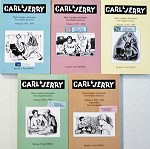 Carl & Jerry: Their Complete Adventures
is now available. "From 1954 through 1964, Popular Electronics published 119 adventures
of Carl Anderson and Jerry Bishop, two teen boys with a passion for electronics
and a knack for getting into and out of trouble with haywire lash-ups built in Jerry's
basement. Better still, the boys explained how it all worked, and in doing so, launched
countless young people into careers in science and technology. Now, for the first
time ever, the full run of Carl and Jerry yarns by John T. Frye are available again,
in five authorized anthologies that include the full text and all illustrations." Carl & Jerry: Their Complete Adventures
is now available. "From 1954 through 1964, Popular Electronics published 119 adventures
of Carl Anderson and Jerry Bishop, two teen boys with a passion for electronics
and a knack for getting into and out of trouble with haywire lash-ups built in Jerry's
basement. Better still, the boys explained how it all worked, and in doing so, launched
countless young people into careers in science and technology. Now, for the first
time ever, the full run of Carl and Jerry yarns by John T. Frye are available again,
in five authorized anthologies that include the full text and all illustrations." |
|