|
|||||||||||||
 |
|||||||||||||
Ferrites - The Mighty Midgets of Electronics
|
|||||||||||||
The transformative role of ferrites - crystalline structures composed of iron oxide and metallic additives - in advancing modern electronics, is reported in this 1961 Electronics Illustrated magazine article. Ferrites uniquely combine magnetic properties with electrical insulation, enabling high efficiency at frequencies where standard iron cores fail due to eddy current losses. This "electronic wonder material" proved critical for television development, allowing for larger picture tubes through efficient flyback transformers and deflection yokes. Furthermore, ferrites revolutionized computing by providing reliable, compact memory cells, replacing failure-prone vacuum tubes in machines like the Whirlwind I. Beyond these core applications, the material facilitates innovations such as ultrasonic remote controls, miniaturized transistor radios, and high-speed telephone switching via the "ferreed." As ceramic-like products fired in kilns, ferrites continue to enable breakthroughs in radar, automotive technology, and signal filtering, solidifying their status as an indispensable component in the progression of shrinking, faster, and more reliable electronic hardware. "Magnetic ferreed counting circuit" patent #US3191152A. Ferrites - The Mighty Midgets of Electronics
Computers, tiny radios, big-screen TVs, and other marvels owe everything to odd-acting crystals. By Ken Gilmore Four years ago the antenna in your bedside radii, was a flat coil an eighth of an inch thick and as big as a sheet of writing paper. Today it is the size of a pencil or smaller and it does an even better job. Not long ago it was said that TV tubes larger than 17 inches would never be practical. Today 27-inchers are not uncommon. Scientists a decade ago had the major problems of computer circuitry worked out but the giant brains were not built because there were no practical memory units of reasonable size. Today has become the age of the computer because we are able to pack millions of memory cells into a few cubic feet. All these remarkable advances, and hundreds of others ranging from day-after-tomorrow radar to improved motor car ignition systems, were made possible by the electronic wonder material of our time: ferrites. Ferrites are nothing more than iron oxide - rust with traces of such additives as zinc, nickel, manganese, magnesium and other substances. The word ferrite sometimes appears as an adjective (ferrite loop - stick, ferrite stampings, etc.) but the plural form becomes a noun ... ferrites. Though the terminology is a bit confusing, a ferrite is a tiny crystalline structure made up of the substances listed above.
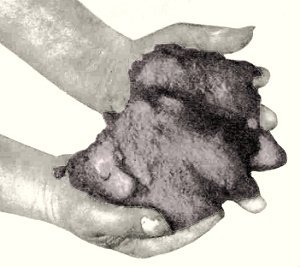
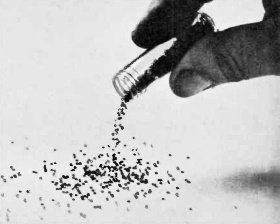
Reddish dust at left is the basic raw material for ferrites. Traces of metals are added to the dust.
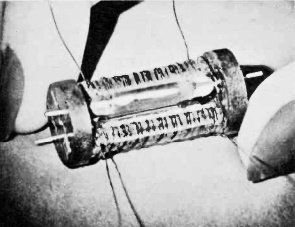
Bell Labs "ferreed" is a ferrite-bar switch that is 1,000 times faster than models now used.
Each of these ferrite doughnuts represents a single memory core for a modern computer.
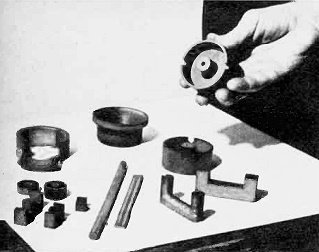
Sample ferrite stampings include TV yokes at upper left; C cores for flyback transformers at right; rod, strip are for radio antennas.
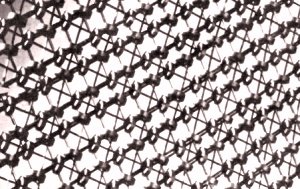
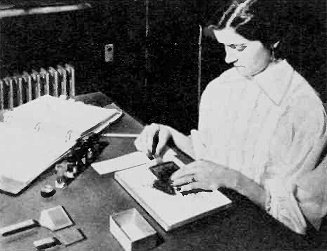
Tiny computer memory cores are counted with a paddle containing 400 holes. Worker scoops up cores, makes certain every hole is filled.
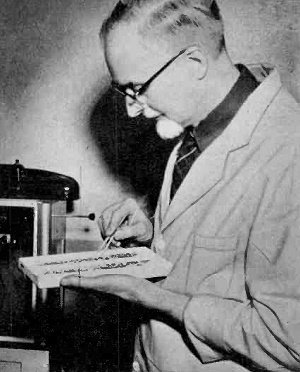
Dr. Ernst Albers-Schoenberg, a leading authority on ferrites, developed memory cores for computers and played a major role in search for other uses for the material. He is holding tray of cores.
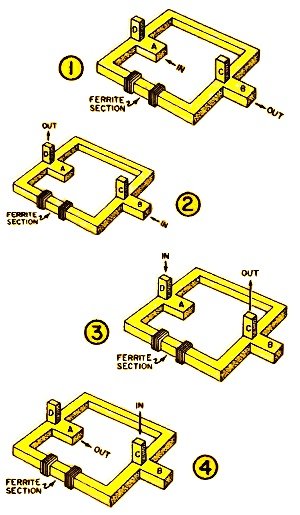
Ingenious ferrite circulator develops some strange phase relationships. Signal that goes in A comes out of B, but signal in B comes out of D rather than A. The diagrams show other possibilities. In radar work, transmitter is hooked to A, antenna to B, receiver to D. Transmitter pulses then cannot damage receiver but radar echoes are channeled to receiver, as they must be. To become useful, millions of ferrite crystals, which look like nothing more than reddish dust, are mixed into a special dough and stamped into intricate shapes by giant machines which exert tons of pressure and look like cookie cutters. After that the stampings are baked in kilns at high temperatures for a day or more. Out of the kiln come blackish bars, rods, rings, blocks and cylinders. The raw material looks pretty nondescript and so do the stampings, but their appearance is deceiving. These electronic cookies are able to do a great many jobs that were simply impossible before they came along. Ferrites perform their tricks because they combine two properties seldom found in one material. First, they are magnetic and can be magnetized and demagnetized like iron. And second, they are insulators. Unlike iron, they will not conduct electricity. Why is this combination so important? Take the output transformer in your hi-fi amplifier. It, like many other electronic devices, works because it has the electrical property of inductance. Its inductance, and hence its efficiency, can be increased hundreds or thousands of times if it is wound on a core of magnetic material, usually iron. But the core creates its own problems. The inductance, which does the transformer's useful work, unfortunately induces an eddy current in the iron core. This eddy absorbs power, cutting down efficiency and thus partially defeating the purpose of the core. At low frequencies the loss is small. But the higher the frequency, the higher the eddy current loss. Finally, the loss becomes so great that the transformer is useless. To combat this problem, transformer designers split iron cores into thin, insulated sheets. This breaks up the conducting path through which the eddy current can flow and raises the useful frequency limit of the transformer. But this is only a partial remedy. As the frequency rises, eddy currents begin to flow in the individual sheets. But ferrites are magnetic materials which also are insulators. Consequently, they can serve as cores but no eddy currents can flow. Thus hundreds or thousands of new or improved electronic devices become possible. The first child of the ferrites to gain wide acceptance came after World War II. Researchers had been intrigued with ferrites but they remained laboratory curiosities. Then along came television. Manufacturers shopped for a magnetic material to increase efficiency of the flyback transformer - the component which provides the high voltage for your TV picture tube. The flyback had to handle a lot of power and at the same time work efficiently at high frequency. A ferrite core did the trick. About this time General Ceramics Corporation, which for almost 150 years had been making ceramic products from ash trays to bathroom fixtures, was looking for new fields to conquer. The choice was ferrites because ferrites and ceramics are first cousins - both are metallic oxides fired in a kiln. Dr. Ernst Albers -Schoenberg, a leading ferrite expert, was made GC's research director. He developed several types of ferrite material, but they caused no great excitement and went mostly to researchers. Then TV came on the scene and the staid old ceramics firm suddenly had back orders amounting to $3,000,000. The biggest part of GC's facilities were turned into ferrite production. Other companies are now in the business but GC is the biggest. By 1950 television was a fixture but the 17-inch tube seemed the practical limit. Even though the flyback was efficient, the coils into which its power was poured to do the beam sweeping just couldn't develop enough magnetic force to deflect the beam over a larger tube face. Again, ferrites to the rescue. An engineer at General Electric built a ferrite collar - or yoke, as it is now known - to fit over the deflection coils around the tube's neck, thus giving the system more magnetic strength. The result was the 21-, 24- and 27-inch picture tube. In 1953 MIT's Lincoln Laboratory designed a computer using electron tube memory cells which showed promise. But there were problems. The most difficult one was that tubes are subject to failure at a predictable rate. If you put 10,000 or so of them together you're likely to average a breakdown a day. Computers, to be really useful, must have hundreds of thousands of memory cells. That would mean tubes popping like firecrackers, faster than they could be replaced. The answer to the problem was simply not to use tubes. Instead, Dr. Albers-Schoenberg developed a ferrite material which could be molded into a doughnut a fraction of an inch in diameter. This tiny structure was able to serve as a computer memory cell because it could be magnetized in one direction or the other (yes or no) and then could produce this information a minute or a year later. Dr. Albers-Schoenberg and Lincoln Lab got together and history was made. For a test, the lab built two computers, one using tubes, the other - the famous Whirlwind I -using ferrite memory cores. The giant brains, containing about 140,000 memory cells each, went into operation in August 1954. Six months later, Whirlwind had made two errors in millions of calculations. Its vacuum tube cousin had been down for repair over a third of the time. In addition, the ferrite memory proved to be faster and able to handle more work. IBM, giant of the computer field, studied the results and switched to ferrite core memories. Today, although magnetic tapes and drums, photographic images, and other devices are being used in specialized applications, all large-scale, random-access computer memories use ferrite doughnuts. Some employ millions of cores. There are other exciting gadgets made of this processed rust. Do you have a super -sonic remote control unit for your TV? When you press a button, this little wizard tells your TV set what to do with a series of sounds too high for you to hear. The TV set must not only pick up these sounds, but must discriminate between signals of several different frequencies. For this job, it uses five to ten ferrite filters which can tell a high squeak from a low one and thus know whether to change the channel or turn up the volume. Within a few years you may have an automobile radio mounted in your car's trunk, thanks to ferrites. The radio now competes for space under the dash because you must turn the dial manually - and the capacitor or inductive tuner behind it - to change stations. But certain ferrite materials change their permeability, or magnetic properties, under the influence of electrical signals. This means that the July, 1961 tuning section of your receiver could be varied electrically rather than mechanically. Your radio could thus be anywhere in the car with no difficulty. Ferrites are helping make things smaller too. Some shirt-pocket transistor radios owe their small size in part to ferrite -core IF transformers the size of a sugar cube. Portable and bedside radio antennas are getting so small that a Dick Tracy wrist radio now seems a possibility. Within a year or so you'll probably be able to do away with unsightly TV rabbit ears with the use of a new ferrite antenna which will be enclosed in the set and will do a better job. Several companies are reported near commercial production. Electronic equipment of all kinds, from voltage converters for Citizens Band transceivers to recording heads on tape recorders, is being improved with ferrites. Scientists at Bell Labs recently dreamed up a gadget they call the ferreed. Basically, it is a tiny switch which operates a thousand times more rapidly than any present model. It may be routing your telephone calls before long. The ultra-high-speed switching is done, needless to say, by a versatile ferrite material. Ferrite devices of another kind may help speed along your telephone calls. Engineers have found new ways to send hundreds or perhaps thousands of conversations over one microwave link or coax cable simultaneously. The only trick is to separate the signals at the other end. This electronic routing is a job for filters, and a newly developed ferrite "cup-core" may just fill the bill. Ferrite microwave switches are doing away with many complex mechanical devices. For instance, a piece of ferrite material is put inside a waveguide - a pipe through which high- frequency signals flow. Normally, the waves go through the material just as though it were not there. But apply an electric current and it stops them cold. Research in ferrites goes on, both to develop better basic materials and to find new ways to use them. Some of the developments promised by ferrite research include: A better, non-flickering fluorescent light. Power tools (electric drills and the like) which will weigh one-third as much as present models. More efficient automotive and boat ignition and electrical systems which will be smaller, lighter, cheaper and more reliable. Clearly, ferrites are destined to play a major role in our lives from here on. |
|||||||||||||
 |
|||||||||||||
|
|||||||||||||

|
||||||||||||||||||||||||||||||||||||