|
|||||||||||||
 |
|||||||||||||
Don't Fry That Ham!
|
|||||||||||||
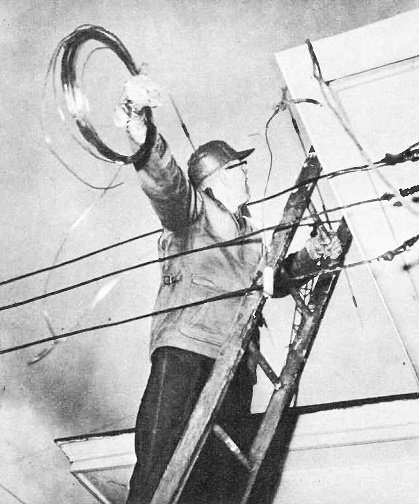
If some of the images in this issue of Electronics Illustrated magazine were made within the last couple years, I would swear they were AI-generated. Surely, there are not really people as stupid as those shown here... but, alas, there apparently are. These photos were published in 1960. The ARRL (American Radio Relay League) has always published recommended safety practices - particularly regarding high voltages from overhead power lines and lightning strikes. How anyone, like the guy in the first photo, could ever even considering standing on a ladder and sticking his arm between even the 240-volt house supply line from the utility pole - without even a current-limiting device like a fuse or circuit breaker inline - is beyond comprehension. Clearly, the antenna already installed runs over top of the power lines. The metal tower in another photo is standing right next to 13 kV lines. Sheesh! ARRL says always assure the distance between a tower and overhead power line is great enough to assure contact cannot be made if the tower falls. Common sense and basic survival instinct should obviate the need to even warn against such idiocy. BTW, the article is pretty clever! Side note: a couple weeks ago I published a piece describing the job I just did to bury a couple 240-volt service lines to replace overhead lines. When completed, I called the power company to have them cut down the old lines, the service person was telling me it could take a long time to get someone out here. After not being successful in convincing her it need to be done soon, I said, "OK, then I'll climb up the pole and cut the lines loose myself." A lineman was out the next morning to remove the wires ;-) Don't Fry That Ham!
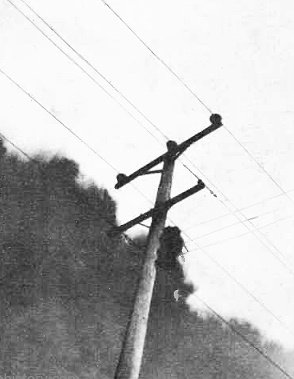
Obviously this OM is trying to string a long wire antenna, but he probably won't feel much like working his rig after he gets a jolt from the house power lead-in wires. There are about 240 volts between his left jaw and his right hip. By Carole F. Hoover, K9AMD Never trust outdoor power lines. Get to know 'em from a distance and be dead sure, not sure dead! The familiar nets of electric light and power wires that crisscross city and country miles alike may look as harmless as Granny's clothesline, but they certainly have lots more personality. The shocking truth is that practically every red -blooded ham who shinnies up a tree, pole, or ladder to string his own antenna probably rubs elbows with enough electricity in those same little wires to lay him low. Of course, as long as he minds his amps and volts, there's no harm done. The time taken to study a few power poles with its electrical distribution system will not be wasted. The first lesson in learning to identify voltages tells us that electricity is carried from pole to pole in many ways. Anywhere from two to eight wires may run between supporting pins on wooden crossarms; a single wire sometimes rides a steel pin and insulator at the center-top of a pole with no crossarms at all; or maybe two to four wires run on distribution racks on the sides of other poles without crossarms. The high -power lines carrying lethal, "primary" voltages of 2300, 7200, or 34,500 volts are usually strung at the very top of a pole, while farther down, wires on racks or spools at lower potentials of 115 to 440 volts are more neighborly, but still not to be trusted. A more reliable clue to finding the voltage of a wire or conductor than checking its location on the pole is noting the size of the insulator that supports the "live wire." A brown or white -glazed porcelain insulator about the size of a bowling ball with large grooves on the sides and top is a sure sign of high voltage. This model usually has one or two covering "skirts" to protect it from water seepage during rainy weather. A fist-size insulator handles 2300 to 7200 volts while a larger one designed for 16,500 volts compares in size to a big beer mug. Many high-voltage circuits still use green glass insulators which are considered harmless in telephone lines but are quite capable of handling much higher voltages elsewhere.
So anxious to rig new beam, ham doesn't notice element swing onto pole circuit carrying 13,000-v, enough to add him to "Silent Key list.
When you don't let power company trim tree branches entire tree may become booby trap. Insulation wears, tree conducts. Even a city-slicker knows that a rattlesnake won't hurt anybody unless he's fooled with, and the same is true of a power line high on a pole. All would be well if hams didn't have the risky habit of getting long wires, ladders, and metal beam elements tangled in everything from the chimney on the roof to the bird house in the backyard. "But all wires are insulated, aren't they?" you may argue. Sure, wires are wrapped up, but that covering protects the conductor against corrosion from bad weather, and not a ham who gets his pinkies on it or an antenna against it.
<-- Top L to R:
<-- Size of insulators identify voltages: Three on top carry 34,500-v conductors. Below them are 7200-v lines. Bare wires extending to right are 110/220-v secondary wires running into home.
"The vital function of any tree includes holding up a long wire first and a bird-nest second," contends the typical amateur, and the same fellow will gasp in horror when he hears that his friendly old oak can turn into a booby trap overnight. Should a power line droop through its branches and rub against a limb, the cambium layer and green sap will do what comes naturally and conduct electricity better than a trimmed Christmas tree. Any doubting Thomases in the crowd will recall that lightning often dives for the nearest tree in a spring storm. "Don't try to tell me that 115 volts on an ordinary streetlight circuit is dangerous," scoffs the amateur who hasn't seen the right light. |
|||||||||||||
 |
|||||||||||||
|
|||||||||||||




|
||||||||||||||||||||||||||||||||||||