Search RFC: |                                     
Please support my efforts by ADVERTISING!
About | Sitemap | Homepage Archive
Serving a Pleasant Blend of Yesterday, Today, and Tomorrow™
Vintage Magazines
Electronics World
Popular Electronics
Radio & TV News
QST | Pop Science
Popular Mechanics
Radio-Craft
Radio-Electronics
Short Wave Craft
Electronics | OFA
Saturday Eve Post
Alliance Test | Isotec
Please Support My Advertisers!
RF Cafe Sponsors
Aegis Power | Centric RF | RFCT
Empwr RF | Reactel | SF Circuits

Formulas & Data

Electronics | RF
Mathematics
Mechanics | Physics


Calvin & Phineas

kmblatt83@aol.com

Resources

Articles, Forums, Radar
Magazines, Museum
Radio Service Data
Software, Videos


Artificial Intelligence

Entertainment

Crosswords, Humor Cogitations, Podcast
Quotes, Quizzes

Parts & Services

1000s of Listings

        Software:

Please Donate
RF Cascade Workbook | RF Symbols for Office
RF Symbols for Visio | RF Stencils for Visio
Espresso Engineering Workbook
Maury Microwave / Noisecom UFX7000B Noise Generator - RF Cafe


Anatech Electronics RF & Microwave Filters - RF Cafe

Please Support RF Cafe by purchasing my  ridiculously low-priced products, all of which I created.

RF Cascade Workbook for Excel

RF & Electronics Symbols for Visio

RF & Electronics Symbols for Office

RF & Electronics Stencils for Visio

RF Workbench

T-Shirts, Mugs, Cups, Ball Caps, Mouse Pads

These Are Available for Free

Espresso Engineering Workbook™

Smith Chart™ for Excel

Copper Mountain Technologies Vector Network Analyzers - RF Cafe

Cascaded Gain (G)

Linear gain in a chain of cascaded components is by far the easiest parameter to calculate. Because its value is a first-order entity with no dependence on any other parameter of a particular component (assuming no signal feedback or leakage), combining gain two successive stages is the simple addition of each stage's gain if expressed in units of dB, or multiplication if expressed as a unitless ratio.

Cascading Gain Values in a Chain of Components

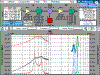
Example cascaded system - RF Cafe

Click here to view an example of a cascaded system.

For example, if a 1st and 2nd stage in a cascade have power (as opposed to voltage) gains of 3.01 dB (multiplication factor of 2) and 10.0 dB (multiplication factor of 10), respectively, then the total gain is:

   3.01 + 10.0 = 13.01 dB,

or a multiplication factor of:

   2 x 10 = 20 [check: 10 * log10 (20) = 13.01 dB].

It's that simple!

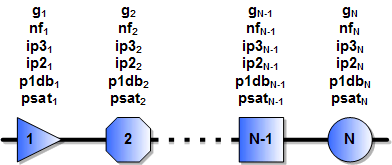
Cascaded components for calculating Gain - RF Cafe

A Typical Chain of Cascaded Components


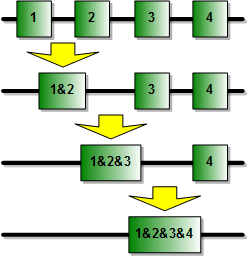
Cascading receiver transmitter stages two at a time - RF Cafe

Combining 2 Stages at a Time for Calculations

Copper Mountain Technologies Vector Network Analyzers - RF Cafe