|
Here is the "Electrician's Mate 3 - Navy Training Courses"
(NAVPERS 10548) in its entirety (or will be eventually). It should provide one of
the Internet's best resources for people seeking a basic electricity course - complete
with examples worked out. See
copyright.
See Table of Contents.
¶ U.S. GOVERNMENT PRINTING OFFICE;
1949
CHAPTER 1
ELECTRICAL CURRENTS AND CIRCUITS
- OHM'S LAW ELECTRICITY
AN INVISIBLE SERVANT
Most of you have had some experience with electricity. Possibly your experience was limited to replacing a
blown fuse or burned-out light bulb. If you were a top-notch amateur, you may have done some wiring about your
home; but now you are about to become an Electrician's Mate, and it is necessary for you to learn the Navy's way
of doing things. This manual will start you off on the right foot. H you must change your method of making
electrical connections, installing switches, or operating motors, don't be upset - the men of the Navy have
learned by experience the best way of doing the job.
Electricity is known by what it does (producing
light, running motors, and operating telephones) rather than by what it is. While there may still be some doubt as
to what electricity is, the laws governing what electricity does are well known and clearly defined.
Electricity can be your slave, or your master. If you learn the laws of electricity well, and respect its
abilities, it will work for you in a thousand and one ways. But if you are careless, and do not learn what
electricity is capable of doing, it may destroy you.
THIS COURSE AND YOU
This course is not intended to make a designing engineer out of you. Instead, it is to acquaint you with the
basic laws of electricity, and to teach you how to apply them in operating and maintaining the electrical
equipment on your ship.
This book starts where the course on Basic Electricity leaves off. You will find
the contents much easier to master if you will first review the course on Basic Electricity (Navpers 10622).
As an Electrician's Mate you are principally concerned with electrical circuits. To start you off right, this
chapter will give you a quick review of the basic ideas about electrical circuits that you have already learned
from your study of elementary electricity.
ELECTRICAL CURRENT IS LIKE WATER IN A PIPE
An electric current is a flow of electrons through a conductor. Therefore, current electricity can be compared
to water flowing through a pipe.

Figure 1. - A source of electrical potential.
Before an electrical current can flow, there must be a source of electrical pressure, just as you must have a
pump to build up water pressure. This electrical pressure is called an ELECTROMOTIVE FORCE and is produced by a
battery or a generator. The electrical pressure between any two points in a circuit is called the POTENTIAL. Look
at figure 1. The cell plays the same part in causing a current to flow as the pump does in forcing ~water through
the pipe.

Figure 2. - Conductors.
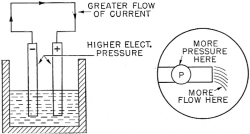
Figure 3. - Electrical circuits - increased electrical pressure - increased current
flow.
Next there must be an "electrical pipe" to carry the flows In the case of electricity, the pipes usually are
solid piece of metal and are called CONDUCTORS. The pipe in figure 2 plays the same part for water as the
conductor does for electricity.
If you increase the pressure on the electrons in the conductor, a greater
current will flow, just as an increased pressure on the water in a pipe will increase its flow (fig. 3).
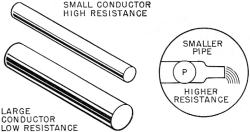
Figure 4. - Electrical circuits. Reduce the size of conductor - increase the
resistance to current flow.

Figure 5. - Electrical circuits - the longer the conductor, the greater the
resistance to current flow.
If the conductor is made smaller, figure 4, the electrical resistance is increased, just as a smaller pipe
increases the resistance to the flow of water.
When a conductor is lengthened, the resistance is
increased, just as a longer pipe increases the resistance to the flow of water (fig. 5). Each time you add another
length of conductor in series, the resistance increases; hence it takes a greater electrical pressure to force the
same amount of current through a long conductor than through a shorter one. You can see this comparison in figure
6. You must remember that the type of metal used in the conductor affects the resistance also. Since copper has a
low resistance, it is used most frequently for ship and shore electrical systems.
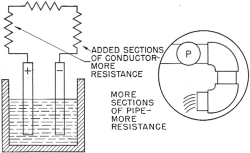
Figure 6. - Electrical circuits - adding resistances in series increases the total
resistance to current flow.
It is obvious that no more water can flow out of a pipe than flows into it. All evidence points to the fact
that the same is true of an electric current; no more current can leave a conductor than enters it. In practice
this means that if you have a battery, generator, or any other source of electromotive force, just as much current
returns to the source as flows away from it. This is known as KIRCHHOFF'S FIRST LAW.
Apply this law to a
SERIES CIRCUIT, as illustrated in figure 7, and you see that THE CURRENT FLOWING IN ALL PARTS OF THE CIRCUIT IS
IDENTICAL. If this law is applied to a PARALLEL CIRCUIT, as shown in figure 21, you see that THE SUM OF ALL
CURRENTS FLOWING TO A JUNCTION EQUALS THE SUM OF CURRENTS FLOWING AWAY FROM IT.
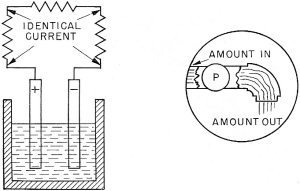
Figure 7. - Current in a series circuit is everywhere identical.
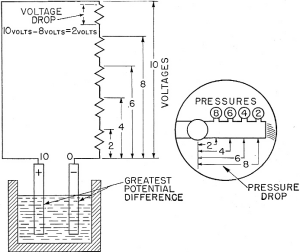
Figure 8. - Electrical pressure is greatest at its source.
Remember this law. You will use it hundreds of times in solving electrical problems. It is simple, but also very
important.
Ever try to draw water from a tap near the end of a water main? Not much pressure? The pressure
is always greatest at the pump and decreases with each step as you move away.
In electrical circuits,
the pressure is the greatest at the source, or as in figure 8, at the positive terminal of the battery; the
pressure decreases throughout the length of the circuit to zero pressure at the negative terminal. The difference
in pressure between any two points in the circuit is the pressure drop, or potential difference. THE SUM OF ALL
THE PRESSURE (VOLTAGE) DROPS IN A CIRCUIT IS EQUAL TO THE APPLIED ELECTROMOTIVE FORCE. This principle is known as
KIRCHHOFF'S SECOND LA W. You will find many problems aboard ship concerning electrical pressure drops, so keep
this law in mind.
THE THREE FACTORS - VOLT, OHM, AMPERE
All electrical circuits have the two factors of PRESSURE and RESISTANCE determining the third, CURRENT. Think
of these factors as illustrated in figure 9; pressure tends to move the electrons, and the resistance of the
conductors tends to stop them.
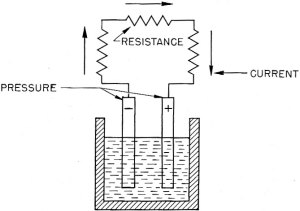
Figure 9. - The three factors in an electrical circuit.
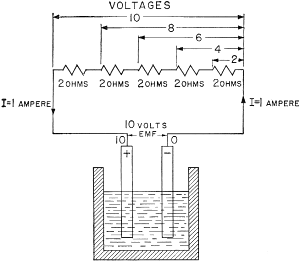
Figure 10. - Volts, ohms, and amperes in a circuit.
The term used to express the unit of electrical pressure is the VOLT. SO whenever you see the terms VOLT or
VOLTAGE used, remember it refers to the force or pressure tending to keep the electrons moving. Voltage is
sometimes called ELECTROMOTIVE FORCE (emf). In most electrical formulas the symbol "E" is used to represent
voltage.
The unit of resistance is the OHM, and like the volt it has an exact value. Briefly, it is the
opposition to the flow of current offered by a column of mercury 106.300 centimeters long and weighing 14.4521
grams, when at 0° centigrade. In electrical equations the letter "R" is the symbol used to designate resistance.
The AMPERE expresses the number of electrons flowing past a point each second. Since the electron is
extremely small, a bundle of 6.3 billion-billion electrons is used as unit and called a COULOMB. When a coulomb
moves past a point in a second, the amount of current flowing in the circuit is said to be one ampere.
Put
the three factors - voltage, resistance, and current together as illustrated in figure 10, and you have the basis
for all electrical computations. The current is determined by the applied voltage and the resistance offered by
the circuit. Many times you will see this relationship stated as in figure 11, where a current of 1 ampere will
flow when the electrical pressure is 1 volt and the resistance of 1 ohm. It is just another way of stating OHM'S
LAW.
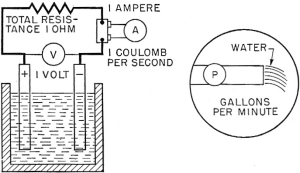
Figure 11. - One form of Ohm's law.
MORE ABOUT OHM'S LAW
You learned in the preceding paragraphs that an increase in voltage means an increase in current, but an
increase in resistance means a decrease in current. In other words the current flowing in a circuit is directly
proportional to the applied voltage, and inversely proportional to the resistance. That is the most common way of
stating Ohm's law. When you put this word statement into a mathematical relationship you get -
Current = Pressure/Resistance
or
Amperes= Volts/Ohms
or
I = E/R
so if
you know two of the values in Ohm's law, you can always find the third.
To aid in solving problems, Ohm's law can be written in two other forms. The first -
E = I x R
enables you to find the voltage if you know the current and resistance.
The second form enables you to find the resistance of the circuit if you know the current and voltage. It is
written -
R = E/I
Here are some practice problems.
1. What current will flow in a
circuit containing a heater element with a resistance
of 10 ohms when the applied voltage is 110?
Solution: I = E/R I = 110/10 I = 11 amperes
2. If you know a certain horn requires 6
amperes to operate it properly and the
resistance of the circuit is 2 ohms, what is the required
voltage?
Solution: E = IR E = 6 x 2 E = 12 volts.
3. What resistance may a
lamp requiring 3 amperes have, if only 6 volts are
available to light it?
Solution: R =
E/I R = 6/3 R = 2 ohms
In electrical circuits, resistance is indicated by a zigzag line. Turn
back to figures 9, 10, or 11 and you will see this illustrated. Many times this symbol will indicate all forms of
resistances whether they be coils, heating devices, or just the resistance of a conductor.
RESISTANCES IN SERIES
When you apply Ohm's law to circuits containing a single resistance, finding the current or voltage is a
simple matter of substituting this single resistance value in the equations of Ohm's law, and then solving for the
answer, as you did in the examples above. But if the circuit contains several resistances, you must find the
combined resistance before the correct values of current and applied voltage can be found.
Resistances
connected in a manner that provides only one path for the current to follow through the circuit and back to the
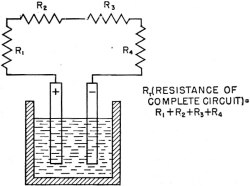
source, are said to be connected in SERIES. The circuit in figure 12 is an example of a series connection. All
current that flows through R1 must flow through R2, R3 and R4
before it returns to the source. Thus the total opposition to the flow of current will be the sum of all the
individual resistances, or RT = R1 + R2 + R3
+ R4
 RF RF
Figure 12. - Resistance of a series circuit.
The devices connected in a series circuit are linked together by conductors and connections. These also have
resistance, and their resistances must be added to the resistance of the devices connected in the circuit to get
the total resistance of a series circuit. Since the resistance of the conductor depends on its length, size, and
the material it is made of the total resistance of a series circuit is determined by the factors illustrated in
figure 13.
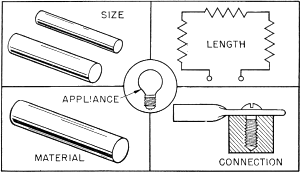
Figure 13. - Factors that determine the resistance of a circuit.
It is important to remember about this extra resistance due to conductors and connections, because in low
resistance circuits (battery circuits, firing circuits, etc.) the greatest part of the circuit resistance is due
to the conductors and connections used.
VOLTAGE DROPS IN A SERIES CIRCUIT
Figure 14 is an illustration of three lamps in series, and if the lamps are considered to be the only
resistances in the circuit the total resistance of the circuit will be -
RT = R1
+ R2 + R3
and the current will be -
IT = I1 =I2 =I3
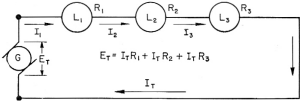
Figure 14. - Voltage in a series circuit.
The combined voltage drop across the lamps will be the sum of the individual voltage drops -
ITRT
= I1R1 + I2R2 + I3R3
But in a series
circuit the current is everywhere equal, so II! I2!and 13 are the same as IT! and the combined voltage drop across
the lamps will be-
ITRT = ITR1
+ ITR2 + ITR3
or,
ITRT = IT
(R1 + R2 + R3)
Since in this circuit the lamps are considered to contain all the resistances, the total voltage drop of the
circuit must be equal to the total applied voltage -
ET = IT (R1 +
R2 + R3)
Thus you may say; THE SUM OF THE INDIVIDUAL IR DROPS ABOUT A SERIES CIRCUIT
IS EQUAL TO THE APPLIED VOLTAGE.

Figure 15. - A series circuit problem.
Here are two sample problems of resistors in series. More may be found in the problems for this chapter given
in the QUIZ at the end of this chapter.
1. The generator in figure 15 produces an emf of 120 volts, and
the circuit contains
resistors of 3,4, and 5 ohms. What is the current?
First find the total
resistance -
RT = R1 + R2 + R3
RT = 3 + 4 + 5
RT = 12 ohms
Now substitute the values of E
and RT in the formula for Ohm's law -
I = E/R I = 120/12 I = 10 amperes
2. The series circuit illustrated in figure 16 is carrying 6 amperes of current and
contains 3
lamps of 2,4, and 6 ohms. What is the applied voltage? What is the
IR drop across each lamp?

Figure 16. - Another series circuit problem.
First find the total resistance -
RT = R1
+ R2 + R3
RT = 2 + 4 + 6
RT = 12 ohms
Using the equation ET
= IRT and substituting the correct values of I and RT -
ET = 6 x 12
ET = 72 volts
Since each lamp is carrying 6 amperes, the individual IR drops will be -
For L1 - E1 = 6 x 2 = 12 volts
For L2 - E2 = 6 x 4
= 24 volts
For L3
- E3 = 6 x 6 = 36 volts
RESISTANCES IN PARALLEL
In parallel circuits, the appliances are connected in such a manner that the total circuit current is divided
between them. Each appliance then provides a branch path for the current to follow. Look at figure 17. The lamps
form three branch paths for the current. Naturally the total resistance is less than what it would be if only one
of the lamps were present.

Figure 17. - Parallel circuit.
You may think of the lamps in parallel as a water pipe having three outlets. When the outlets are all the same
size, the total resistance offered will be -
Total resistance = Resistance of one outlet / Number of
outlets or, if the three lamps in figure 17 are of the same resistance, the total resistance will be -
RT = Resistance of one lamp /3
So if each lamp has a resistance of 12 ohms, the total
resistance will be -
RT = 12/3 =4 ohms.
UNEQUAL RESISTANCES IN PARALLEL
Seldom will you find parallel circuits that contain resistances all of equal value. The task of finding the
total resistance is then a little more complicated. In this case the simplest way to find the total resistance is
to use the formula -
1/RT
= 1/R1 + 1/R2 + 1/R3

Figure 18. - Resistance in parallel.
Now try a problem to see how this system works out. In figure 19 you have three resistances (30, 50, and 75
ohms) in parallel, and you wish to know the total current when the applied voltage is 102.

Figure 19. - A problem on resistances in parallel.
First find the total resistance using the formula
1/RT
= 1/R1 + 1/R2 + 1/R3
Substitute the values of resistance for R1,
R2, and R3 -
1/RT
= 1/30 + 1/50 + 1/75
Next find the least common denominator and add
1/RT = (5 + 3
+ 2)/150
1/RT = 10/150
To find RT cross multiply and solve -
10 RT = 150
RT
= 15 ohms.
Now you find the current from Ohm's law. Since E is 120 volts -
I = E/R I
= 120/15 I = 8 amperes
VOLTAGES IN PARALLEL CIRCUITS
In parallel circuits, the voltage across each branch of the circuit is equal to the voltage across every other
branch. Thus, in figure 20, the voltages across L1, L2, and L3 are all the same
and are equal to the applied voltage; that is -
E = E1 = E2 = E3

Figure 20. - Voltages in parallel circuits.
This principle holds regardless of the number of branches, or the relative resistance of each. The VOLTAGES
ACROSS ALL LEGS OF A PARALLEL CIRCUIT ARE EQUAL.
CURRENT IN PARALLEL CIRCUITS
Since the voltages across all parallel branches of a circuit are equal, the most current, like most water,
will flow through the branch of lowest resistance. Turn back to figure 17 again. The resistance of the 4-inch
outlet is less than that of the 2-inch, so more water will flow through it. The same thing is true in electrical
circuits; the most current flows through the lowest resistance.
In figure 19 you have three unequal resistances; 30, 50, and 75 ohms. Naturally the most current will flow
through the 30-ohm lamp, and the least through the 75-ohm lamp, but how much through each? The solution to the
problem is just one of applying Ohm's law to each leg of the circuit. The voltage applied to the lamp in each leg
is 120, since the voltages across all parallel branches of a circuit are equal.
Here is the solution
The current through L1 is -
I1 = 120/30 = 4.0 amperes
The current
through L2 is -
I2 = 120/50 = 2.4 amperes
The current through L3 is
-
I3 = 120/75 = 1.6 amperes
How about the total current? You read in a preceding
paragraph Kirchhoff's FIRST LAW, which says that AS MUCH CURRENT FLOWS AWAY FROM A POINT AS FLOWS INTO IT.

Figure 21. - Currents in a parallel circuit.
Thus, as shown in figure 21, at point A the total current must divide and flow through the three lamps, and at
point B the three currents from the lamps must all unite to form the total current, which flows back to the
battery. In other words, THE TOTAL CURRENT MUST BE THE SUM OF THE INDIVIDUAL CURRENTS.
IT
= I1 + I2 + I3
IT = 4.0 + 2.4 + 6
IT
= 8 amperes.
SAMPLE PROBLEM - PARALLEL CIRCUITS
Figure 22 is a sample problem of resistances in parallel. You are~ asked to find the resistance of L3.

Figure 22. - Sample problem on resistances in parallel.
First substitute the known values of resistance in -
1/RT = 1/R1 + 1/R2
+ 1/R3
1/4 = 1/6 + 1/20 + 1/R3
Then solve for R3 -
1/4 - 1/6 - 1/20 = 1/R3
(15 - 10 - 3)/60 = 1/R3
2R3 = 60
R3
= 30 ohms
In the preceding problem you used the same parallel resistance formula. The only difference
between this and other examples is the unknown you solved for.
You may have problems with 4, 5, 6 and even
many more resistances in parallel. In that case, the parallel resistance formula just gets longer, such as -
1/RT = 1/R1
+ 1/R2 + 1/R3 + 1/R4 + 1/R5 ...
for as many more as you wish
to add.
More practice problems on parallel circuits can be found in the questions for this chapter in the
QUIZ at the end of this chapter. Try your luck.
SERIES - PARALLEL CIRCUITS
Many hook-ups of resistances in combinations of series and parallel circuits will be found aboard ship. No new
formulas need be used. You just break the complete circuit into simple series and parallel circuits. Solve each
part separately and then combine the parts.
Here is a sample problem. In figure 23A five resistances are
connected as indicated. You are asked to find the total current.

The first step is to find the combined resistance of R1-R2 and R4-R5,
by using the parallel resistance formula for each group.
For group R1-R2, the
equivalent resistance, Rx, is -
1/Rx
= 1/5 + 1/20
1/Rx = (4 + 1)/20
1/Rx = 5/20
Rx
= 4 ohms.
For group R4-R5, the equivalent resistance, Ry, is -
1/Ry = 1/4 + 1/12
1/Ry = (3 + 1)/12
1/Ry = 4/12
Ry = 3 ohms
The combined resistance of R1-R2
is 4 ohms, and of R4-R5, 3 ohms. As far as the flow of current is concerned, a single
resistance of 4 ohms can replace R1-R12, and one of 3 ohms can replace R4-R5.
Thus for calculation it is possible to redraw the circuit as in figure 23B and get a circuit with three
resistances of 4, 6, and 3 ohms in series. The total resistance will be -
RT = 4 + 3 + 6
ohms
and the current will be -
I = E/R
I = 130/13
I = 10 amperes
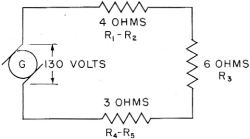
Figure 23B. - Equivalent circuit of figure 23A.
Figure 24A presents another example of a series-parallel problem. It has a few more resistors than the
preceding problem, but it is just as simple. You are told that the current in the circuit, I, produces an m-drop
across the 2-ohm resistor of 24 volts. What voltage must the generator have?
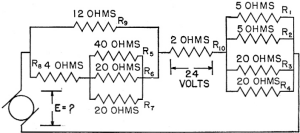
Figure 24A. - A series-parallel network.
The first step is to find Rx, the combined resistance of the R1-R2-R3-R4
branch. Using the parallel resistance formula -
1/Rx
= 1/5 + 1/5 + 1/20 + 1/20
1/Rx = 10/20
Rx = 2 ohms
Now for the R5-R6-R7
branch, Ry -
1/Ry = 1/40 + 1/20 + 1/20
1/Rx = 5/40
Rx = 8 ohms
Look at figure 24B. A single resistor Rx of 2 ohms is equivalent to
and replaces the R1-R2-R3-R4 parallel circuit; while Ry of
8 ohms replaces R5-R6-R7. Combine Rs and Ry (4+8) and you
have 12 ohms in parallel with resistance R9, also of 12 ohms. So Rz, the effective
resistance of this parallel circuit, is -
1/Rz = 1/12 + 1/12
Rx = 6 ohms
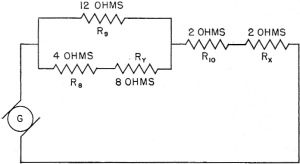
Figure 24B. - Equivalent circuit for Figure 24A.

Figure 24C. - Most simplified form of circuit of figure 24A.
Now you have resolved your series-parallel circuit into an equivalent circuit with three resistors in series,
as shown in figure 24c. Thus the total resistance of the circuit will be -
RT = 6 + 2 + 2
RT = 10 ohms
Look back at figure 24A again. A 24-volt IR drop is indicated across the 2-ohm resistor. You know the
resistance 2 ohms and the voltage 24, so by using Ohm's law the current is found to be -
I = 24/2 =
12 amperes
Since in figure 24A, R10
is in series with the rest of the circuit, 12 amperes must be the total being delivered by the generator. In that
case, the IR drop across the 6-ohm resistor and the other 2-ohm resistor will be
E1 = 6 x
12
E1 = 72 volts.
E2 = 2 x 12
E2 = 24
volts.
The total IR drop across the whole circuit is -
E = 72 + 24 + 24
E = 120
volts.
And 120 volts is the emf being delivered by the generator.
POWER IN ELECTRICAL CIRCUITS
You learned in Basic Electricity that power is the RATE of doing work, and that electrically, power is equal
to the product of the current times the voltage, or -
Like water flowing out of a pipe, the greater the
volume and greater the pressure, the larger will be the power.
Look back again at the problem you just completed. The current was 12 amperes, with an applied E of 120 volts,
so the power of the circuit is
P = 120 x 12
P= 1440 watts.
More problems
dealing with power in series and parallel circuits are found in the QUIZ at the end of the chapter. The more you
practice, the better you will be able to solve these problems.
HEATING IN ELECTRICAL CIRCUITS
You know from Ohm's law that E = IR, so you can substitute IR for E in the power equation of the preceding
paragraph and from P = E x I you get
P = IR x I
P = I2R
This means
that the POWER, or the electrical energy used up each second, in forcing electrons through a conductor depends on
the RESISTANCE of the conductor and the SQUARE OF the CURRENT. This power is the electrical energy used up, each
second, in forcing a current I through a conductor whose resistance is R. The electrical energy thus "used up"
does not disappear; it is merely transformed into heat which warms the conductor. Therefore every electrical
machine or piece of electrical equipment that has conductors - a motor, generator, transformer, or even a cable -
is heated by the current going through it. The above formula tells us how much heating the current produces.
Consider an example: A motor which has an armature resistance of 1 ohm, when operating at full load had an
armature current of 5 amperes. Therefore the power used up in heating the armature is -
P = I2R
P = 5 x 5 x 1 P = 25 watts
Now suppose the motor is overloaded so that the armature current goes
up to 10 amperes. Then -
P = I2R P = 10 x 10 x 1 P = 100 watts
This shows you what it means when you say "the power used up in heating a conductor goes up as the square of the
current in the conductor." It means that a small increase in current produces a great increase in heating. Thus in
the problem above, when the current was only DOUBLED the heating increased FOURFOLD. For this reason it is
dangerous to overload electrical machines, because even a slight overloading produces a great increase in heating.
Often this increased heating will char or break down the insulation around the conductor, and this leads to
grounds, shorts, etc., and soon the machine is ruined. In short, OVERLOADING of electrical machines MEANS
OVERHEATING, and overheating starts a destructive process which will rapidly ruin the machine. So - when operating
electrical machinery always be careful - Do NOT OVERLOAD.
To help you tell when machines are being
overloaded each electrical machine bears a name plate which tells you how much current the machine takes at full
load, and how much it is heated up (what temperature rise it has) at this current. The temperature rise is usually
given as so many degrees rise "above ambient temperature". The AMBIENT here means the temperature of the
compartment in which the machine is located.
Chapter 1 Quiz
(click
here)
|