|
|
|||||||||
| Software: RF Cascade Workbook | RF Symbols for Office | RF Symbols & Stencils for Visio | Espresso Workbook | ||||||||||
|
|||||||||||||||||||||||||||||||
   |
   |
||||||||||||||||||||||||||||||
|
Please Support RF Cafe by purchasing my ridiculously low-priced products, all of which I created. RF & Electronics Symbols for Visio RF & Electronics Symbols for Office RF & Electronics Stencils for Visio T-Shirts, Mugs, Cups, Ball Caps, Mouse Pads These Are Available for Free |
|||||||||||||||||||||||||||||||



Berkeley Nucleonics' Model 8060 Impedance Tuner/Generator


Press Release Archives:
2026 | 2025 |
2024 |
2023
|
2022 |
2021
Content is copyright of company represented. Page format, custom text and images are RF Cafe copyright - do not distribute. Note: Posting of press releases costs $100 each for non-advertisers.

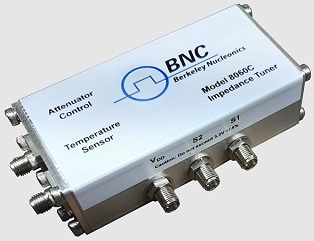
Berkeley Nucleonics' Model 8060 Impedance Tuner/Generator
San Rafael, CA – August 2022 – This new state of the art Model 8060 Impedance Tuner / Generator from Berkeley Nucleonics puts reliable, repeatable noise parameter measurements in your lab at about $10k, an order of magnitude below what a mechanical table top system might cost. The compact digital device offers a standard frequency range from 0.1 MHz to 6.0 GHz and can be customized to tuned up or down for application-specific needs. A cryogenic option (Model 8060C) provides greater performance capability allowing cold noise parameter measurements. The small size and fully electronic design permit noise-parameter measurements of packaged and on-wafer devices, ensuring flexibility and short test times. The Model 8060C is designed to work down to absolute zero temperature (Zero Kelvin) use primarily in Radio Astronomy and Space Exploration, cryogenic Nuclear Magnetic Resonance (NMR), and Quantum Computers. A host of MATLAB and other scripts are provided to allow users to take advantage of their own VNA, Spectrum Analyzer, and Noise Source.
|
Applications
|
Features
|
A Digital Impedance Generator
Our proprietary wideband impedance tuner method allows for quick and precise measurements of noise parameters for a large number of frequencies with astounding repeatability. On-board memory stores calibration data and documentation. A temperature sensor is included for monitoring the internal temperature which improves measurement accuracy. The Model 8060 frequency range is optimized for most commercial applications, such as WiFi, WiMax, LTE, 3G, 4G, and 5G, Bluetooth wireless standards.
Receiver Design
To design a receiver, engineers will need to select transistors for the design. You could obtain a sample of the transistor and perform noise parameter measurements while possibly setting the transistor to different power consumption settings and also varying the temperature. This gives the engineer complete information on how to select "matching" components (inductors and capacitors) that go at the input of the transistor to obtain the lowest noise figure and ultimately allows him to design the best performing receiver.
Amplifier Design
If an engineer has developed an amplifier, he may want to know its noise figure given that an antenna is not exactly 50 ohm. The engineer measures noise parameters and then uses them to calculate the amplifier noise figure for a particular antenna.
An engineer has an amplifier and wants to know whether its noise figure can be improved. The measurement of noise parameters would reveal how far away the amplifier noise figure is from the minimum possible noise figure. Noise parameters can then be used to determine what needs to be done (i.e. what "matching" network is needed) to improve the noise figure.
Component Manufacturing
Component manufacturers wants to bin parts (these could be transistors that are not designed for 50 ohm ) based on their performance. A quick measurement of the minimum noise figure at just one frequency could allow binning parts by performance.
About Berkeley Nucleonics Corporation
Founded in 1963, BNC is a leading manufacturer of precision electronic instrumentation for RF/Microwave research. BNC has its corporate headquarters in San Rafael, California with several additional manufacturing facilities and sales offices located throughout the United States. Phased Array Antennas are evolving rapidly, and BNC is at the forefront of this technology shift, capitalizing on these new requirements with its patented, high performance, software-defined radio technology, and a PC-controlled, networked architecture that provides unparalleled performance for the price. In addition to the RF / Microwave signal source line of equipment, BNC offers Phase Noise Test Systems (Signal Source Analyzers) & Real-Time Spectrum Analyzers in 1963, BNC is a leading manufacturer of precision electronic instrumentation for RF/Microwave research. BNC has its corporate headquarters in San Rafael, California with several additional manufacturing facilities and sales offices located throughout the United States. Phased Array Antennas are evolving rapidly, and BNC is at the forefront of this technology shift, capitalizing on these new requirements with its patented, high performance, software-defined radio technology, and a PC-controlled, networked architecture that provides unparalleled performance for the price. In addition to the RF / Microwave signal source line of equipment, BNC offers Phase Noise Test Systems (Signal Source Analyzers) & Real-Time Spectrum Analyzers.
Contact
Bernadette Jamieson
Customer Support Manager
Berkeley Nucleonics Corporation
22955 Kerner Boulevard
San Rafael, CA 94901 USA
Phone: 415-453-9955
(x210)
800-234-7858
Email: info@berkeleynucleonics.com
Posted September 7, 2022
Copyright: 1996 - 2026 |
About RF Cafe RF Cafe began life in 1996 as "RF Tools" in an AOL screen name web space totaling 2 MB. Its primary purpose was to provide me with ready access to commonly needed formulas and reference material while performing my work as an RF system and circuit design engineer. The World Wide Web (Internet) was largely an unknown entity at the time and bandwidth was a scarce commodity. Dial-up modems blazed along at 14.4 kbps while tying up your telephone line, and a lady's voice announced "You've Got Mail" when a new message arrived... |
Copyright 1996 - 2026 All trademarks, copyrights, patents, and other rights of ownership to images
and text used on the RF Cafe website are hereby acknowledge My Hobby Website: My Daughter's Website: |
