|
|||||||||||||
 |
|||||||||||||
Bell Telephone Laboratories - Voice of a Guided Missile |
|||||||||||||
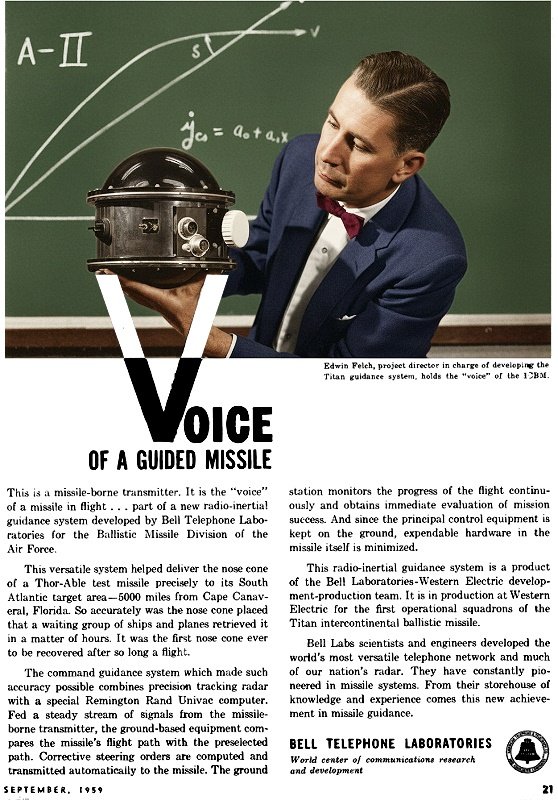
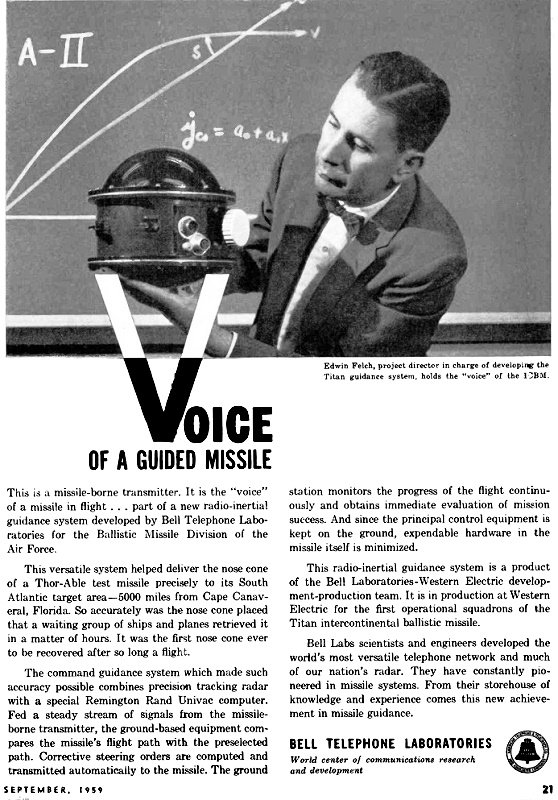
AI-enhanced version of image below. In this 1959 Radio-Electronics magazine promo, Bell Telephone Laboratories showcased its advanced radio-inertial guidance system, a technological breakthrough enabling precise long-range missile flight. Developed for the Air Force's Ballistic Missile Division, this innovation proved its efficacy by guiding a Thor-Able nose cone to a precise target five thousand miles away, allowing for a successful aerial and maritime recovery. The system utilized a missile-borne transmitter to feed continuous data to ground-based radar and a Remington Rand Univac computer, which calculated real-time steering corrections. By keeping the primary command equipment on the ground, engineers minimized expendable hardware within the missile. This sophisticated guidance technology, produced by the Bell Laboratories and Western Electric team, became foundational for emerging Titan intercontinental ballistic missile squadrons. This achievement highlighted Bell's historical expertise in pioneering radar and communication networks, reinforcing the company's essential role in modernizing our nation's defense capabilities through superior scientific engineering and strategic industrial production during the Cold War era. Note the AI-enhanced version of the ad. Bell Telephone Laboratories - Voice of a Guided Missile
Edwin Felch, project director in charge of developing the Titan guidance system, holds the "voice" of the ICBM. This is a missile-borne transmitter. It is the "voice" of a missile in flight ... part of a new radio-inertial guidance system developed by Bell Telephone Laboratories for the Ballistic Missile Division of the Air Force. This versatile system helped deliver the nose cone of a Thor-Able test missile precisely to its South Atlantic target area - 5000 miles from Cape Canaveral, Florida. So accurately was the nose cone placed that a waiting group of ships and planes retrieved it in a matter of hours. It was the first nose cone ever to be recovered after so long a flight. The command guidance system which made such accuracy possible combines precision tracking radar with a special Remington Rand Univac computer. Fed a steady stream of signals from the missile-borne transmitter, the ground-based equipment compares the missile's flight path with the preselected path. Corrective steering orders are computed and transmitted automatically to the missile. The ground station monitors the progress of the flight continuously and obtains immediate evaluation of mission success. And since the principal control equipment is kept on the ground, expendable hardware in the missile itself is minimized. This radio-inertial guidance system is a product of the Bell Laboratories - Western Electric development-production team. It is in production at Western Electric for the first operational squadrons of the Titan intercontinental ballistic missile. Bell Labs scientists and engineers developed the world's most versatile telephone network and much of our nation's radar. They have constantly pioneered in missile systems. From their storehouse of knowledge and experience comes this new achievement in missile guidance. |
|||||||||||||
 |
|||||||||||||
|
|||||||||||||


|
||||||||||||||||||||||||||||||||||||