See Page
1 |
2 |
3 |
4 of the September 2018 homepage archives. Friday 28
 The October 2018 issue of
QST magazine has a feature
article on the IkaScope WS200 Wireless Oscilloscope. It is a great concept that provides
a compact, wireless o-scope probe with 30 MHz bandwidth at a 200 Msps sampling
rate, a 1 MΩ input impedance, and a maximum range of 80 Vpk-pk with an
8-bit A/D converter. A software app runs on all modern platforms and OS's. It will even
run on your smartphone. One nice feature is high isolation from ground by virtue of its
wireless connection. Of course you can always establish a system or earth ground reference
with the provided ground clip. IkaLogic is located in France, but Sealig distributed
their products in the U.S. The October 2018 issue of
QST magazine has a feature
article on the IkaScope WS200 Wireless Oscilloscope. It is a great concept that provides
a compact, wireless o-scope probe with 30 MHz bandwidth at a 200 Msps sampling
rate, a 1 MΩ input impedance, and a maximum range of 80 Vpk-pk with an
8-bit A/D converter. A software app runs on all modern platforms and OS's. It will even
run on your smartphone. One nice feature is high isolation from ground by virtue of its
wireless connection. Of course you can always establish a system or earth ground reference
with the provided ground clip. IkaLogic is located in France, but Sealig distributed
their products in the U.S.
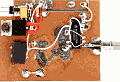 Robert Melville and Alaina G. Levine suggest reviving
the "dead bug"
method of prototype circuit board layout technique to facilitate microwave and
high-speed digital circuits without a traditional PCB. I built quite a few of
these back in the 1980's when working as an electronics technician at
Westinghouse. Write the authors, "Don't get me wrong - I love printed circuit
boards. PCBs are, of course, essential in mass-produced products. Even for
hobbyists, a small run assures almost perfectly repeatable circuits. And PCBs
with a good ground plane are essential for high-frequency circuits operating at
more than a few megahertz. A ground plane is a large area of copper that's used
as a low-inductance electrical return path..." Robert Melville and Alaina G. Levine suggest reviving
the "dead bug"
method of prototype circuit board layout technique to facilitate microwave and
high-speed digital circuits without a traditional PCB. I built quite a few of
these back in the 1980's when working as an electronics technician at
Westinghouse. Write the authors, "Don't get me wrong - I love printed circuit
boards. PCBs are, of course, essential in mass-produced products. Even for
hobbyists, a small run assures almost perfectly repeatable circuits. And PCBs
with a good ground plane are essential for high-frequency circuits operating at
more than a few megahertz. A ground plane is a large area of copper that's used
as a low-inductance electrical return path..."
 This article by the Cleveland Institute of Electronics
is a sort of early infomercial in printed form. You probably know that 1960's was a time
of major evolution in electronics with first the transition from vacuum tubes to solid
state devices in the early part of the decade, and then from discrete component circuits
to
integrated circuits in the latter part. Plenty of skeptics swore that the
newfangled fad would quickly fade out due to initially sky-high prices and low
reliability of germanium and silicon devices coming from university and
corporate laboratories. Actually, it was more a matter of hoping it would die
out so that they would not need to re-train and buy new test equipment for their
shops. Others welcomed and embraced the potentials of the new technology and
were determined to get in on the ground floor... This article by the Cleveland Institute of Electronics
is a sort of early infomercial in printed form. You probably know that 1960's was a time
of major evolution in electronics with first the transition from vacuum tubes to solid
state devices in the early part of the decade, and then from discrete component circuits
to
integrated circuits in the latter part. Plenty of skeptics swore that the
newfangled fad would quickly fade out due to initially sky-high prices and low
reliability of germanium and silicon devices coming from university and
corporate laboratories. Actually, it was more a matter of hoping it would die
out so that they would not need to re-train and buy new test equipment for their
shops. Others welcomed and embraced the potentials of the new technology and
were determined to get in on the ground floor...
 Alliance Test sells
used / refurbished test equipment,
we offer short- and long-term rentals. They also offer repair, maintenance and calibration.
Prices discounted up to 80% off list price. Agilent/HP, Tektronix, Anritsu, Fluke, R&S
and other major brands. A global organization with ability to source hard to find equipment
through our network of suppliers. Please visit Allied Test Equipment today to see how
they can help your project... Alliance Test sells
used / refurbished test equipment,
we offer short- and long-term rentals. They also offer repair, maintenance and calibration.
Prices discounted up to 80% off list price. Agilent/HP, Tektronix, Anritsu, Fluke, R&S
and other major brands. A global organization with ability to source hard to find equipment
through our network of suppliers. Please visit Allied Test Equipment today to see how
they can help your project...
 "By layering a pattern of
gold and graphene stripes on a silicon substrate, a research team
developed a photodetector with high speed, wide bandwidth, and high sensitivity.
Graphene seems to be following a trajectory somewhat paralleling that of the
first laser. When the latter was publicly announced in 1960, pundits and
skeptics remarked that it was 'a solution looking for problems to solve.' Of
course, we know how that assessment turned out, as the laser is not only an
indispensable tool in the design kit, but it also has been the enabling
component in countless applications not even envisioned at the time. Similarly,
when graphene..." "By layering a pattern of
gold and graphene stripes on a silicon substrate, a research team
developed a photodetector with high speed, wide bandwidth, and high sensitivity.
Graphene seems to be following a trajectory somewhat paralleling that of the
first laser. When the latter was publicly announced in 1960, pundits and
skeptics remarked that it was 'a solution looking for problems to solve.' Of
course, we know how that assessment turned out, as the laser is not only an
indispensable tool in the design kit, but it also has been the enabling
component in countless applications not even envisioned at the time. Similarly,
when graphene..."
Thursday 27
 Electron Test Equipment, of Dublin, Ireland, provides
leading-edge semiconductor test
equipment and we have earned an excellent reputation for the quality and reliability
of our semiconductor reliability test equipment. They have been added to my
Test Equipment
vendor page. PRT-Laser & PRT-Photodiode ATE for semiconductor reliability testing.
Various performance measurements include: Failure-in-Time (FIT) and MTTF. The Electron
line of ATE for semiconductors is the only affordable solution that utilizes semiconductor
parameters and ultra-low current measurements that can simultaneously measure 1026 semiconductor
components ... Electron Test Equipment, of Dublin, Ireland, provides
leading-edge semiconductor test
equipment and we have earned an excellent reputation for the quality and reliability
of our semiconductor reliability test equipment. They have been added to my
Test Equipment
vendor page. PRT-Laser & PRT-Photodiode ATE for semiconductor reliability testing.
Various performance measurements include: Failure-in-Time (FIT) and MTTF. The Electron
line of ATE for semiconductors is the only affordable solution that utilizes semiconductor
parameters and ultra-low current measurements that can simultaneously measure 1026 semiconductor
components ...
 ESA / ESTEC will be holding its second Industry
Days event on October 16th and 17th, in Noordwijk, the Netherlands. It focuses on
Additive Manufacturing for
RF / Microwave Hardware. "Additive Manufacturing (AM) can suppose a
breakthrough technology for the development of RF/microwave hardware such as
waveguide harness, filters and antennas. The use of this manufacturing process
allows the design of RF / microwave hardware to achieve enhanced performance.
RF, thermal and mechanical performance can be improved by using the additional
freedom provided by AM. The assessment of different AM approaches has already
started and it considers the whole process chain..." ESA / ESTEC will be holding its second Industry
Days event on October 16th and 17th, in Noordwijk, the Netherlands. It focuses on
Additive Manufacturing for
RF / Microwave Hardware. "Additive Manufacturing (AM) can suppose a
breakthrough technology for the development of RF/microwave hardware such as
waveguide harness, filters and antennas. The use of this manufacturing process
allows the design of RF / microwave hardware to achieve enhanced performance.
RF, thermal and mechanical performance can be improved by using the additional
freedom provided by AM. The assessment of different AM approaches has already
started and it considers the whole process chain..."
 Copper
Mountain Technologies develops innovative and robust RF test and measurement solutions
for engineers all over the world. Copper Mountain's extensive line of unique form factor
Vector Network Analyzers
include an RF measurement module and a software application which runs on any
Windows PC, laptop or tablet, connecting to the measurement hardware via USB
interface. The result is a lower cost, faster, more effective test process that
fits into the modern workspace in lab, production, field and secure testing
environments... Copper
Mountain Technologies develops innovative and robust RF test and measurement solutions
for engineers all over the world. Copper Mountain's extensive line of unique form factor
Vector Network Analyzers
include an RF measurement module and a software application which runs on any
Windows PC, laptop or tablet, connecting to the measurement hardware via USB
interface. The result is a lower cost, faster, more effective test process that
fits into the modern workspace in lab, production, field and secure testing
environments...
 I would love to see a modern electromagnetic (EM)
field software simulation of this antenna design. Imagine attempting a ray-tracing model
of the symmetrical combination of multiple linear and circular radiating elements of
the antenna shown in this 1964 article that appeared in Electronics magazine.
Doing so would have required hours of expensive time on an ENIAC or weeks from a team
of woman "computers" such as the kind NASA used for plotting Apollo trajectories (see
Hidden Figures). I'd like to see someone model it in EZNEC. Supposedly,
at least one working WARLA (Wide
Aperture Radio Location Array) system was built and tested, but details of
the results are not provided (probably classified at the time)... I would love to see a modern electromagnetic (EM)
field software simulation of this antenna design. Imagine attempting a ray-tracing model
of the symmetrical combination of multiple linear and circular radiating elements of
the antenna shown in this 1964 article that appeared in Electronics magazine.
Doing so would have required hours of expensive time on an ENIAC or weeks from a team
of woman "computers" such as the kind NASA used for plotting Apollo trajectories (see
Hidden Figures). I'd like to see someone model it in EZNEC. Supposedly,
at least one working WARLA (Wide
Aperture Radio Location Array) system was built and tested, but details of
the results are not provided (probably classified at the time)...
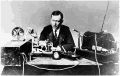 If you like reading a bit about the history of
radio, then you will want to check out Brad Brannon's piece on the Microwaves &
RF website titled, "A Selected History of Receiver Innovations over the Last 100 Years".
Get a load of the photo of Edwin Armstrong and his wife Marion sitting on the beach,
enjoying their "portable" radio. "This article, the first of a two-part series on receiver
technology, looks at the genesis and early advances of this all-important area. Many
contributed to the early days of wireless, but it's safe to say that Guglielmo
Marconi ranks as one of the more prominent. While known for his wireless
technology, many people are less familiar with the business he created around
wireless technology at the turn of the 19th century. For about 20 years..." If you like reading a bit about the history of
radio, then you will want to check out Brad Brannon's piece on the Microwaves &
RF website titled, "A Selected History of Receiver Innovations over the Last 100 Years".
Get a load of the photo of Edwin Armstrong and his wife Marion sitting on the beach,
enjoying their "portable" radio. "This article, the first of a two-part series on receiver
technology, looks at the genesis and early advances of this all-important area. Many
contributed to the early days of wireless, but it's safe to say that Guglielmo
Marconi ranks as one of the more prominent. While known for his wireless
technology, many people are less familiar with the business he created around
wireless technology at the turn of the 19th century. For about 20 years..."
At VidaRF, the phrase 'Providing Simple Solutions
for Complex Connections' is more than just a slogan – it's a mindset, a mission, and
a driving force behind everything we do. Their pledge is to design and distribute high
performance, cost effective RF
Microwave products to fit each customer's unique applications. Please visit VidaRF
today to see how their lines of attenuators & terminations, directional couplers,
power dividers, coaxial connectors, and circulator & isolators can be of use to your
project. "When the standard just will not do, VidaRF has the solution for you!"...
 Cord cutting - getting rid of your paid cable
and/or satellite television subscription - has become somewhat of a sport for the last
decade. Doing so comes with bragging rights. Mounting an old-fashioned multi-element
television on your roof is akin to a victorious army displaying the flag of its fallen
foe after the battle. The spoils of war are more money in your pocket while streaming
the news and entertainment you desire from the multitude of free, online broadcasters,
and while receiving programming from nearby over-the-air TV and radio stations. I heard
a promotion on the radio this morning claiming that 93% of Americans hear a radio broadcast
every day.
OTA is back in style. Here is my attic-mounted Channel Master CM-5020
antenna with an
Alliance
Model U-100 Tenna-Rotor. Cord cutting - getting rid of your paid cable
and/or satellite television subscription - has become somewhat of a sport for the last
decade. Doing so comes with bragging rights. Mounting an old-fashioned multi-element
television on your roof is akin to a victorious army displaying the flag of its fallen
foe after the battle. The spoils of war are more money in your pocket while streaming
the news and entertainment you desire from the multitude of free, online broadcasters,
and while receiving programming from nearby over-the-air TV and radio stations. I heard
a promotion on the radio this morning claiming that 93% of Americans hear a radio broadcast
every day.
OTA is back in style. Here is my attic-mounted Channel Master CM-5020
antenna with an
Alliance
Model U-100 Tenna-Rotor.
Wednesday 26
 This is the electronics market prediction for
the
Netherlands, circa 1966. It was part of a comprehensive assessment by the editors
of Electronics magazine of the state of commercial, military, and
consumer electronics at the end of 1965. Philips, headquartered in Amsterdam,
was singled out as a prime mover for the country. Established in 1891, Philips
is still today a major economic contributor for the Netherlands. Electronics'
end-of-year issue published its prognostication for Europe as a whole as well as
for many individual countries. It also attempted to assess the Soviet Union's
(USSR) electronics industry... This is the electronics market prediction for
the
Netherlands, circa 1966. It was part of a comprehensive assessment by the editors
of Electronics magazine of the state of commercial, military, and
consumer electronics at the end of 1965. Philips, headquartered in Amsterdam,
was singled out as a prime mover for the country. Established in 1891, Philips
is still today a major economic contributor for the Netherlands. Electronics'
end-of-year issue published its prognostication for Europe as a whole as well as
for many individual countries. It also attempted to assess the Soviet Union's
(USSR) electronics industry...
 "Ever noticed that the GPS location on your smartphone
isn't all that smart? For example, sometimes your smartphone claims you are in the duck
pond when in fact you are on the other side of the park and can't even see the duck pond?
But now, thanks to a research conducted at the University of Otago, New Zealand, in collaboration
with Curtin University, Australia, the accuracy of the
global positioning system (GPS) in smartphones can be significantly
improved. By combining signals from four different Global Navigation Satellite Systems
(GNSSs), Otago's Dr Robert Odolinski and Curtin University colleague Prof Peter Teunissen,
have demonstrated..." "Ever noticed that the GPS location on your smartphone
isn't all that smart? For example, sometimes your smartphone claims you are in the duck
pond when in fact you are on the other side of the park and can't even see the duck pond?
But now, thanks to a research conducted at the University of Otago, New Zealand, in collaboration
with Curtin University, Australia, the accuracy of the
global positioning system (GPS) in smartphones can be significantly
improved. By combining signals from four different Global Navigation Satellite Systems
(GNSSs), Otago's Dr Robert Odolinski and Curtin University colleague Prof Peter Teunissen,
have demonstrated..."
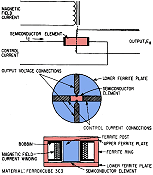 According to author Albert Hilbinger, dynamic
range down to DC and circuit simplicity offset the low efficiency of
Hall-effect modulators. The mixer circuit output has a suppressed carrier signal,
making it a true product of the two inputs (fLO ± IF in the frequency domain).
Evidently the scheme never gained wide acceptance in the industry because a
search of the term does not produce much - other than this 1964 Electronics
magazine article. Achieving a
suppressed carrier with standard diode mixers requires a quadrature arrangement
using two mixers and a pair of 90° power splitters, which nowadays is done
handily within a single integrated circuit. Sensors are the main exploitation
for the Hall effect these days... According to author Albert Hilbinger, dynamic
range down to DC and circuit simplicity offset the low efficiency of
Hall-effect modulators. The mixer circuit output has a suppressed carrier signal,
making it a true product of the two inputs (fLO ± IF in the frequency domain).
Evidently the scheme never gained wide acceptance in the industry because a
search of the term does not produce much - other than this 1964 Electronics
magazine article. Achieving a
suppressed carrier with standard diode mixers requires a quadrature arrangement
using two mixers and a pair of 90° power splitters, which nowadays is done
handily within a single integrated circuit. Sensors are the main exploitation
for the Hall effect these days...
Transient Specialists specializes in
EMC test equipment rentals
and carries a complete line of ESD guns, surge immunity test equipment, and EFT generators.
Rentals available for military (Mil-Std 461), automotive (ISO 7637), and commercial (IEC
61000-4) EMC testing. Flexible terms, accredited calibrations and technical support on
EMC testing equipment offered. Equipment consists of top EMC Test System manufacturers,
including Teseq, Thermo Keytek, EM Test and EMC Partner...
 Sometimes you need an unequal power split in the
signal path and cannot afford to waste power by using a standard equal-output power splitter
with an attenuator in one path. Gavin Watkins has a paper titled, "A 1:8 Unequal Power Splitter," on the High Frequency Electronics
website that details a new way to design a fairly wideband circuit that does the
job and is relatively tolerant of manufacturing variances. Says Mr. Watkins, "A
high ratio power splitter is described which does not require any very high
impedance transmission line. An example is presented of a 1:8 splitter, which
would normally require one transmission line with an impedance of 252 Ω. The
approach taken here uses an additional quarter wavelength..." Sometimes you need an unequal power split in the
signal path and cannot afford to waste power by using a standard equal-output power splitter
with an attenuator in one path. Gavin Watkins has a paper titled, "A 1:8 Unequal Power Splitter," on the High Frequency Electronics
website that details a new way to design a fairly wideband circuit that does the
job and is relatively tolerant of manufacturing variances. Says Mr. Watkins, "A
high ratio power splitter is described which does not require any very high
impedance transmission line. An example is presented of a 1:8 splitter, which
would normally require one transmission line with an impedance of 252 Ω. The
approach taken here uses an additional quarter wavelength..."
Since 2001,
Antenna Test Lab Co has evaluated countless antennas and RF transmitter
products. With a fully anechoic chamber, antennas can be quickly developed and RF products
refined and deployed. Mounting surfaces like drywall, glass, wood, and even curved metal
 simulated automobile available. The price for a standard
resolution
2D or 3D field pattern plot is only $450
- for a passive or radiating antenna. That is an incredible deal! Be sure to check out
the whitepapers on antenna testing topics. simulated automobile available. The price for a standard
resolution
2D or 3D field pattern plot is only $450
- for a passive or radiating antenna. That is an incredible deal! Be sure to check out
the whitepapers on antenna testing topics.
 "Researchers have developed a hybrid material
of polymer and liquid metal that can be used to develop non-toxic,
stretchable circuits for next-generation flexible electronics and
medical devices. A team at the National Center for Nanoscience and Technology created
the material. Called a metal-polymer conductor (MPC), it is composed of elastic polymer
and liquid metal. It can be bent and stretched at will, meaning that circuits made with
it can take most two-dimensional shapes. The material also is biocompatible, making the
components made with it non-toxic, said Xingyu Jiang, a professor at the center
who worked on the project..." "Researchers have developed a hybrid material
of polymer and liquid metal that can be used to develop non-toxic,
stretchable circuits for next-generation flexible electronics and
medical devices. A team at the National Center for Nanoscience and Technology created
the material. Called a metal-polymer conductor (MPC), it is composed of elastic polymer
and liquid metal. It can be bent and stretched at will, meaning that circuits made with
it can take most two-dimensional shapes. The material also is biocompatible, making the
components made with it non-toxic, said Xingyu Jiang, a professor at the center
who worked on the project..."
Tuesday 25
 USAF radar technician
Gordon G. Zagar was in the 5th Combat
Communications Group (5CCG Alumni on LinkedIn) at Robins AFB, Georgia, during the same
timeframe I was there in the early 1980s. However, he worked on the newfangled all-solid-state
TPN-19 combination air traffic surveillance and precision approach radar system whereas
I worked on the MPN-14 radar system. Gordon is now the owner ofZagar Consulting, which
"is a unique consulting firm with a turnkey model that offers a broad range of
services from site selection and start-up operations through design and
operational project management." His company serves life science, healthcare,
academic, alternative energy, arena operations, technology and consumable
goods..." USAF radar technician
Gordon G. Zagar was in the 5th Combat
Communications Group (5CCG Alumni on LinkedIn) at Robins AFB, Georgia, during the same
timeframe I was there in the early 1980s. However, he worked on the newfangled all-solid-state
TPN-19 combination air traffic surveillance and precision approach radar system whereas
I worked on the MPN-14 radar system. Gordon is now the owner ofZagar Consulting, which
"is a unique consulting firm with a turnkey model that offers a broad range of
services from site selection and start-up operations through design and
operational project management." His company serves life science, healthcare,
academic, alternative energy, arena operations, technology and consumable
goods..."
Rohde & Schwarz USA (R&S USA) has produced
a primer titled, "Spectrum Analyzer Fundamentals - Theory and Operation of Modern Spectrum
Analyzers." This is a very comprehensive work that covers basic operation
and analysis and includes application to modern communications systems. In this
primer you will learn about: Basics of spectrum analysis, Time and frequency
domains, FFT analyzers, Analyzers using the heterodyne principle, settings for
using a spectrum analyzer, Nonlinear devices under test, crest factor and
complementary cumulative distribution function (CCDF), Phase noise measurements,
and Mixers and mixer measurements...
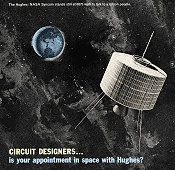 Hughes Aerospace has many openings for qualified
design engineers in Culver City, California. High power airborne transmitters, low
noise receivers using parametric amplifiers, solid state maser component development,
radar processing systems, crystal oscillators, telemetering, and high efficiency spaceborne
power supplies are among the kinds of specialties needed by Hughes to support military
and civilian projects. If you have been looking for just such an opportunity, then the
wait is finally over... provided you happened to see this advertisement in Electronics
magazine back in the fall of 1965. Quiz question: What is the difference between
a geosynchronous orbit and a geostationary orbit? Hughes Aerospace has many openings for qualified
design engineers in Culver City, California. High power airborne transmitters, low
noise receivers using parametric amplifiers, solid state maser component development,
radar processing systems, crystal oscillators, telemetering, and high efficiency spaceborne
power supplies are among the kinds of specialties needed by Hughes to support military
and civilian projects. If you have been looking for just such an opportunity, then the
wait is finally over... provided you happened to see this advertisement in Electronics
magazine back in the fall of 1965. Quiz question: What is the difference between
a geosynchronous orbit and a geostationary orbit?
 Apex Waves, of Cary, NC, provides customers with
new, new surplus, and refurbished
/ reconditioned modular test equipment from manufacturers like National Instruments,
Tektronix, Keysight / Agilent, and more! Where the distributors try to push you onto
the latest products, we track down your exact model you've been looking for, despite
being discontinued or end of life. Their listing on my
Test Equipment & Calibration
Manufacturers & Services page has been updated with this new
information... Apex Waves, of Cary, NC, provides customers with
new, new surplus, and refurbished
/ reconditioned modular test equipment from manufacturers like National Instruments,
Tektronix, Keysight / Agilent, and more! Where the distributors try to push you onto
the latest products, we track down your exact model you've been looking for, despite
being discontinued or end of life. Their listing on my
Test Equipment & Calibration
Manufacturers & Services page has been updated with this new
information...
 "Hispasat, the Spanish satellite communications operator, and Thales
Alenia Space, the joint venture between Thales (67%) and Leonardo (33 %), are developing
a stratospheric balloon demonstration for 4G/5G telecom applications. Scheduled for October
2018 in southern Spain, the demonstration will test 4G/5G applications by allowing direct
communications between smartphones and a High-Altitude Pseudo-Satellite (HAPS) - a stratospheric
balloon in this case. To match the early interest of Hispasat for the innovative market
of HAPS, Thales Alenia Space, serving as prime contractor for this demonstration
and offering its payload expertise of 4G/5G telecommunication missions..." "Hispasat, the Spanish satellite communications operator, and Thales
Alenia Space, the joint venture between Thales (67%) and Leonardo (33 %), are developing
a stratospheric balloon demonstration for 4G/5G telecom applications. Scheduled for October
2018 in southern Spain, the demonstration will test 4G/5G applications by allowing direct
communications between smartphones and a High-Altitude Pseudo-Satellite (HAPS) - a stratospheric
balloon in this case. To match the early interest of Hispasat for the innovative market
of HAPS, Thales Alenia Space, serving as prime contractor for this demonstration
and offering its payload expertise of 4G/5G telecommunication missions..."
Monday 24
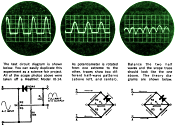 Can a single diode be used to constitute a
full-wave rectifier circuit? The short answer is yes, it can, as is demonstrated
by an actual circuit built by Messrs. Duffy and Olesky. The real question is can
a single-diode full-wave rectifier be used in a practical circuit? Under certain
controlled instances it can as long as component values and tolerances for both
the power supply and the load can be controlled acceptably. High impedance,
ultra low current circuits in today's marketplace are more likely to be able to
support the single-diode rectifier, but then so many products are composed of a
single integrated circuit that can easily include an internal two- or four-diode
full-wave bridge that such a money- and space-saving scheme is not necessary.
Still, it is an interesting theoretical study... Can a single diode be used to constitute a
full-wave rectifier circuit? The short answer is yes, it can, as is demonstrated
by an actual circuit built by Messrs. Duffy and Olesky. The real question is can
a single-diode full-wave rectifier be used in a practical circuit? Under certain
controlled instances it can as long as component values and tolerances for both
the power supply and the load can be controlled acceptably. High impedance,
ultra low current circuits in today's marketplace are more likely to be able to
support the single-diode rectifier, but then so many products are composed of a
single integrated circuit that can easily include an internal two- or four-diode
full-wave bridge that such a money- and space-saving scheme is not necessary.
Still, it is an interesting theoretical study...
 I appreciate the convenience and, often, the superiority
of digital electronics over legacy analog equipment. However, that is not to say the
older stuff is not useful even in today's environment. A great debate actually exists
in the science community regarding whether nature is basically analog (Newtonian) or
digital (quantum) in nature. Even the seemingly all-digital products in the marketplace
have some cursory amount of analog in them. Barry Manz has a short piece on the Electronic
Design website titled, "Analog: Still Alive and Well," that deals with the issue - analog
content in the digital world that is, not the
philosophical debate
about the universe... I appreciate the convenience and, often, the superiority
of digital electronics over legacy analog equipment. However, that is not to say the
older stuff is not useful even in today's environment. A great debate actually exists
in the science community regarding whether nature is basically analog (Newtonian) or
digital (quantum) in nature. Even the seemingly all-digital products in the marketplace
have some cursory amount of analog in them. Barry Manz has a short piece on the Electronic
Design website titled, "Analog: Still Alive and Well," that deals with the issue - analog
content in the digital world that is, not the
philosophical debate
about the universe...
 John Booher, of TotalTemp, has published a blog
post titled, "Conduction v. Convection for Thermal Testing."
He asks the question, "What are the trade offs of heat transfer via conduction
versus convection in regards to thermal testing?" Answer: "Heat transfer via
conduction is generally faster and more efficient. Depending on your purposes,
conduction has a some clear performance advantages and some limitations which we
will talk about. In general however, when appropriate conduction is often the
best choice for performance. More to the point, in this discussion, we are
talking about trade offs between a temperature chamber and thermal platforms.
Temperature chambers are an example of forced convection. Forced convection in a
temperature... John Booher, of TotalTemp, has published a blog
post titled, "Conduction v. Convection for Thermal Testing."
He asks the question, "What are the trade offs of heat transfer via conduction
versus convection in regards to thermal testing?" Answer: "Heat transfer via
conduction is generally faster and more efficient. Depending on your purposes,
conduction has a some clear performance advantages and some limitations which we
will talk about. In general however, when appropriate conduction is often the
best choice for performance. More to the point, in this discussion, we are
talking about trade offs between a temperature chamber and thermal platforms.
Temperature chambers are an example of forced convection. Forced convection in a
temperature...
 At the end of 1965, Electronics magazine
printed an analysis of the state of the
electronics markets in Europe (before there was a formal EU). The authors predicted
a whopping 10% increase to $7.8B for the combined consumer, commercial, and military
markets. Separate reports are included for West Germany (the Berlin Wall was still up
then), the UK, France, and Italy are covered in separate sections. Figures are included
on a chart for the Netherlands, Sweden, and Belgium / Luxemburg. The Soviet Union, although
obviously not part of Europe, is also covered. As a comparison of then versus now, Statistica
claims a 2018 consumer electronics market of $59B ($64B in 2019), and EE Times
reports a $15B defense electronics market for 2018 (~$79B total)... At the end of 1965, Electronics magazine
printed an analysis of the state of the
electronics markets in Europe (before there was a formal EU). The authors predicted
a whopping 10% increase to $7.8B for the combined consumer, commercial, and military
markets. Separate reports are included for West Germany (the Berlin Wall was still up
then), the UK, France, and Italy are covered in separate sections. Figures are included
on a chart for the Netherlands, Sweden, and Belgium / Luxemburg. The Soviet Union, although
obviously not part of Europe, is also covered. As a comparison of then versus now, Statistica
claims a 2018 consumer electronics market of $59B ($64B in 2019), and EE Times
reports a $15B defense electronics market for 2018 (~$79B total)...
Bree Engineering, Inc., a leading manufacturer
of custom electronic filters, multiplexers, filter banks and other related types of components
in the frequency range of 0.1 MHz to 40 GHz, has published this whitepaper
titled, "." 5G technology is all about
opening a world of new ideas. With any new technology and its subsequent rollout, it's
never just as simple as just flipping a switch. At Bree Engineering we
understand that, which is why we've been working hard to gear up for 5G. We know
that just as with 3G and 4G technology, the RF path is crucial if 5G is going to
deliver the speeds promised – which is projected to be up to 10 times...
RF Superstore launched in 2017, marking the return
of Murray Pasternack, founder of Pasternack Enterprises, to the RF and microwave Industry.
Pasternack fundamentally changed the way RF components were sold. Partner Jason Wright
manages day-to-day operations, while working closely with Mr. Pasternack to develop RF
Superstore into a world class RF and
microwave
component supplier. RF coaxial connectors & adapters, coaxial cable & cable
assemblies, surge protectors, attenuators. Items added daily. Free shipping on orders
over $99. We're leading the way again!
 "The IC industry is counting on
integrated
silicon photonics as early as 2021 to enable performance gains in networking and
high-performance computing (HPC) devices, but integrated photonics design today remains
a costly and time-consuming manual endeavor, requiring expertise in photonics and electronics.
Mentor - along with customer Hewlett Packard Enterprise (HPE) - is hoping to change that
with the introduction of the LightSuite Photonic Compiler, billed as the
industry's first integrated electrical / photonic layout automation tool,
promising to help engineers do in a matter of minutes what otherwise could take
weeks when performed manually..." "The IC industry is counting on
integrated
silicon photonics as early as 2021 to enable performance gains in networking and
high-performance computing (HPC) devices, but integrated photonics design today remains
a costly and time-consuming manual endeavor, requiring expertise in photonics and electronics.
Mentor - along with customer Hewlett Packard Enterprise (HPE) - is hoping to change that
with the introduction of the LightSuite Photonic Compiler, billed as the
industry's first integrated electrical / photonic layout automation tool,
promising to help engineers do in a matter of minutes what otherwise could take
weeks when performed manually..."
|